One thing I love about the CREC is the ethos of just doing stuff, of amateurism in the best Chestertonian sense of the word. It's been baked into the CREC from the beginning.
1/
"Hey we're three churches with a close connection who want greater denominational accountability, but some of us are credobaptist and some are paedobaptist so there's no denomination we can all join together.
Let's start our own."
2/
"Hey we want a classical Christian school for our kids, but there are none around. Let's start our own."
"But none of us have ever started or ran a school before!"
"Immigration is the international movement of people to a destination country of which they are not usual residents or where they do not possess nationality in order to settle as permanent residents." -from Wikipedia
1/
By contrast, a sojourner/stranger (גֵּר in Hebrew) was often a temporary resident, in the land to escape famine or war in their own land or to look for work, but with the intention of eventually moving on.
There were provisions for sojourners to stay which I'll mention below
2/
Sojourners were required to attend the reading of the law (Deut. 31:12), held to the same legal standards as citizens (Lev. 24:22; Num. 15:15-16), and were required to keep the Sabbath (Ex. 23:12) as well as all the other religous festivals (numerous verses).
3/
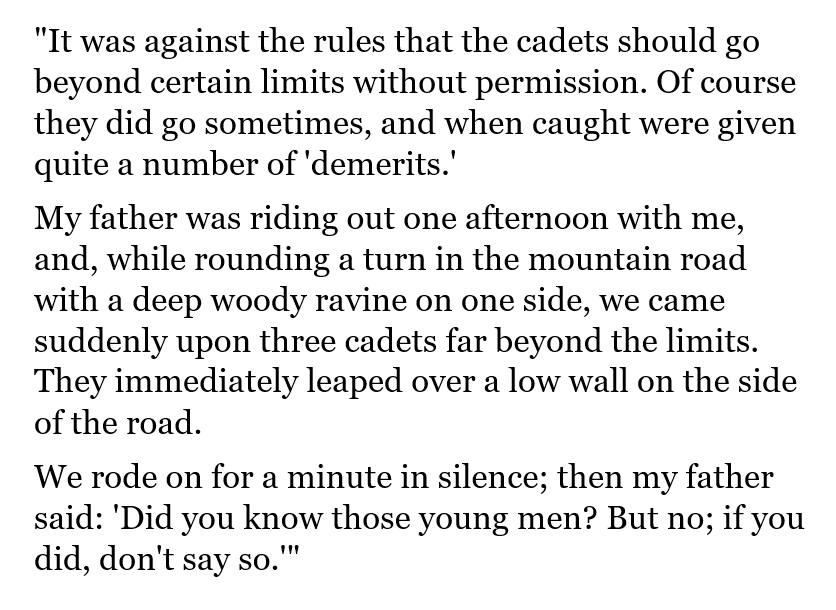
It was Lee's job to enforce the rules, but it was more important to him that his son not be a snitch.
It used to be understood that parents should teach their kids not to tattle. I'm not sure that's the case anymore.
2/
I know lots of guys who have anon accounts on this site. If I see one of them posting something I think is way over the line, I'll talk to them about it. I won't dox them for it.
3/
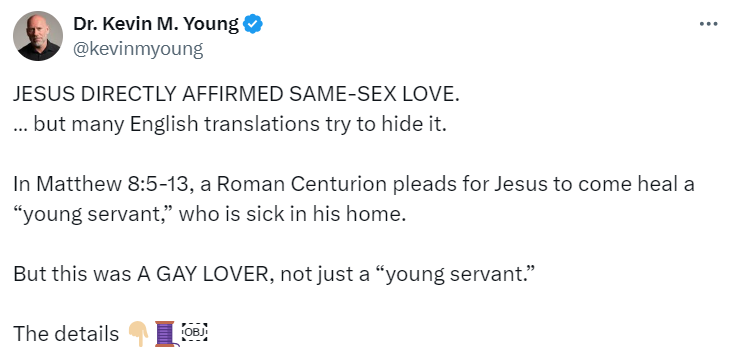
I normally try not to give this guy any attention, but this was such dumb thread I thought I would break it down breifly.
1/
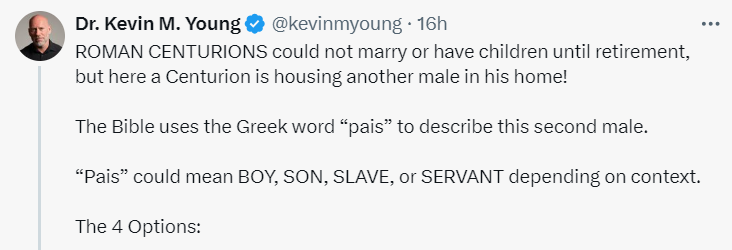
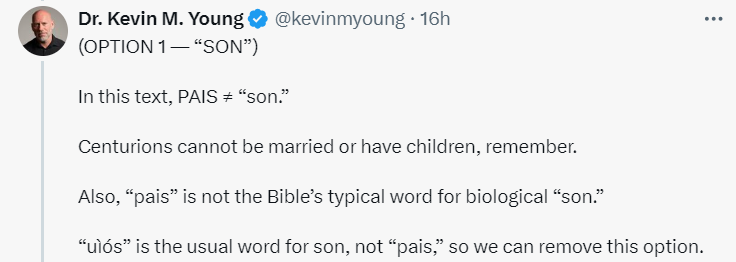
He says that pais can't mean son here because Roman centurions were forbidden from marrying.
It's true that in the first two centuries centurions couldn't contract legal marriages. This didn't prevent a large number of them from living with a woman and having kids with her.
2/
Not that I believe this was the centurion's son. I'm just pointing out that his argument against it is weak.
3/
Envision the worst sinner you can. Make him the most vile person imaginable. Serial killer? Serial rapist? Serial child molester?
Now imagine he hears the gospel, the Holy Spirit convicts him of sin, and he repents and looks to Christ's death on the cross to save him.
1/
At that moment, instantly, he is as clean in God's eyes as Christ Himself, as morally perfect and pure as Jesus, because all of his sins are laid to Christ's account and paid for by Christ's sacrifice, and all Christ's righteousness is laid to his account.
2/
If you can't accept this, if this offends you, then you are offended by the gospel.
This man may still have consequences for his actions. The death penalty would be in order for the crimes I listed above. But in terms of his standing in God's kingdom, he is a child of God.
3/
1. The best account for morality that atheism can provide is that it is a faculty evolved to promote the survival of the race. Which is to say it's not morality at all, but a simple pragmatic if/then. If we want the human race to continue, we shouldn't do X.
Unfortunately, that only works if a person is concerned about future generations. It has nothing to say to the determined hedonist who only cares about his own pleasure. It can't even say that he's actually wrong, only different.
2/
The existence of morality is dependent on the existence of a standard external to us, not part of the natural world. It is also dependent on teleology, the idea that there is something we're made for and thus ought to be aiming for. It requires a Creator.
3/