Read on Twitter
What is the transpose of a (1,1) tensor? 

If we define a matrix to be an array of numbers, the transpose flips the array along the diagonal.
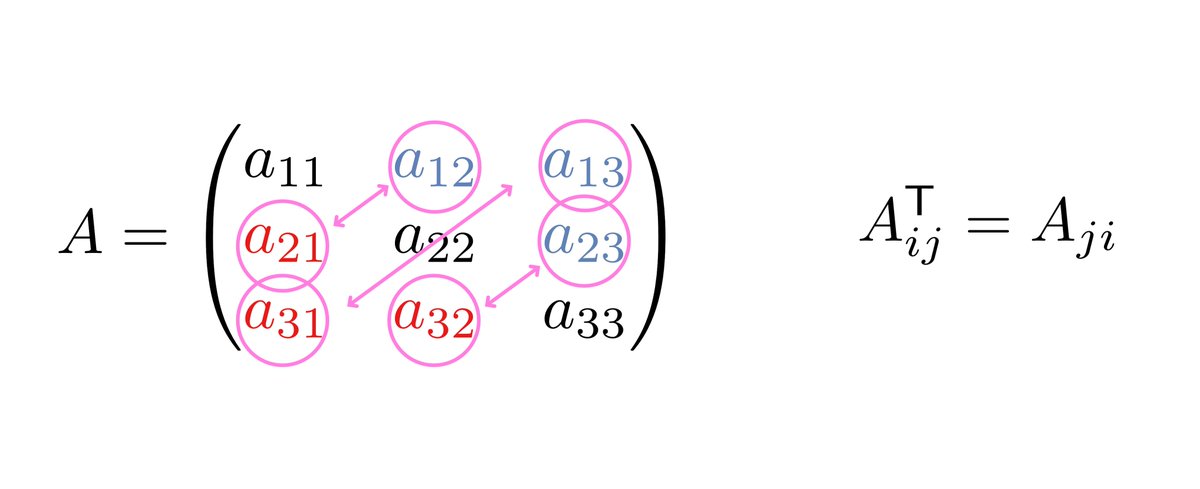
Physicists like tensors. Lower and upper indices indicate linear functions of the (dual) vector space. Repeated upper and lower indices indicate a contraction, or a sum over all possible index values. “Matrices” are (1,1) tensors that map vectors to vectors.
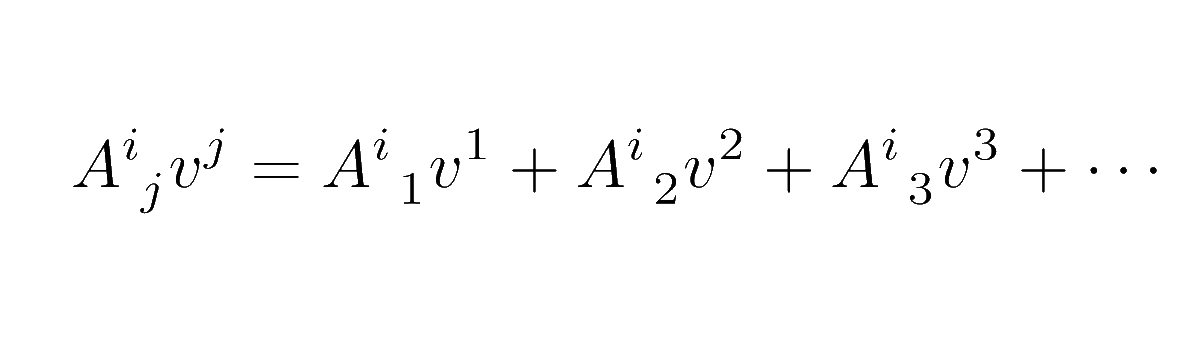
We like writing tensors with indices because the heights of the indices are shorthand for how the tensor transforms under an isomorphism (symmetry of the space).
We do this even if we know our math colleagues giggle when they see us doing this.
We do this even if we know our math colleagues giggle when they see us doing this.
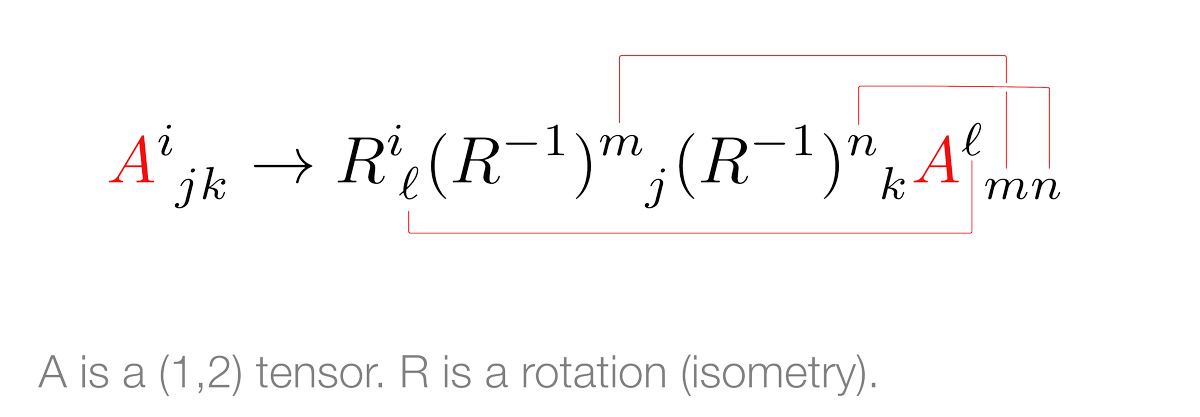
In a metric space you can raise and lower indices. The metric defines an inner product, a bilinear function on vectors that we may write in angle bracket notation. For real spaces, the inner product (and thus the metric) is symmetric.

The natural manifestation of the transpose in this language is something called the adjoint. Given a linear transformation A, the adjoint is the linear transformation that satisfies:
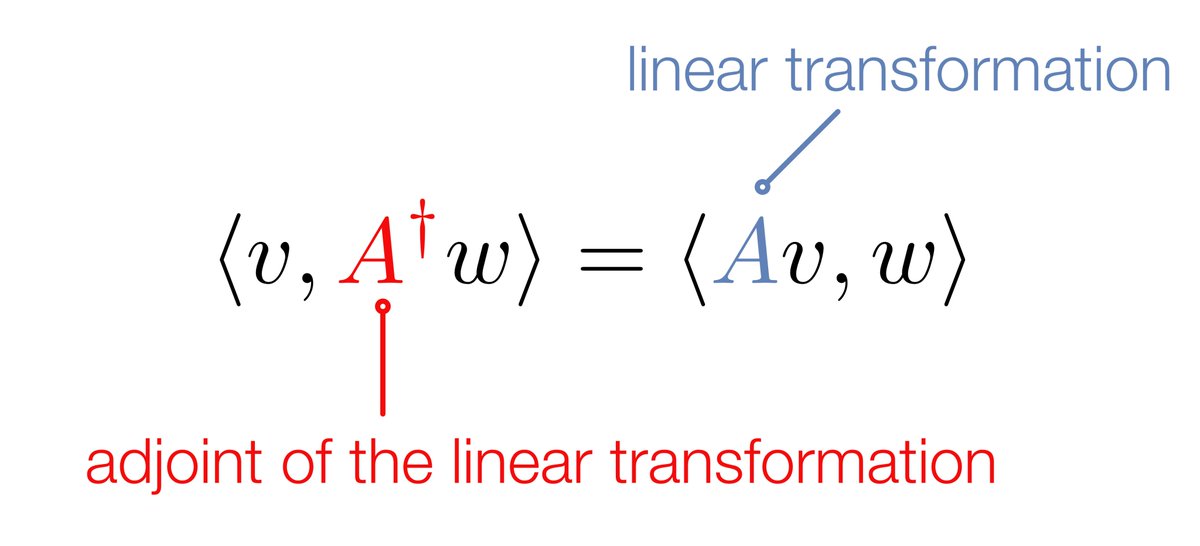
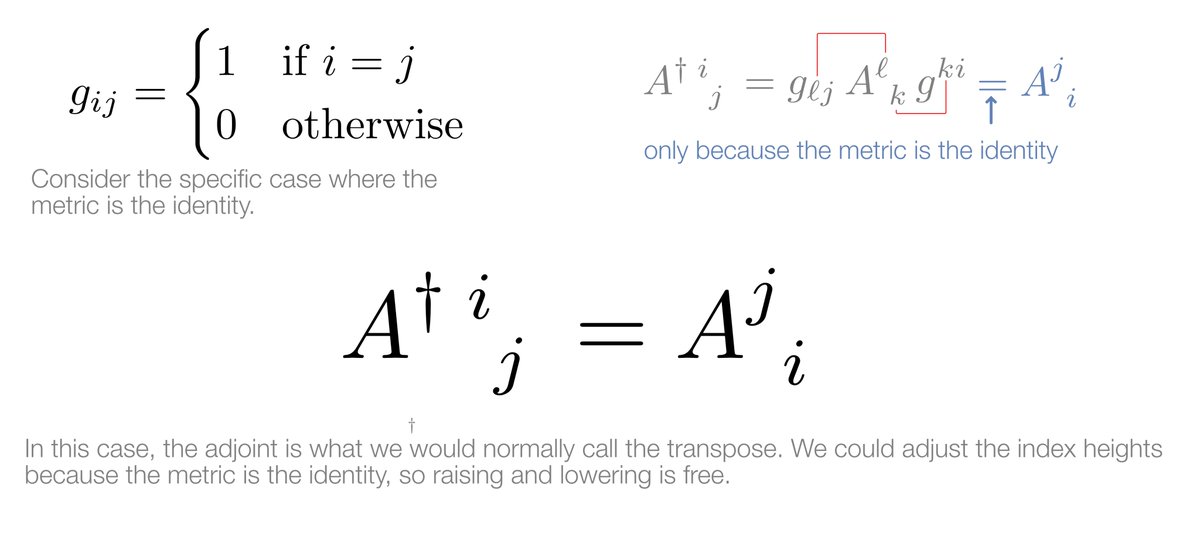
*If* the metric is simply the identity, then the adjoint is what we normally call the transpose in matrix language.
The index heights changed, which is usually not allowed. We have implicitly used the metric (identity) to write 1st index up/2nd index down.
The index heights changed, which is usually not allowed. We have implicitly used the metric (identity) to write 1st index up/2nd index down.
More generally, the adjoint is the more significant quantity and unlike the transpose, it depends on the metric. This shows up in special relativity. Lorentz transformations are those which preserve the metric.
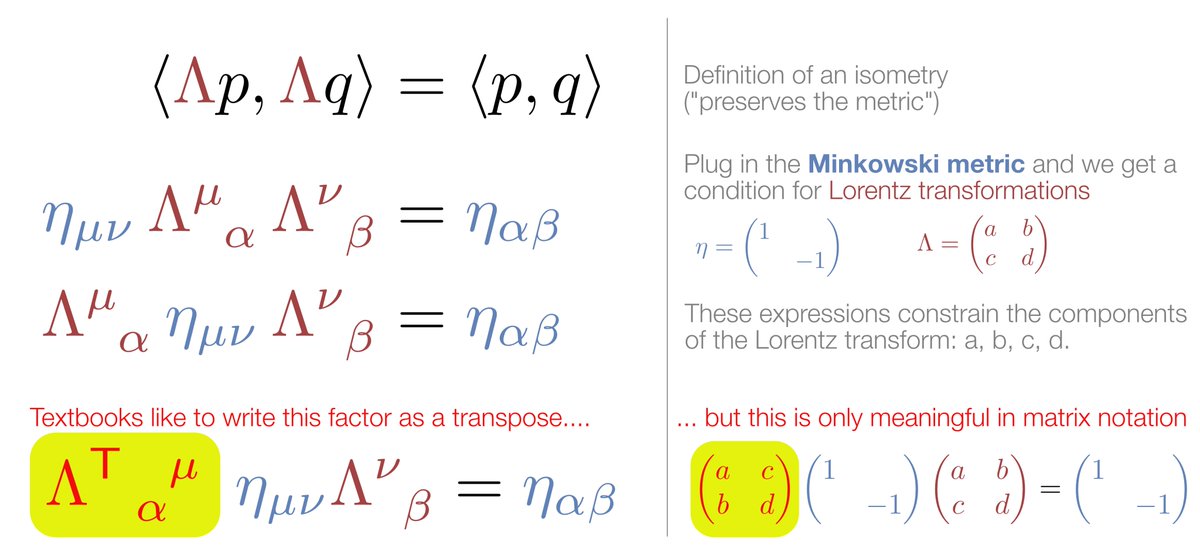
The Lorentz transform is often written in "matrix notation" in a way that can be puzzling, especially to those first trying to make sense of tensor notation.
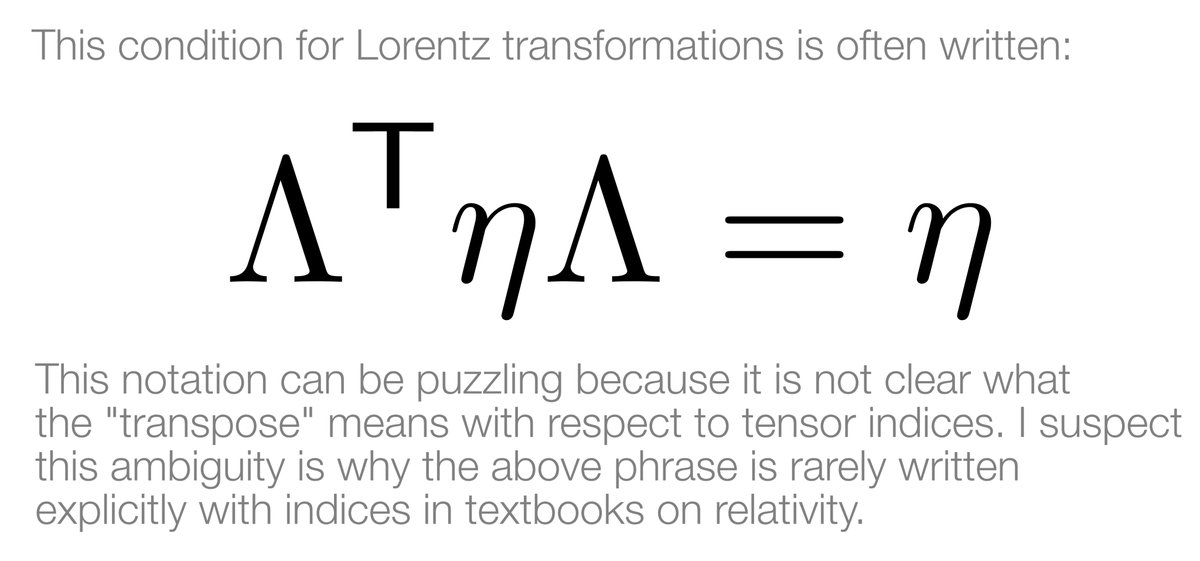
From the [linear] algebraic point of view, it is more natural to write this condition with the metric and inverse metric explicitly. One may also use the adjoint as shorthand for the metric dependence.

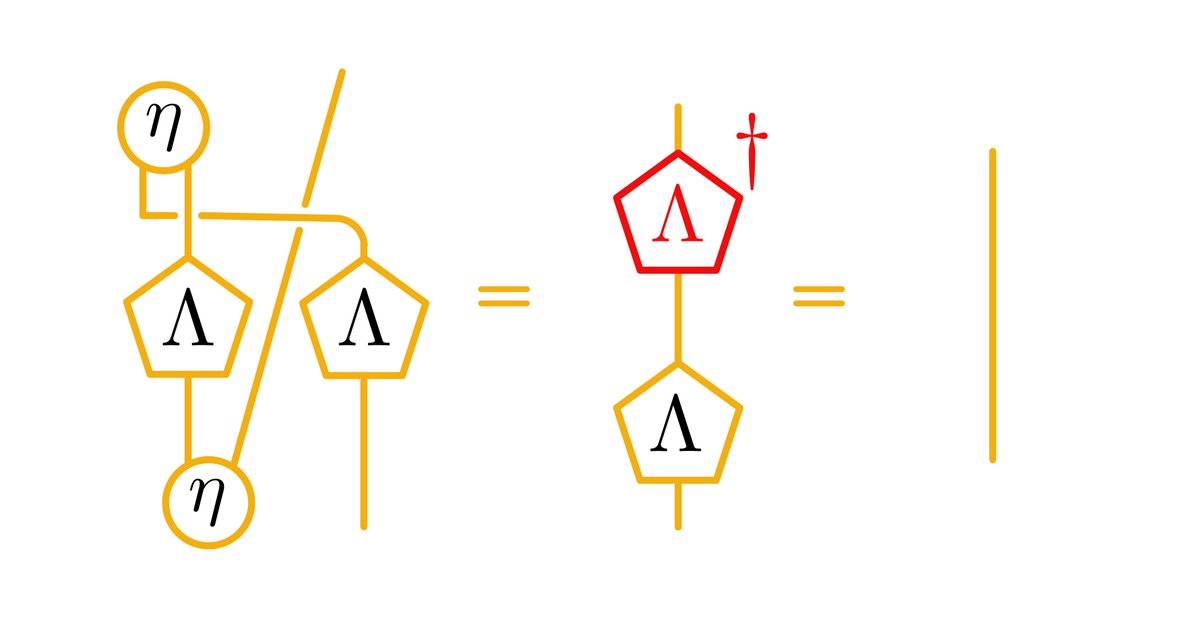
In a variant of so-called birdtracks notation, one may write the isometry condition as follows. Lines represent indices. The crossed line on the left indicates the "transpose-y" part of the adjoint.
We can go through the same argument for complex vector spaces. Here the vectors are complex and we use a bar as shorthand for complex conjugation.
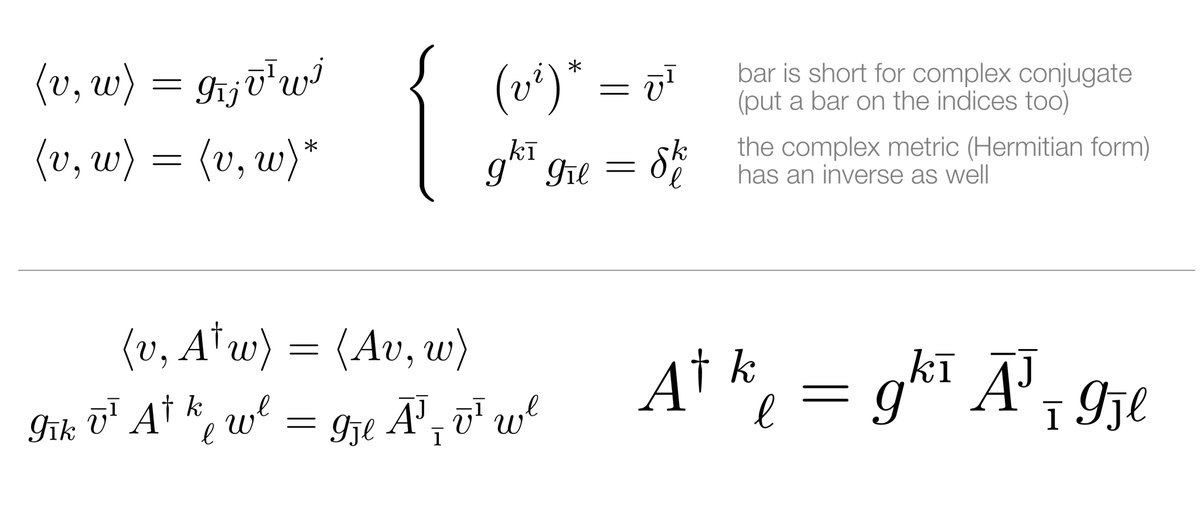
If the metric is the identity, then the adjoint is the conjugate-transpose in matrix notation. This is physicists call this the Hermitian conjugate and are introduced to it in quantum mechanics.

The condition for isometries in complex space takes the same form as we saw for real space. This condition is the familiar one for unitary matrices.
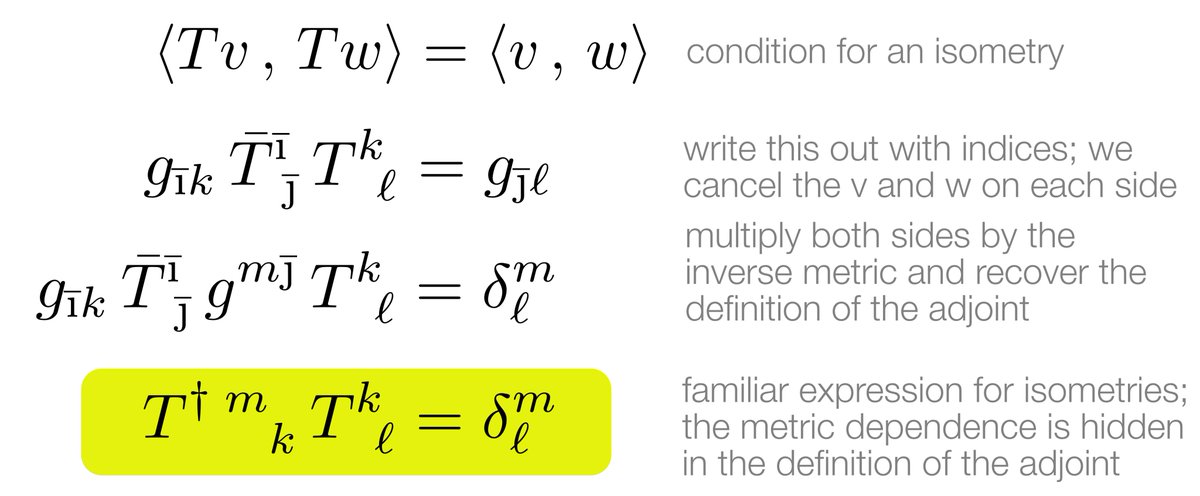
We can write the general definition of the adjoint in my birdtracks-variant notation like this. The dashed lines are barred (conjugated) indices.

This is part of our [relatively] new @UCRiverside Physics 17: Linear Algebra for Physicists course, next offered in Spring 2024.
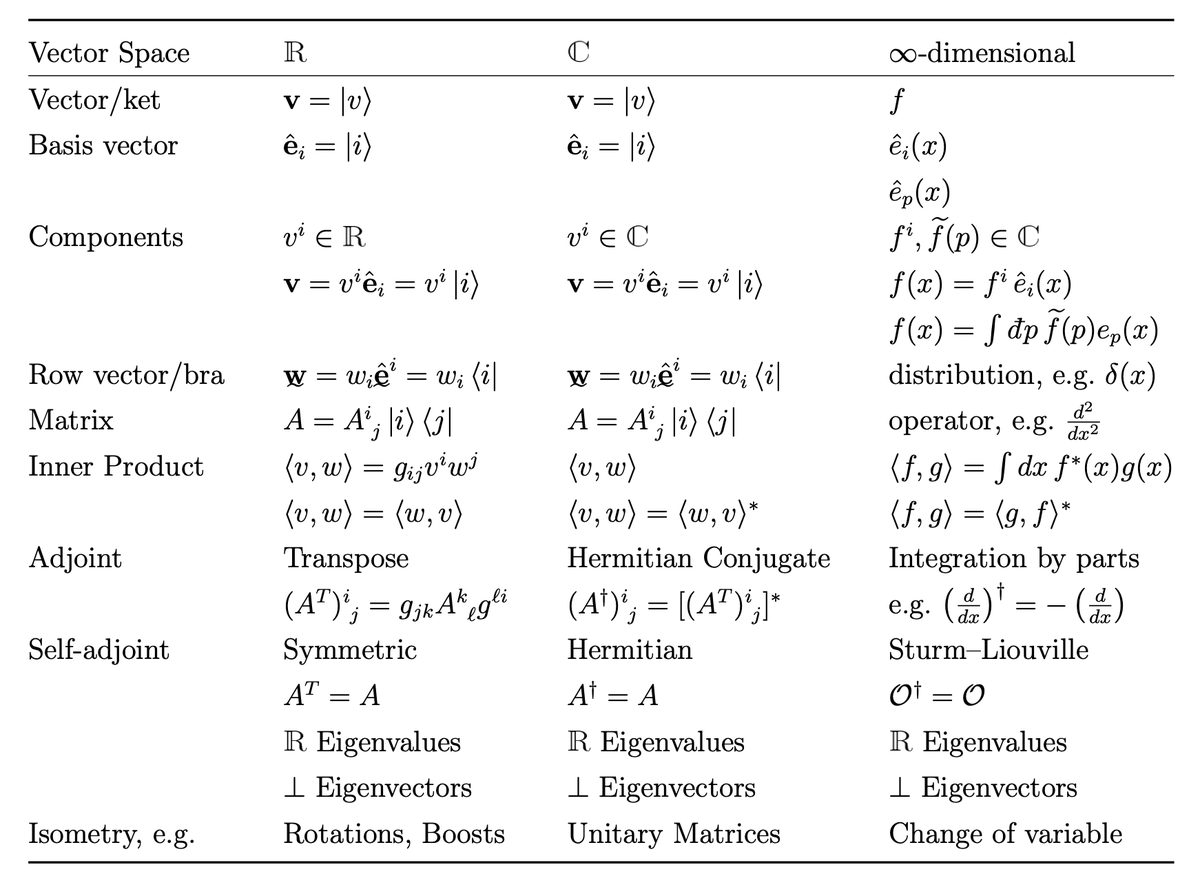
[Forgive the typos in the table below. I'll leave it to my students to catch them later.] sites.google.com/ucr.edu/physic…
[Forgive the typos in the table below. I'll leave it to my students to catch them later.] sites.google.com/ucr.edu/physic…
• • •
Missing some Tweet in this thread? You can try to
force a refresh