I generated a population heat map for Chicago using a cool dataset that places people inside residential building footprints rather than census blocks. This yields a much more realistic view of population density. Lots of interesting things to observe. (1/6)
This pocket of Streeterville ⬇️ has the highest population density in the city, followed by Gold Coast, Lakeshore East, and South Loop. Next after that is a long and narrow strip from Lakeview to Uptown along the lakefront. (2/6)
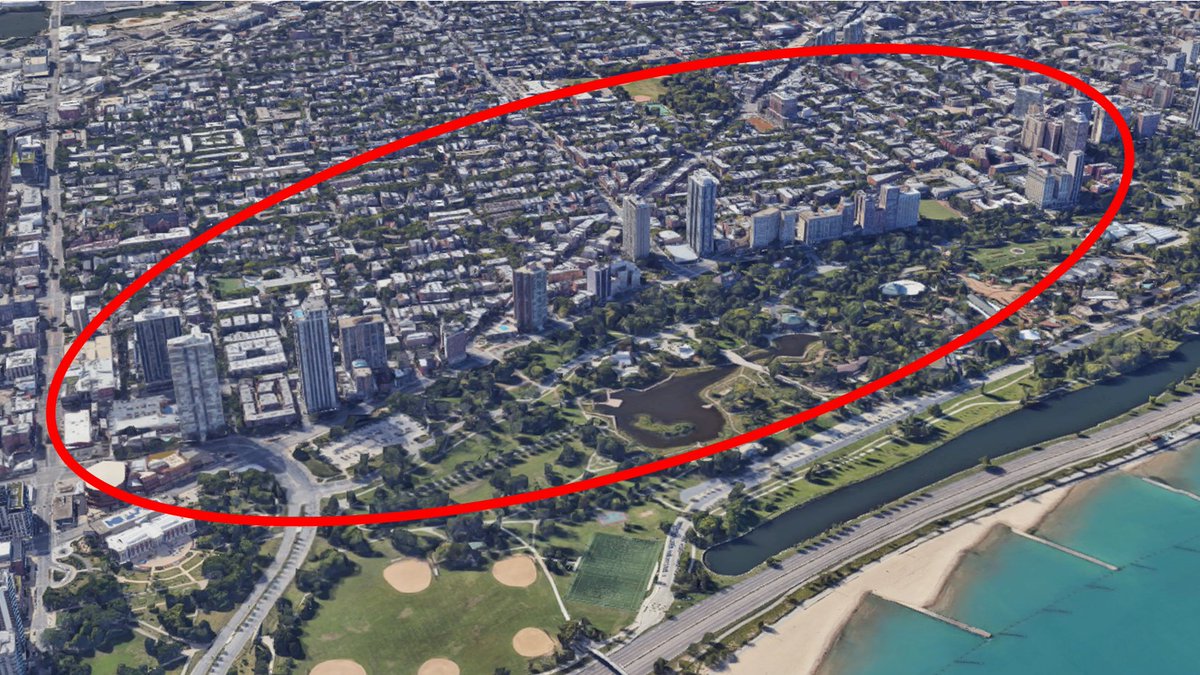
This stretch of the lakefront in Lincoln Park is dramatically underbuilt compared to the rest of the North Side. Not hard to guess why. (3/6)
Some other density hot spots are Little Village, Rogers Park, Devon Street in West Ridge, Albany Park near the Brown line, and the lakefront high rises in Kenwood and Hyde Park.
Also showing up bright: the Pavilion Apartments near O'Hare! I didn't know they existed. (4/6)
On the flip side, the darker areas are either non-residential, places built at lower densities, and places that have suffered disinvestment. Particularly notable are Englewood and West Englewood. The arrow points to "the area" where Norfolk Southern displaced 400 families. (5/6)
Credit for the underlying data goes to Forest Gregg, who has departed these shores for the Other Place (fgregg[at]mastodon[dot]social). It's a very neat dataset that you can find at the link below. I used the 5-per-dot version. (6/6) bunkum.us/chicago-dots/
• • •
Missing some Tweet in this thread? You can try to
force a refresh

🧵Four views of @DivvyBikes ride data, from June 2013 to May 2024. I've always wanted to compile this data, and I finally did it. A number of interesting things pop up.
1) Member rides grew steadily from 2013-2017 before leveling off, but non-member rides were stable from Day 1.
2) After 2017, seasonal patterns stabilized and the 2019 system expansion didn't seem to impact much. 3) COVID upended everything! Member rides plummeted but non-member rides surged. 4) The launch of e-bikes boosted rides across the board.
5) The non-member COVID surge started to taper in 2023, but member rides grew. This suggests that some of the newbies became coverts. You love to see it! 6) We may have reached a new equilibrium where annual rides stabilize. Which begs the question: how do we keep it growing?
This 1836 plat shows the city's extent around the time of incorporation, and how it was laid out. I overlaid modern streets and shorelines to see how things have changed, and how much they've stayed the same!
Some observations: 🧵
Aside from the highway, the street network for Chicago's historic core has changed remarkably little. There were just two bridges in the vicinity, at Kedzie and Dearborn.
Several major changes to the Chicago River can be seen. On the left you can see the original course of the South Branch before it was straightened in 1929. On the right is the North Branch before the canal that created Goose Island was cut.
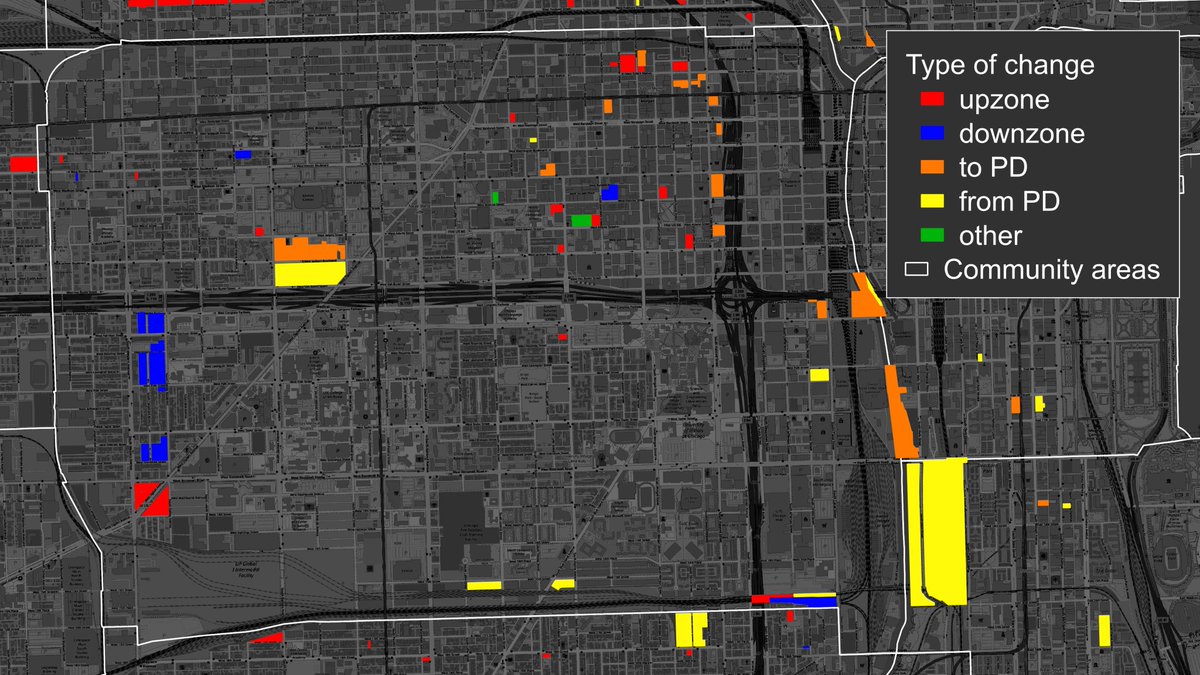
By my calculations, there were 3,932 parcels in Chicago that were zoned differently in 2023 than 2014. That's 0.64% of all parcels.
Of those, I considered 29.5% to be upzones and 23.2% to be downzones. More than a third of the upzones happened in West Town or Logan Square.
West Town leads the pack for upzones in large part because a four-block stretch of Grand Ave just north of the Kinzie Industrial Corridor was rezoned from light manufacturing to denser business and commercial in 2014.
On the flipside, and somewhat surprisingly, the Near West Side leads for downzones. This is due to a large chunk of parcels just west of the IMD that was downzoned from multifamily residential to townhome residential.
Check out this fascinating 1946 map from a never-finished Chicago comprehensive plan. Among other things, it shows proposed expressways and new community area boundaries. Laying those features over a modern map makes for an interesting comparison. 🧵
The vision for the city's expressway network was incredibly expansive. Many were (thankfully) never built, including:
- two crosstown routes, roughly along Cicero and California/Western
- a Stony Island route connecting the Bishop Ford to DLSD
- Extensions on both ends of DLSD
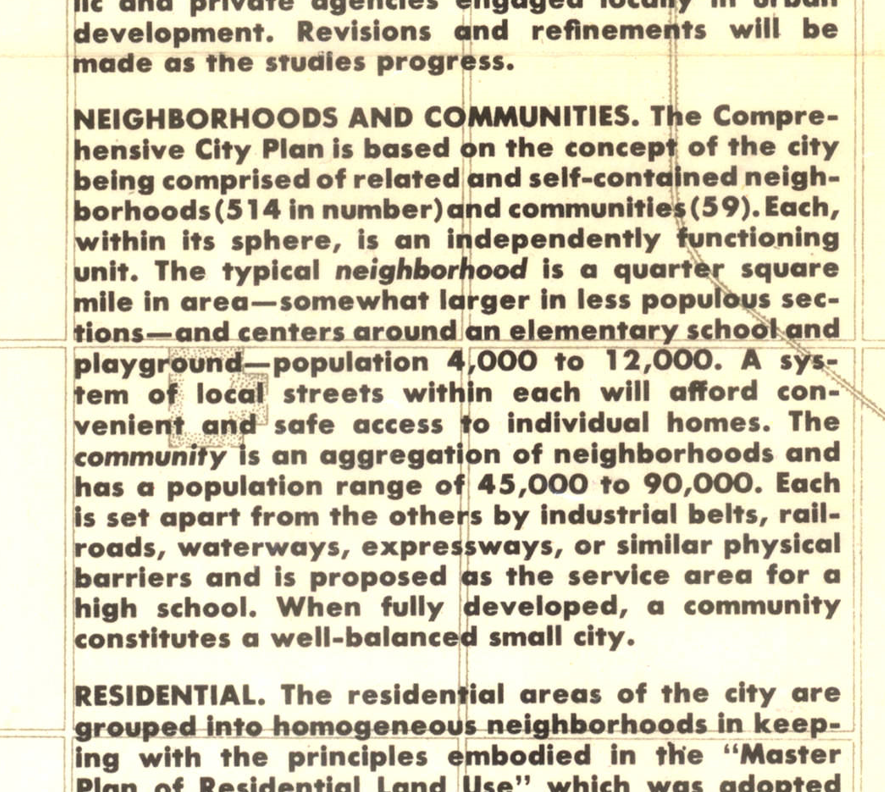
The plan includes 59 community areas that are more aligned with logical boundaries (like railroads and highways) than the current 77 community areas. The text describes them as mini cities containing all the local amenities people need (schools, retail, hospitals, etc).