Not to mention all the new myths in the making that have arisen during this pandemic...
🙄 "Immunity debt"
🙄 "Robust hybrid immunity"
🙄 "Respirators work at an individual level but not at a population level"
🙄 "Targeted protections"
🙄 "The virus doesn't transmit in schools"
• • •
Missing some Tweet in this thread? You can try to
force a refresh

Monovalent: includes only one version of the virus, versus bivalent (two versions), trivalent (three), multivalent (multiple), etc.
Convergent mutations: mutations evolving independently in multiple lineages.
Spike: the protein on the surface of the viral particle, which attaches to host cells. Vaccines target this protein, but it also evolves rapidly among variants.
N: nucleocapsid protein, involved in packaging the virus's genome and other functions. Very similar among variants.
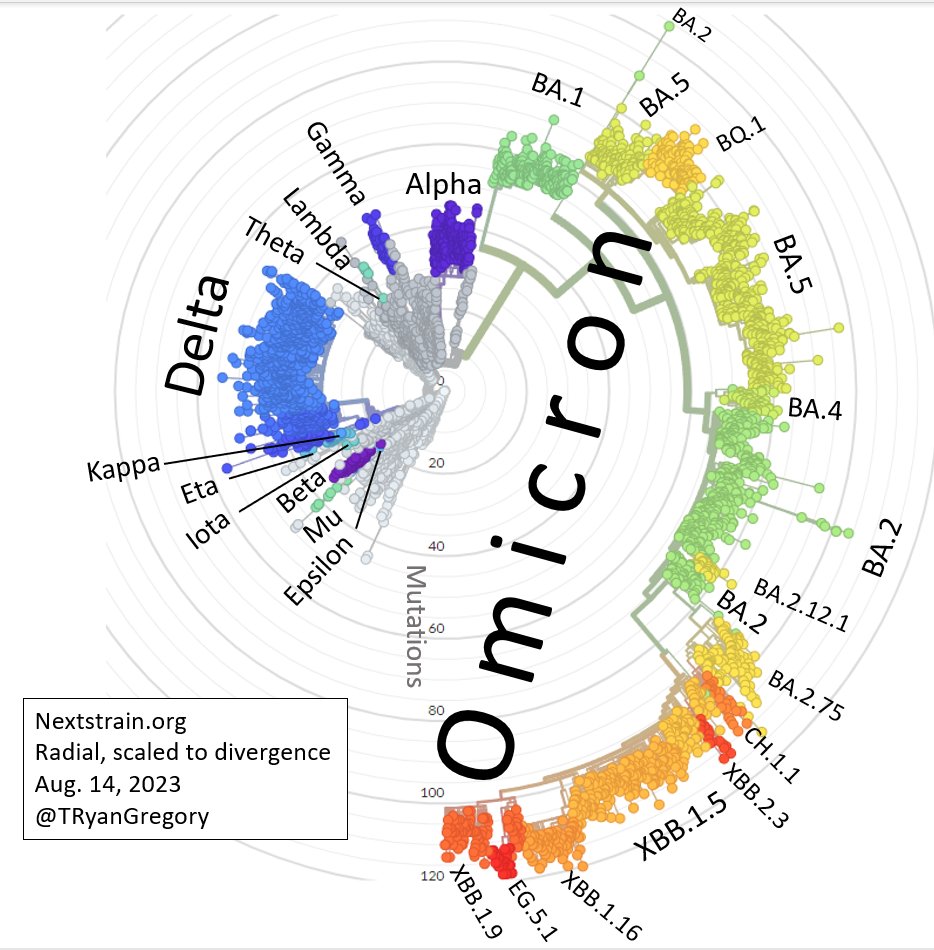
There is no meaningful comparison between the current state of "Omicron" and previous variants that received their own official nicknames in the form of Greek letters. Why not? 🧵
1. Greek letters were assigned very readily over a period of 180 days between May and November 2021. Many of those that got names were insignificant. There's no comparison between "Omicron" and "Iota". There are now >1,700 "Omicron" variants and recombinants with PANGO labels.
2. The working definitions for variant designations have changed.
In March 2023, WHO updated the working definitions for variants of concern (VOCs) and variants of interest (VOIs) and it became less likely that a variant would be considered a VOC.
If you want to know what is top of mind for me with variants these days, it's the following:
🧵
1/
1) Combinations of mutations that confer both strong immune escape and ACE2 binding, most notably "FLiP" mutations (S:L455F + S:F456L). We already have these in multiple lineages, including Kraken + FLip (XBB.1.5.70, GK*), Eris + FLip (HK.3*), and Centaurus + FLip (DV.7.1*).
2/
More info about mutation notation and FLip mutations in this 🧵of🔗:
BA.2.86 is clearly spreading, even based on the very limited testing these days. On paper it looked bad but lab tests suggest it shouldn't really compete well with existing XBBs. The fact that it is nonetheless showing up around the world is a bit puzzling and concerning. 🧵
Maybe there's something going on with BA.2.86 outside of what we've come to expect based mostly on immune escape and ACE2 binding. Of course there's more to the virus than spike protein. It could be concerning if it's doing something pretty different.
But again, my main concern isn't really with BA.2.86 itself. The issue for me is that it represents the founding of a new *lineage* that recently made a major switch in evolutionary environment.
A bit about the two levels of viral evolution and BA.2.86. 🧵
BA.2.86 (Pirola) recently switched from evolving within a single host (someone with a long-term infection) to being transmitted among hosts. What evolves within a host is different from what evolves among hosts.
1/
Within a host, there will be a "swarm" or "quasispecies" of slightly different versions of the virus (because the host was infected by more than one version and/or due to mutations happening in viral lineages within that host).
2/
Whether a random genetic error (mutation) is fit or unfit depends on the environment. The mutations that confer an advantage within hosts are often different from those that are advantageous among hosts in a population with significant existing immunity.
3/
I know I keep repeating these things, but they are important.
It's not all about individual variants because...
🧵
1. A notable individual variant may not take off, but its descendants might.
Two notable examples:
i) BA.2.75 (Centaurus). People thought it was overhyped. It didn't do a whole lot. However, almost everything circulating today is its descendant, including XBB recombinants.
ii) XBB (Gryphon). People thought it was overhyped at the time too. It didn't do a whole lot. However, almost everything circulating today is its descendant, including XBB.1.5 (Kraken), XBB.1.16 (Arcturus), EG.5 (Eris), FL.1.5.1 (Fornax), etc.