
Culture Critic Profile picture
Oct 3 9 tweets 3 min read Twitter logo Read on Twitter
Imagine how morally depraved a society must be to demolish this.

NYC's Penn Station was torn down in 1963 to build Madison Square Garden, and the station was forced underground.

“One entered the city like a god; one scuttles in now like a rat.”

A reminder of how it looked 🧵 Image
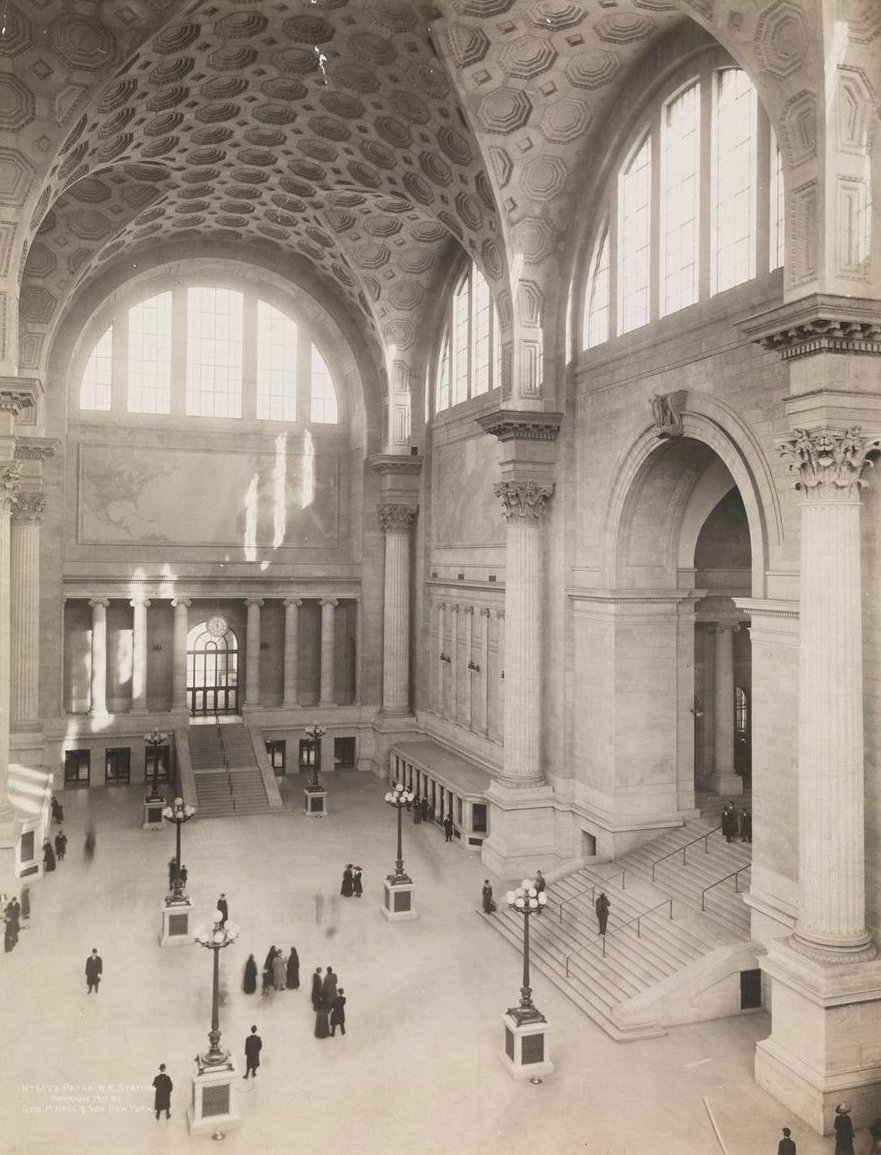
The main waiting room was NYC's largest indoor space. Both the interior and exterior drew inspiration from St. Peter's Basilica and the Bank of England. Image
The Corinthian columns of the main waiting room led up to a majestic marble ceiling that was 150 feet high. Image
The soaring train shed featured arching steel girders, staggered mezzanines, and glass-block floors that let sunlight through to the tracks. Image
A huge clock hung under the glass dome in the main concourse. Image
Inspired by the Baths of Caracalla in Rome, it was the fourth-largest building on Earth. Image
Travelers entered through an exterior facade of massive Doric columns. It was described as "a great Doric temple to transportation". Image
The exterior was adorned with mighty, freestanding stone eagles, weighing up to 5,700 pounds each. Image
"Pennsylvania Station was built to last forever, but due to greed and myopia, the magnificent structure was put to the wrecking ball just over fifty years after it was built." Image

• • •

Missing some Tweet in this thread? You can try to force a refresh

 

Keep Current with Culture Critic

Culture Critic Profile picture

Stay in touch and get notified when new unrolls are available from this author!

Read all threads

This Thread may be Removed Anytime!

PDF

Twitter may remove this content at anytime! Save it as PDF for later use!

Try unrolling a thread yourself!

how to unroll video
  1. Follow @ThreadReaderApp to mention us!

  2. From a Twitter thread mention us with a keyword "unroll"
@threadreaderapp unroll

Practice here first or read more on our help page!

More from @Culture_Crit

Sep 26
"The Course of Empire" is a series of paintings by Thomas Cole depicting the rise and fall of an imaginary civilization.

Inspired by his visit to the ruins of ancient Rome, they were meant as a warning to the U.S. against the pride of empire building.

Which stage are we in? 🧵 Image
1. The Savage State / Commencement of the Empire (1836) Image
2. The Arcadian / Pastoral State (1834) Image
Read 6 tweets
Sep 18
Those who say that America doesn't have magnificent cathedrals are simply wrong.

A thread of the finest churches in the U.S. 🧵 Image
1. St. Patrick's Cathedral, New York City, NY (1878)

A Gothic sanctuary in the heart of the city - it's the largest Gothic Catholic cathedral in the country, and a symbol of the triumph of religious freedom in America. Image
2. The Cathedral of Saint Paul, Saint Paul, MN (1915)

A 306-foot-tall Beaux-Arts masterpiece crowned with a mighty copper dome. The architect, Emmanuel Louis Masqueray, was also chief architect of the 1904 World's Fair in St. Louis, Missouri. Image
Read 12 tweets
Sep 15
Reminder that Buenos Aires was once known as the Paris of South America.

A thread of colorized images from the early 20th century 🧵 Image
1. Constitución railway station, 1900

See @argentinaacolor for many more from this era! Image
2. Florida Street, 1927 Image
Read 12 tweets
Sep 8
Baroque was a movement that sought above all else to inspire awe.

Its goal was maximum drama and grandeur by emphasizing motion, contrast and extravagant detail.

A thread of Baroque wonders in art and architecture 🧵 Image
1. Prometheus Bound - Peter Paul Rubens (c.1612) Image
2. The Abduction of Proserpina - Gian Lorenzo Bernini (1622) Image
Read 16 tweets
Sep 6
"Maybe this world is another planet's hell." - Aldous Huxley

A thread of the most terrifying depictions of hell ever painted 🧵 Image
1. The Garden of Earthly Delights (right panel) – Hieronymus Bosch (1515)

A nightmarish scene imagining the monstrosities of hell - including a bird-headed creature eating a naked man and a hollowed out giant with trees for limbs. Image
2. The Last Judgment - Jan van Eyck (1440)

Death is depicted as a bat-like, skeletal figure, looming over the damned. Some of the damned can be identified as kings and members of the clergy by their headdresses. Image
Read 11 tweets
Sep 4
Art Nouveau was a nature-inspired, decorative movement which flourished between 1890 and 1910 across Europe and the Americas.

A thread of its most beautiful examples 🧵 Image
1. Gran Hotel Ciudad de México, Mexico City (1899) Image
2. The Félix Potin building, Paris (1904) Image
Read 13 tweets

Did Thread Reader help you today?

Support us! We are indie developers!


This site is made by just two indie developers on a laptop doing marketing, support and development! Read more about the story.

Become a Premium Member ($3/month or $30/year) and get exclusive features!

Become Premium

Don't want to be a Premium member but still want to support us?

Make a small donation by buying us coffee ($5) or help with server cost ($10)

Donate via Paypal

Or Donate anonymously using crypto!

Ethereum

0xfe58350B80634f60Fa6Dc149a72b4DFbc17D341E copy

Bitcoin

3ATGMxNzCUFzxpMCHL5sWSt4DVtS8UqXpi copy

Thank you for your support!

Follow Us on Twitter!

:(



