We learned yesterday that Allen Weisselberg's severance agreement will ultimately pay him $2 million by 12/31/24 if he fully complies. What I didn't appreciate is what he promised in return: 1/
To some extent, it's not atypical to require an employee to promise not to assist with others' claims. The problem here is context--and timing. 2/
Let's start with the fact that while Weisselberg left the company at the end of 2022 and the agreement contemplated his completing his work in good faith before that date, it wasn't executed by him until the literal eve of his Jan. 10, 2023 sentencing. 3/
And it wasn't signed by Alan Garten, the Trump organization's chief legal officer, until Jan. 12, two days after Weisselberg entered Rikers. 4/
What's more, according to the payment schedule appended to the agreement, the Trump Org. did not start paying him until Mar. 31, 2023, well into his prison sentence and certainly *after* reports that the Manhattan DA was still investigating Weisselberg for insurance fraud. 5/
Now let's go back to *his* severance obligations. They include cooperating in an investigation or litigation against the company or Trumps by meeting with them in connection with "discovery or pretrial issues" and providing "truthful testimony on behalf of Releasees." 6/
That means he was likely obligated to meet with them before his trial testimony. 7/
The severance agreement also entitles Weisselberg to be indemnified for any reasonable attorney's fees in any legal matter against him or the company--but there's some big catches. 8/
He can't hire a lawyer without the company's prior approval, and "to the extent there is no direct conflict of interest and at the election of the Company, [Weisselberg] shall be jointly represented by counsel for the Company." 9/
Put another way, if he wants his own fees paid, they get to decide who represents him and even force their own lawyers on him. 10/
But, of course, all of this pales in comparison to Weisselberg's commitment that except where forced by subpoena or other court-ordered process, he won't give information to anyone else with claims against the company and/or anyone he individually released (e.g., Trump)...11/
or "take any action to induce, encourage, instigate, aid, abet or otherwise cause" any person or entity "to bring or file a complaint, charge, lawsuit or other proceeding of any kind against the Company or any person or entity released by this Agreement." 12/
Read broadly, the agreement precludes Weisselberg from voluntarily cooperating with any law enforcement or prosecutorial agency in exchange for lenience as to other crimes for which he could be under investigation and/or ultimately charged. 13/
And yes, that might be the definition of unenforceable as a matter of public policy. But if you're Weisselberg, what incentive do you have to test that proposition when you have $2 million in severance, payable even if you die, riding on it? None. FIN.
• • •
Missing some Tweet in this thread? You can try to
force a refresh

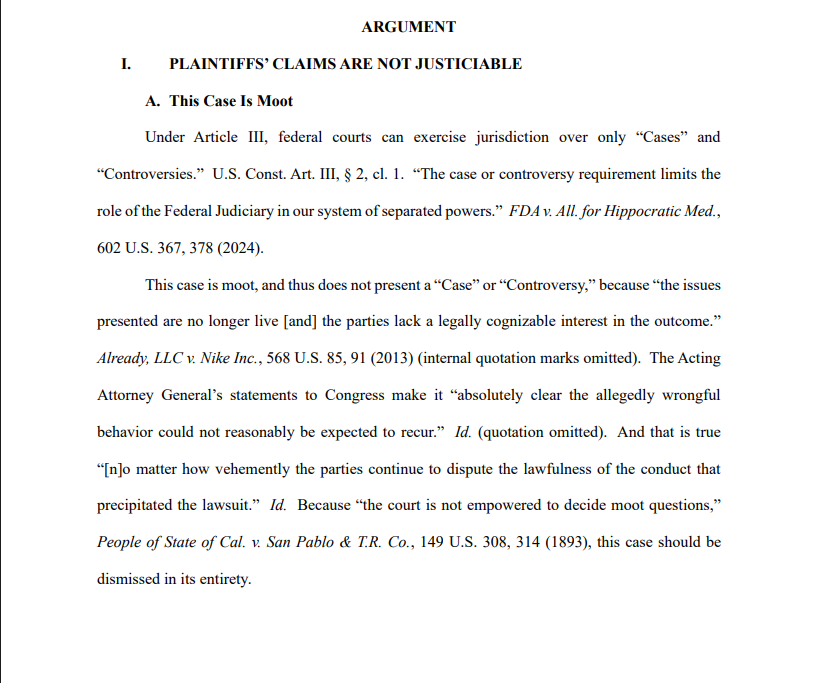
NEW: In opposing efforts to block the Anti-Weaponization Fund in not just one, but two courts, DOJ claims the case is now moot because acting AG Todd Blanche says they've dropped the fund. 1/
I'm not aware of any cases finding a dispute moot because of verbal promises by government officials. But more importantly, based on the cases they cite in their abbreviated legal argument about mootness, nor is DOJ. 2/
Ordinarily, the "voluntary cessation" doctrine requires the party claiming mootness to show "it is absolutely clear the allegedly wrongful behavior could not reasonably be expected to recur." 3/
The new DOJ investigation of E. Jean Carroll, according to CNN, stems from her testifying at her 2022 deposition that her lawyers were handling her case on contingency and that no one else was funding her case. But correspondence filed in the first-tried Carroll case reflects that it was always more complicated. 1/
In April 2023, as they were preparing for trial, Carroll’s counsel informed Trump’s team that E. Jean recalled that she had learned that a non-profit was helping defray the costs associated with her suit, costs that her lawyers assumed when they took the case on contingency. 2/
By the next day, having spoken with Trump’s counsel, Carroll’s lawyers wrote again to clarify the Trump side’s “misunderstanding of the facts.” 3/
NEW: DOJ sent Congress a six-page “report,” as required by Section 3 of the Epstein Files Transparency Act. But DOJ’s list of “government officials” and “politically exposed persons” included in the produced materials is, like the redactions themselves, too much and not enough. 1/
On one hand, the letter is missing multiple boldfaced names — like former Norwegian Prime Minister Thorbjorn Jagland and Steve Tisch — who are under fire because of their dealings with Epstein. 2/
And on the other? The inclusion of pop cultural figures who died decades ago, including Elvis Presley, Marilyn Monroe, and Michael Jackson. 3/
NEW: As the FBI executes a search warrant at a Fulton County board of elections office, it's worth remembering that there is existing litigation between DOJ and Fulton County over DOJ's attempt to obtain records pertaining to the 2020 election. 1/
In October, and at the request of the Georgia Election Board, DOJ issued a subpoena to Fulton County for "all used and void ballots, stubs of all ballots, signature envelopes, and corresponding envelope digital files from the 2020 General Election in Fulton County." 2/
In its December 2025 civil lawsuit, DOJ claims it sought these records due to "unexplained anomalies in vote tabulation and storage related to the 2020 election.” justice.gov/crt/media/1420…
NEW: Folks have been asking why Attorney General Pam Bondi, in her letter to Tim Walz, fixated on DOJ’s obtaining MN’s voting data. The answer may lie in Trump’s public statements—and MN’s last three elections. 1/
On Jan. 9, Trump met with oil and gas executives at the White House in a meeting his administration then posted to YouTube. Roughly 54 minutes in, Trump was asked about the feds’ failure to share evidence of Renee Good’s killing with state officials. 2/
Trump started by criticizing Gov. Walz and complaining about the “$19 billion” fraud uncovered in MN and mostly, according to him, perpetrated by Somali immigrants. But within a minute or so, he was talking about the elections. 3/
NEW: Comey moves to dismiss on grounds of multiple alleged instances of grand jury misconduct, stating that because the two-count indictment was never presented to the full grand jury, there was no actual indictment within the five-year statute of limitations for the two charged crimes.
This is hardly Comey's only effort to dismiss the indictment. He has two fully briefed and already argued motions to dismiss: one on grounds of selective/vindictive prosecution and the other due to Lindsay Halligan's allegedly unlawful appointment.
Some expected that Comey would wait for Judge Michael Nachmanoff to decide whether, as a magistrate judge previously ruled, he should get the transcripts and other grand jury materials.