
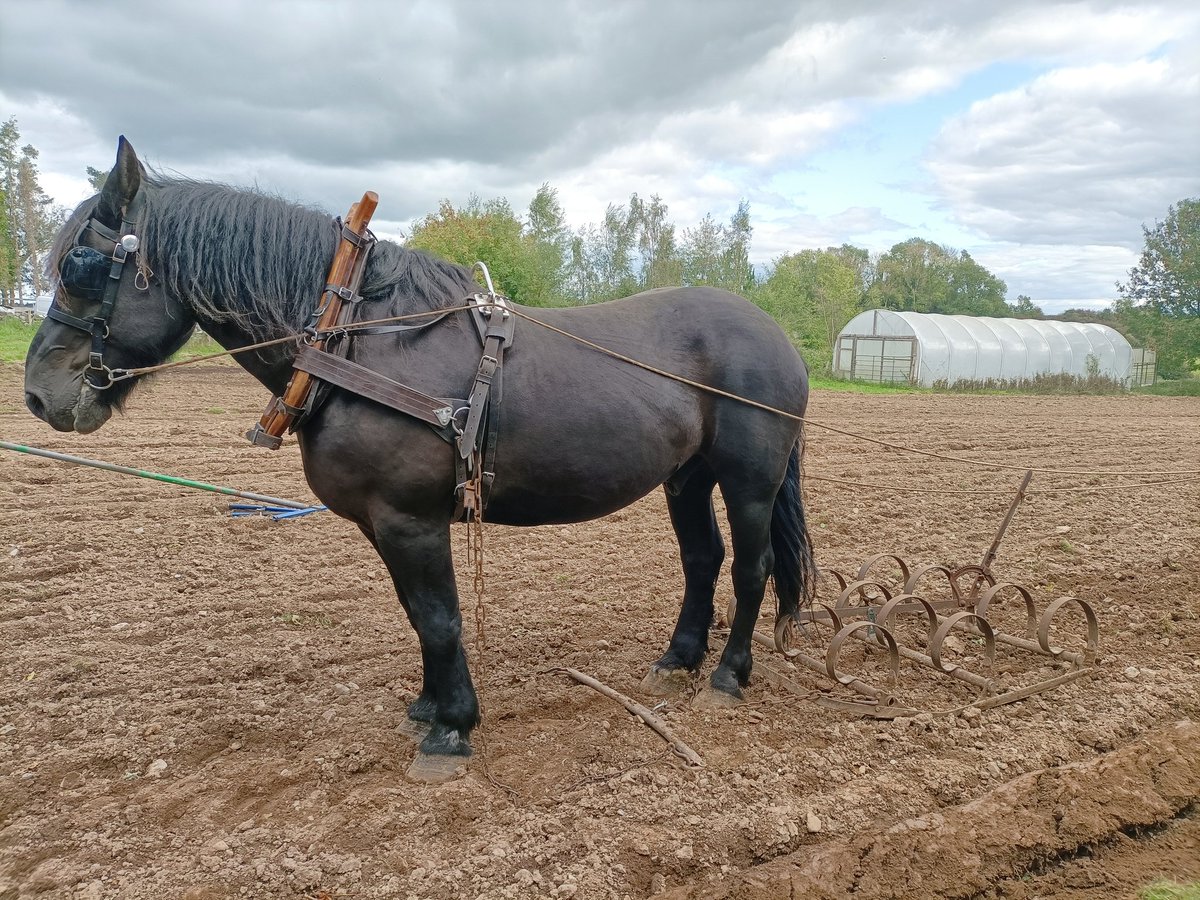
I spent time on a @farmfornature walk on EamonnMcDonaghs mixed farm in Mayo. He ploughs 2 acres with ox, sells the veg direct, almost 0 inputs, profits almost 100% from his output. Is ruthlessly, organically profit focused. Here's a thread on what I learned...
...
1. Be a price maker. Not a price taker. Eamon sells direct. To customers and shops he knows. At a price that makes sense to all three.
2. A conventional farm makes revenue by spending money on fertility. A successful mixed farm makes revenue by saving money on fertility...
3. Livestock value in this system is not in the profit they generate. It's in the money they save and the resilience they provide. Bedding and manure underpin the veg enterprise. The revenue model of low cost inputs and organic output wouldn't work without them
... 4. Synthetic fertilisers are price volatile. On Farm fertility sources - compost, manure, woodchip - are not price volatile. Eamonn didn't notice the fertiliser crisis and the economic consequences his neighbours suffered. Longterm economic farm resilience is found...
... On the floor of your barn, in your compost heap, in your cover crops.
5. On my farm, I need to move from being a sheep farmer who has manure as an afterthought, to being a fertility producer who has meat as a side product...
6. Produce or farm practices can make money. Save money. Provide fertility, labour, food or raw materials. Generate marketing. Boost grant support. Provide fuel or building materials. Each enterprise needs to do at least three of these on a mixed farm to pull it's weight...
7. There will be people who argue that this type of farming is soft headed, loss making and a hobby. Everything Eamon does makes a profit. A good profit. Mixed farming rewards efficiency, care, expertise and frugality with lower costs and revenue...
8. Other people will argue that this kind of farming can't feed the world. The current form of conventional farm doesn't currently feed the world. And what it feeds it can't feed for much longer without radical change...
My farm needs to pivot. We need to reimagine our livestock as an engine of fertility underpinning profitability. And livestock give us the key to managing input costs and maximising profit.
The future, fir my farm at least, lies in marrying the ideas of the past to the...
... Understanding, circumstances and opportunities of the present.
Farming. Like twas 1799.
• • •
Missing some Tweet in this thread? You can try to
force a refresh

I'm coming, slowly, to the idea that the destruction of our biodiversity, is also the destruction of the part of our collective sanity that requires wilderness to thrive. That we require to thrive. We are anxious. Nervous. Worried. Scared. Because we fear for the future, but also
...because we have been designed by evolution, for tens of millennia, to make sense of, and in, the natural world. Out senses are keyed, tuned, honed and alive to the scents, sounds, tastes and touch of mountains, woods, wet soil, petrichir hot in the air, the dense scent...
...of deciduous trees. For millennia , it was this exact sense we relied on for survival, security, safety and satiety. It may sound unfarmerly. But it's not. Farmers know this in their bones. We go outside to feel happy, to become calm, to find work that gives us a sense...
Farming was a guardian. A custodian. A guarantor. A certainty. A comfort.
The work of farming was food and filth, muck, life and death. But it was more.
Farms were not just custodians of a landscape. They were custodians of that part of our identity we stowed in the landscape
...People have always looked to farms and farmers to keep safe the sense of ourselves we have banked in the land, the landscape. Brillat Savarin said, "Show me what you eat and I'll tell you who you are". That sense of cultural self is not just in the food we eat...
...it's in the landscape we dream of. The pictire postcard we frame in our mind when we think of the countryside. The sense that our wilderness contains multitudes. The stone walls that grapple the hills, the hawthorns and hazels that frame the far hills...
My farm is untidy. Inefficient. Self seeded trees colonise viable field. Blocked drains create wetland. The margins, yard, old veg plots overgrown with hip tall weeds. An orchards is filled with rotting trees. Parts of it can't be access with a tractor...
....in high summer it's mess. You can't see the pasture from the driveway. Angelica and hogweed grown taller than I am. Bushes and trees crowd onto the road. The new or hard overgrown. Thick with weeds and bramble. The top field by the spring choked with uncut rushes...
...the new orchard choked with weeds. The death of small farms, and their untidy, weed tolerant, unkempt, unmowed, inefficient ways has also meant the death of habitat. Nature does not live in tidy places...
An old farmer stopped on the road. Reversed his tractor to talk to me. 70 he is. "You wouldn't know this" he said. "But this is the first yearcI have heard the cuckoo before I saw the swallows since the 1970's" Ot might seem like a small thing. But its not. It's everything...
...he told me why. A hurricane had ripped through their migration path in the North of France decimating their numbers. And he wanted me to know. It was all he said. He started his tractor, shifted into gear, and trundled off to tend cattle...
...he has farmed the same land his whole life. Anchored there he knows he is also tied to other places. That what happens here shares there. What happens in France or Africa shares our summer. And he knows it us important e ough to say, know, stop and share...
Heres why I think small farms hold one of the keys to our environmental causes. And why their loss, and replacement with large scale farming is a potentially dangerous tragedy...
...small farmers live where they work and love where they work. Their homes, families, their connection to communities mean they are tied to their land. It means something. It can mean almost everything...
...leveraging that love in the service of ecology is not a big ask. Most if you are not motivated deep down by profit, economics and money. Economics are a subset of farming. Sure. They are a context we operate in. But we don't love economics. We love our work...



