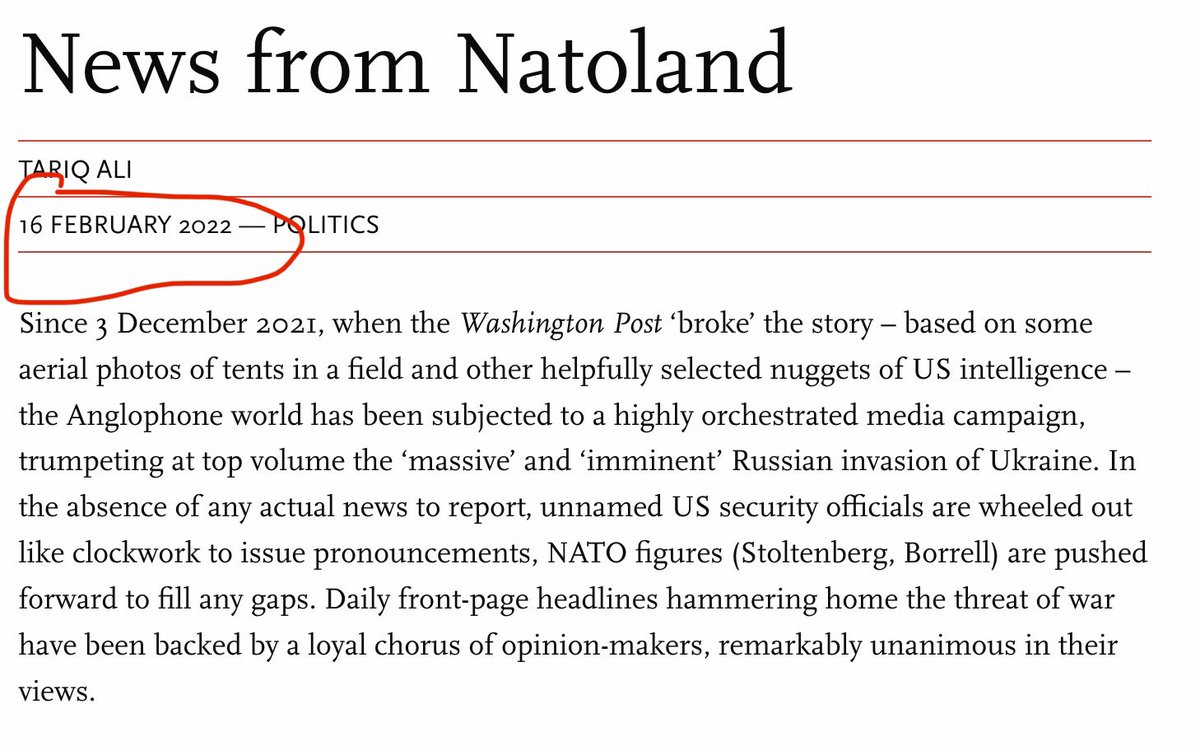
Read on Twitter
🚨 New Publication 🚨
In @JIRD_jour, @jan_smolenski and I critique the trend of IR theorists with little expertise in Ukrainian, Russian, and Eastern European politics making broad descriptive and prescriptive claims about the war in Ukraine.
Thread 1/23
rdcu.be/dp3Q3

In @JIRD_jour, @jan_smolenski and I critique the trend of IR theorists with little expertise in Ukrainian, Russian, and Eastern European politics making broad descriptive and prescriptive claims about the war in Ukraine.
Thread 1/23
rdcu.be/dp3Q3
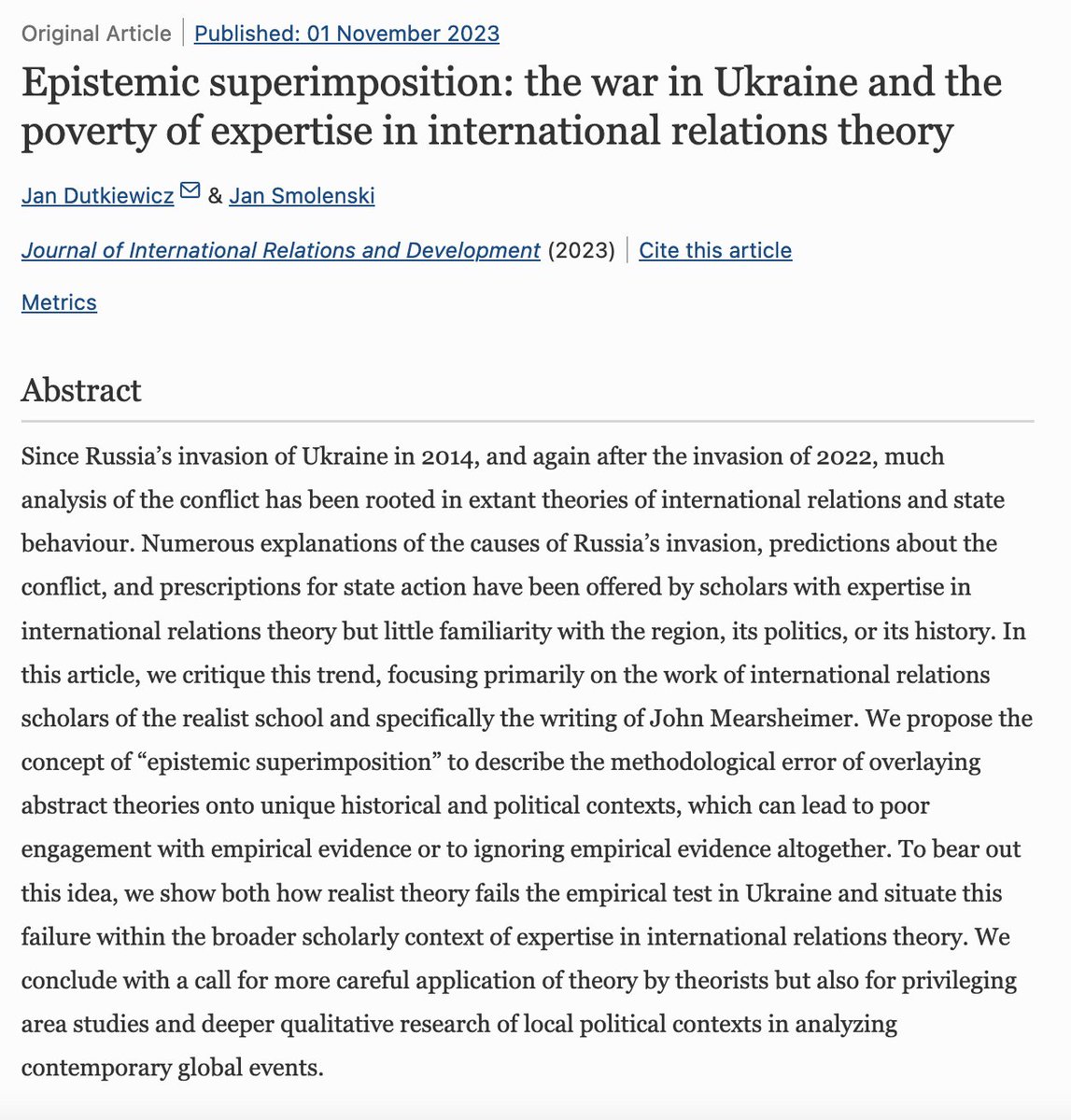
In the wake of Russia’s all-out war on Ukraine launched on February 24, 2022, among the loudest academic voices analyzing the conflict have been adherents of the “realist” theoretical tradition. Of course, we had already heard from them in 2014...
2/23
2/23
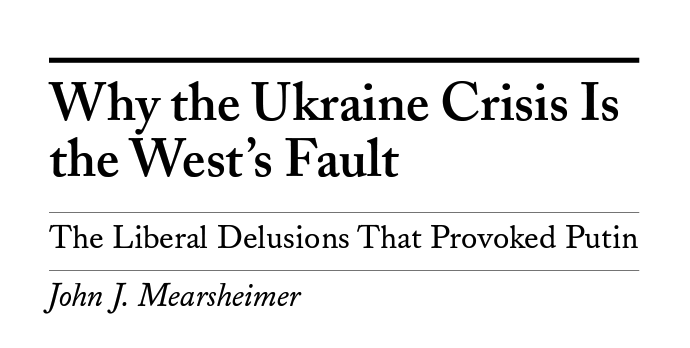
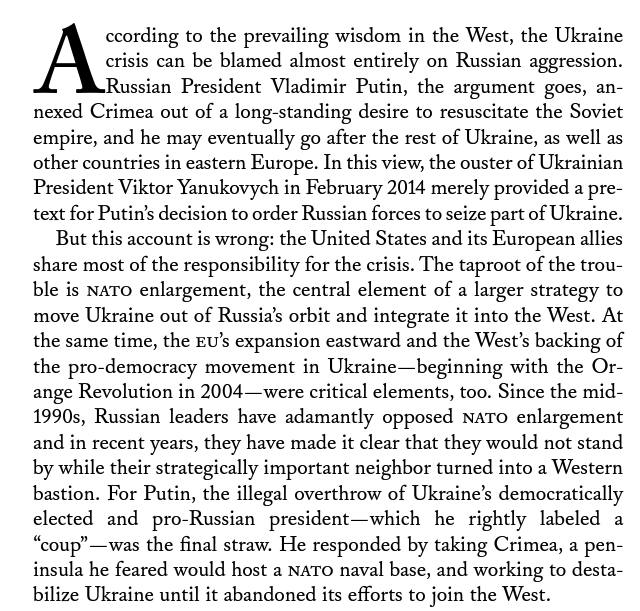
Leading proponents of the theory claimed that Russia’s hand was forced by the West, which sought to wrest Ukraine away from her sphere of influence, including through NATO expansion, causing a pre-emptive military strike and the annexation of Crimea.
3/23
3/23
At the time, this view was critiqued by scholars of Ukraine like Alexander Motyl, who did not mince words.
4/23 jstor.org/stable/43555427
4/23 jstor.org/stable/43555427
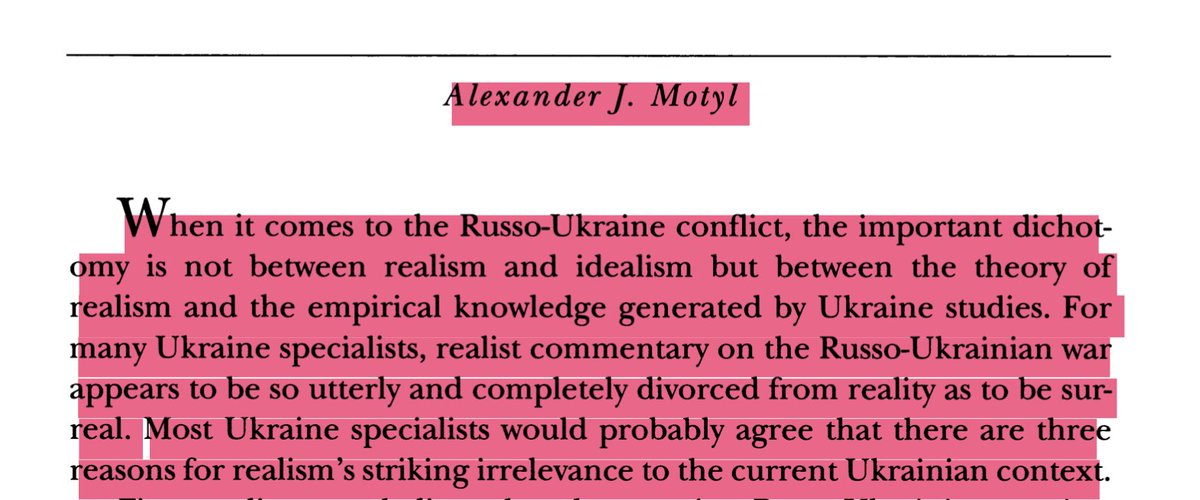
Yet between the invasions in 2014 and 2022 there seems to have been little effort made by the realists to bridge this gap by engaging with area studies and the empirics of Ukrainian, Russian, or Eastern European politics. In 2022 Mearhseimer was singing the same old song.
5/23
5/23
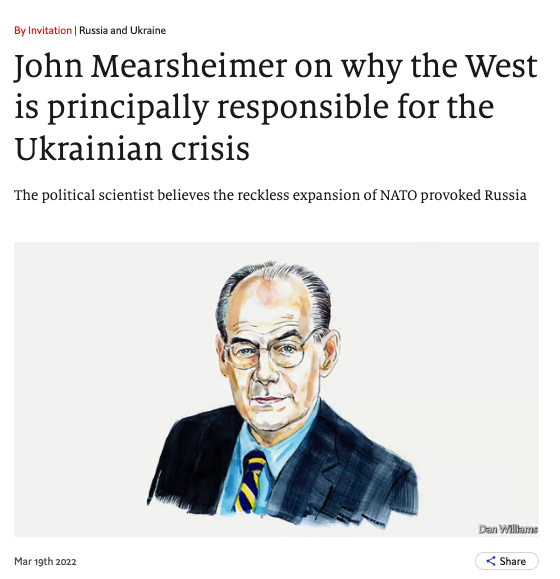
Although scholars like John Mearsheimer have claimed expertise about the war and have been treated as experts, their interventions involve two errors: 1) claiming expertise based on theory rather than empirics and 2) reading empirics selectively to match theoretical claims.
6/23
6/23
In this article, we propose the concept of “epistemic superimposition” to describe the process of giving primacy to theoretical assumptions in analyzing political current events. We then discuss the problems this causes for both academic and public knowledge production.
7/23
7/23
We proceed in three steps things:
1) We examine claims about the causes of Russia’s invasion made by John Mearhsiemer and a number of other realists and critique them on an empirical basis.
2) Define EpSu.
3) examine the role of theory as a marker of expertise within IR
8/23
1) We examine claims about the causes of Russia’s invasion made by John Mearhsiemer and a number of other realists and critique them on an empirical basis.
2) Define EpSu.
3) examine the role of theory as a marker of expertise within IR
8/23
Part 1
We examine Mearsheimer’s 2014 and 2022 claims about Ukraine in light of the analytical framework of offensive realism and show how this allows for a very tidy explanation of the situation on the ground.
9/23
We examine Mearsheimer’s 2014 and 2022 claims about Ukraine in light of the analytical framework of offensive realism and show how this allows for a very tidy explanation of the situation on the ground.
9/23
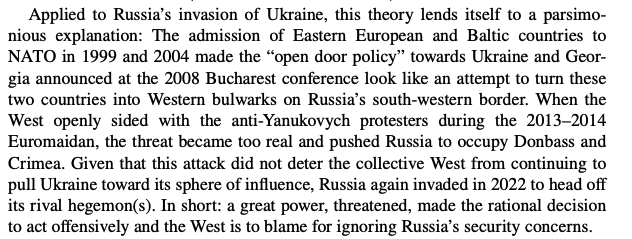
It bears noting that this “expert” was claiming until February 21, 2022 (three days before the invasion) that Putin’s buildup of troops on Ukraine’s border was little more than performative brinksmanship.
10/23
10/23

There are major problems in Mearsheimer’s work, including choice of primary sources, analysis of empirics, and engagement with scholars of Ukraine and/or Ukrainian scholar. We find him lacking (to say the least).
11/23
11/23
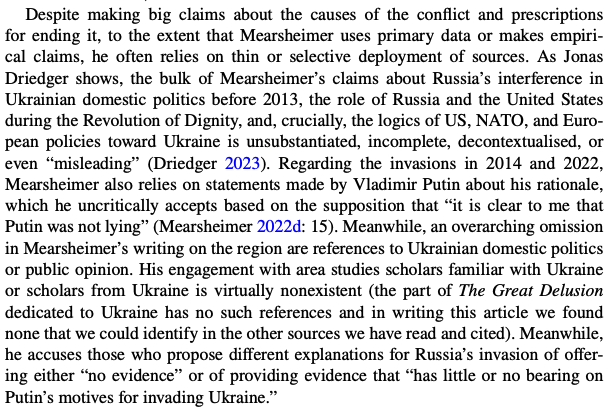
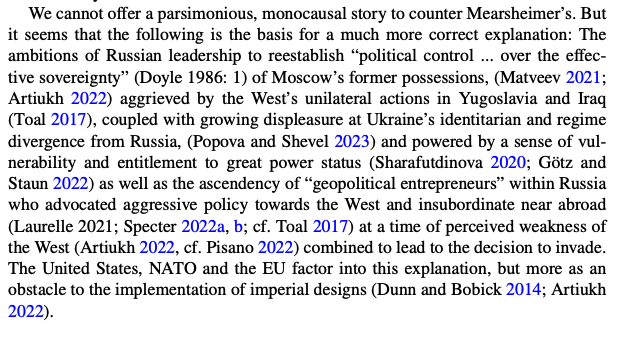
We then spend multiple pages building a well-sourced case (read the paper, can’t reveal everything here) for a different, less tidy explanation:
12/23
12/23
Part 2
We focus in on the conflation in Mearsheimer’s (and other realists’) writing about the conflict between description and prescription, which runs firmly against basic principles of theory testing in the social sciences.
13/23
We focus in on the conflation in Mearsheimer’s (and other realists’) writing about the conflict between description and prescription, which runs firmly against basic principles of theory testing in the social sciences.
13/23
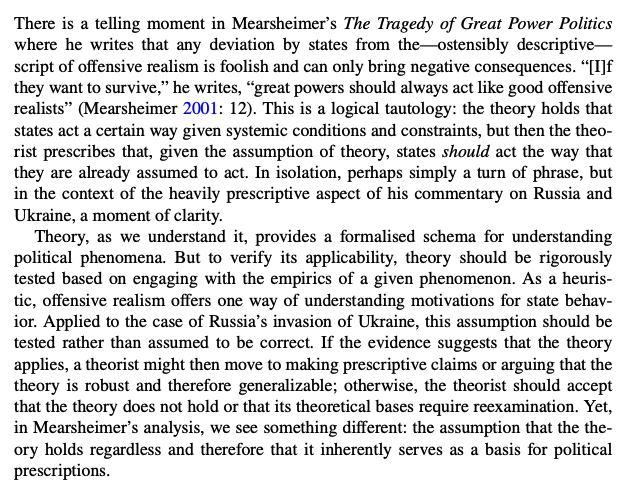
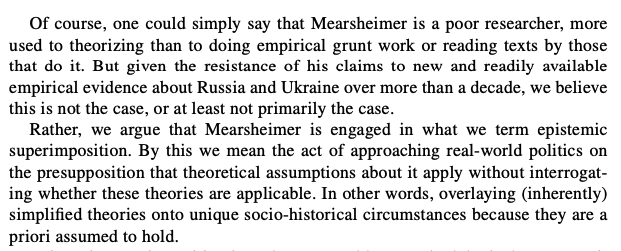
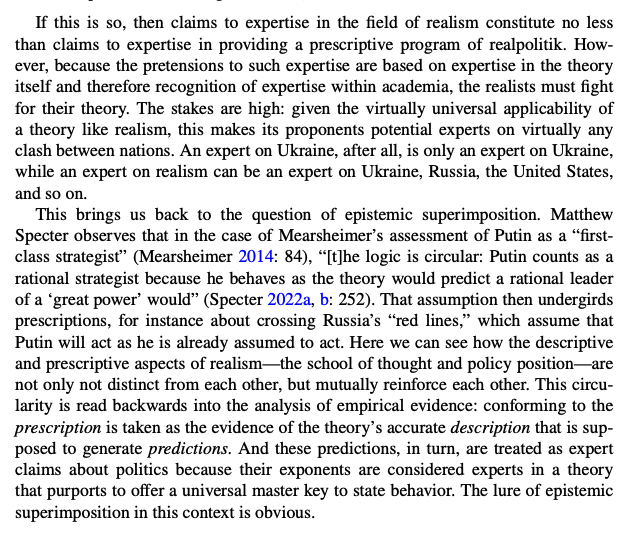
This is a grievous methodological error: assuming that theories hold and engaging in vulgar empiricism (per EP Thompson’s critique of Althusser) where theory guides what facts are chosen and presented so as to match the expectations of the theory.
14/23
14/23
We term this error “epistemic superimposition.”
15/23
15/23
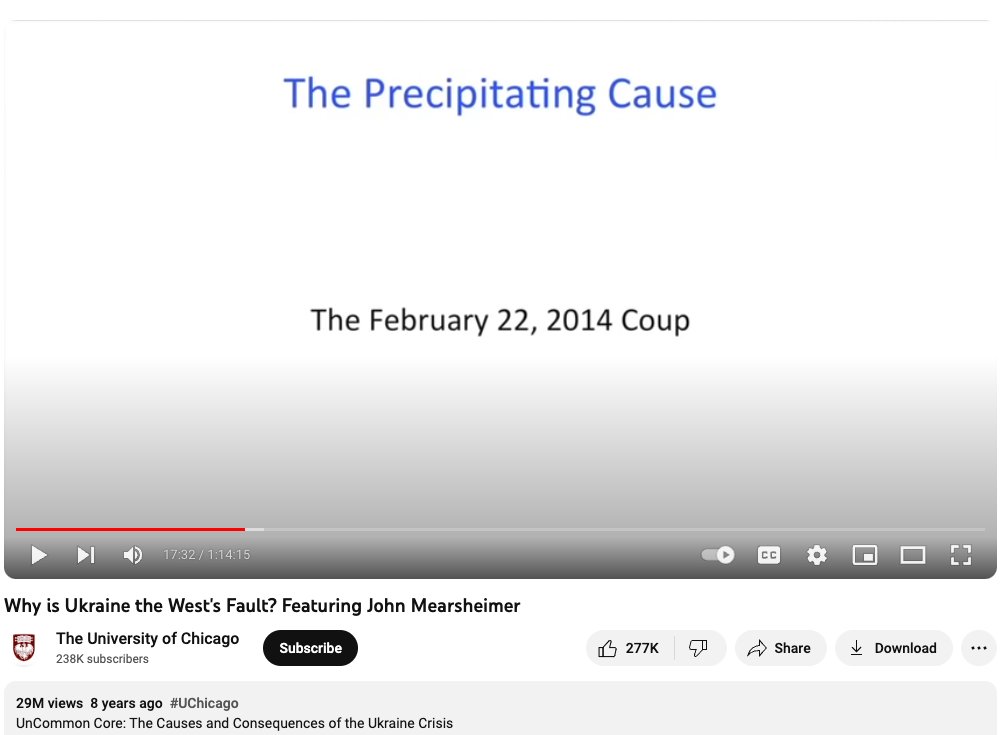
When it comes to Russia’s invasion, this error has consequences for shaping public opinion and knowledge production. Consider that Mearsheimer’s 2015 lecture “Why is Ukraine the West’s Fault?” has been viewed tens of millions of times since February 2022.
16/23
16/23
Part 3
2022 commentary by Mearsheimer and other realists is nothing if not consistent (and consistently as wrong in 2022 as it was in 2014).
17/23
2022 commentary by Mearsheimer and other realists is nothing if not consistent (and consistently as wrong in 2022 as it was in 2014).
17/23
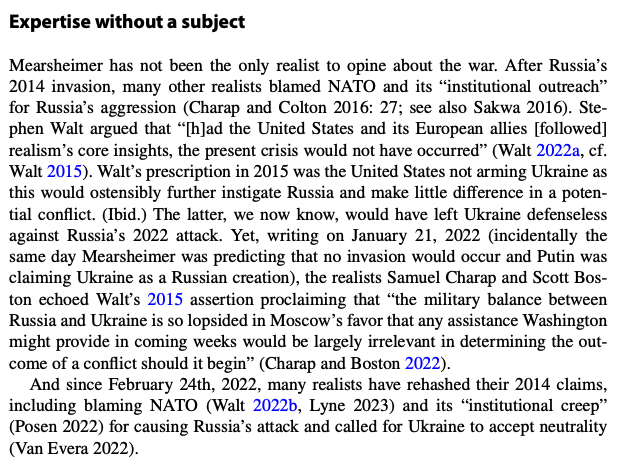
We spend a number of pages (again: read the paper, can’t reveal everything here) examining the hierarchy of knowledge production in the field of IR and the privileging of theory over area studies. A fatal error.
18/23
18/23
But, we argue, privileging theory – and especially grand theories like realism that can claim to explain virtually any conflict – serves a particular purpose: defending the expertise of realists about IR!
19/23
19/23
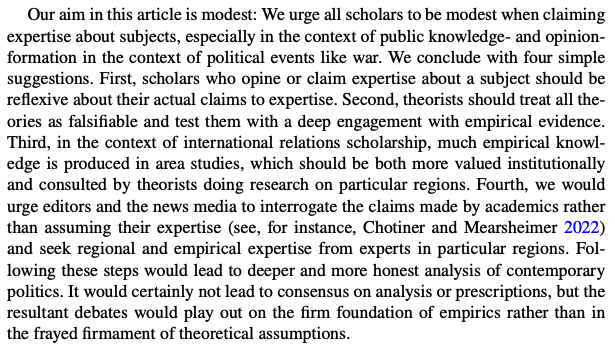
The target of our critique throughout is not theorizing per se, but rather theorizing that neglects knowledge of local contexts and assumes theory as inherently valid. We end with a modest but important call to action to address epistemic superimposition.
20/23
20/23
Thank you to the editors @VjosaMusliuand @OBurlyuk for inviting us to submit this article and to @popovaprof @ALanoszka @steven_seegel and Elizabeth Dunn and (honestly) to the reviewers for their comments on previous versions of this article.
21/23
21/23
Open access:
Dutkiewicz, Jan & Smolenski, Jan. (2023) “Epistemic superimposition: the war in Ukraine and the poverty of expertise in international relations theory.” Journal of International Relations and Development. DOI:10.1057/s41268-023-00314-1
22/23
link.springer.com/epdf/10.1057/s…
Dutkiewicz, Jan & Smolenski, Jan. (2023) “Epistemic superimposition: the war in Ukraine and the poverty of expertise in international relations theory.” Journal of International Relations and Development. DOI:10.1057/s41268-023-00314-1
22/23
link.springer.com/epdf/10.1057/s…
This article is part of a special forum in @jird_jour on the politics of knowledge production in Russia’s war against Ukraine. The thread of the other articles is here:
23/23
23/23
https://twitter.com/JIRD_jour/status/1707026378921500824
May be of interest to:
@sumlenny
@R2khV
@BohdanaKurylo
@anneappelbaum
@TimothySnyder
@geogvma
@sasha_etkind
@Mylovanov
@Alexstubb
@sumlenny
@R2khV
@BohdanaKurylo
@anneappelbaum
@TimothySnyder
@geogvma
@sasha_etkind
@Mylovanov
@Alexstubb
I'll add that this article is both an intervention into current debates about Rus-Ukr, but is also a methodological critique. If you teach the article, I'd love to hear what students thought of it. I'm also sure Jan or I would be to Zoom in. Let me know.
https://x.com/PopovaProf/status/1720058250668757277?s=20
• • •
Missing some Tweet in this thread? You can try to
force a refresh