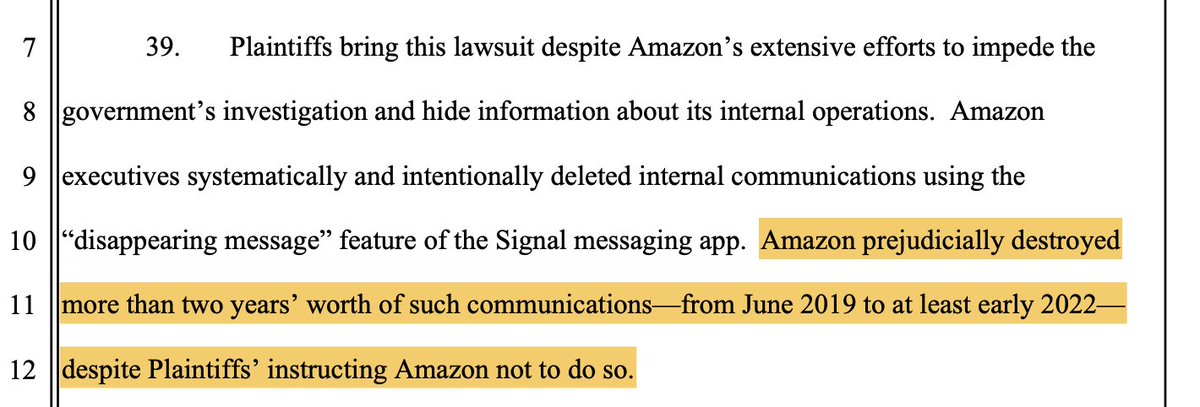
1. Amazon is in a world of legal hurt — I just read the less-redacted version of the FTC’s monopoly lawsuit. Lots of evidence of Amazon execs knowingly screwing consumers & killing competition, aware of their own wrong-doing.
A few highlights. First, destroying evidence.
2. Here’s an exec saying that blocking sellers from offering lower prices on other sites is "a dirty job, but we need to do it."
3. This is wild — Amazon retaliates so harshly against sellers who discount elsewhere that a competing platform (maybe Walmart?), in order to attract sellers, had to create an algorithm that ensures sellers’ prices can never ever drop below what they charge on Amazon.
4. “Prices will go up,” declared Jeff Wilke, Amazon’s CEO of Worldwide Consumer, after implementing an algorithm that makes it impossible for competitors to win market share by lowering their prices.
5. Amazon's secret price-raising system, Project Nessie, fleeced at least $1 billion from shoppers.
To evade detection, Amazon turned Nessie off when attention to prices was highest, such as during the holiday season.
6. If you control a spigot that can dump tens of millions of dollars into your lap just like that, you are a monopoly. No question.
7. Why is there no alternative to Amazon? Here’s Amazon using its price manipulation tools to kill Jet, an upstart competitor. Three months after Jet launched, it was forced to "revise [I [its] price leadership strategy…”
8. And here’s Amazon doing the same to Walmart
9. And here’s Amazon doing the same to Zulily.
10. Here’s Jeff Bezos, founder of "the world's most consumer-centric company," telling executives to stuff “defect” ads in front of shoppers — ads that aren’t relevant to their search — because it’s a way to make lots of money.
11. Stuffing ads into results also helps Amazon steer shoppers away from lower priced products.
12. Lots of new evidence about how Amazon thwarts competition by forcing sellers to use its fulfillment.
Amazon had an “oh crap” moment when it looked at the numbers and realized that Seller Fulfilled Prime (SFP) was undermining its monopoly control of e-commerce.
13. A top executive couldn’t sleep as he realized that SFP was helping independent shippers compete against Amazon.
14. Amazon realized SFP was like playing without a monopoly moat.
15. Amazon moved to kill SFP after an executive learned that UPS was advertising that its fulfillment service could fulfill Prime orders.
With just the thought of having to compete on the merits, this executive was "losing [his] mind."
16/16. Also fascinating is the fact that at every turn, there's someone inside Amazon saying "don't do this, it's bad for shoppers!" And Amazon does it anyway.
PS — To get our latest research on Amazon, anti-monopoly policy, and how communities can take charge of their local economies dropped in your inbox every 3 weeks, sign up: hometownadvantage.org
• • •
Missing some Tweet in this thread? You can try to
force a refresh

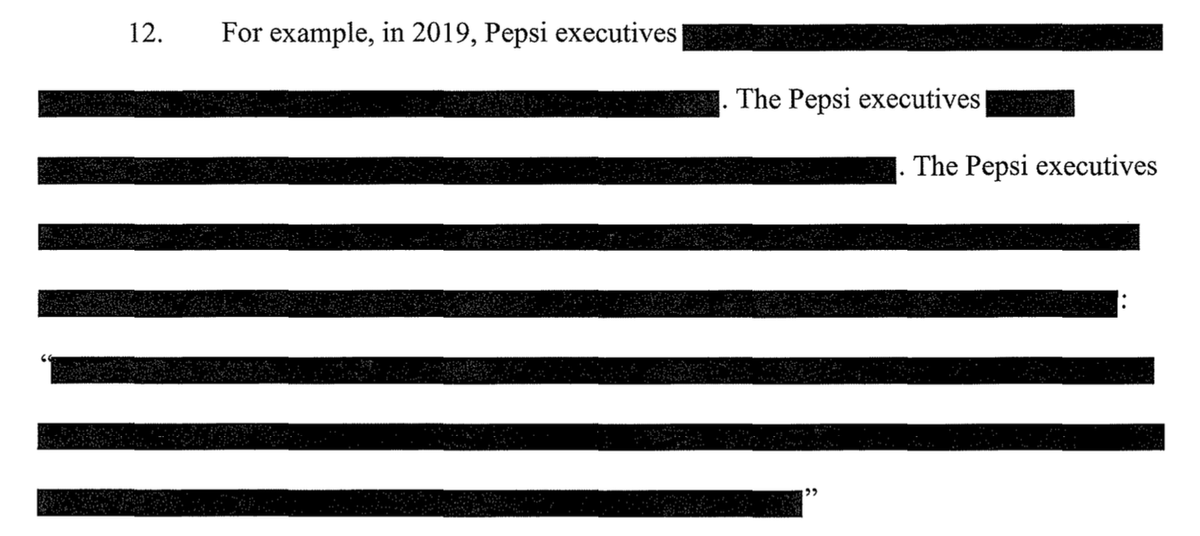
1. For at least 10 years, Pepsi has conspired with Walmart to force up grocery prices. That’s the shocking evidence made public today in an unsealed FTC lawsuit. The suit was dropped in May by @AFergusonFTC just before it was to be un-redacted. We went to court to get it unsealed & won.
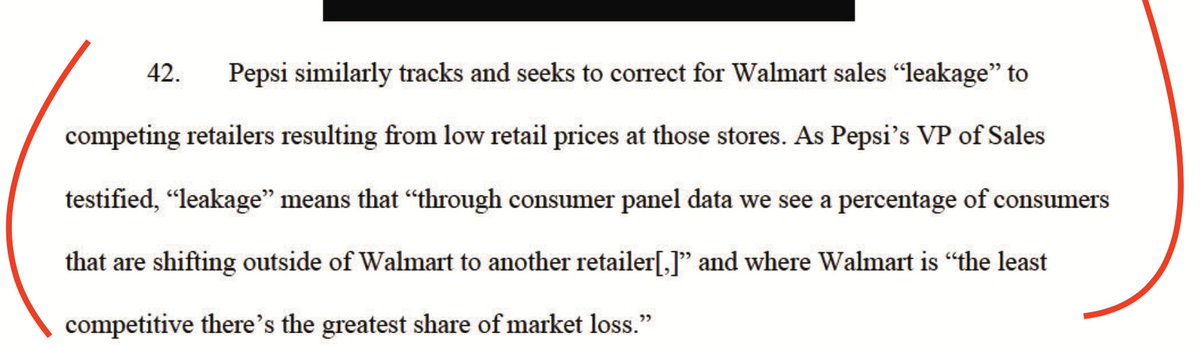
2. The evidence we can now see demolishes the core argument made by opponents of the Robinson-Patman Act. They claim not enforcing the law has led to lower prices. But this new material shows the opposite: Pepsi forced all grocers besides Walmart to raise their prices.
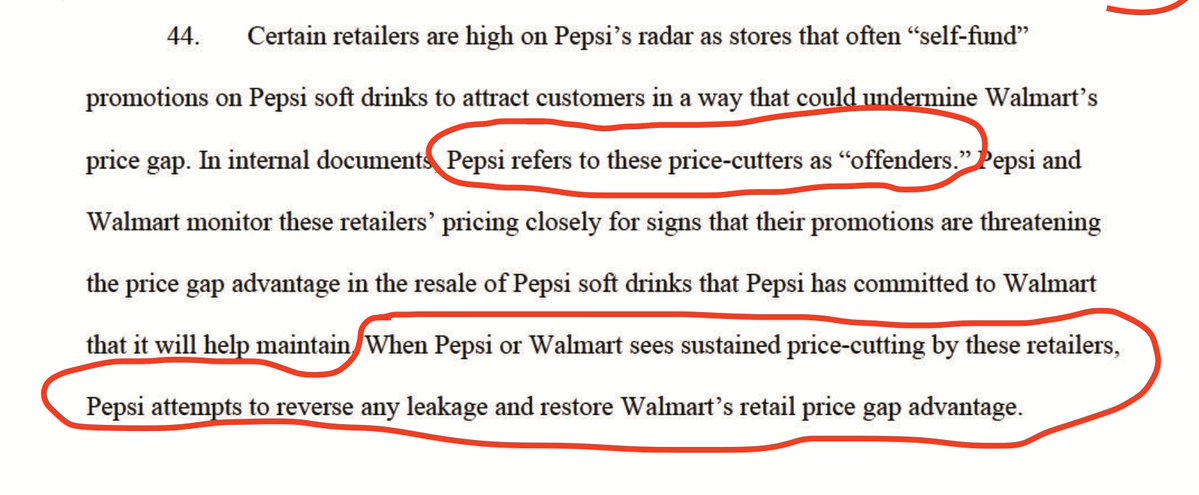
3. Pepsi monitors prices at Walmart's competitors. If they see other grocery stores starting to match or beat Walmart on price, an alarm goes off in Pepsi and a team swings into action.
1. This is now unsealed. The FTC filing shows Pepsi worked closely with Walmart to force other retailers to raise their prices on Pepsi products. The Khan-era FTC brought the case; Trump/Ferguson dropped it as “weak.” It looks anything but. It directly targets high prices.
2. The evidence shows that Pepsi punished Walmart’s competitors if they discounted Pepsi products. Pepsi would increase their wholesale cost or eliminate promotional payments to force Walmart's rival to raise its price to consumers.
3. This was done to maintain Walmart’s “price gap.” The purpose of the price gap is to provide Walmart an advantage over other retailers. Pepsi documents describe this as a “foundational commitment” that aligns with the company’s strategy.
1. ILSR has filed a motion in federal court to unseal the FTC’s antitrust complaint against PepsiCo. The case bears directly on high grocery prices & food deserts—and would've marked a crucial revival of the neglected Robinson-Patman Act. But the public may never get to see it.
2. Most of the complaint is heavily redacted, including the name of the favored retailer (reportedly Walmart). The complaint alleges that Pepsi gave a favored big-box retailer illegal price breaks — while raising prices to competing independent grocers and their customers.
3. In antitrust cases, complaints are often temporarily sealed. But courts generally move quickly to remove the redactions, so the public can see the evidence and understand what’s at stake.
1. My colleague Ron Knox just published a killer guide to resisting monopolies. It shows that fighting monopoly power isn't just a job for the government — it's something regular people can do every day in their communities and workplaces. microcosmpublishing.com/catalog/zines/…
2. Resist Monopolies! — published by the great folks at Microcosm — weaves together the stories of people across the country pushing back against corporate domination — and winning.
3. The book brilliantly connects today’s struggles to our long, rich history of anti-monopoly activism — and the heroes, then and now, leading the way. It’s an essential read. microcosmpublishing.com/catalog/zines/…
1. How strong are your state’s antitrust laws? Does your state AG have all the tools s/he needs to go after corporate abuse? What can your state legislature do to fight monopolies? ILSR has new resources for you, created by my colleague @ronmknox: ilsr.org/independent-bu…
2. Back in the 19th century, states were the first on the scene when corporations started to amass too much power. They came up with the first antitrust laws, which inspired federal law.
3. Today, states are playing a pivotal role in reviving antimonopoly law. They’re blocking mergers that would hurt workers, investigating landlord collusion to raise prices, suing to break up Big Tech, going after the PBMs that kill pharmacies, and more. ilsr.org/articles/state…
1. Big news! The FTC took action today to end Walmart’s stranglehold on the grocery market. The agency filed suit against Pepsi for giving illegal and unfair price advantages to Walmart while charging competing grocery retailers higher prices. ilsr.org/articles/stacy…
2. It is a violation of the Robinson-Patman Act for a large supplier to collaborate with a big retail chain to help it drive smaller retailers out of business and dominate the market. But for the last 40 years — until now — the FTC declined to enforce the law.
3. Walmart has deftly exploited the lack of enforcement. For decades, it has strong-armed suppliers, demanding special deals while forcing suppliers to hike their prices to competing chains and independent retailers.