Read on Twitter
1/7. The only trace on that graph which does not show large improvement in cereal yield per hectare is the trace for Niger.
The graph ended with an anomalously bad crop year for cereals in Niger (2021). Fortunately, 2022 was much better; here's an article
worldbank.org/en/news/press-…
The graph ended with an anomalously bad crop year for cereals in Niger (2021). Fortunately, 2022 was much better; here's an article
worldbank.org/en/news/press-…
2/7. By displaying high productivity countries like the USA along with Niger, you forced OurWorldInData to scale the graphs so that it's hard to see the trend in Niger.
But if you display Niger alone, as I've done here, you'll see that cereal yields declined there until about thirty years ago, but they've improved since then (except for 2021).

But if you display Niger alone, as I've done here, you'll see that cereal yields declined there until about thirty years ago, but they've improved since then (except for 2021).
https://twitter.com/ncdave4life/status/172004439970958975

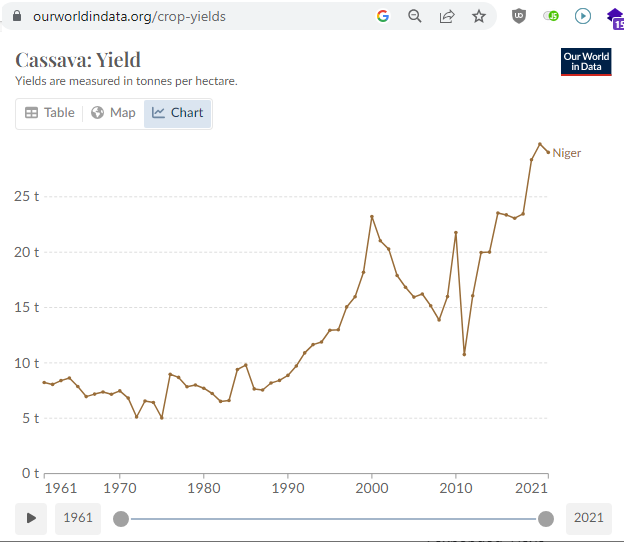
@Willard1951 @JimBlack48 @BlasphemousBan1 @S_Metzeler @Anvndarnamn5 @GAJAJW @RClausius42 @Data79504085 @BenKoby1911 @priscian @EthonRaptor @Michael_D_Crow @Mark_A_Lunn @NomadicQuantum @AristotleMrs @ScienceBlog3 @AuroriaEn @AndreGrossza @DenisDaly @Veritatem2021 @JusticeTrudeau @judgementalbe1 @ChrisBBacon3 @Coleski14 @wallytoms0 @Climatehope2 @LesserMegadeath @WernerReinhard5 @S_D_Mannix @ammocrypta @Jaisans @CarrudoDon @LiveLifeBK24 @TheDisproof @Joeyd87745119 @Devonian1342 @Hji45519156 @waxliberty @SuperFoxyLoxy @JaapTitulaer @wjack76995 @Rocky35418823 @NobaconEgbert @balls95652097 @JustThi30117912 @BointonGiles @SeekerTheGreat1 @ubique60 @DaleGribble_666 3/7. The other major staple crop in Niger is cassava. Its yields have improved considerably.
sealevel.info/Niger_Cassava_…
sealevel.info/Niger_Cassava_…

4/7. That's probably because cassava benefits tremendously from additional CO2, especially in the dry conditions which are prevalent in most of Niger. Here's a paper about it:
Cruz et al 2018. Elevated CO2 reduces whole transpiration and substantially improves root production of cassava grown under water deficit. Archives of Agronomy and Soil Science 64: 1623-1634. doi:10.1080/03650340.2018.1446523tandfonline.com/doi/abs/10.108…
Cruz et al 2018. Elevated CO2 reduces whole transpiration and substantially improves root production of cassava grown under water deficit. Archives of Agronomy and Soil Science 64: 1623-1634. doi:10.1080/03650340.2018.1446523tandfonline.com/doi/abs/10.108…
5/7. Most of Niger is desert or near-desert, which means most of its land is poorly suited for growing crops. Over the 60 year period shown, Niger's population increased by about 640%. As a result, the amount of land under cultivation drastically increased, resulting in more marginal land being put to the plow.
That, of course, can be expected to lower the average cereal yield per hectare. Nevertheless, other than a bad year in 2021, yields there have been improving since the mid 1990s.
That, of course, can be expected to lower the average cereal yield per hectare. Nevertheless, other than a bad year in 2021, yields there have been improving since the mid 1990s.

6/7. That's probably because of the well-known fact that, in addition to improving production by CO2 fertilization, rising CO2 levels improve crops' water use efficiency and drought resilience. Here's a paper about wheat:
Fitzgerald GJ, et al. (2016) Elevated atmospheric [CO2] can dramatically increase wheat yields in semi-arid environments and buffer against heat waves. Glob Chang Biol. 22(6):2269-84. doi:10.1111/gcb.13263.onlinelibrary.wiley.com/doi/full/10.11…
Fitzgerald GJ, et al. (2016) Elevated atmospheric [CO2] can dramatically increase wheat yields in semi-arid environments and buffer against heat waves. Glob Chang Biol. 22(6):2269-84. doi:10.1111/gcb.13263.onlinelibrary.wiley.com/doi/full/10.11…
@Willard1951 @JimBlack48 @BlasphemousBan1 @S_Metzeler @Anvndarnamn5 @GAJAJW @RClausius42 @Data79504085 @BenKoby1911 @priscian @EthonRaptor @Michael_D_Crow @Mark_A_Lunn @NomadicQuantum @AristotleMrs @ScienceBlog3 @AuroriaEn @AndreGrossza @DenisDaly @Veritatem2021 @JusticeTrudeau @judgementalbe1 @ChrisBBacon3 @Coleski14 @wallytoms0 @Climatehope2 @LesserMegadeath @WernerReinhard5 @S_D_Mannix @ammocrypta @Jaisans @CarrudoDon @LiveLifeBK24 @TheDisproof @Joeyd87745119 @Devonian1342 @Hji45519156 @waxliberty @SuperFoxyLoxy @JaapTitulaer @wjack76995 @Rocky35418823 @NobaconEgbert @balls95652097 @JustThi30117912 @BointonGiles @SeekerTheGreat1 @ubique60 @DaleGribble_666 7/7. The science has been settled for over a century: elevated CO2 is tremendously beneficial for agriculture. The climate activists who refuse to acknowledge that established fact are science deniers.
sealevel.info/learnmore.html…
sealevel.info/learnmore.html…
@Willard1951 @JimBlack48 @BlasphemousBan1 @S_Metzeler @Anvndarnamn5 @GAJAJW @RClausius42 @Data79504085 @BenKoby1911 @priscian @EthonRaptor @Michael_D_Crow @Mark_A_Lunn @NomadicQuantum @AristotleMrs @ScienceBlog3 @AuroriaEn @AndreGrossza @DenisDaly @Veritatem2021 @JusticeTrudeau @judgementalbe1 @ChrisBBacon3 @Coleski14 @wallytoms0 @Climatehope2 @LesserMegadeath @WernerReinhard5 @S_D_Mannix @ammocrypta @Jaisans @CarrudoDon @LiveLifeBK24 @TheDisproof @Joeyd87745119 @Devonian1342 @Hji45519156 @waxliberty @SuperFoxyLoxy @JaapTitulaer @wjack76995 @Rocky35418823 @NobaconEgbert @balls95652097 @JustThi30117912 @BointonGiles Compilation:
@ThreadReaderApp @Rattibha @threaddotblue unroll
@reSeeIt save conversationtwitter-thread.com/t/172022968681…
@ThreadReaderApp @Rattibha @threaddotblue unroll
@reSeeIt save conversationtwitter-thread.com/t/172022968681…
• • •
Missing some Tweet in this thread? You can try to
force a refresh