Imagine you walk into a room that's absolutely packed with people. It's so crowded that no one can really move, they're all shoulder to shoulder. Now, you want to squeeze into the room too, but there's no space. 1/ Image
Everyone is pushing back against you, not because they're mean or don't want you there, but simply because there's no more room.
In the world of quantum mechanics, particles like electrons have a rule that's kind of like a law of politeness at a fancy party: ... 2/
... no two of them can have exactly the same set of quantum numbers. It's as if every person at the party has a unique combination of name, outfit color, and hat style. This is known as the Pauli exclusion principle. 3/
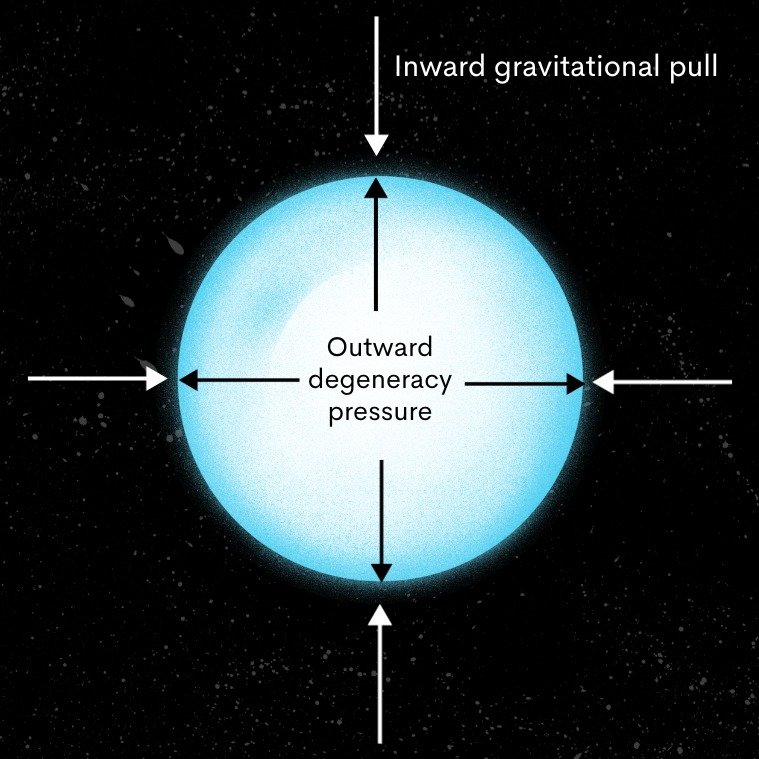
So, what happens inside the cores of stars, or in the remnants of stars called white dwarfs, is similar to trying to push into our crowded room. Electrons are packed together so closely that they can't occupy the same quantum state as their neighbors. 4/
They push back against any additional pressure trying to squash them closer together. This push-back is what we call "degeneracy pressure.”
Degeneracy pressure doesn't come from the usual thermal motion of particles that we associate with things like air pressure or ... 5/
... steam in a kettle. Instead, it comes purely from the quantum rule that says electrons won't share their quantum states. It's a standoffish kind of pressure that's incredibly strong and can counteract the immense gravitational forces trying to collapse a star. 6/
To visualize it, imagine trying to push more people into our already crammed room. It's not the heat or energy of the people pushing back; it's the fact that there's simply no more space as per the "party rules." 7/
These rules keep white dwarfs and other exotic stellar objects from collapsing under their own gravity, giving us a universe that's a whole lot more interesting.
In essence, degeneracy pressure is a cosmic "No More Room!" sign, and it's one of the reasons why ... 8/
... stars don't just keep on squishing down into black holes all the time. It's quantum mechanics thrown into space, and it holds up stars. 9/9

• • •

Missing some Tweet in this thread? You can try to force a refresh

 

Keep Current with Erika #PlanetaryDefense 🎯

Erika #PlanetaryDefense 🎯 Profile picture

Stay in touch and get notified when new unrolls are available from this author!

Read all threads

This Thread may be Removed Anytime!

PDF

Twitter may remove this content at anytime! Save it as PDF for later use!

Try unrolling a thread yourself!

how to unroll video
  1. Follow @ThreadReaderApp to mention us!

  2. From a Twitter thread mention us with a keyword "unroll"
@threadreaderapp unroll

Practice here first or read more on our help page!

More from @ExploreCosmos_

Oct 24
Astronomers have calculated the number of black holes in the universe. And the number is 40 quintillion (40 followed by 18 zeros).
Hence, stellar-mass black holes make up 1% of all the ordinary matter in the cosmos. 1/
But, how did astronomers arrive at this number? Black holes are such dense regions in spacetime that even light cannot escape them. So, astronomers tracked the evolution of the stars that could become black holes. 2/
Stars 5-10 times more massive than the Sun fuse heavier elements in their cores. When the chain of elements reaches iron, the nuclear fusion reactions stop. That is because iron takes more energy than it gives out to form the next element. 3/
Read 9 tweets
Oct 16
Asteroid Apophis is coming back.

Apophis stands out as the most dangerous asteroid that passes close to our planet.
In March 2021, it had a close encounter with Earth, and it's poised to return in 2029.
During its 2029 closest approach, Apophis will pass within.... 1/
... a mere 32,000 km of Earth's surface.
This will bring it below the orbits of geostationary satellites, making it as luminous as a satellite.
It will be the closest asteroid of this size in recorded history (10 times closer than the Moon). 2/
Observers in Europe, Africa and Western Asia will easily be able to see the asteroid with the naked eye.
Given that such encounters occur only once every few thousand years, scientists are proposing missions to investigate Apophis around this timeframe. 3/
Read 9 tweets
Sep 27
On September 20, 2023, NASA released a new stunning mosaic image of the lunar South Pole, created by combining images from two different cameras in orbit around the Moon.
1/ Image
The image reveals unprecedented detail of the region, including the Shackleton Crater, a large impact crater with a permanently shadowed floor. Some of the regions have not received sunlight for more than three billion years! 2/
The image was created by the Lunar Reconnaissance Orbiter Camera (LROC) and ShadowCam teams, with images provided by NASA, the Korea Aerospace Research Institute, and Arizona State University. The new mosaic image shows the Shackleton Crater in great detail, ... 3/
Read 5 tweets
Sep 2
After Chandrayaan 3's success, #India has successfully launched a mission to study the Sun. The #AdityaL1 mission is the country's first space-based observatory to study the Sun.
The word Aditya means the Sun in Sanskrit and L1 is the point around which it will be placed. 1/
It will be fired into a halo orbit around the L1 Lagrange point between Earth and Sun, lying 1.5 million km away.
There are two advantages of placing a spacecraft at L1 Lagrange point. Firstly, it's a stable point, and a spacecraft placed here requires minimal fuel. 2/
Secondly, it gets an uninterrupted view of the Sun while remaining in constant contact with Earth. So, the mission is never interrupted by eclipses or atmosphere's disturbances.
The Aditya L1 Probe will take around 4 months to reach the L1 Lagrange point. 3/
Read 10 tweets
Aug 14
I don't know what you think, but for me, The Parker Solar Probe, "touching" the sun, has been one of the great achievements of our time.
But, why didn't it melt? 1/

#Thread
The Parker Solar Probe created history by becoming the first spacecraft to "touch" the Sun.
It passed through the Sun's atmosphere, known as the corona. Temperatures in the solar corona can soar up to a million degrees Celsius. 2/
It is the hottest region of the Solar atmosphere and is about 15 times hotter than the surface of the Sun. But the critical question is, why didn't the Probe melt when it touched the Sun?. 3/
Read 19 tweets
Aug 8
Two CMEs have been released by the Sun. The one that was released later has caught up with the one before it and cannibalised it. This cannibal CME will hit the Earth today, August 8, and cause a strong solar storm event. 1/ Image
At the moment, it is not confirmed whether the hit will be a head-on collision or a glancing blow. But researchers are keeping a close eye on the cloud to understand the condition. A full-force strike can damage small satellites, impact mobile networks, and GPS, and ... 2/
... even pose a threat to ground-based electronics and power grids by increasing the magnetic potential by huge amounts. 3/3
Read 5 tweets

Did Thread Reader help you today?

Support us! We are indie developers!


This site is made by just two indie developers on a laptop doing marketing, support and development! Read more about the story.

Become a Premium Member ($3/month or $30/year) and get exclusive features!

Become Premium

Don't want to be a Premium member but still want to support us?

Make a small donation by buying us coffee ($5) or help with server cost ($10)

Donate via Paypal

Or Donate anonymously using crypto!

Ethereum

0xfe58350B80634f60Fa6Dc149a72b4DFbc17D341E copy

Bitcoin

3ATGMxNzCUFzxpMCHL5sWSt4DVtS8UqXpi copy

Thank you for your support!

Follow Us on Twitter!

:(