2/5》 If we got at most 0.92°C of warming from 58% of the forcing of a full doubling of CO2, then (at most) how much warming we could get from a full doubling of CO2?
3/5》 Those figures are very conventional estimates, widely accepted by climate alarmists. Yet those same climate alarmists believe that TCR climate sensitivity is 1.5 to 2.0°C/doubling of CO2, and ECS is about 3.0°C/doubling of CO2.
4/5》 Most climate alarmists uncritically accept estimates of basic climate parameters, like TCR, ECS, ERF, radiative imbalance, etc. without bothering to check them for consistency. I made an online spreadsheet to make it easy to do some of those checks: sealevel.info/radiative_imba…
5/5》Give it a whirl!
Enter your best guesses for things like the warming to date, percentage of warming that's from human GHG emissions, etc., and it will calculate YOUR implied estimates for common climate parameters.
@MartinJBern @_ClimateCraze @BerkeleyEarth @ThreadReaderApp @Rattibha @threaddotblue unroll
@reSeeIt save thread
• • •
Missing some Tweet in this thread? You can try to
force a refresh

1/10. Where on earth do you "learn" such nonsense, Willard?
Growing ranges for most major crops cover climate zones with average temperatures that vary by tens of °C. Major crops like corn, wheat, potatoes & soybeans are produced from Mexico to Canada.
Compared to that, a degree or two of warming (disproportionately at night, in winter, at chilly high latitudes) is de minimis -- as is the 0.35±0.13°C between now and what the IPCC calls "1.5°C of warming").
2/10. Willard wrote, "fertilization is the male gamete to female gamete to produce seed/fruit... not the N-P-K addition"
Wrong. In agriculture, that's called pollination.
3/10. Willard wrote, "(yes, it is often temperature sensitive)"
Wrong. Farmers choose planting dates to optimize growing conditions, including temperatures, for their crops.
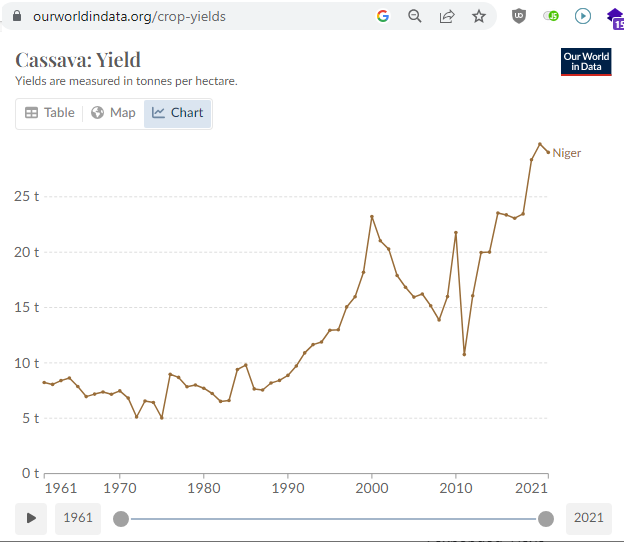
1/7. The only trace on that graph which does not show large improvement in cereal yield per hectare is the trace for Niger.
The graph ended with an anomalously bad crop year for cereals in Niger (2021). Fortunately, 2022 was much better; here's an article worldbank.org/en/news/press-…
2/7. By displaying high productivity countries like the USA along with Niger, you forced OurWorldInData to scale the graphs so that it's hard to see the trend in Niger.
But if you display Niger alone, as I've done here, you'll see that cereal yields declined there until about thirty years ago, but they've improved since then (except for 2021).
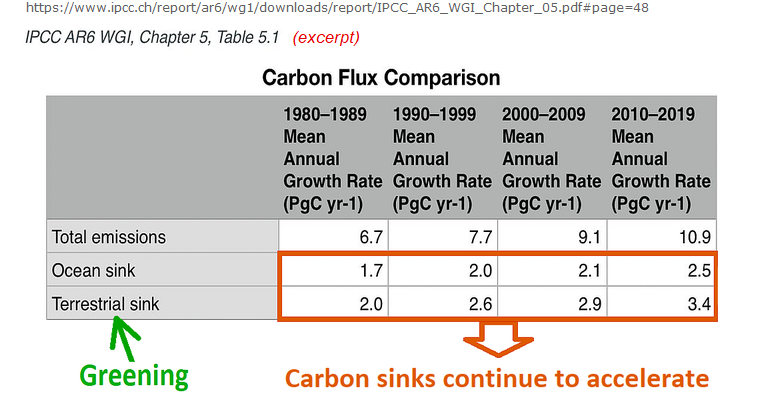
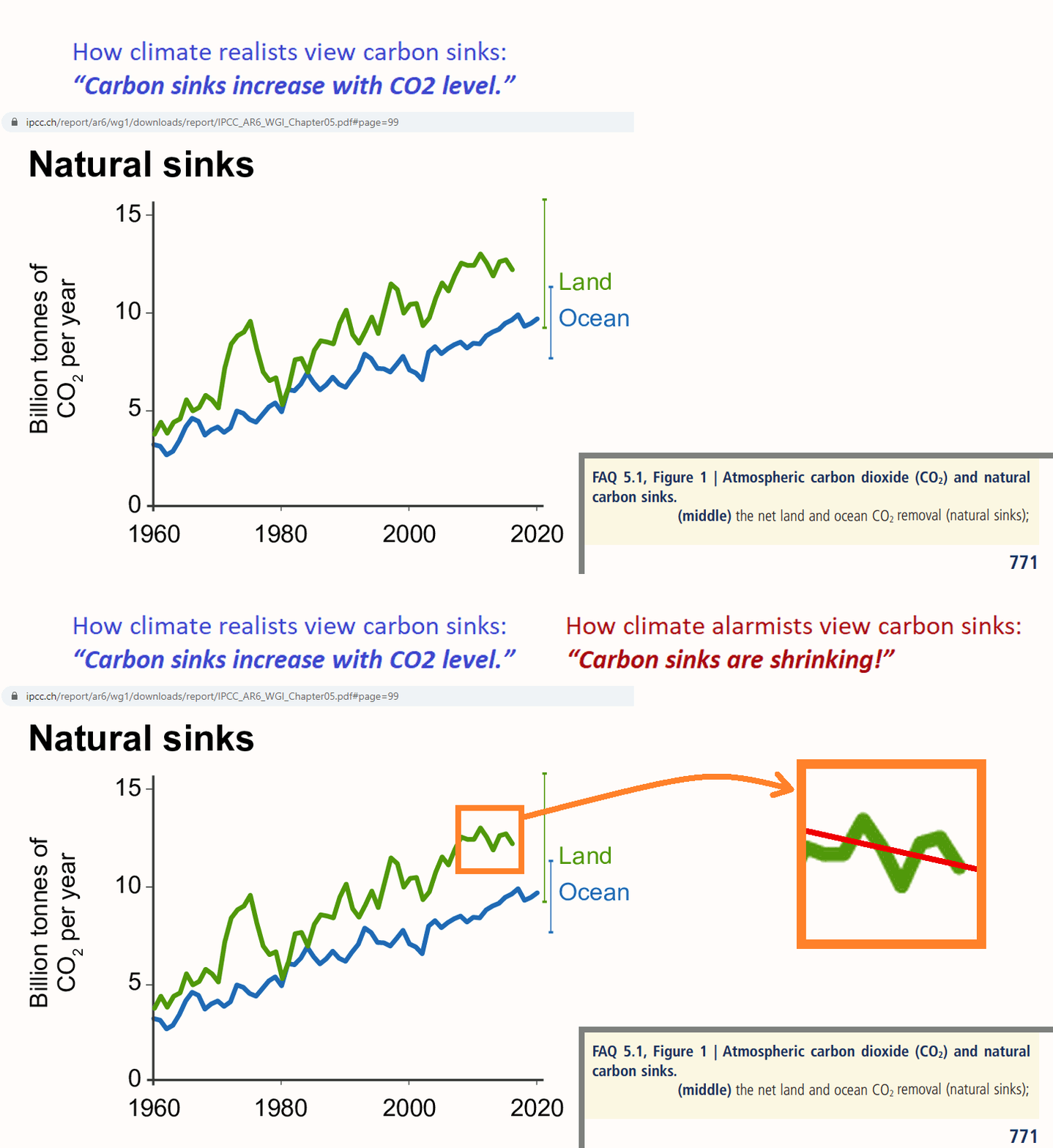
As you can see, as atmospheric CO2 levels have risen, the natural CO2 removal rate has sharply accelerated. (That's a strong negative/stabilizing climate feedback.) sealevel.info/AR6_WG1_Table_…
BBanana wrote, "Temperature increases have already reduced global yields of major crops."
That's false. It's long been known that warming generally improves agricultural productivity. Here's a CIA study which summarized the relation:
2/10. Fig.7 from that study shows the number of people who could be supported per hectare of arable land, vs. temperature. The 7 curves represent varying precipitation rates. In each case, higher temperatures allow the support of higher populations, due to better crop yields.
3/10. Also, elevated CO2 directly improves crop yields, and mitigates drought impacts. That's helping make famines rare for first time in history.
Those too young to grok how revolutionary that is should count themselves blessed! Famine used to be a scourge comparable to war & disease.
According to NOAA's AGGI chart, over the last 1/3 century CH4 has accounted for just 8.6% of the radiative forcing increase from anthropogenic GHGs. Not 18% or 25%.
That's about 1/10ᵗʰ of the contribution which we get from the ongoing rise in CO2. If that tiny contribution to modest and benign warming worries you, perhaps counseling would help.
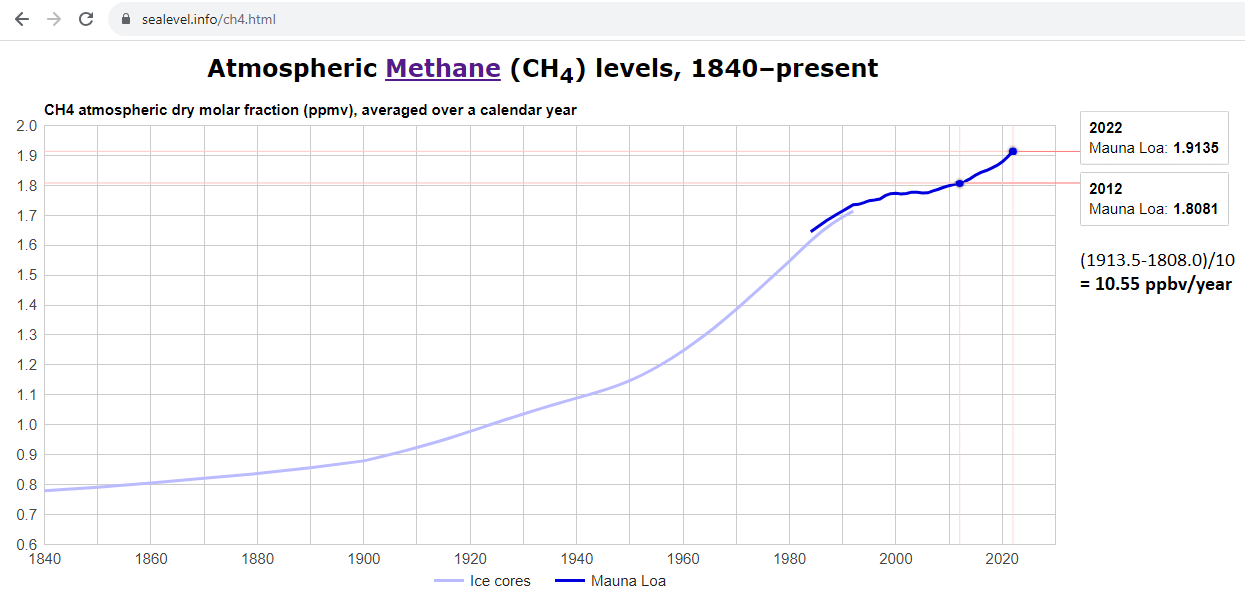
Despite the modest uptick in CH4 level over the last 15 years, the rate of rise in CH4's radiative forcing is still much slower than it was 50-60 years ago.
3/4. The relatively sharp rise in CH4 level in the 1960s & 1970s was insufficient to reverse the worrisome 1950s-70s cooling trend.
Here's a clip from CBS TV, in which Walter Cronkite, The Most Trusted Man in America™, reporting:
Hubert Lamb (source for that CBS story) was the founding director of the UEA Climate Research Unit.
Here's a 1974 CIA report, based on the best current science, about the worrisome cooling trend:
Here's an excerpt, from the Summary:
"The western world's leading climatologists have confirmed recent reports of a detrimental global climatic change… during 50 of the last 60 years the Earth has, on the average, enjoyed the best agricultural climate since the eleventh century… The world is returning to the type of climate which has existed over the last 400 years. That is, the abnormal climate of agricultural-optimum is being replaced by a normal climate of the neo-boreal era. The climate change began in 1960…"
The grim climate to which we were thought to be returning was the Little Ice Age. "Boreal" means cold:
boreal. adj. Relating to or characteristic of the climatic zone south of the Arctic, especially the cold temperate region dominated by taiga and forests of birch, poplar, and conifers…
The global cooling scare was one of the main reasons for the shiny new anti-air-pollution laws governing power plants, in the 1970s. The other main reason was "acid rain." (Note: Unlike "acidified" oceans, which are actually alkaline, acid rain really is acidic.)