
I built a spreadsheet to calculate the operating point of a combination of filters and fans in a #corsirosenthalbox. The Link is a few tweets down in the thread. It might have inappropriate extrapolations or other errors, but I hope it will help designers configure boxes. 1/🧵 
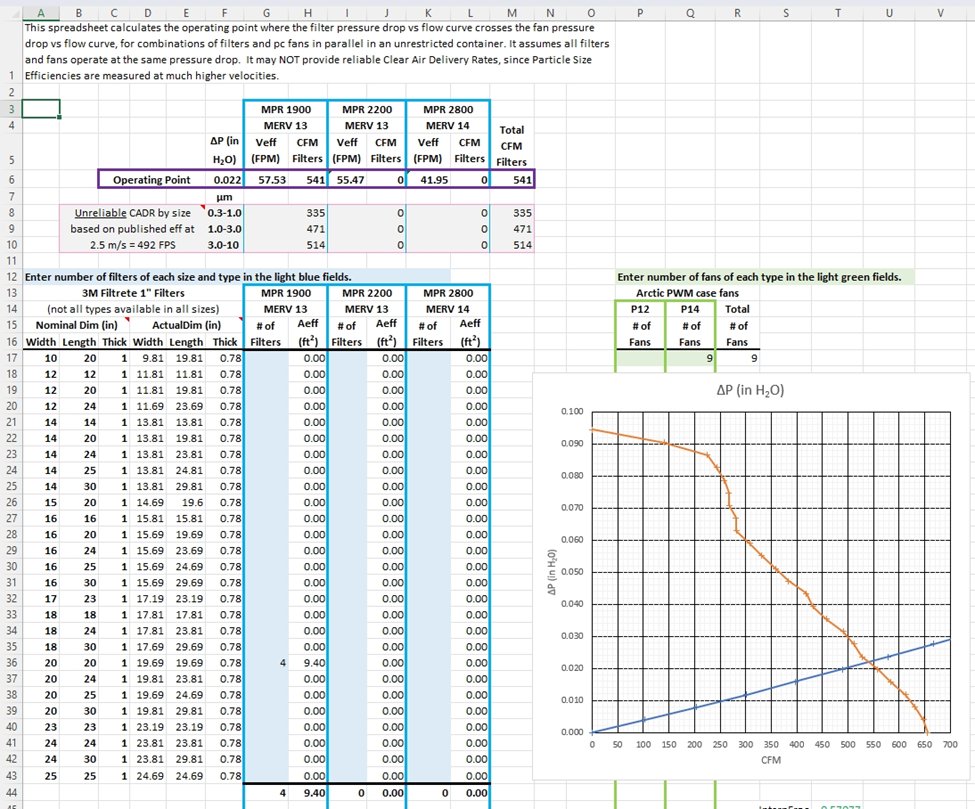
Tech types, please look at 2nd sheet (1900 Fltr Anlyss) to see what I did & what needs fixing. @CorsIAQ @JimRosenthal4 @robwiss @joeyfox85 @DavidElfstrom @cleanairkits @CRBoxKits @CleanAirStars @RFantinatto @open_erv @haussamen @sameo416 @syntagmatic @PlasticFull @leanhealth 2/

I'm really looking for comments and suggestions. If I made mistakes, I want to know about them. 3/
Here’s the link to the spreadsheet:
4/docs.google.com/spreadsheets/d…
4/docs.google.com/spreadsheets/d…
And here’s a link to the doc:
5/docs.google.com/document/d/121…
5/docs.google.com/document/d/121…
I’ve only included filters for which I have pressure vs. CFM data at several points. I fit that data in a physics-friendly way and interpolate to low pressures where DIY CR boxes live. I’d like to include more filters, so please send me data if you have it. 6/
For filters, I need actual dimensions, including margin sizes and number of pleats to calculate a Veff as explained on the 1900 Fltr Anlyss sheet. A picture would help.7/
Likewise, I’ve only included fans for which I have pressure vs CFM data. I’d like to include more fans, so please send me data if you have it. Even an image of a fan curve would help. 8/
The spreadsheet assumes the fans are well enough spaced that they don’t interact and the box has no restrictions in or out (grills), so the pressure drop across all the filters is the same and equal to the pressure drop across all the fans (but opposite sign, of course). 9/
I’ve included CADR calculations, but they’re iffy since, as @JimRosenthal4 explained here the data were prolly taken at 295 FPS, and may not apply at these slow velocities. 10/texairfilters.com/what-is-a-merv…
But even with caveats and restrictions, it does allow mixing of filter sizes and types, as well as fan types. It should even work for a dropped ceiling approach with multiple filters and fans on 2’x4’ tiles sharing a single plenum, as suggested here: . F/
https://x.com/JimRosenthal4/status/1720475070190039302
Fixed the link, I hope: Filters and Fans_12.xlsx
And fixed the link to the doc, I hope: Fans and Filters Spreadsheet Documentation_01.docx
@JimRosenthal4 Oops. That should read "taken at 495 FPS". I thought I fixed that typo. Thanks @DavidElfstrom.
@JimRosenthal4 Should read "taken at 495 FPS".
@CorsIAQ @JimRosenthal4 @robwiss @joeyfox85 @DavidElfstrom @cleanairkits @CRBoxKits @CleanAirStars @RFantinatto @open_erv @haussamen @sameo416 @syntagmatic @PlasticFull @leanhealth I posted links to the spreadsheet and documentation, but I didn't now how to use Google Drive. I hope these links will work now:
Filters and Fans_12.xlsx
Fans and Filters Spreadsheet Documentation_01.docx
Please let me know if it's fixed or not.
Filters and Fans_12.xlsx
Fans and Filters Spreadsheet Documentation_01.docx
Please let me know if it's fixed or not.
I dunno why, but when viewing the spreadsheet in Google Drive, the charts don't display fully. But when I download them, they look OK.
I hop I've fixed Google Drive now so the links work. I dunno why, but when viewing the spreadsheet in Google Drive, the charts don't display fully. But when I download them, they look OK.
@blouisBLT asked some useful questions about the way I calculated Aeff, which prompted me to autopsy a used @3M Filtrete 2800. Side margins blocks all the pleats they cover (give or take a pleat), as I conjectured. But end margins do shield about half what they cover. Click ALTs.
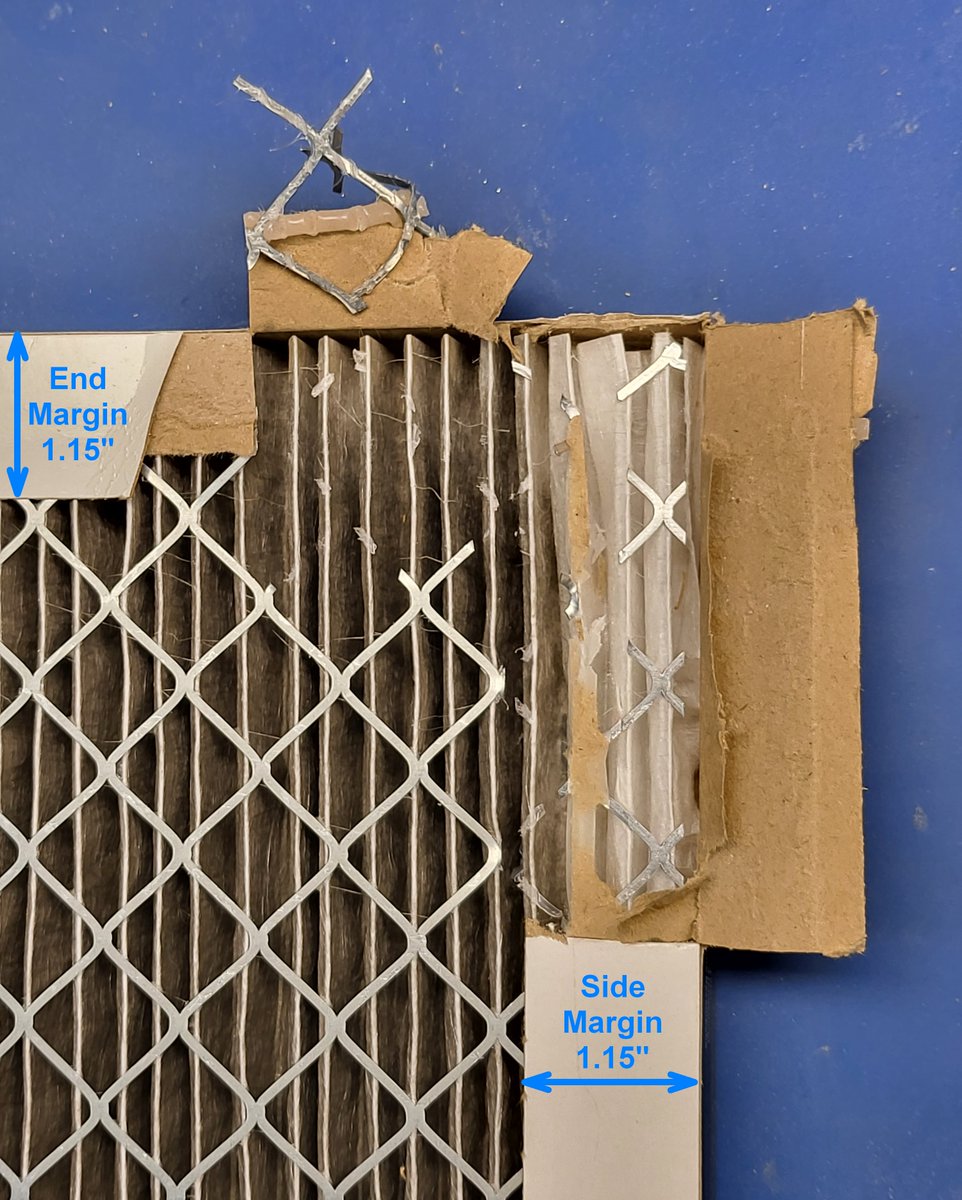
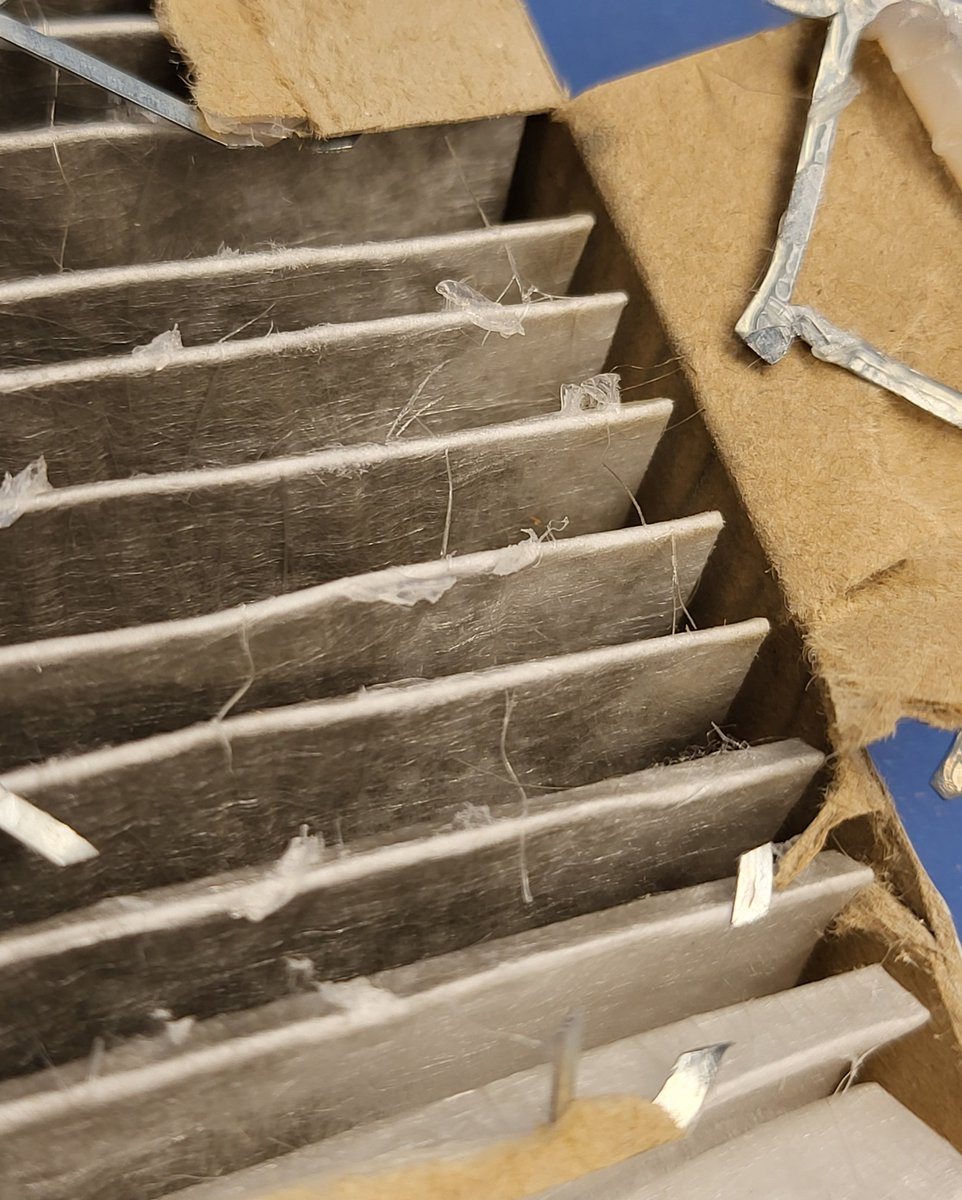
So I changed the algorithm for calculating Aeff. It only makes a tiny difference in the calculated operating point for the size filters I used as reference, but should make translating to other sizes a bit more accurate.
The old links to Google docs should still work,
spreadsheet:
docs.google.com/spreadsheets/d…
renamed Filters and Fans_13.xlsx
documentation:
docs.google.com/document/d/121…
renamed Fans and Filters Spreadsheet Documentation_13.docx
Just DL again.
spreadsheet:
docs.google.com/spreadsheets/d…
renamed Filters and Fans_13.xlsx
documentation:
docs.google.com/document/d/121…
renamed Fans and Filters Spreadsheet Documentation_13.docx
Just DL again.
#corsirosenthalbox @CorsIAQ @JimRosenthal4 @robwiss @joeyfox85 @DavidElfstrom @cleanairkits @CRBoxKits @CleanAirStars @RFantinatto @open_erv @haussamen @sameo416 @syntagmatic @PlasticFull @leanhealth
Criticism and suggestions are encouraged.
Criticism and suggestions are encouraged.
If anyone has data like this for the 2500 filters Costco is now selling, please post or DM me so I can include them. Click ALT.
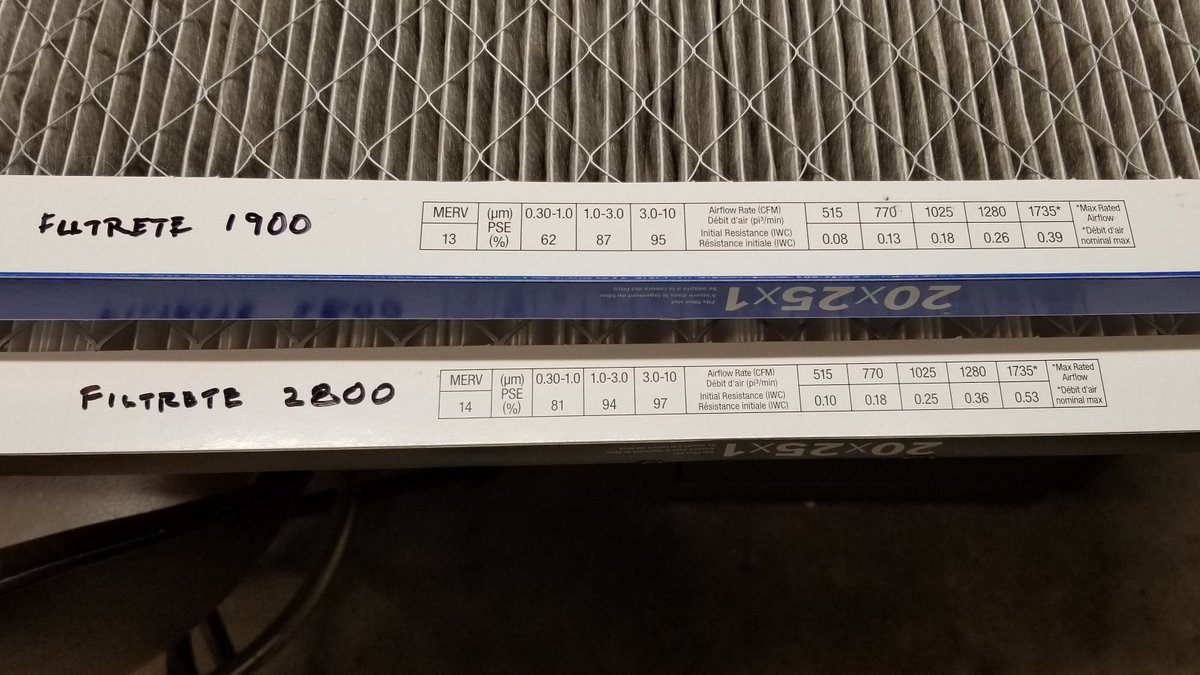
Spreadsheet update, now including 3M Filtrete MPR 1085 MERV 11 and MPR 1500 MERV 12. Thanks for the data @robwiss. #corsirosenthalbox
The same link
should work and result in the updated sheet
Fans and Filters_16.xlsx Call it F&F_16.
Just DL again.docs.google.com/spreadsheets/d…
should work and result in the updated sheet
Fans and Filters_16.xlsx Call it F&F_16.
Just DL again.docs.google.com/spreadsheets/d…
@robwiss posted measured CADR here:
showing that even MERV 11 and MERV 12 filters can give very good CADR at the low velocities of DIY PC-fan #CorsiRosenthalBox s.
showing that even MERV 11 and MERV 12 filters can give very good CADR at the low velocities of DIY PC-fan #CorsiRosenthalBox s.
https://x.com/robwiss/status/1729492897274241340
Rob measures CADR by how fast the box depletes a saltwater aerosol. His PMD331 measures at 0.3, 0.5, and 1.0 µm and he adds them to approximate the 0.3-1.0 µm E1 bin. (It’s really hard to measure velocities V and CFM for a box.)
3M reports efficiencies Eff for the E1 bin in a table printed on the filters. They use a duct where it’s easier to measure V (prolly 492 FPS for Eff) and compute CFM.
I used F&F_16 to estimate Rob’s operating points, incl pressure drop ΔP, Veff, and Tot CFM.
But Eff = CADR/CFM!
I used F&F_16 to estimate Rob’s operating points, incl pressure drop ΔP, Veff, and Tot CFM.
But Eff = CADR/CFM!
So, I used his CADR and the F&F_16 Tot CFM to get an implied ImpEff. As the table shows, ImpEff is higher than 3M got at 492 FPS, prolly because V is lower, and particles dawdle among those sticky fibers. Except the MPR2500 MERV14, where it’s a bit smaller. Click ALT for more.
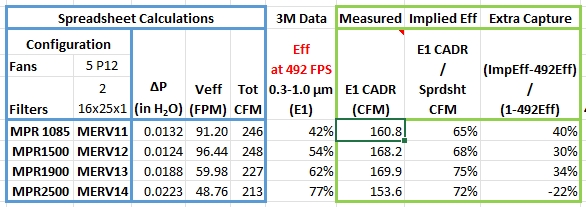
Calculating ImpEff this way is a stretch. For one thing, the F&F_16 Tot CFM is for the ideal case and doesn’t include other losses, such as fan-fan interactions and the finger guards on Rob’s boxes. If those losses were accounted for, the ImpEff would be even higher.
I dunno why the 2500 is different. The 2nd table in this figure is for slightly different size filters and more fan power. (Rob posted his data for this before the 4-filter runs.) The 2nd table is another look at 1900 and 2500. This time the 2500 did improve at low (62) FPM.
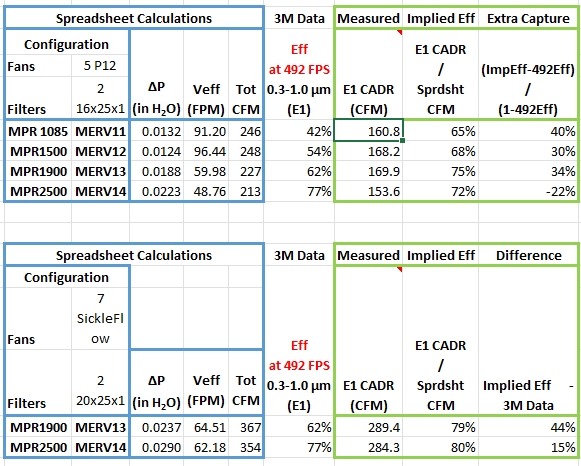
But comparing different sizes adds more uncertainty; the way F&F_16 accounts for dimensions isn’t perfect. And maybe the 2500 issue isn’t real and is due to errors in the spreadsheet or somebody’s data or typos. I make lots of those.
If I understood this better & had more data, I’d put ImpEffs in F&F_NN so people could forecast the advantage of MERV 11 and 12 filters. (I think these are electrostatic, but not all 11 & 12s are.) I’d love to see more CADR data with different configurations of 1085s and 1500s.
• • •
Missing some Tweet in this thread? You can try to
force a refresh






