Read on Twitter
1/18.
Zoya Teirstein @zteirstein, please stop spreading climate disinformation. Climate propaganda is killing people. Do you care?
There are NO "climate sensitive diseases." That's unscientific marketing FUD, from the parasitic climate industry.
Zoya Teirstein @zteirstein, please stop spreading climate disinformation. Climate propaganda is killing people. Do you care?
There are NO "climate sensitive diseases." That's unscientific marketing FUD, from the parasitic climate industry.
https://twitter.com/ncdave4life/status/1432810945017962505
2/18.
Lyme disease was first identified in chilly Lyme, CT. Rocky Mountain Spotted Fever was first found in frigid Idaho & Montana. Both spread SOUTH — obviously NOT due to global WARMING.
Like every other climate scare, this one is a lie.
There's no evidence at all that climate change is spreading ticks and the diseases they carry, or any other disease. One degree of warming is equivalent to just 50-70 miles latitude change — completely trivial compared to tick ranges.
Lyme disease was first identified in chilly Lyme, CT. Rocky Mountain Spotted Fever was first found in frigid Idaho & Montana. Both spread SOUTH — obviously NOT due to global WARMING.
Like every other climate scare, this one is a lie.
There's no evidence at all that climate change is spreading ticks and the diseases they carry, or any other disease. One degree of warming is equivalent to just 50-70 miles latitude change — completely trivial compared to tick ranges.
https://twitter.com/ncdave4life/status/1432810945017962505
@zteirstein 3/18.
Here's a tweetstorm where you can learn many things about CO2 and climate that Grist and the rest of the Climate Industry will never tell you.
Here's a tweetstorm where you can learn many things about CO2 and climate that Grist and the rest of the Climate Industry will never tell you.
https://twitter.com/ncdave4life/status/1718328892161740908
@zteirstein 4/18.
The climate scam needs to end. The renewable energy rollout is already killing many thousands of people through fuel poverty, and impoverishing millions more.
independent.co.uk/news/uk/home-n…
independent.co.uk/news/uk/home-n…
The climate scam needs to end. The renewable energy rollout is already killing many thousands of people through fuel poverty, and impoverishing millions more.
independent.co.uk/news/uk/home-n…
independent.co.uk/news/uk/home-n…
@zteirstein 5/18.
But that's just the tip of the iceberg. Where climate activists succeed in curtailing agriculture, to fight climate change, the human toll will be catastrophic — as it already has been in the Democratic Socialist Republic of Sri Lanka:
un.int/srilanka/news/…
But that's just the tip of the iceberg. Where climate activists succeed in curtailing agriculture, to fight climate change, the human toll will be catastrophic — as it already has been in the Democratic Socialist Republic of Sri Lanka:
un.int/srilanka/news/…
@zteirstein 6/18.
I've sadly concluded that most "climate journalists" don't really care what's true, nor who the climate industry's lies hurt. Do you?
If you're an exception, prove it by opening your mind, to learn about #ClimateChange from impartial scientists.
I've sadly concluded that most "climate journalists" don't really care what's true, nor who the climate industry's lies hurt. Do you?
If you're an exception, prove it by opening your mind, to learn about #ClimateChange from impartial scientists.
https://twitter.com/ncdave4life/status/1718330498345247067
@zteirstein 7/18.
The evidence is compelling that CO2 emissions are beneficial, not harmful. Here are some relevant scientific papers about it:
sealevel.info/negative_socia…
sealevel.info/negative_socia…
The evidence is compelling that CO2 emissions are beneficial, not harmful. Here are some relevant scientific papers about it:
sealevel.info/negative_socia…
sealevel.info/negative_socia…
@zteirstein 8/18.
The supposed major harms from CO2 emissions are all merely hypothetical, and mostly implausible. None of them are actually happening.
For instance, the coral of the Great Barrier Reef are doing fine:
archive.ph/IcRIY
archive.ph/IcRIY
The supposed major harms from CO2 emissions are all merely hypothetical, and mostly implausible. None of them are actually happening.
For instance, the coral of the Great Barrier Reef are doing fine:
archive.ph/IcRIY
archive.ph/IcRIY
@zteirstein 9/18.
"Extreme weather" is not getting worse. Hurricanes, tornadoes, nor'easters, and droughts are not worsening. In fact, tornadoes & droughts have become much less destructive.
Here're the facts on hurricanes, from an expert:
rogerpielkejr.substack.com/p/2023-update-…
"Extreme weather" is not getting worse. Hurricanes, tornadoes, nor'easters, and droughts are not worsening. In fact, tornadoes & droughts have become much less destructive.
Here're the facts on hurricanes, from an expert:
https://twitter.com/ncdave4life/status/1717639013295681723
rogerpielkejr.substack.com/p/2023-update-…
@zteirstein 10/18.
Droughts have showed only a slight decreasing trend, but they're MUCH less destructive now, because elevated CO2 levels make plants more water-efficient and drought-resilient.

Droughts have showed only a slight decreasing trend, but they're MUCH less destructive now, because elevated CO2 levels make plants more water-efficient and drought-resilient.
https://twitter.com/ncdave4life/status/1670086316988542976

@zteirstein 11/18.
Strong tornadoes have decreased markedly (though nobody is sure why).
sealevel.info/learnmore.html…
sealevel.info/learnmore.html…
Strong tornadoes have decreased markedly (though nobody is sure why).
sealevel.info/learnmore.html…
sealevel.info/learnmore.html…
@zteirstein 12/18.
The tide gauge at Harlingen has a continuous sea-level measurement record all the way back to 1865. Contrary to climate industry FUD, the sea-level trend has not been significantly affected by climate change.
sealevel.info/learnmore.html…
The tide gauge at Harlingen has a continuous sea-level measurement record all the way back to 1865. Contrary to climate industry FUD, the sea-level trend has not been significantly affected by climate change.
sealevel.info/learnmore.html…

@zteirstein 13/18.
All of the important effects of CO2 emissions and manmade climate change are positive!
Elevated CO2 (eCO2) is beneficial for almost all ecosystems. In fact, eCO2 even helps pine forests withstand bark beetles.
academic.oup.com/treephys/artic…
All of the important effects of CO2 emissions and manmade climate change are positive!
Elevated CO2 (eCO2) is beneficial for almost all ecosystems. In fact, eCO2 even helps pine forests withstand bark beetles.
academic.oup.com/treephys/artic…

@zteirstein 14/18.
Elevated CO2 helps warm the Earth, but there's no convincing evidence that's harmful. In fact, scientists call the warmest climate periods "climate optimums."
That's because, by all objective measures, warm is better than cold.
unherd.com/thepost/bjorn-…
Elevated CO2 helps warm the Earth, but there's no convincing evidence that's harmful. In fact, scientists call the warmest climate periods "climate optimums."
That's because, by all objective measures, warm is better than cold.
unherd.com/thepost/bjorn-…
@zteirstein 15/18.
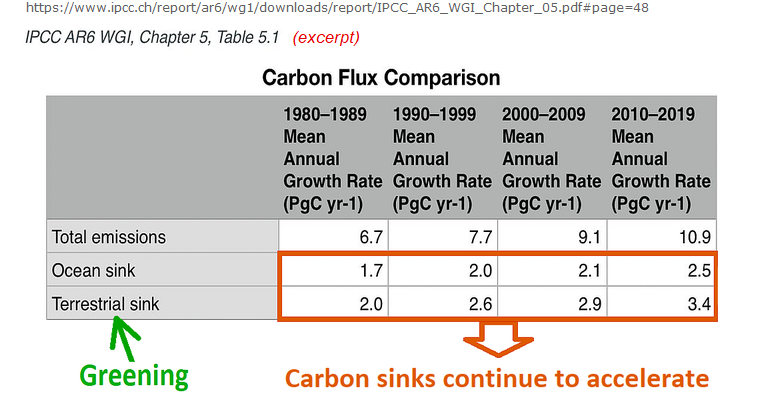
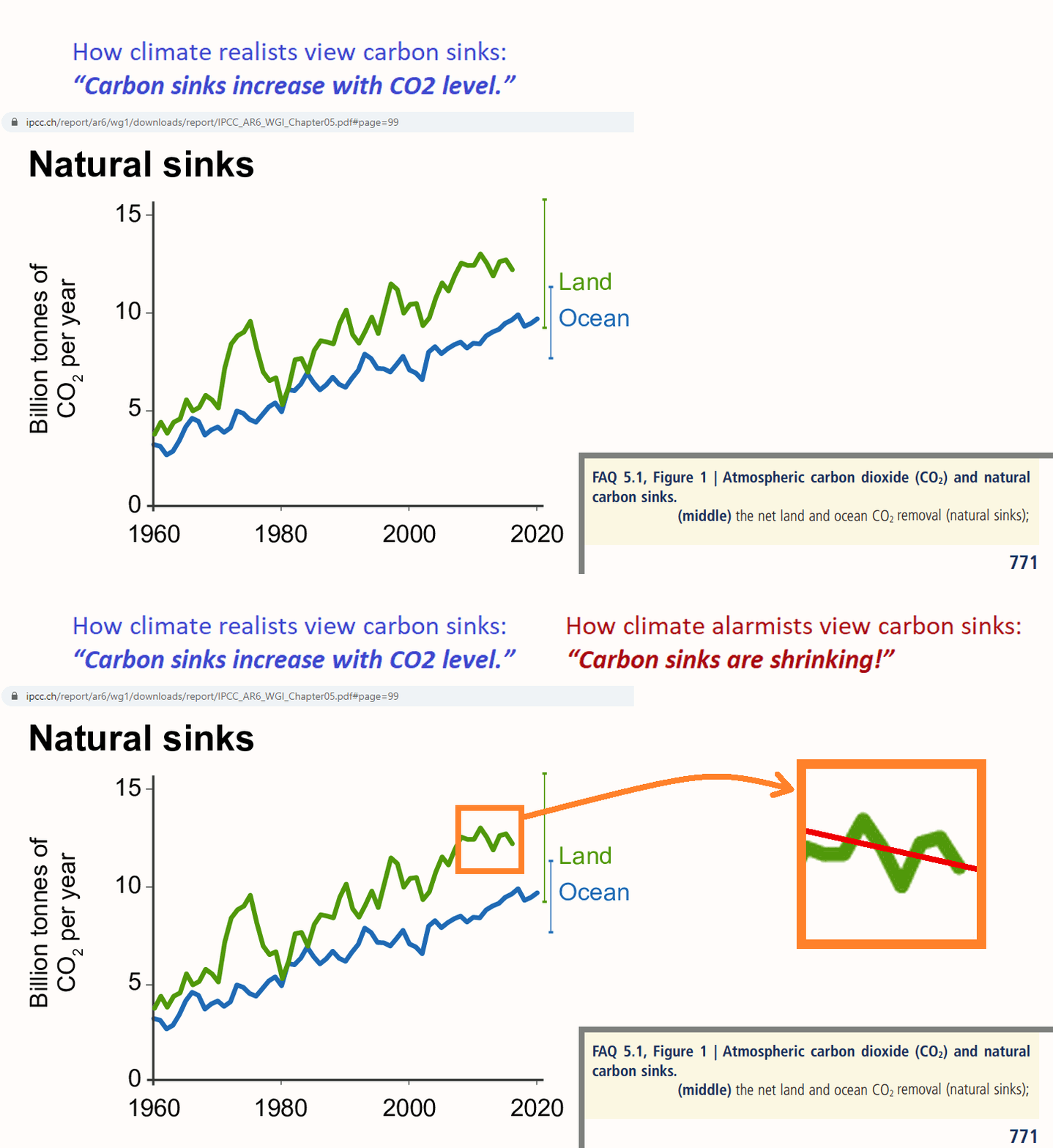
Natural ecosystems benefit from CO2 emissions, too. In fact, CO2 emissions are greening the Earth.
This is NASA's video about it:
nasa.gov/technology/car…
sealevel.info/greening_earth…
Natural ecosystems benefit from CO2 emissions, too. In fact, CO2 emissions are greening the Earth.
This is NASA's video about it:
nasa.gov/technology/car…
sealevel.info/greening_earth…
@zteirstein 16/18.
The fact that elevated CO2 is extremely beneficial for agriculture has been known to science for >100 years.
tinyurl.com/1920sciamCO2
The fact that elevated CO2 is extremely beneficial for agriculture has been known to science for >100 years.
tinyurl.com/1920sciamCO2
17/18.
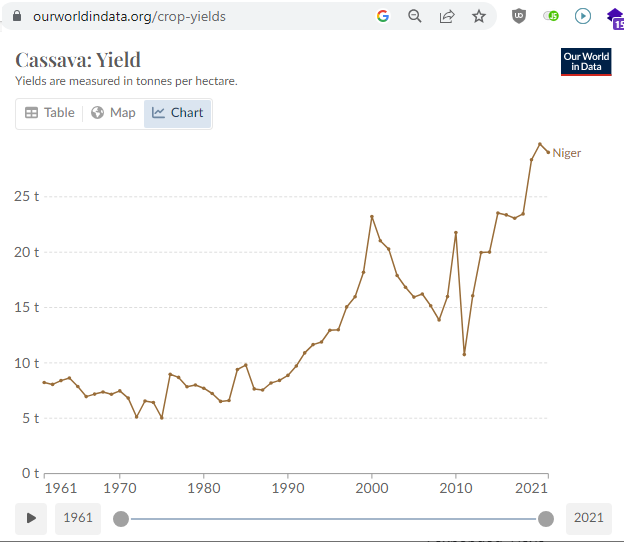
Rising CO2 levels improve crop yields in two major ways: through "CO2 fertilization," and by improving drought resilience and water use efficiency (WUE). That's long-settled science, among agronomists.
Most plants utilize C3 photosynthesis, and agronomy studies show that for C3 crops the CO2 fertilization benefit is highly linear as CO2 levels rise, until above about 1000 ppmv (which is far higher than we could ever hope to drive outdoor CO2 levels by burning fossil fuels). That linearity is obvious in the green (C3) trace, in this graph:
Here's a study about wheat (a C3 crop):
Fitzgerald GJ, et al. (2016) Elevated atmospheric [CO2] can dramatically increase wheat yields in semi-arid environments and buffer against heat waves. Glob Chang Biol. 22(6):2269-84. doi:10.1111/gcb.13263.
Plants (and animals) are carbon-based lifeforms. Plants get the carbon they need from CO2 in the air; CO2 is, literally, plant food. The higher the CO2 level, the less air plants must process through their stomata, and the less water they lose in the process (transpiration).
Elevated CO2 improves plants' WUE and drought resilience by improving CO2 stomatal conductance relative to transpiration. So eCO2 is especially beneficial in arid regions, and especially beneficial for crops which are under drought stress.
Corn (maize) has been very heavily studied. Even though it is a C4 grass (and C4 plants are better at enduring low CO2 levels), corn benefits greatly from elevated CO2, especially under drought stress. Here's a paper:
Chun et al. (2011). Effect of elevated carbon dioxide and water stress on gas exchange and water use efficiency in corn. Agric For Meteorol 151(3), pp 378-384, ISSN 0168-1923. doi:10.1016/j.agrformet.2010.11.015.
EXCERPT: "There have been many studies on the interaction of CO2 and water on plant growth. Under elevated CO2, less water is used to produce each unit of dry matter by reducing stomatal conductance."
That improvement is one of several major reasons that catastrophic drought-triggered famines are fading from living memory, for the first time in history.
If you're too young to remember huge, devastating, drought-triggered famines, count yourself blessed. Through all of human history, until very recently, famine was one of the great scourges of mankind, the Third Horseman of the Apocalypse. But no more. That is a miracle!
Here's the data:
Ending famine is a VERY Big Deal, comparable to ending war and disease. Compare:
● Covid-19 killed 0.1% of world population.
● 1918 flu pandemic killed about 2%.
● WWII killed 2.7%.
● The near-global drought and famine of 1876-78 killed about 3.7% of the world population.
Rising CO2 levels improve crop yields in two major ways: through "CO2 fertilization," and by improving drought resilience and water use efficiency (WUE). That's long-settled science, among agronomists.
Most plants utilize C3 photosynthesis, and agronomy studies show that for C3 crops the CO2 fertilization benefit is highly linear as CO2 levels rise, until above about 1000 ppmv (which is far higher than we could ever hope to drive outdoor CO2 levels by burning fossil fuels). That linearity is obvious in the green (C3) trace, in this graph:
Here's a study about wheat (a C3 crop):
Fitzgerald GJ, et al. (2016) Elevated atmospheric [CO2] can dramatically increase wheat yields in semi-arid environments and buffer against heat waves. Glob Chang Biol. 22(6):2269-84. doi:10.1111/gcb.13263.
Plants (and animals) are carbon-based lifeforms. Plants get the carbon they need from CO2 in the air; CO2 is, literally, plant food. The higher the CO2 level, the less air plants must process through their stomata, and the less water they lose in the process (transpiration).
Elevated CO2 improves plants' WUE and drought resilience by improving CO2 stomatal conductance relative to transpiration. So eCO2 is especially beneficial in arid regions, and especially beneficial for crops which are under drought stress.
Corn (maize) has been very heavily studied. Even though it is a C4 grass (and C4 plants are better at enduring low CO2 levels), corn benefits greatly from elevated CO2, especially under drought stress. Here's a paper:
Chun et al. (2011). Effect of elevated carbon dioxide and water stress on gas exchange and water use efficiency in corn. Agric For Meteorol 151(3), pp 378-384, ISSN 0168-1923. doi:10.1016/j.agrformet.2010.11.015.
EXCERPT: "There have been many studies on the interaction of CO2 and water on plant growth. Under elevated CO2, less water is used to produce each unit of dry matter by reducing stomatal conductance."
That improvement is one of several major reasons that catastrophic drought-triggered famines are fading from living memory, for the first time in history.
If you're too young to remember huge, devastating, drought-triggered famines, count yourself blessed. Through all of human history, until very recently, famine was one of the great scourges of mankind, the Third Horseman of the Apocalypse. But no more. That is a miracle!
Here's the data:
Ending famine is a VERY Big Deal, comparable to ending war and disease. Compare:
● Covid-19 killed 0.1% of world population.
● 1918 flu pandemic killed about 2%.
● WWII killed 2.7%.
● The near-global drought and famine of 1876-78 killed about 3.7% of the world population.

18/18.
If you want to understand a commercialized and politicized topic like #ClimateChange, you need balanced, accurate information. I'm here to help:
This resource list has:
● accurate intro climatology info
● in-depth science from BOTH skeptics & alarmists
● links to balanced debates between experts on BOTH sides
● info about climate impacts
● links to the best blogs on BOTH sidessealevel.info/learnmore.html
If you want to understand a commercialized and politicized topic like #ClimateChange, you need balanced, accurate information. I'm here to help:
This resource list has:
● accurate intro climatology info
● in-depth science from BOTH skeptics & alarmists
● links to balanced debates between experts on BOTH sides
● info about climate impacts
● links to the best blogs on BOTH sidessealevel.info/learnmore.html
@zteirstein 19/18.
Compilation:
@ThreadReaderApp @Rattibha @threaddotblue unroll
@reSeeIt save conversationtwitter-thread.com/t/172563498813…
Compilation:
@ThreadReaderApp @Rattibha @threaddotblue unroll
@reSeeIt save conversationtwitter-thread.com/t/172563498813…
• • •
Missing some Tweet in this thread? You can try to
force a refresh