Jonathan Gorard Profile picture
Nov 17 20 tweets 4 min read Twitter logo Read on Twitter
Shock waves, solitons and spacetime singularities: what do sonic booms and water ripples have to do with cosmic censorship and the determinism (or otherwise) of general relativity?
Brace for a brief adventure in hyperbolic partial differential equations (PDEs). (1/20)
Image
Image
PDEs may be broadly classified into three types: elliptic, which are time-independent and where information propagation is instantaneous; parabolic, which are time-dependent and diffusive; and hyperbolic, which are time-dependent and non-diffusive (i.e. wavelike). (2/20)
Hyperbolic PDEs are quite special, and can be analyzed using the method of “characteristics”, in which the PDE is reduced to a family of ordinary differential equations (ODEs), each of which is associated to a path through spacetime called a "characteristic line/curve". (3/20)
These characteristic curves determine the flow of information through the domain of the PDE - when they get closer together, this indicates a compression wave; when they spread out, this indicates a rarefaction wave. But when they *intersect*, that's where the fun starts. (4/20)
When two characteristic curves intersect, the solution becomes multi-valued at that point. The PDE no longer tells us uniquely how to evolve the solution from that point onwards, so we say that it has become "ill-posed" (i.e. it is no longer deterministic/well-posed). (5/20)
In some cases (e.g. for waves in granular materials), this non-determinism/multi-valuedness is tolerable. But in others (e.g. in electromagnetism, or inviscid fluid mechanics), it's not. But here there's an old trick: just integrate the PDE over a finite spacetime volume. (6/20)
This gives rise to the "weak" or "integral" form of the PDE, and the behaviour of the PDE at ill-posed points can be described in terms of solutions to this form (so-called "weak" or "nonlinear" solutions). Weak/nonlinear solutions form a superset of standard solutions. (7/20)
These weak solutions typically take the form of distributions, like delta functions: objects which are not themselves classical functions (hence not solutions to the original PDE), but which can be integrated to yield functions (hence solutions to the weak/integral form). (8/20)
In inviscid fluid mechanics, nonlinear solutions tend to be shock waves - discontinuous pressure waves propagating faster than the local speed of sound. For other PDE systems, like in electromagnetism, they may form solitons - stable, self-sustaining wave packets. (9/20)
In general, whether a nonlinear solution becomes a shock wave or a soliton depends upon whether dispersive or dissipative effects dominate, and hence whether the PDE acts more like the inviscid Burgers' equation (shocks) or the Korteweg-de Vries equation (solitons). (10/20)
What does any of this have to do with black holes? The Einstein field equations are a mixed hyperbolic-elliptic system, but using the so-called ADM formalism we can split these 10 mixed equations into 6 hyperbolic "evolution" equations and 4 elliptic "gauge" equations. (11/20)
In so doing, we "foliate" our spacetime into a time-ordered sequence of spacelike hypersurfaces (Cauchy surfaces). The characteristic curves of the hyperbolic evolution equations are then just the normal (perpendicular) curves to these hypersurfaces. (12/20)
Under gravitational collapse, these characteristics get closer together. If the collapse is strong enough, they intersect (as do the corresponding hypersurfaces), and so the evolution equations become ill-posed, and our spacetime ceases to be "globally hyperbolic". (13/20)
Physically, this corresponds to the formation of a singularity - the relativistic analogue of a shock wave or soliton. In fact, we can say that many black hole metrics (such as Schwarzschild for a static black hole or Kerr for a spinning one) are "gravitational solitons". (14/20)
Formally, this means that they can be generated by the Belinski-Zakharov (inverse) transform. Informally, it means that they are self-sustaining objects of "pure gravity" (i.e. they are vacuum solutions, sustained solely by their own gravitational field). (15/20)
Incidentally, this explains why such black hole metrics are, paradoxically, vacuum solutions: a Schwarzschild black hole has "mass", yet its Ricci tensor (and hence its energy-momentum) is zero everywhere, except at the r=0 singularity, where it is undefined. (16/20)
But now we see that this is because it's acting just like a distribution or delta function: it may be undefined at r=0 and zero everywhere else, but it can still be integrated over a spacetime volume to yield a finite result (e.g. the ADM or Bondi mass of the black hole). (17/20)
The question of whether the Einstein field equations remain well-posed (and hence deterministic) for "physically reasonable" initial conditions remains open: that's the Strong Cosmic Censorship conjecture. Yes, we know that singularities are a robust prediction of GR... (18/20)
...as per the Penrose-Hawking singularity theorems, yet, for as long as they remain "cloaked" behind event horizons, they can't affect the hyperbolicity/well-posedness of the external spacetime: that hope of "cloaking" is the Weak Cosmic Censorship conjecture. (19/20)
Yet these lofty questions about the formation of black holes and the determinism of GR are ultimately grounded in exactly the same mathematics that governs the formation of shock waves around fighter jets, or the formation of ripples around canal boats. (20/20)

• • •

Missing some Tweet in this thread? You can try to force a refresh

 

Keep Current with Jonathan Gorard

Jonathan Gorard Profile picture

Stay in touch and get notified when new unrolls are available from this author!

Read all threads

This Thread may be Removed Anytime!

PDF

Twitter may remove this content at anytime! Save it as PDF for later use!

Try unrolling a thread yourself!

how to unroll video
  1. Follow @ThreadReaderApp to mention us!

  2. From a Twitter thread mention us with a keyword "unroll"
@threadreaderapp unroll

Practice here first or read more on our help page!

More from @getjonwithit

Nov 18
Here's a quick story about comonads, and how they can be used to unify various concepts in functional programming, category theory, rewriting systems and multicomputation. It starts with a practical problem: how to implement better compositional rewriting in Mathematica. (1/11) Image
First, a brief recap of some basic functional programming/category theory. A “functor” is just a Map in Mathematica: it allows one to apply a function to every element of a data structure (e.g. a list), whilst still preserving the "shape" of that data structure. (2/11) Image
[The name “functor” here refers to the fact that, if we consider each data structure to be a category, then a Map that doesn't change the "shape" of a structure consequently represents a homomorphism between the respective categories, and hence a functor.] (3/11) Image
Read 11 tweets
Nov 16
[This is part 2 of my series on tensor calculus, differential geometry, etc.]
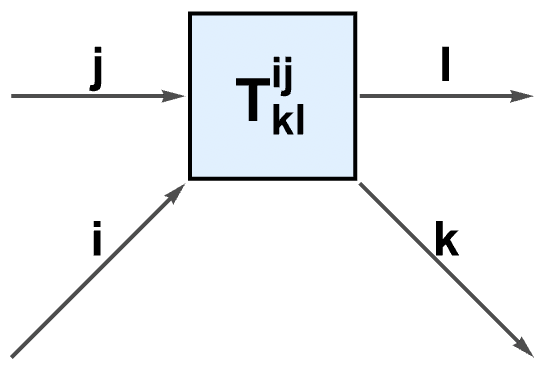
These blobs are called "tensors", and the "rank" of a tensor represents how many legs it has. Here's a rank-4 tensor with two contravariant indices (inputs) and two covariant indices (outputs). (1/11)
Image
We can build higher-rank tensors out of lower-rank ones by stacking the blobs on top of each other; for instance, here we have assembled a rank-4 tensor out of two rank-2 tensors. As an equation: "M_{j}^{i} N_{l}^{k} = T_{j l}^{i k}". This is called a "tensor product". (2/11) Image
We can also turn higher-rank tensors into lower-rank ones by connecting wires; for instance, here we have turned a rank-4 tensor into a rank-2 tensor by plugging an output into an input. As an equation: “T_{k i}^{i j} = M_{k}^{j}”. This is called “index contraction”. (3/11) Image
Read 11 tweets
Nov 15
Lots of pop-sci talks about general relativity and quantum mechanics being “incompatible”, but what does that really mean? And how do quantum field theory, curved spacetime and (effective) quantum gravity fit into that picture? It's a surprisingly interesting story... (1/17)
Image
Image
One of the most important features of quantum mechanics is that it is *linear*: when we add two solutions to the Schrödinger equation together, the result is always another solution to the Schrödinger equation. Physically, this corresponds to the superposition principle. (2/17)
Namely, the linearity of the Schrödinger equation follows from the fact that, if a system can be in one of two possible states, then it can also be in a "superposition" (i.e. a complex linear combination) of those two states - in stark contrast to classical mechanics. (3/17)
Read 17 tweets
Nov 14
[This thread is hopefully(!) the first in a series on tensor calculus, differential geometry and the foundations of general relativity...]
This is a blob. This blob has no inputs and no outputs, so we shall refer to it as a "scalar", and we denote it by an "S". (1/10) Image
This is a one-legged blob. This blob has one input (denoted "i") and no outputs, so we shall refer to it as a "vector", and we denote it by "V^i" with a superscript. The superscripted (input) index "i" is referred to as a "contravariant" index. (2/10) Image
This is another one-legged blob. This blob has one output (also denoted "i") and no inputs, so we shall refer to it as a "covector" (or a "one-form"), and we denote it by "V_i" with a subscript. The subscripted (output) index "i" is referred to as a "covariant" index". (3/10) Image
Read 10 tweets
Nov 5
What actually *is* curvature? It's a surprisingly hard question, and one which wasn't satisfactorily answered until the early 20th century, thanks to the work of Tullio Levi-Civita, Gregorio Ricci-Curbastro and other (largely Italian) differential geometers. (1/9) Image
The (deep) answer?
Curvature is a measure of how much a space fails to be parameterized by a single coordinate system.
The room you're in right now is not (appreciably) curved, meaning that you can describe every point within it uniquely with a set of (x, y, z) coordinates. (2/9)
But what about the surface of a sphere (like the Earth(ish))? We all know that you can describe every point on the surface of the Earth with latitude-longitude coordinates, so surely it can't be curved either?
Well, it (sort of) wouldn't be, were it not for the North Pole… (3/9)
Read 9 tweets
Nov 4
The Rabin-Scott theorem is one of the (philosophically) deepest mathematical results I know. When properly understood, I claim that it can't help but alter your view of reality in a fairly foundational way. Yet its typical textbook presentation obscures much of this depth. (1/8) Image
Suppose you have a non-deterministic computer (formally, a non-deterministic finite automaton) which can perform a whole tree of possible actions from a given input state, and I have a deterministic one, which can only follow a single path. Clearly yours is better, right? (2/8)
Well, no. The Rabin-Scott theorem says that I can still simulate yours by defining each state of my computation to be a *collection* of possible states of yours. So the state space of my computation is simply the power set (i.e. the set of possible subsets) of yours. (3/8)
Read 8 tweets

Did Thread Reader help you today?

Support us! We are indie developers!


This site is made by just two indie developers on a laptop doing marketing, support and development! Read more about the story.

Become a Premium Member ($3/month or $30/year) and get exclusive features!

Become Premium

Don't want to be a Premium member but still want to support us?

Make a small donation by buying us coffee ($5) or help with server cost ($10)

Donate via Paypal

Or Donate anonymously using crypto!

Ethereum

0xfe58350B80634f60Fa6Dc149a72b4DFbc17D341E copy

Bitcoin

3ATGMxNzCUFzxpMCHL5sWSt4DVtS8UqXpi copy

Thank you for your support!

Follow Us on Twitter!

:(