Read on Twitter
The Copenhagen interpretation of quantum physics is one of the most influential and controversial views on the nature of reality. In this thread, I will explain what it is, how it developed, and why it matters.
A thread ✍️

A thread ✍️
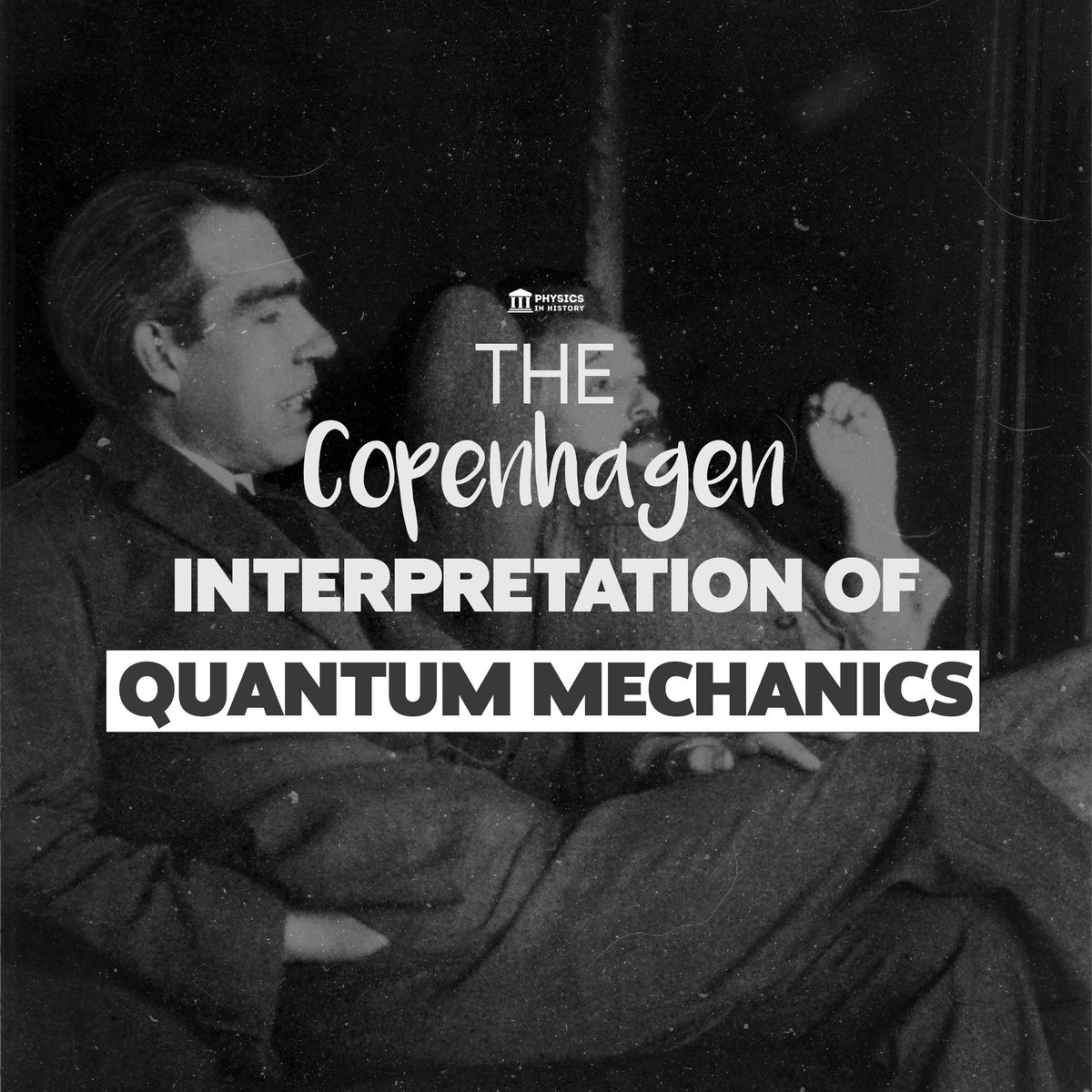
The Copenhagen interpretation was born out of the work of a group of physicists led by Niels Bohr, who founded the Institute for Theoretical Physics in Copenhagen, Denmark, in 1920.
📷Niels Bohr Archive
📷Niels Bohr Archive

Bohr and his colleagues, such as Werner Heisenberg, Max Born, and Wolfgang Pauli, were among the pioneers of quantum mechanics, the theory that describes the behavior of atoms and subatomic particles.

Quantum mechanics revealed that the physical world is not as deterministic and predictable as classical physics had assumed. Instead, it showed that there is an inherent uncertainty and randomness in the outcomes of quantum experiments..

... and that the properties of quantum objects, such as their position and momentum, are not well-defined until they are measured.
The Copenhagen interpretation tried to make sense of these strange phenomena by proposing some key ideas, such as:
The Copenhagen interpretation tried to make sense of these strange phenomena by proposing some key ideas, such as:
The wavefunction:
This is a mathematical function that describes the state of a quantum system, such as an electron or a photon. The wavefunction contains all the possible information about the system, but it does not tell us what we will actually observe when we measure it.
This is a mathematical function that describes the state of a quantum system, such as an electron or a photon. The wavefunction contains all the possible information about the system, but it does not tell us what we will actually observe when we measure it.

The Born rule: This is a rule that tells us how to calculate the probability of observing a certain outcome when we measure a quantum system. For example, if we measure the position of an electron, the Born rule tells us how likely it is to find it in a certain region of space.
The rule is based on the square of the wavefunction, which is why quantum mechanics is sometimes called wave mechanics.
The uncertainty principle: This is a principle that states that there are certain pairs of properties of quantum systems, such as position and momentum, or energy and time, that cannot be measured simultaneously with arbitrary precision.
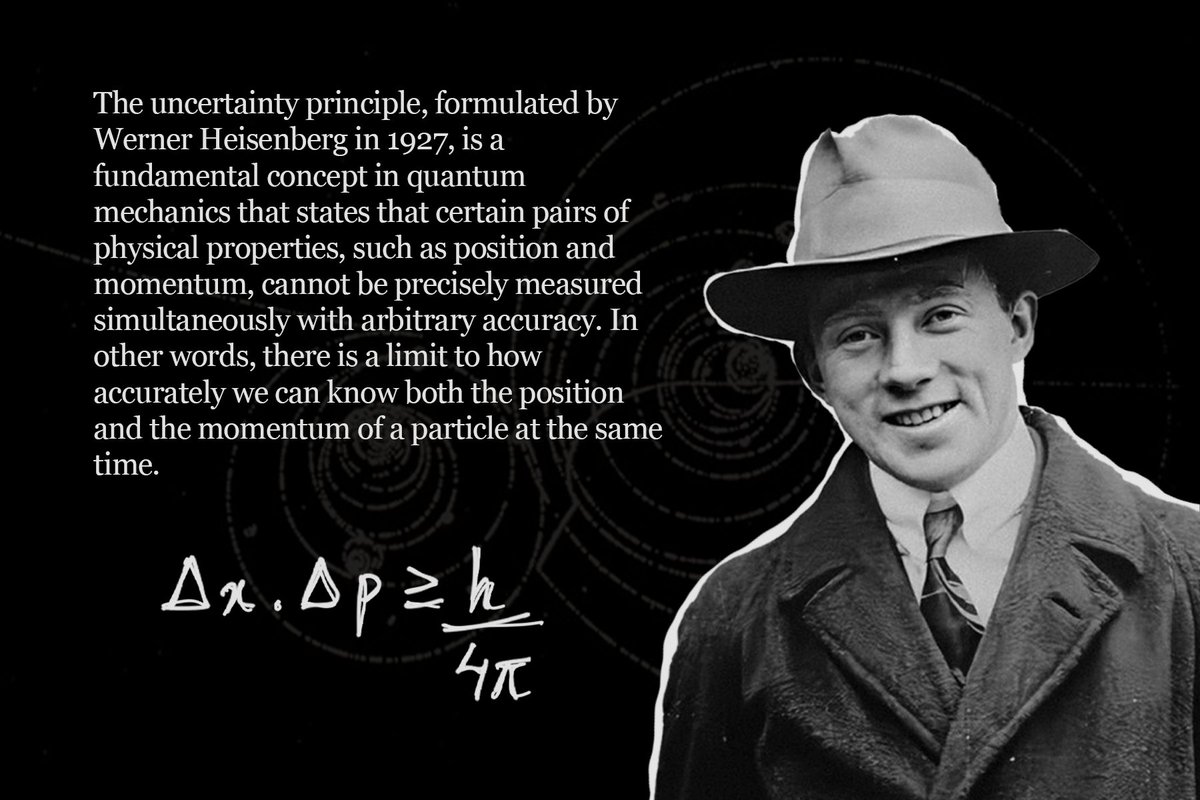
The more we know about one property, the less we know about the other. This is not due to any limitations of our measuring devices, but to the intrinsic nature of quantum reality.
The principle of complementarity:
This is a principle that states that quantum systems have certain aspects that are complementary, meaning that they cannot be observed or described at the same time.
This is a principle that states that quantum systems have certain aspects that are complementary, meaning that they cannot be observed or described at the same time.
For example, an electron can behave either like a particle or like a wave, depending on how we measure it. But it is not both a particle and a wave at the same time. It implies that there is no single, complete, or objective description of quantum reality.
But only different perspectives that are valid in different contexts.
The collapse of the wavefunction:
This is a process that occurs when we measure a quantum system, and the wavefunction changes from a superposition of many possible states to a single definite state.
This is a process that occurs when we measure a quantum system, and the wavefunction changes from a superposition of many possible states to a single definite state.
For example, before we measure the position of an electron, the wavefunction describes it as being in many places at once. But when we measure it, the wavefunction collapses to one specific location.
The collapse of the wavefunction is irreversible and random, and it is the source of the indeterminacy and unpredictability of quantum phenomena.
The Copenhagen interpretation is not a single, coherent, or definitive theory, but rather a collection of views and attitudes that emerged from the discussions and debates of the early quantum physicists.
It is often criticized for being vague, incomplete, or unsatisfactory, and for leaving many questions unanswered, such as:
What is the nature and role of the observer or the measurement in quantum mechanics? Is the observer part of the quantum system or outside of it?
What is the nature and role of the observer or the measurement in quantum mechanics? Is the observer part of the quantum system or outside of it?
Does the observer have any influence on the outcome of the measurement? Does the observer need to be conscious or intelligent?
What is the meaning and reality of the wavefunction? Is the wavefunction a physical entity or a mathematical tool?
What is the meaning and reality of the wavefunction? Is the wavefunction a physical entity or a mathematical tool?
Does the wavefunction represent the actual state of the quantum system or our knowledge of it? Does the wavefunction exist before or after the measurement? What is the mechanism and cause of the collapse of the wavefunction?
When and how does the collapse occur? Is the collapse a physical process or a subjective phenomenon? Is the collapse instantaneous or gradual? Is the collapse deterministic or probabilistic?
What is the status and scope of quantum mechanics? Is quantum mechanics a complete and final theory of nature, or does it need to be modified or supplemented by other theories?
Does quantum mechanics apply to all physical systems, or only to microscopic ones? Can quantum mechanics be reconciled with classical physics, relativity, or gravity?
The Copenhagen interpretation is not the only way to interpret quantum mechanics. There are many other interpretations that have been proposed over the years, such as the many-worlds interpretation, the de Broglie-Bohm interpretation, the consistent histories interpretation,..
.. the objective collapse interpretation, and the quantum logic interpretation, to name a few. Each interpretation has its own advantages and disadvantages, and none of them has been universally accepted or rejected by the scientific community.
Thank you very much for reading this thread, if you liked it you can check out our other threads on physics and mathematics:
https://x.com/physinhistory/status/1677896640307273728?s=46&t=vMsjMEZP_cYdwWGGJlOKyw
A thread on the greatest unsolved problems in Modern physics 👇
https://x.com/physinhistory/status/1671550243882582022?s=46&t=vMsjMEZP_cYdwWGGJlOKyw
You can check out out physics and mathematics printable wall posters here 👇
physicshistory.gumroad.com/l/forces
physicshistory.gumroad.com/l/forces
• • •
Missing some Tweet in this thread? You can try to
force a refresh