Read on Twitter
Really nice article of @MichaelGiberso3 and @DC_Hartman titled "
https://twitter.com/DC_Hartman/status/1702306269934018631
Three key paradigms shape how states regulate wholesale and retail electric power. 

1/Traditional Paradigm: Monopoly at both wholesale and retail levels.State-regulated utilities handle all generation, transmission, and retail services. FERC oversees wholesale power sales and transmission rates.
2/ Hybrid Paradigm: Monopoly for retail customers, but markets introduced at the wholesale level. RTOs play a crucial role in coordinating transmission planning and operations. State-regulated utilities participate in RTOs, maintaining a blend of regulation and market dynamics.
3/ Restructured Paradigm: Competitive generation and retail services with RTO involvement. Independent power producers and retail energy providers compete in the market.
Electric power restructuring aimed to bring down high rates, promote efficiency, and provide consumer options. A shift from traditional regulation was expected to encourage more efficient investment decisions and operations in the generation sector.
Evidence shows wholesale power market competition has improved efficiency in generator operations, investment decisions, and has shifted risk from ratepayers to investors.


Restructuring also boosted demand-side engagement. Economic demand response, vital for system reliability, flourishes where competition thrives. Communication tech facilitates customer participation, reducing reliance on utility-directed outages.

Retail competition's value isn't solely about rates. Consumers gain from diverse product offerings, like renewable power, flexible pricing structures, and payment options. Non-price benefits, though challenging to quantify, showcase the value these options offer.

The following point reminded me the situation in France : "an academic study of restructuring in Connecticut found its
market dominated by the default service offering instead of by competition among retail suppliers." I looked at this study sciencedirect.com/science/articl…
market dominated by the default service offering instead of by competition among retail suppliers." I looked at this study sciencedirect.com/science/articl…
The standard services described in introduction of this article cited by @MichaelGiberso3 and @DC_Hartman look similar to the French regulated fares.
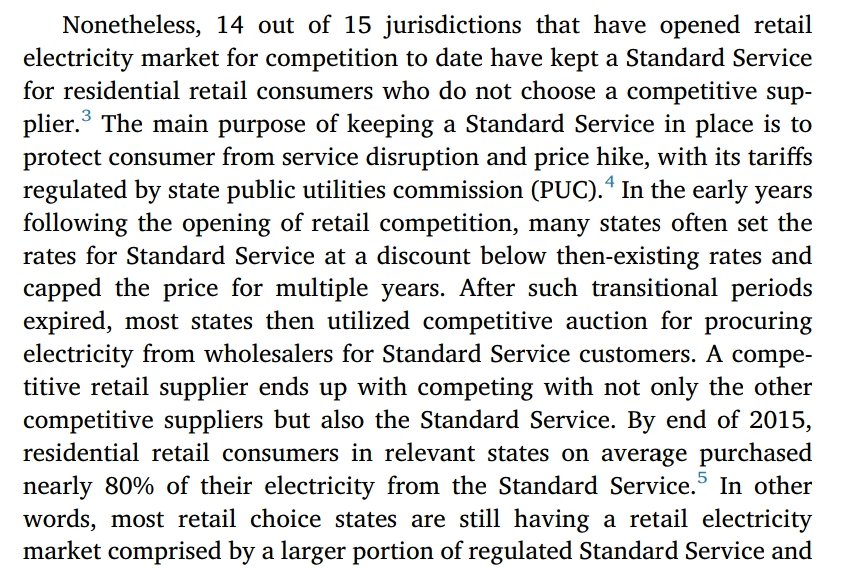
In conclusion, the authors of this same study "found that billed prices by competitive suppliers
on average were more reflective to the change in Standard Rates, than
to the movement of wholesale prices." The similarity with France is quite striking as well.
on average were more reflective to the change in Standard Rates, than
to the movement of wholesale prices." The similarity with France is quite striking as well.
The links to the study titled "Electric Paradigms: Competitive
Structures Benefit Consumers" by @MichaelGiberso3 and @DC_Hartman for @RSI rstreet.org/research/elect…
Structures Benefit Consumers" by @MichaelGiberso3 and @DC_Hartman for @RSI rstreet.org/research/elect…
@MichaelGiberso3 @DC_Hartman @RSI @threadreaderapp unroll
• • •
Missing some Tweet in this thread? You can try to
force a refresh