1/ Some were surprised yesterday that an African American Judge, Rossie Alston Jr. was the person to temporarily save the Confederate Memorial, dedicated to reconciliation between North and South, in Arlington National Cemetery.
But they shouldn't be.
A 🧵:
2/ Frederick Douglass was one of the great Americans of the 19th century. An escaped slave, his writing and oratory made him one of the pre-eminent figures of the abolitionist movement, an international celebrity, and probably the most prominent African American of his time.
3/ At the dedication of the Emancipation Statue featuring Lincoln in 1876, Douglass endorsed the prudential politics that caused Lincoln to put the preservation of the Union, before the slavery issue.
In doing so, he showed both his and Lincoln's statesmanship.
4/ "Had he put the abolition of slavery before the salvation of the Union, he would have inevitably driven from him a powerful class of the American people and rendered resistance to rebellion impossible,” Douglass said.
5/ "Viewed from the genuine abolition ground, Mr. Lincoln seemed tardy, cold, dull, and indifferent; but measuring him by the sentiment of his country, a sentiment he was bound as a statesman to consult, he was swift, zealous, radical, and determined.”
6/ Indeed, when the monument itself was criticized for its symbolism, Douglass himself did not complain or call for its removal, but instead championed the building of additional monuments to add context.
He was about building up, not tearing down.
7/ Compare this wisdom from a person who had suffered under slavery with the radical bloviating of the Biden administration and their allies among America’s radical left, who have suffered nothing, but control almost all American institutions.
8/ The Biden regime is only interested in dividing America and punishing its political enemies, as it is trying to do by tearing down a long-established monument to North-South reconciliation.
9/ In the years before the Civil War, radical abolitionists under the motto "No Union with Slaveholders", criticized Douglass's willingness to engage in dialogue with slave owners.
He replied:
"I would unite with anybody to do right and with nobody to do wrong."
10/ For more history, stories, and takes that you won't find in the regime media, please follow my account!
• • •
Missing some Tweet in this thread? You can try to
force a refresh

1/ WHY ARE "REPUBLICAN" CAMPAIGNS IN MONTANA BEING SUPPORTED BY DEMOCRAT DARK MONEY?
We recently saw the power of grassroots engagement, supported by President Trump, in knocking off RINOs in Indiana.
In Montana, our RINO problem is even more severe, but it doesn't get reported on because we are far from the national media, and our small state media is completely controlled by the left.
In the last legislative session, without any warning to the voters who elected them, nine GOP State Senators crossed the aisle to hand organizational control of the Senate to the Democrat minority and stymie conservative priorities from budget bills to infrastructure, to critical issues like making judicial elections partisan (Despite overwhelming GOP votes in the state, Democrats have been able to maintain ultimate control through "non-partisan" judges heavily backed by out of state leftist and trial lawyer money.)
Again, this isn't an issue of these "GOP" reps voting with the Dems on this or that issue. They voted with the Dems on PROCEDURAL AND ORGANIZATIONAL matters-- so they were literally playing for the other team while wearing the R as a skinsuit.
Many of these Senators are now trying to get re-elected as Republicans and counting on Democrat dark money to make it happen.
All of this is documented in the linked articles here.
2/ I've been fairly critical of the Montana GOP at times, but I will give them credit for moving decisively against these lawmakers, unlike some other state parties who have looked the other way when treacherous reps have undermined fundamental GOP priorities.
The state party completely severed recognition of the nine lawmakers as Republicans, pulled all campaign funding, and revoked their voting rights at party conventions.
The GOP has moved aggressively against these lawmakers, but bolstered by out-of-state money and Democrat campaign expertise, they still have a lot of influence. gallatinrepublicans.com/fireweed-and-t…
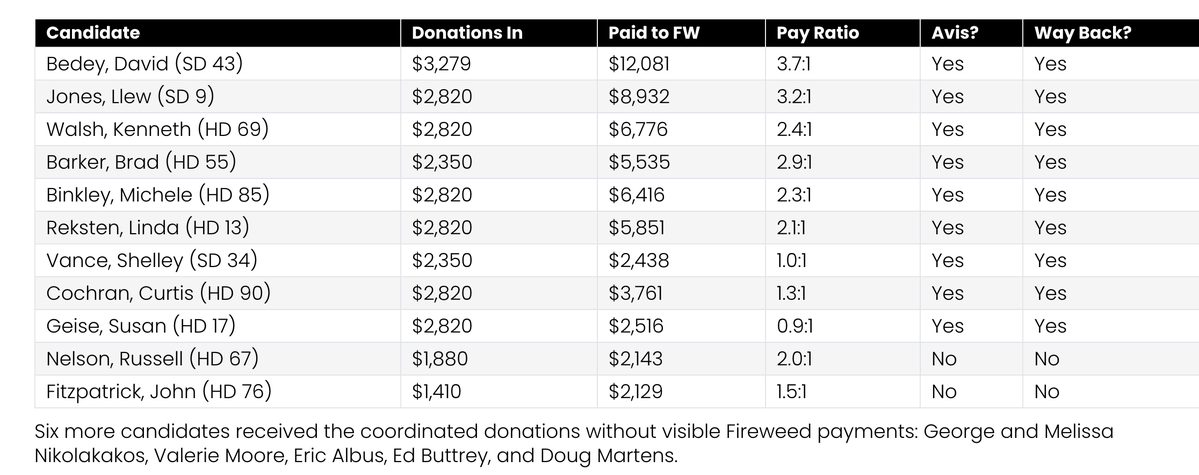
3/ The rot goes beyond the State Senate though. The seventeen "GOP" candidates below were also taking money from people affiliated with Fireweed a "progressive" Montana political consulting firm.
The amounts may seem small, but in a state with districts of 11,000-40,000 people, a little money goes a long way
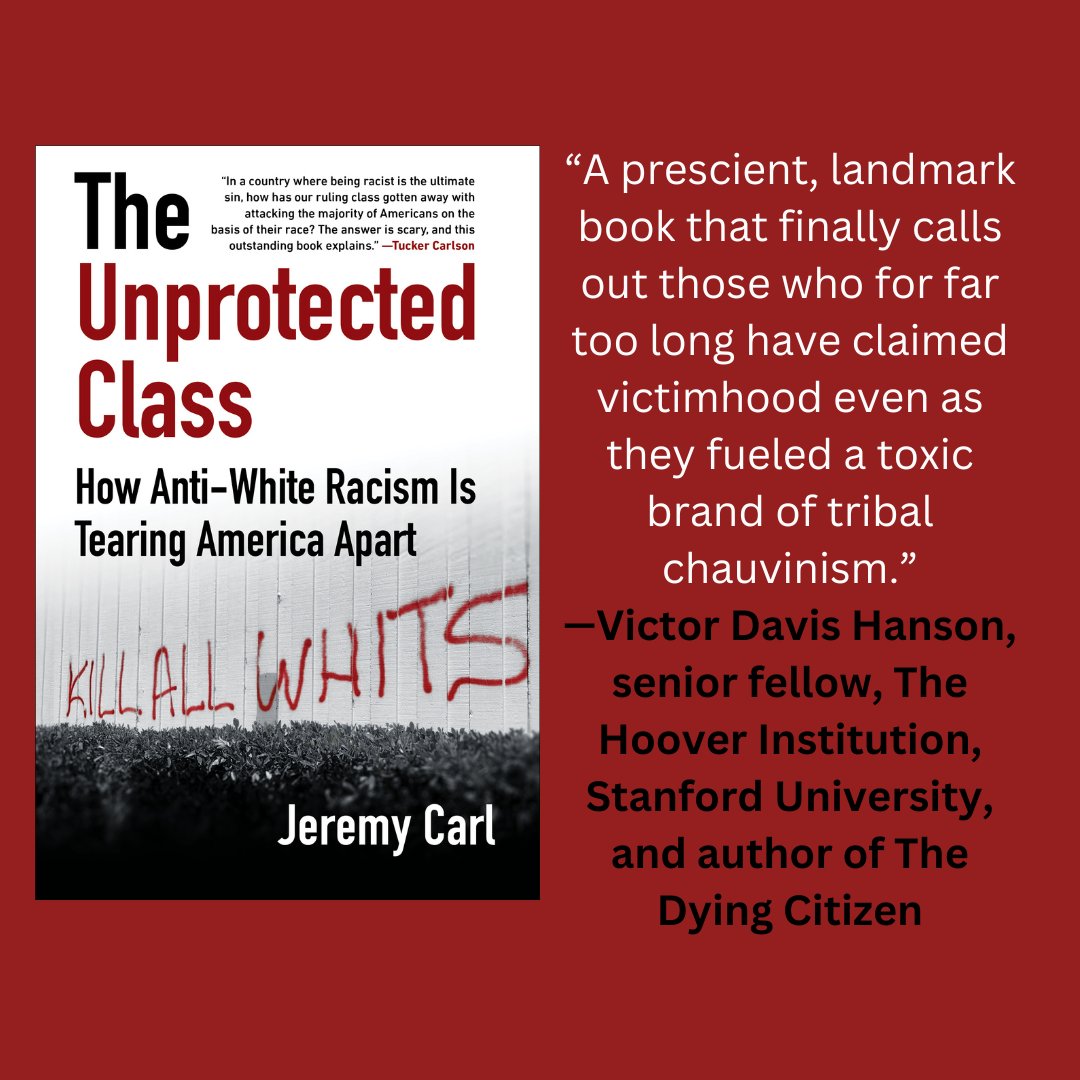
1/ After the overwhelmingly positive response to my viral comments on Vivek Ramaswamy's post, I expanded it by pulling some relevant excerpts from my chapter on Silicon Valley in The Unprotected Class.
I think this will add some useful facts and data to a discussion that is currently a bit light on them.
2/ I also offer some additional commentary speaking to my personal experiences here and how the Tech right and MAGA/Nationalist right can find common ground.
3/ And I discuss the enormous demographic changes that immigration brought to Silicon Valley-- and its consequences.
1/ @Steve_Sailer has a post up on his Sub***ck with this powerful image from a 1973 Time cover story on Minnesota in 1973, and an almost identical gesture from the Minneapolis riots almost a half century later.
It gets to the heart of why Tim Walz is so dangerous. . .
2/ The entire piece is here, and it's brief but sobering reading.
As of today my book is available instantly on Kindle, available for immediate delivery in hardcover, and it will be available (in the next few days) in audiobook format.
You can read some of the early plaudits in the thread below.
2/ Lemkin developed the concept of genocide during World War II and, after the war, working closely with the prosecutors during the Nuremberg trials, he further refined it.
His proposals were the centerpiece of what became the United Nations Convention on Genocide.
3/ But the UN final document omitted Lemkin's concept of Cultural Genocide, after France and Britain vetoed it, concerned it might be used against them to describe some of their policies.