@ProgressChamber has joined an amicus brief, alongside @NetChoice, @ccianet, and @CatoInstitute regarding Murthy v. Missouri (formerly known as Missouri v. Biden) which is now pending before the Supreme Court.
Murthy is a case that implicates the First Amendment rights of social media platforms and the ability of the government to censor/control how they host content.
Missouri and Louisiana AGs, in their initial case, contended that Biden administration officials violated the First Amendment by pressuring companies like Meta, Twitter/X, and YouTube to suppress content relating to the COVID-19 pandemic.
A preliminary injunction froze communications between tech companies and the gov't. The Supreme Court stayed the injunction while it considers arguments on whether gov't communications w/ social media led to censorship and if the breadth and terms of the injunction were proper.
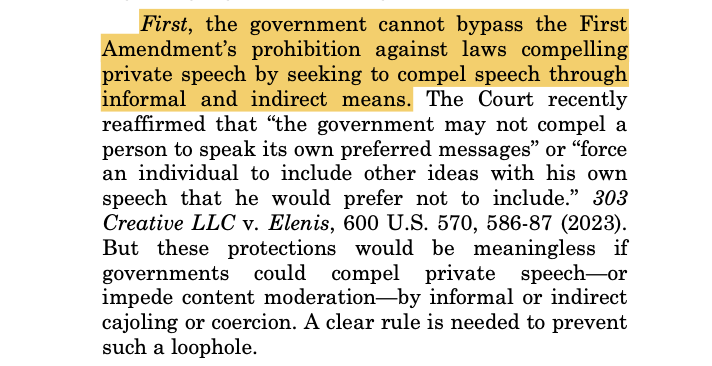
Amici take no position in support of either party in this case but holds that "the government may not use informal means to compel speech it could not compel directly."
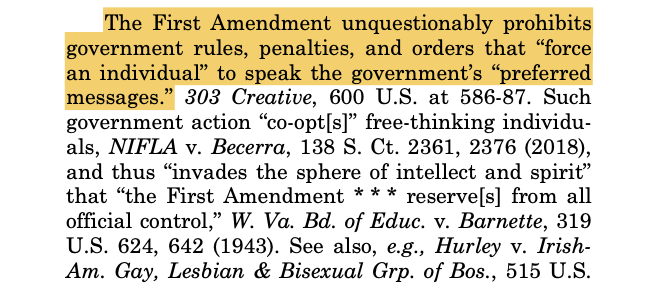
The Court must therefore “look through forms” and prohibit even “informal” government action whose “substance” abridges First Amendment freedoms.
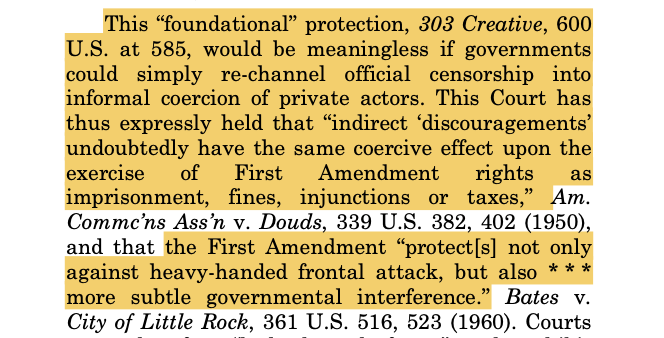
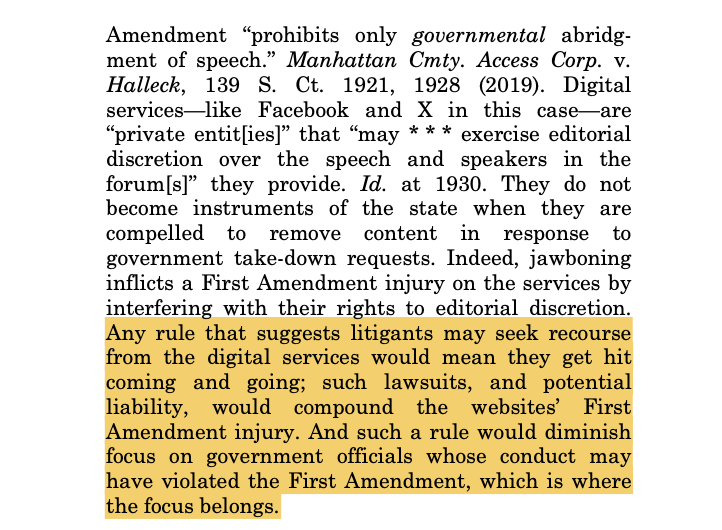
Amici also posit that when jawboning infringes online speech, the focus for redress must be the government, not coerced providers.
Jawboning refers to the "inappropriate demands made of private actors by government officials." cato.org/policy-analysi…
The gov't is solely responsible when it coerces a private party to restrict speech that the gov't itself cannot reach.
Digital service providers forced to follow government direction on editorial decisions suffer a First Amendment injury themselves & must not be held liable.
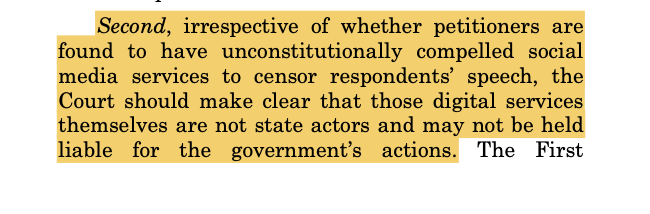
It is critical to underscore that a Supreme Court decision in this case can set major precedent concerning digital service providers' freedom of expression and their ability to make decisions about what content they host or remove.
• • •
Missing some Tweet in this thread? You can try to
force a refresh

The DOJ’s first expert was a familiar face. Harvard professor, Robin Lee, testified during the liability case on a market definitions, monopoly, power, and effect on competitio.
In the remedies phase, he looked at competitive effects and evaluated both proposals.
His three objectives were to:
1. Stop Google’s anti-competitive conduct 2. Create a high likelihood of preventing future monopolization 3. Resolve competitive harms from Google‘s conduct
He considered, but couldn’t precisely identify how markets would’ve looked absent Google’s conduct a.k.a. build a but-for world.
It was infeasible because the conduct is long-lasting, and there are innumerable computations for alternatives
Good morning from Day 3 of DOJ/States v Google ad tech remedy trial.
We’re hearing from the DOJ’s experts, but I want to highlight an exchange made during DOJ’s economic expert (Robin Lee) hinting that the judge may be leaning away from structural remedies/break up proposals.
Judge Brinkema: A lot of your opinion is based on another assumption that Google would attempt to re-monopolize. It’s interesting because that ran through other witness narratives, but I don’t see any evidence in the record that Google has been subject to an injunction in another case and has circumvented them.
DOJ:The Play Store case is issued an injunction, though in a different market
Judge Brinkema: But do you have a history of Google being enjoined and circumventing?
Google: By the way, that injunction was stayed in the Ninth Circuit
I was going to point this out but @aripap does a good job.
It’s been 2 days & we’re officially halfway through the DOJ’s case in the ad tech remedy trial where the govt is seeking divestiture of AdX & DFP. But none of the DOJ’s witnesses seem to agree on how this should play out
The final witness of the day was Jed Dederick, Chief Revenue Officer of The Trade Desk. Dederick also testified during the liability trial and said he was excited and interested in the courts liability ruling because there is a lot of interest and industry hope about this case.
Dederick testified that competition is anemic in open web display advertising. There’s not much innovation and buyers are not interested in investing compared to other ad channels.
Ad buyers and agencies lost trust in open web display advertising because they have questions about where the money goes and there’s not enough transparency around fees.
The next witness the DOJ called was Jay Friedman of Goodway Group
When asked about AI, he testified that it had not impacted publisher ad servers yet, but it’s hard to forecast. That being said, he believed any AI disruption would be leveraged by Google because “nobody on the planet has a broader base of knowledge” to train machines learning models.
Friedman believes divesting AdX would result in lower prices because Google’s fee has been an “anchor at the top of the market. The world has accepted that there is Google and everyone else.”
On publisher ad server competition, Friedman testified that the ad server needs to be truly independent and operate in publishers best interests. “I am on the buy side, so for me to say that means I really think publishers need help.”
The DOJ’s next witness was Luke Lambert, who works at Omnicom confluence subsidiary, solely focused on Amazon.
Lambert testified that he saw open web display advertising slowing down, but thought “disappearing” is an aggressive way to put it. He still plans to purchase as much web display advertising as he can because of scale and because most of his work sits in the upper funnel.
He said that transparency into the final auction logic would be beneficial to understand why an ad is won or lost, and that he wants more than what the DOJ has included in its proposal.