India blocked me before tweeting this so I assume didn't want an answer to these questions but since anti-discrimination law is one of my areas of expertise I'm happy to provide some anyway.

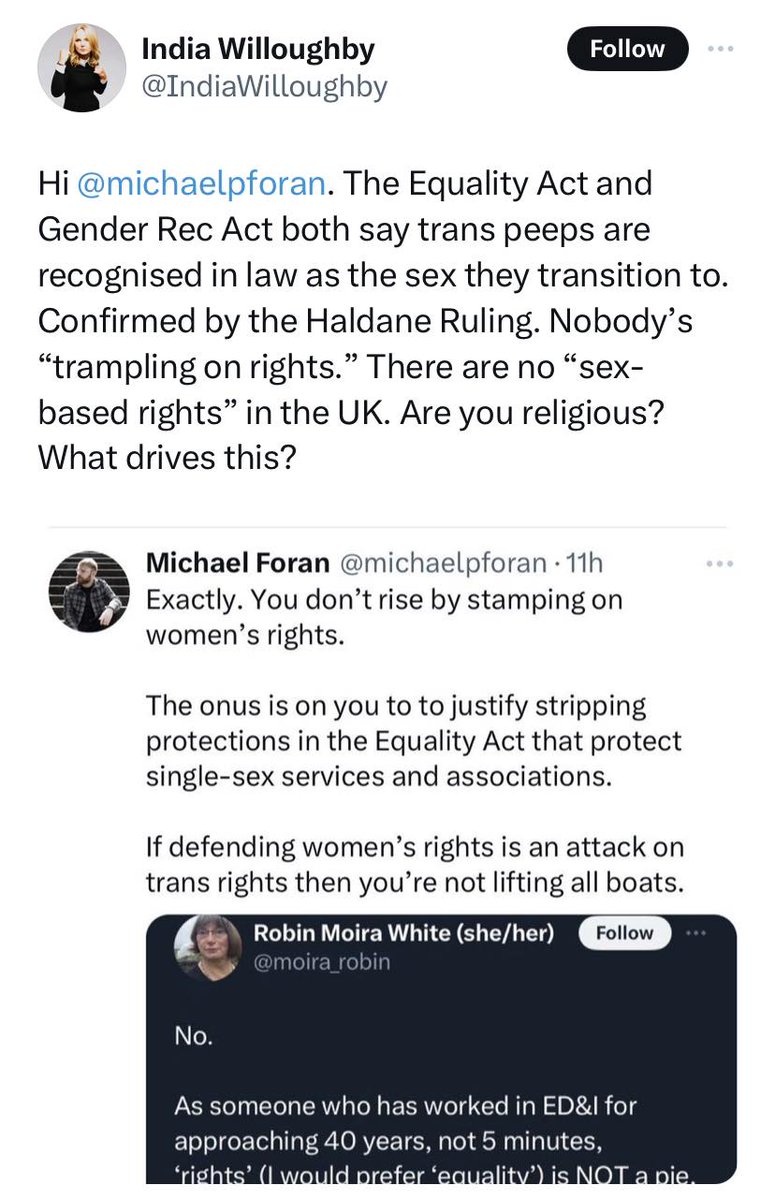
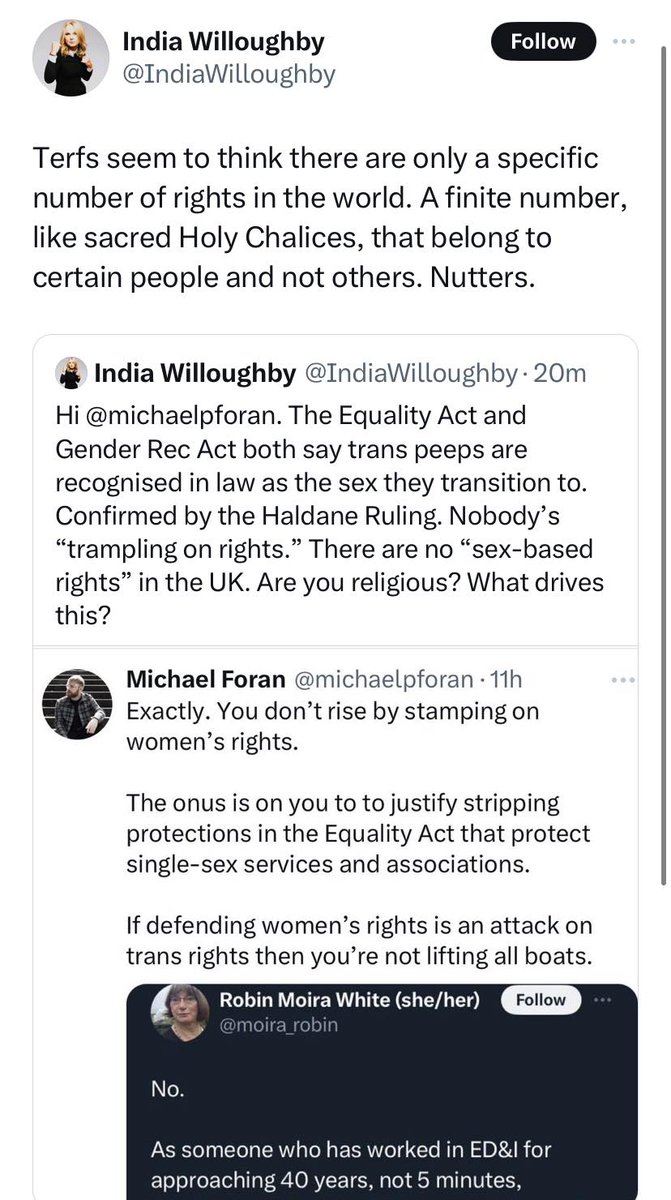
The GRA sets out a process where one can be recognised as legally a member of the opposite sex for many purposes. The Equality Act protects people from gender reassignment discrimination. None of these override the exceptions in the Equality Act that permit single-sex services.
Schedule 3 sets out clear exceptions that permit exclusion on the basis of either sex or gender reassignment if one has established a single sex service"
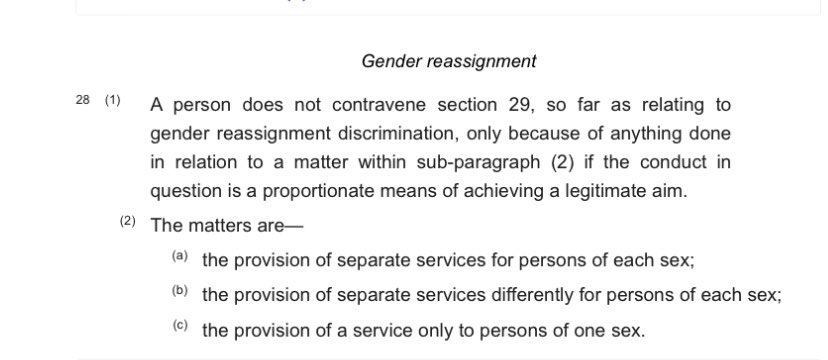
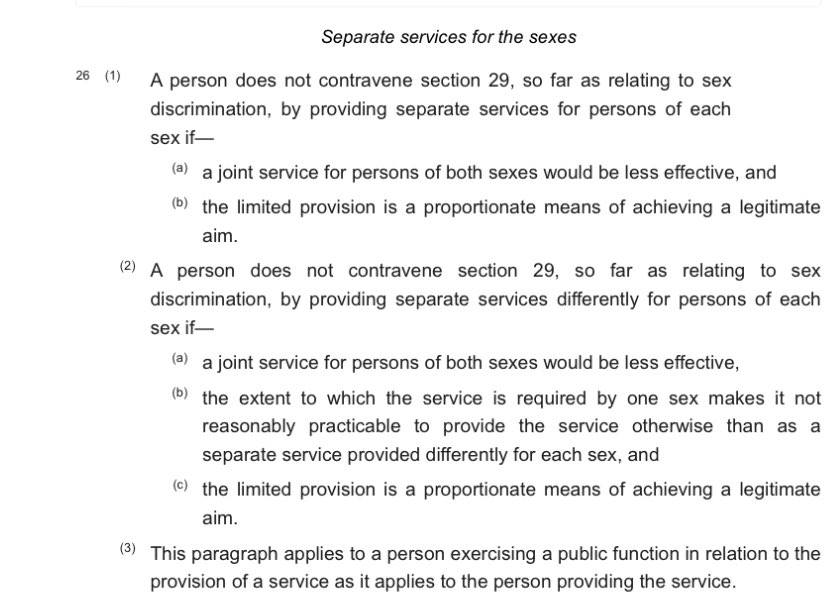
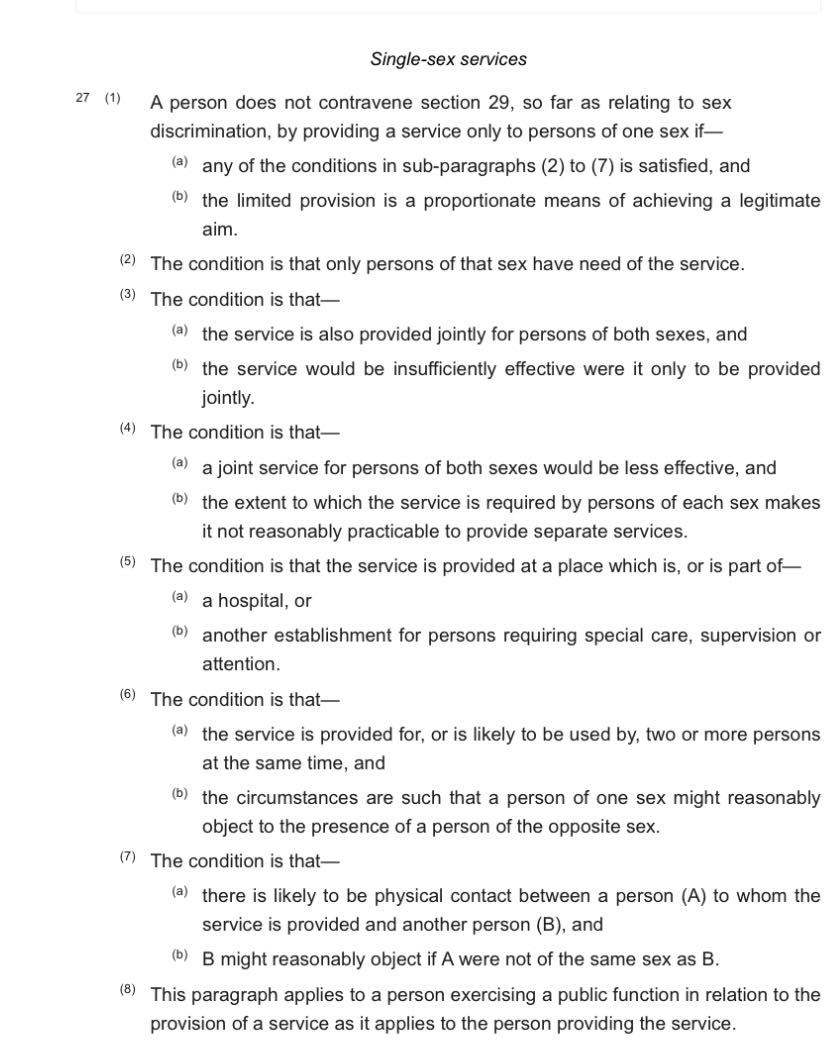
This means that it is permissible to exclude trans women from female only services if the exclusion is a proportionate means of achieving a legitimate aim. Protection the privacy, safety, and dignity of women is a legitimate aim.
Some try to argue that this assessment of proportionality must be case-by-case as between individual users rather than as between policies. That's false. Blanket policies are capable of justification under the Equality Act and the explanatory notes use one as an example:

Self-ID advocates have flipped and flopped a bit about whether they think a GRC should make a difference here. That has been clarified by FWS3 - a decision which is open to challenge but is the current doctrine that we have.
So here is the current legal position:
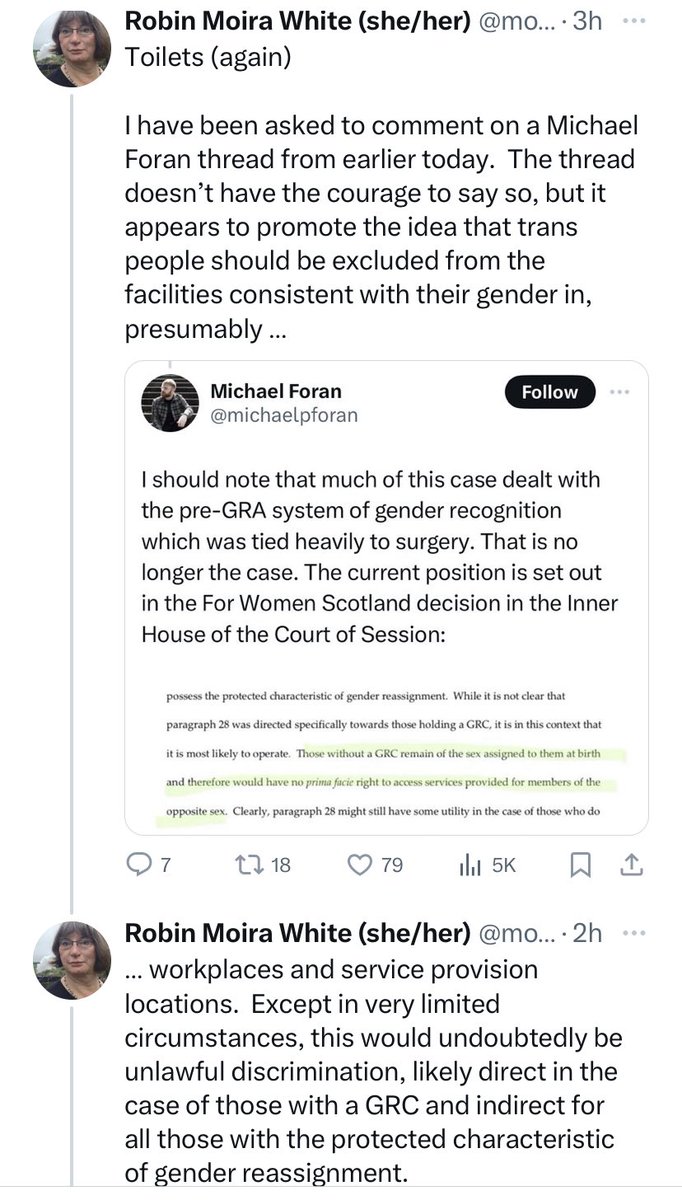
Without a GRC, trans women are legally men in UK law. This has been affirmed in Green v Secretary of State for Justice and FWS3. They therefore have no prima facie right to access female only services:
Without a GRC, trans women are legally men in UK law. This has been affirmed in Green v Secretary of State for Justice and FWS3. They therefore have no prima facie right to access female only services:

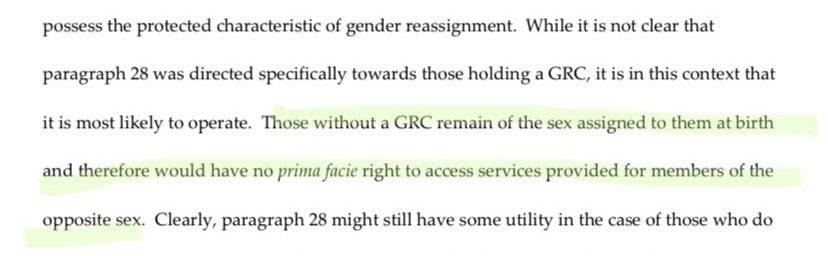
With a GRC (about 5-6k in the country) there is a prima facie right to use opposite sex services but this presumption can be overcome if the Schedule 3 exceptions are engaged to protect the human rights of women.
That means that a women's leadership scheme would likely need to admit trans women with GRCs but not services providing a refuge or a communal shower, changing room, or toilet. When human rights are engaged, the Schedule 3 exceptions can be justifiably used.
Neither the GRA nor the Equality Act enshrine a right for trans women to use female only single sex services. The law of this country does not operate on a self-ID basis.
The rights enshrined in our equality law protect trans people from being fired or denied service or otherwise treated less favourably that another person of their sex. Even with a GRC the law permits female only services and associations.
India is not a lawyer and so can be forgiven for complete ignorance of human rights law. Although when you run your mouth about a topic by quote tweeting an expert after blocking them, maybe you should reign it in a bit.
Some human rights don't conflict: the can't because they're absolute. The right not to be tortured can never be justifiably infringed. Others are qualified rights and they can be. These rights conflict all the time and so more of one right for some leads to less for others.

Take freedom of expression and privacy. A journalist wants to publish private information about someone. Free expression is in conflict with privacy. More freedom of expression for the journalist means less privacy for the subject; more privacy means less freedom of expression.
In cases where rights conflict, a balance must be struck. That's what equality and human rights law is all about. It might seem like access to single sex spaces is the same kind of conflict but that's only true at a surface level.
The rights in conflict here are not privacy on the one had and a right to be included on the other because there is no right to access single sex spaces. There are rights to privacy that women can expect to have when using a communal changing room but no right to access.
Trans people have a right to gender recognition as set out in the GRA and they have rights not to be discriminated against as compared to others of their sex and they have rights to privacy. None of them entail a right to use single sex services intended for the opposite sex.
There may be cases where an indirect discrimination claim could be brought for failure to provide adequate services, but that does not mean that the default here is a mixed sex changing room. That would only be the default if women had no right to privacy.
Instead a woman could sue for indirect sex discrimination for the unjustified denial of single sex services and a trans woman could sue for indirect gender reassignment discrimination if forced to used a male communal service.
The solution that human rights law requires is one that results in as minimal impairment on the rights of others as possible. That is achieved with third spaces, not the destruction of female only spaces.
There are sex-based rights. the right not to be discriminated against on the basis of sex is an obvious one. Others are general rights such as privacy where the content of the right in a given context depends on recognising the sex of those involved.
Anyone seeking to deny the existence of or to remove these rights is absolutely trampling on women's privacy rights. Equality and Human Rights law requires serious thinking about how policies affect everyone involved. It can't be reduced to political slogans you put on a placard.
Finally, India has made some strange personal comments. I assume to impute my motives or my character. That has nothing to do with the law, which will remain what it is regardless of how much nasty people scream otherwise.
• • •
Missing some Tweet in this thread? You can try to
force a refresh