115 years ago Maria Prymachenko was born. Truly a genius of Ukrainian art. You've probably seen her artwork. But let's talk about some myths about Prymachenko and why they are untrue. A thread 🧵
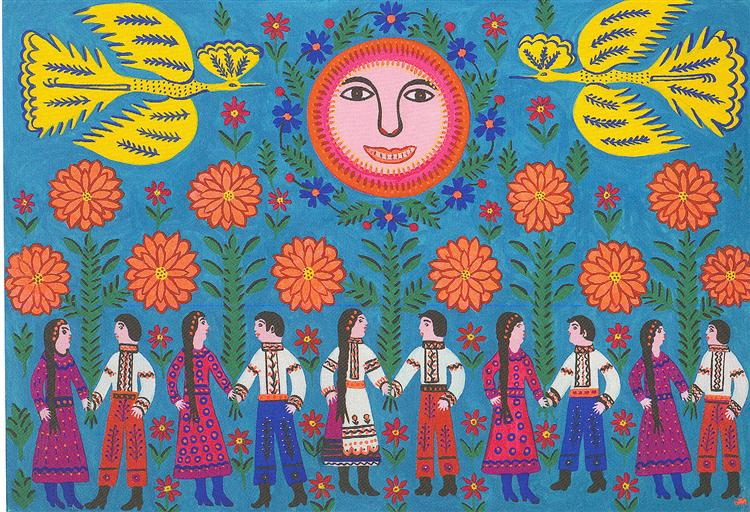
"Our army, our defenders", 1978
❌She was uneducated and had no art education ✅ She studied for four years in the school, which was typical for peasants. She had no academic art education, but her mum taught her embroidery and 🇺🇦 traditional art. In Kyiv she graduated from Masters of Folk Art School.
❌She painted only naive animals and flowers. ✅ Her works were about different topics – the trauma of war, the cold war and nuclear terror, the Chornobyl catastrophe, alcohol addiction, Ukrainian songs, etc.
"May be cursed nuclear war", 1989
❌She never left her village. ✅She studied in Kyiv where the Central Experimental Studios of Folk Art and then (after the Second World War) she visited the city for the openings of her exhibitions, and to visit friends (like Alla Horska, Lidia Orel, etc). But she never left 🇺🇦
❌She was rich because she was famous. ✅She had many exhibitions even abroad, but she lived very modestly in the village. Serhiy Parajanov remembers that Prymachenko asked to gift her cement because it was hard to find everything.
❌We know everything about her. ✅There are not so many researchers about her and her art. That's why there are still so many myths about Prymachenko and she's still considered as just a naive artist, but she was so much more than that.
❌Russian war on Ukraine doesn't affect her heritage. ✅Unfortunately in February 2022 museum in Ivankiv where many of her works (as well as ceramics, and embroidery) were destroyed. About 15 works were saved by courageous museum workers. For example this "Blue Bull", 1947
Maria Prymachenko Family Foundation wants to build a new museum in her native village Bolotnya (can you imagine there is still no museum of Prymachenko?). You can support them and buy clothes with her works – ukrainianbeasts.com
And of course, if you want to know more – here is a book with my article about Prymachenko and why she is so important for Ukrainian art through the years, they are shipping worldwide. rodovid.net/product/298/ma…
• • •
Missing some Tweet in this thread? You can try to
force a refresh

People say they don't see my posts anymore in their feed. I hate algorithms. Even though I didn't post much, I want to continue to show you 🇺🇦 art. For today – a thread about Mykhailo Zhuk (1883-1964) 🧵
Zhuk was born in Nova Kakhovka, Kherson oblast (now occupied). His father was a painter, and since childhood began to help his father. At the age of 13, Mykhailo was already studying at the Kyiv Drawing School of Mykola Murashko.
He did not manage to enter St. Petersburg Art Academy, but he was accepted to the Kraków Academy of Arts, from which he graduated in 1904 with a silver medal. From 1905 to 1916, Mykhailo Zhuk taught at various schools in Chernihiv.
181 years ago, Illya Rypin (Repin) was born. He is one of the most famous realist artists. Rypin was a teacher of many artists and undoubtedly influenced the history of world art. But many people still do not know that Rypin is a Ukrainian artist. 🧵
The future artist was born in Chuguiv, in the Kharkiv region, into a Cossack family. His father traded horses, and his mother organised a small school for adults and children. Ilya Rypin's cousin first brought watercolour paints.
At the age of 11, he was sent to study drawing and became a student of the local icon painter Ivan Bunakov. Rypin worked as an icon painter for a long time, until in 1863 he collected all the money he had earned and went to St. Petersburg to study at the academy.
Today is the remembrance day of Lyubov Panchenko (1938-2922), a great artist from the Sixties generation. She died after the occupation of her hometown, Bucha. I've noticed that I made a small thread in 2022. This is a bigger one about her life and art 🧵
Lyubov Panchenko has a typical story for Ukrainian female artist born in village: her parents were against her drawing, but they allowed her to study something more practical. So Lyuba took up embroidery. Then the soviet system censored. For a long time, the artist was forgotten.
The future artist was born in the village of Yablunka, which is now part of the city of Bucha, near Kyiv. Her mother taught little Lyuba to embroider. It was not only a way to decorate the house, but also to earn money.
Since childhood, Lyuba loved to draw.
Today, 100 years ago, in Bilopillya, Sumy region, Viktor Zaretskyi was born – a great 🇺🇦 artist from the Sixties generation, one of my favourite artists. I post his artwork very often here, but it's never enough. So here is his story 🧵
He spent his childhood in the Donetsk region. In 1947, he became a student of the Kyiv Art Institute. At the institute, he met his future wife and co-author of the mosaics – the outstanding artist and leader of the Sixties circle, Alla Horska.
At the beginning of his career, Zaretsky worked, like other artists of that time, in socialist realism, creating paintings on mining themes. But in the early 1960s, he travelled to Chornobyl Polissya, and that trip changed everything.
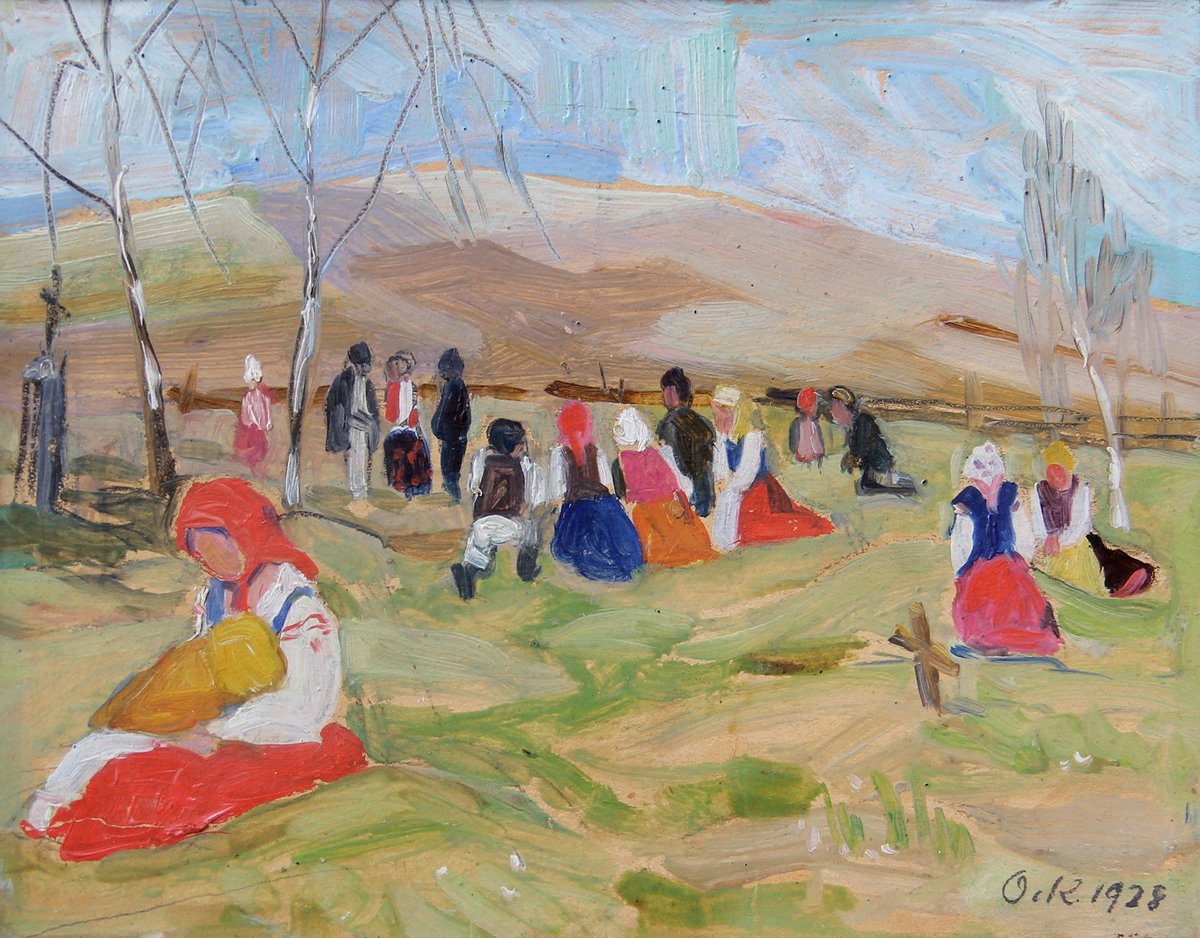
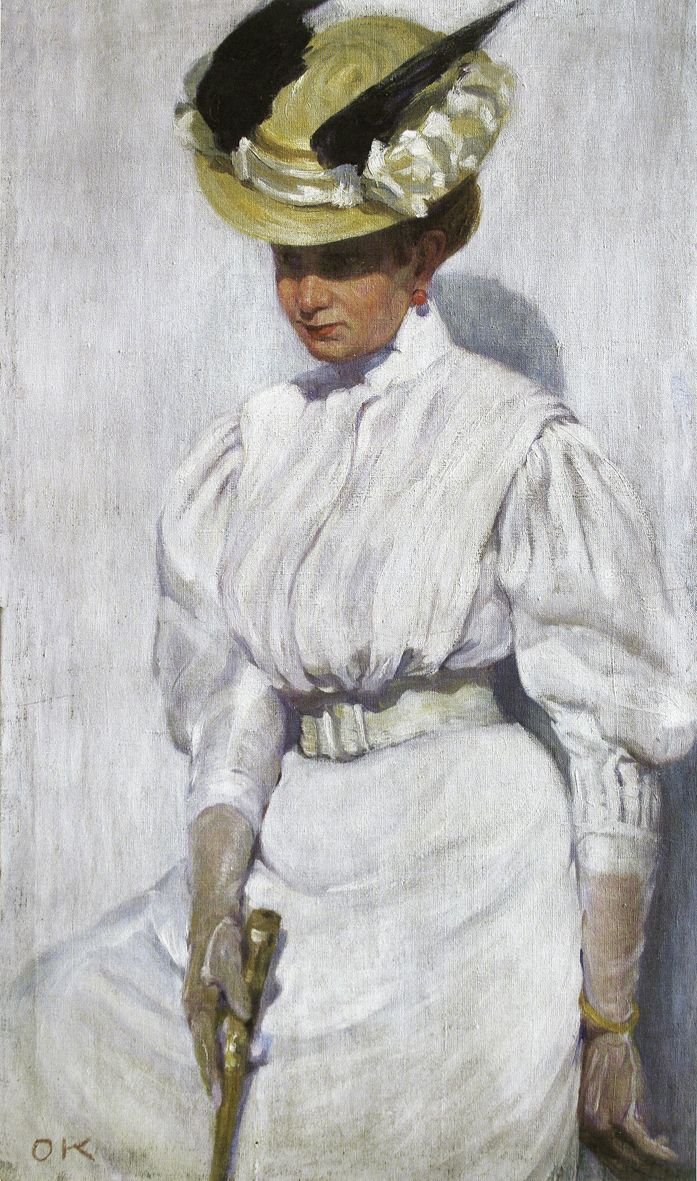
It's been two months since I wanted to share this artist and her story with you; I don't know why I've been postponing it. But here we go – Olena Kulchitska (1877-1967), artist, feminist, teacher 🧵
Olena was born in the city of Brezhany, in the Ternopil region. The girl loved to draw from an early age, and her father did everything he could to encourage her daughter's passion. Her first art education was at Lviv Art School.
She graduated from the School of Applied Arts in Vienna — the same one where Gustav Klimt studied and the only one at the time that accepted girls. For 5 years, she studied painting, ceramics, sculpture, enamel, the basics of book graphics, engraving and etching.
Ukrainian artist Margit Selska-Raich (1900-1980) deserves many threads about her life and art, so here we go 🧵
Margit Reich was born in Kolomyia to a Jewish family. Since childhood, Margit was encouraged to study, so at 18, the girl entered the private Free Academy of Arts in Lviv, later studying art in Krakow and Vienna. She often visited Paris.

It was in Lviv that she met her future husband, who was also an artist, Roman Selsky. In 1924, she visited Paris and fell in love with modern art. She drew a lot from paintings in the Louvre, visited modernist exhibitions, and was fascinated by cinema and photography.