Interesting piece on the lawyer for the Scottsboro Boys, who, apparently, in his earlier career as a New York defense attorney, won acquittals for many clearly guilty people including Al Capone. But the article repeats some common misconceptions about the Scottsboro case itself.
It is usually said the Alabama jury convicted the nine solely on the word of Victoria Price, who claimed she was hoboing on a freight train with Ruby Bates when a dozen black boys climbed in from another train car, threw some white boys out of the moving gondola, and raped them.
But the prosecution had more than that. Multiple eyewitnesses along the train route saw the fight in the gondola car. One farmer saw the ejected white boys walking down the track, faces bloody. Another saw into the gondola for a second just as a black figure threw a woman down.
Orville Gilley was one of the white boys in the gondola car. He escaped being thrown off the moving train because by the time they got to him the train had sped up to 45mph. He backed up Price. “Undoubtedly the strongest corroborative evidence the state could have produced.”
A knife that belonged to Victoria Price was found in the possession of one of the defendants during his arrest. According to the arresting deputy, "He said he took it off the white girl Victoria Price."
You might not put much stock in this, but many of the defendants implicated each other in the first trial, claiming they'd witnessed the rape but not participated. "That, as much as the testimony of Price and Bates, led to their conviction," one sympathizer later wrote.
Ruby Bates told a doctor who treated her for syphilis that she got it from the rape on the train.
It's true Ruby Bates later recanted, telling the second trial that her testimony in the first one had been false. But the Tablet article doesn't mention that her revised testimony was actually damaging to the defense because it was obvious to everyone that she'd been bribed.
Bates was so unconvincing that, when people asked the prosecutor if he would go after her for perjury, he said, “She is making me such a damn good witness I prefer to leave her on the ground.” The defense lawyer later all but admitted her testimony had been bought.
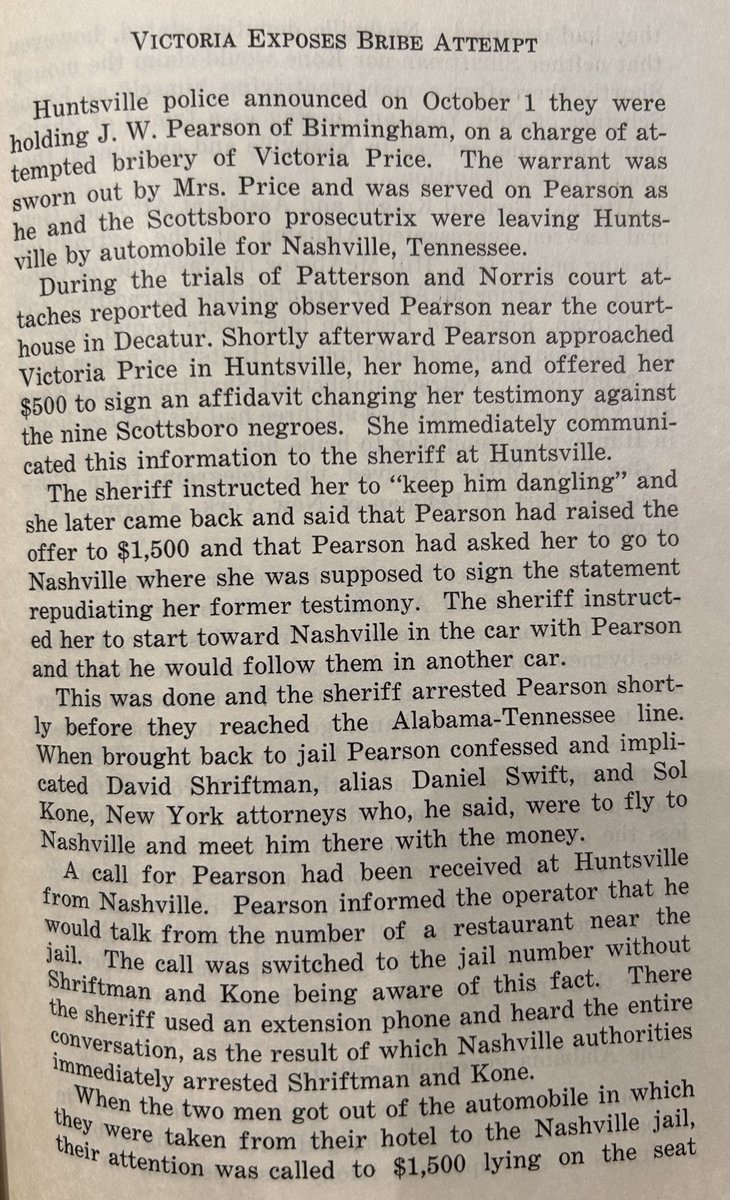
The defense was caught red-handed trying to bribe witnesses several times. These two lawyers, David Shriftman and Sol Kone, were caught with $1,500 in a briefcase. They were released on bond and fled never to be seen again.
Oddly, the examining doctor at Scottsboro also changed his testimony: First he said the girls were “loaded with male sperm”; later he said he found only a little and it was all non-motile, meaning the girls must have had sex days earlier, not on the train.
The main tactic of the defense was to impugn the character of the girls. (Any comment from the #MeToo movement on these quotes?)
Judge James E. Horton threw out Heywood Patterson's conviction on the grounds that, if she’d actually been raped, Victoria Price should have had more wounds on her body and been more agitated during the medical examination.
Horton: “History, sacred and profane, and the common experience of mankind teach us that women of the character shown in this case are prone for selfish reasons to make false accusations both of rape and of insult upon the slightest provocation or even without provocation.”
This quote from one of the prosecutors, referring to the bribed witnesses, is indeed bad. The Alabama judge reprimanded him for uttering it. But there are other quotes the author of the Tablet article doesn't cite.
Prosecutor Thomas Knight: "I do not want a verdict based on racial prejudice or a religious creed. I want a verdict based on the merits of this case."
Judge Callahan: “Something has been said about the defendant’s being a Negro. I would be ashamed of you if that entered into your consideration in this case. No man is worthy to be in the jury box that would reach the guilt or innocence of a man on any such contemptible grounds”
It’s fine to believe that there was reasonable doubt and the boys should not have been convicted. But it is false to say there was “no evidence” or that the whole thing was a frame-up from beginning to end.
If you want to know more about the Scottsboro trial, the Communist-directed international outcry (similar to Sacco & Vanzetti just five years earlier), the best book is Stories of Scottsboro (1994) by James Goodman. amazon.com/Stories-Scotts…
P.S. Since the Tablet article makes such a point of Liebowitz being streetwise, I must highlight this funny exchange where the Alabama judge has to supply Liebowitz with the right vocabulary to ask about Price’s snuff habit. “‘Dip’ is the word you will have to use.”
• • •
Missing some Tweet in this thread? You can try to
force a refresh

Irish authorities will go to great lengths to stop anyone “politicizing” horrific crimes by immigrants. In 2023, the boyfriend of murder victim Ashling Murphy made an impact statement in court that was initially reported but later censored from RTÉ press coverage of the trial. The section that was deleted from news stories said: “It just sickens me to the core that someone can come to this country, be fully supported in terms of social housing, social welfare, and free medical care for over 10 years—never hold down a legitimate job, and never once contribute to society in any way shape or form.”
After Ashling Murphy was murdered, Irish politicians repeated over and over the line that “there is no link betweeen migration and crime.” However, as Lenihan points out, of the 12 women murdered in Ireland that year, six were killed by immigrants.
Amazing. Most speeches from the last NatCon have a few dozen views. “The Great Feminization” is now approaching 100,000. I’m truly grateful to see this important message spreading. A few additional thoughts:
1. Remember how insane everything got in 2020? That is just a small preview of how things will be when women come to dominate our institutions. Back in the 1970s, a lot of people thought introducing women into institutions wouldn’t change them, or might make them slightly softer but otherwise the same. That prediction has been proven false. Look at how much the legal profession, journalism, medicine, and journalism have changed now that women are the majority of the younger cohorts. Imagine how much more they’ll change as the remaining men age out.
2. People think the difference between men and women is that men are logical and women are emotional. That’s true, but it’s just a tiny fraction of what “feminization” means.
For example, men have the concept of an honorable enemy. Men can engage in conflict with an opponent and still respect them. When the conflict is over, they’ll shake the other guy’s hand and accept the outcome gracefully.
Women don’t have that. If you’re her enemy, you are subhuman garbage. No rules govern the fight; no shaking hands when it’s over. It is never over.
Joyce Benenson speculates that this is because men evolved for warfare between tribes and women evolved for sexual competition within the tribe. See her book “Warriors and Worriers.”
Whatever the reason, this is actually the number one thing I worry about with the Great Feminization. I see it already in the female-dominated Democratic Party. That’s what I mean when I say logic vs. emotion is only a small fraction of the danger.
According to Wikipedia, the 1958 “Kissing Case” in Monroe, NC, involved two black boys, aged 9 and 7, who were thrown in prison after a white girl innocently kissed them during a playground game. Elsewhere Wikipedia states they were “convicted of rape.”
This is how Gov. Luther Hodges of North Carolina describes the incident in his memoir. His three main points:
- The boys were not criminally prosecuted. They were sent to reform school due to their having an unsuitable home environment, in the opinion of the juvenile judge.
- The kissing incident was merely the latest offense in an escalating pattern of delinquency, including petty theft.
- Far from innocent play, the older boy had reportedly cornered the girl and not let her go until she agreed to kiss him.
By unsuitable home life, the judge meant the boys’ mothers made no effort to curb their criminal behavior and one “has a poor reputation in the community … particularly among her own race—a reputation for using her children and young girls as prostitutes.”
Ben Burns made his career in black journalism, usually as the only white editor in the newsroom. He single-handedly put together the first issue of Ebony in his living room. A thread from his memoir, “Nitty Gritty: A White Editor in Black Journalism”:
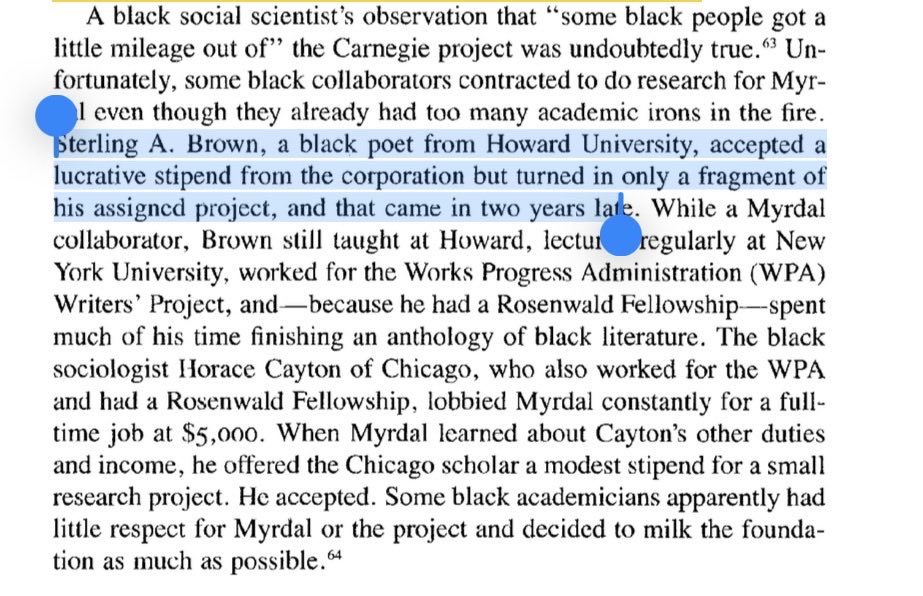
Bribery was common at the Chicago Defender—five dollars clipped to a news release, brand new cars for reporters. Burns thought it was dishonest, but no one else had a problem with it. “The practice became established and was accepted by most of the black community. I had no choice but to ignore and pretend I knew little about what I viewed as a kind of bribery.”
He had to write a lot of copy where he pretended to be black, obviously, such as the inaugural editorial for Ebony: “Ebony will try to mirror the happier side of Negro life… Sure you can get all hot and bothered about the race question (and don't think we don't) but not enough is said about all the swell things we Negroes do.”
A female scholar interviewed a bunch of senior citizens in Greensboro, NC, about their memories of integration and white flight. Their testimony is interesting, even if the author adds on a lot of nonsense about their “white privilege” and “victimhood narratives.”
Most interviewees had children in school when busing came in. “Our son quit takin’ his lunch because they would steal his lunch or his lunch money, so he just didn't eat.” “When my daughter went there . . . she was afraid to go to the bathroom, to the point that we had to take her to a urologist.” “He would have our son get down and lick his shoes and he would say, ‘Your people have slaved my people, now I'm gonna slave you.’”
A school administrator told one parent: “Mack, I think if you can afford it you would be smart to send [your daughter] to private school . . . because she has too much visibility,” i.e., she is blonde.
Do magazines even need to exist anymore? A tweet gets more reach than an essay, faster, with less effort.
Yes, they do. Forget magazines in the abstract, make it concrete. Here are ten pieces we published at TAC that show the value of medium. These could not have been tweets.
5. "A Murder in CHAZ," on the death of a teenager in Seattle's Summer of Love, one of the many murders that can be laid at BLM’s door. theamericanconservative.com/a-murder-in-ch…
6. A reported piece on Ukraine's Hungarian minority, showing that the Zelensky government has problems with other ethnic groups, not just Russians. theamericanconservative.com/can-ukrainian-…
8. The definitive piece on John Silber, governor of Massachusetts and controversial university president (you might think Silber is obscure but this piece has immense historical value and is also a great read). theamericanconservative.com/the-autocrat-o…
And two brilliant pieces on globalization, Wall Street, and the economy:
Reporting is the most obvious thing magazines offer that X and Substack don't. We never had the budget to do as much of it as we wanted at TAC, but it was always great when we could send our writers on the road to get a story.