Lauri Myllyvirta Profile picture
Jan 25 16 tweets 4 min read Read on X
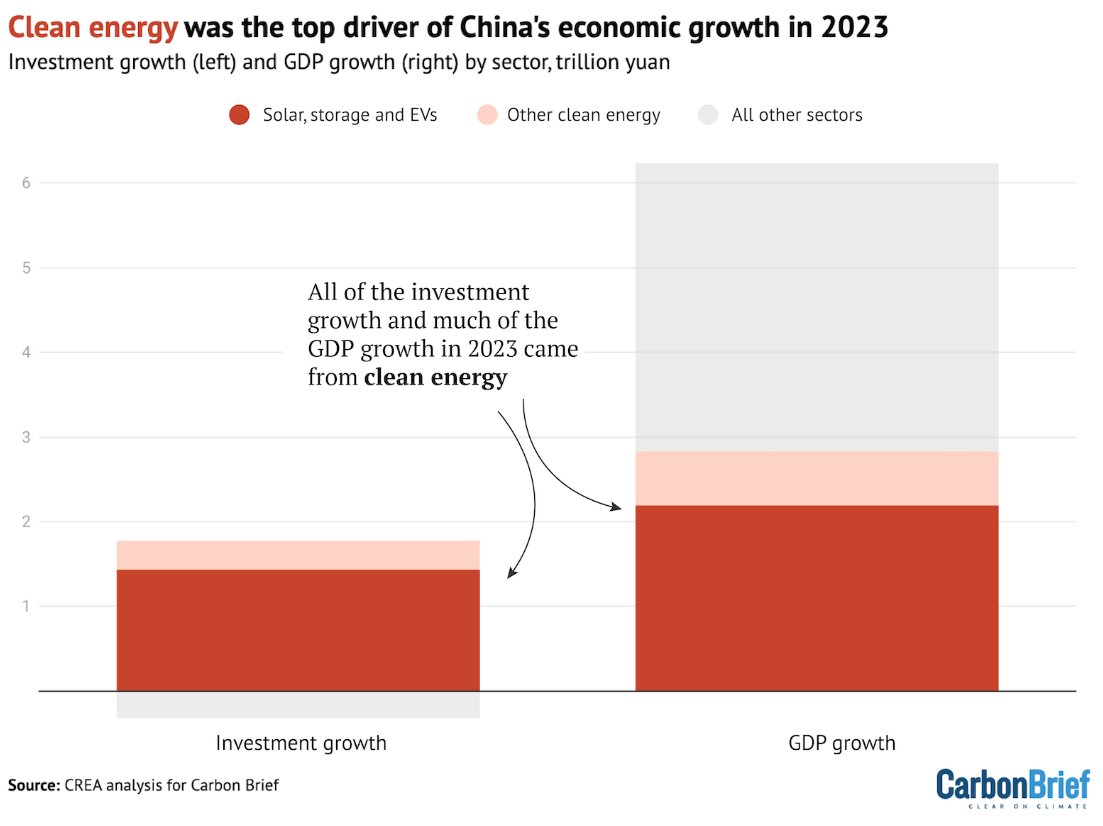
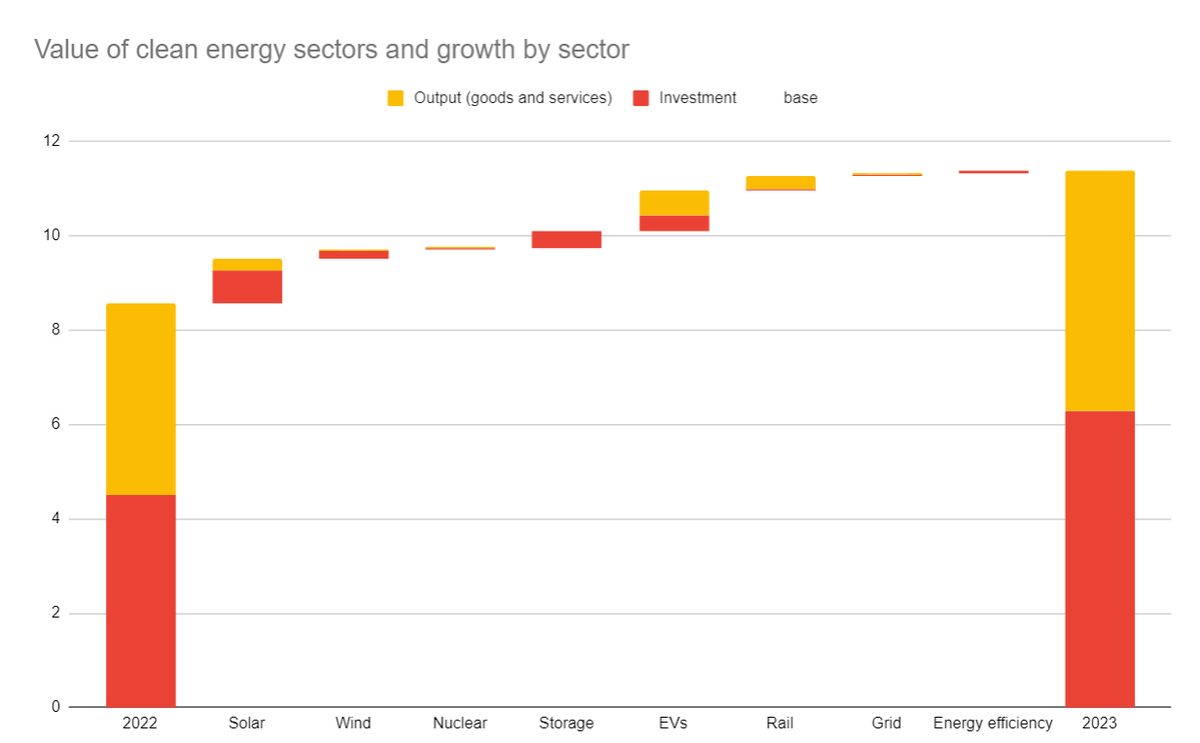
NEW: China’s unprecedented clean energy investment boom was the main driver of the country's economic growth in 2023. Without clean energy sectors, the country’s GDP would have grown by only 3% instead of 5.2%, missing the government’s target by a wide margin. Image
China’s investment in clean energy increased 40% on year, and rose to 5% of the country’s GDP, at 6.3tn yuan ($890bn). The investment spending is roughly equal to the GDP of Switzerland or Turkey. Investment in clean energy was responsible for all net growth in investment.
Including the value of production of goods and services, clean energy sectors contributed 9% of China’s GDP, up 30% year-on-year.
In one year, China:
*added >300 GW of solar manufacturing
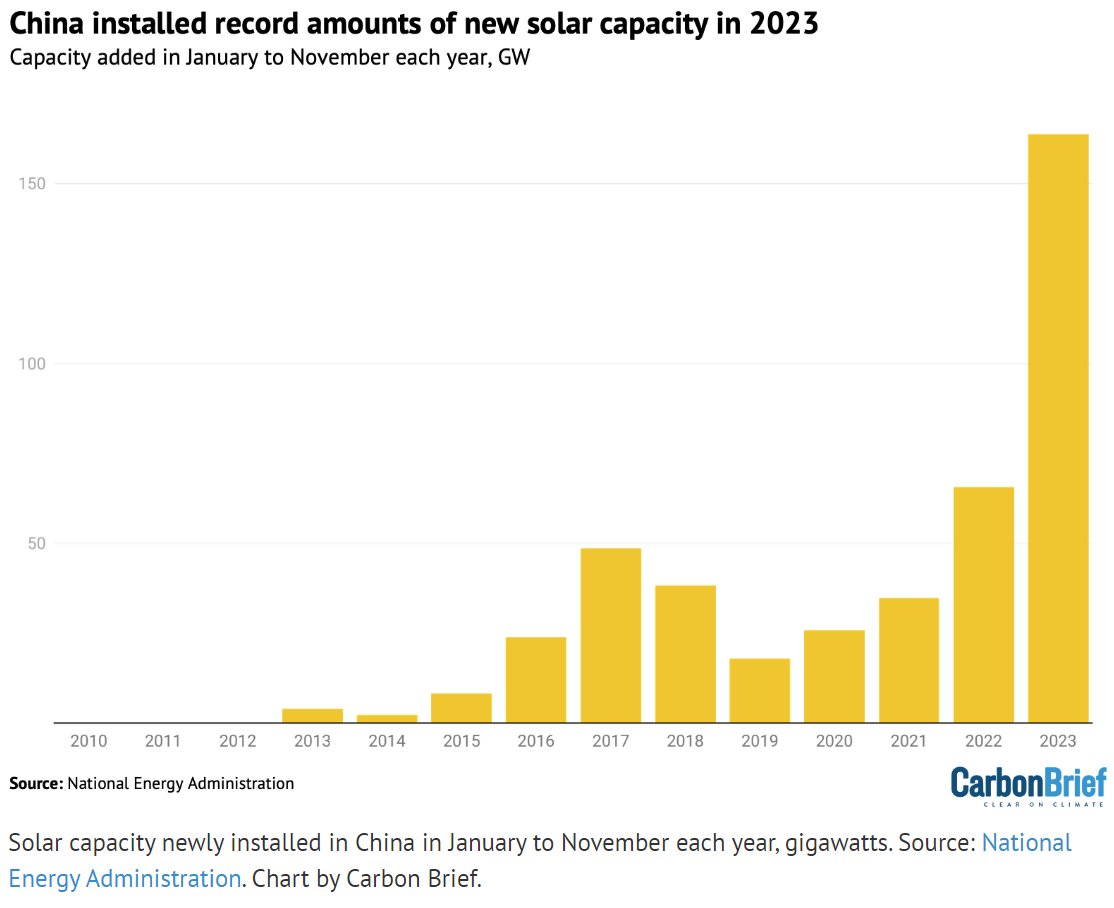
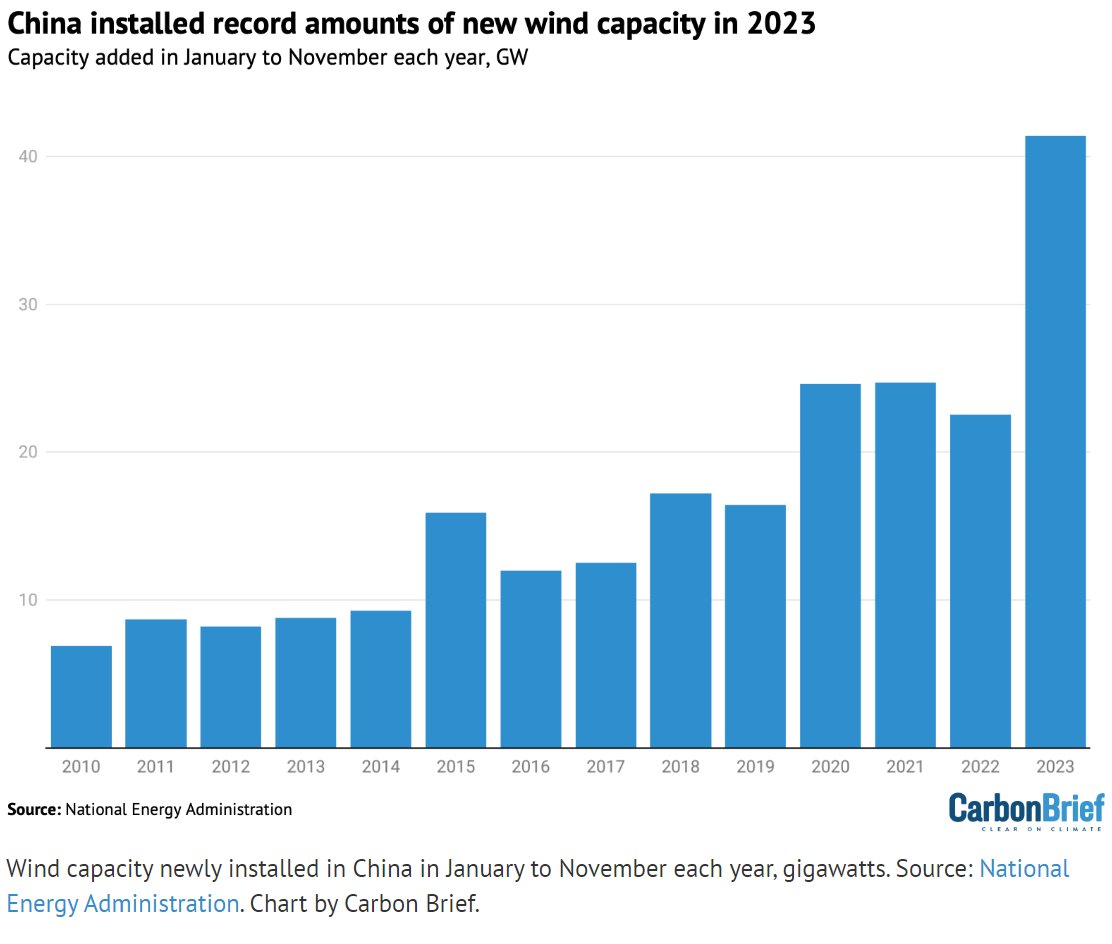
*added >200 GW solar and >60GW of wind power
*added batterymaking capacity equal to 16 Tesla Gigafactories
*started building 50 GW of pumped hydro
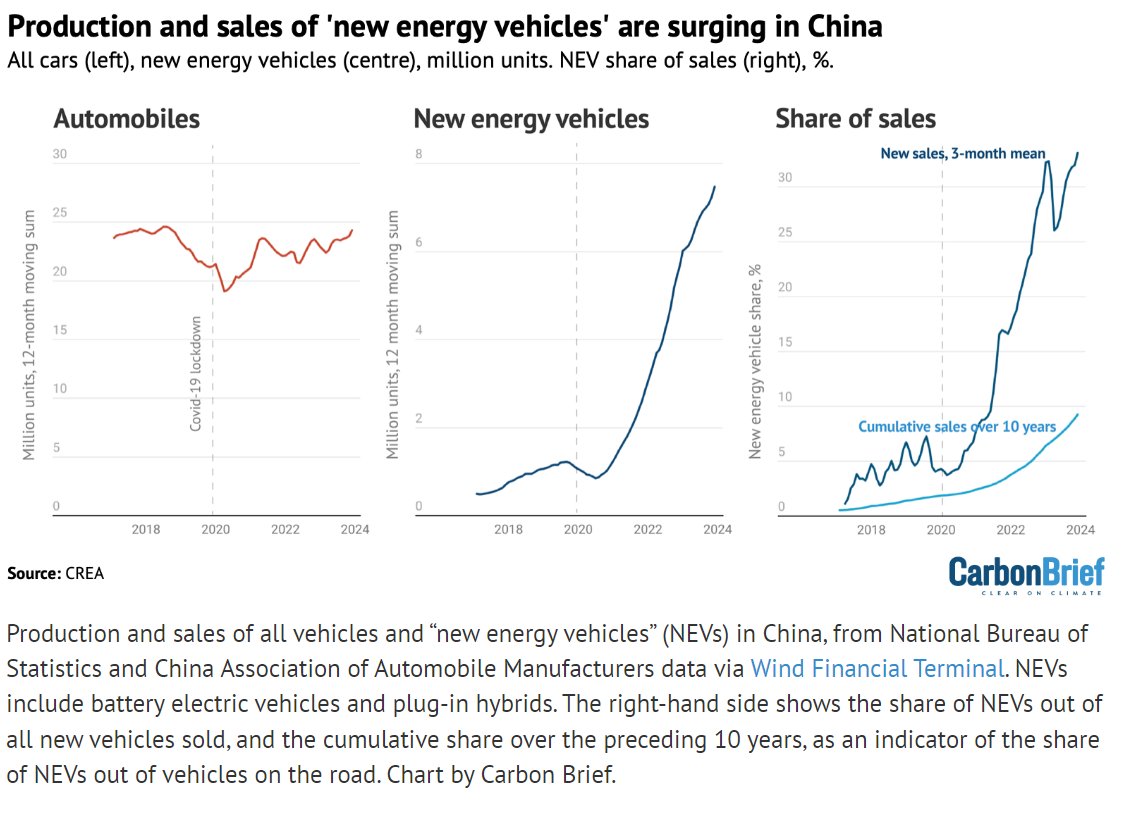
*produced 9.5mn EVs (vs 7.2mn in 2022)
*approved 10 new nuclear reactors
Image
Image
Image
The largest contributors to growth were solar power, EVs, energy storage and rail transportation, which all saw strong growth both in investment and in production of goods and services. Image
All in all, we estimated the value of economic activity in 22 different areas. The full article has the link to a spreadsheet with the references and the basis for the calculations.
carbonbrief.org/analysis-clean…
The clean energy boom marks a major pivot in China’s macroeconomic strategy, with the real estate sector contracting and investment shifting into manufacturing - primarily clean energy manufacturing. Local governments, state-owned enterprises and private capital all shifted.
This pivot was only possible because clean energy and industrial policy had built the foundation and scaled up these sectors, priming them for rapid growth. The real estate slump coincided with demand pull from clean energy technologies that had become economically competitive.
What are the implications of this clean energy boom?
1) With the accelerated deployment of clean energy, particularly solar, China’s emissions are much closer to peaking.
2) The clean energy industry has become a key part of China’s macroeconomic strategy, in addition to energy and industrial policy. After this huge bet on manufacturing, the government has an interest in making sure the demand is there, putting the transition on a firmer basis.
3) China now has a major stake in the success of clean energy in the rest of the world and in building up export markets - expect intensified efforts to finance and develop clean energy projects overseas.
4) Global emissions trajectories have been upended. China’s supply boom pushed down the prices of solar panels by 42% and batteries by 50% year-on-year. This, in turn, has encouraged much faster take-up of clean-energy technologies.
4, cont'd) The IEA projects that if global deployment of solar power and grid-connected batteries follows the expansion of manufacturing capacity, then global power-sector coal use and carbon dioxide emissions could be a sizable 15% lower than in the base case by 2030.
5) The manufacturing boom also cements China’s dominant position in supply chains. Other countries face a choice of benefiting from the low-cost supply, or paying the cost of building new supply chains. Such efforts would further increase supply and push down global prices.
6) The clean energy boom has given a new lease of life to China’s investment-led economic model. There are however limits to how much capital the sector can absorb so eventually, the economic model will has to be transformed to rely less on investment as a growth driver.
Read the full article here:
carbonbrief.org/analysis-clean…

• • •

Missing some Tweet in this thread? You can try to force a refresh

 

Keep Current with Lauri Myllyvirta

Lauri Myllyvirta Profile picture

Stay in touch and get notified when new unrolls are available from this author!

Read all threads

This Thread may be Removed Anytime!

PDF

Twitter may remove this content at anytime! Save it as PDF for later use!

Try unrolling a thread yourself!

how to unroll video
  1. Follow @ThreadReaderApp to mention us!

  2. From a Twitter thread mention us with a keyword "unroll"
@threadreaderapp unroll

Practice here first or read more on our help page!

More from @laurimyllyvirta

Jan 19
Big new environmental policy document from China's top decision-making bodies dropped while I was on my bourgeois Christmas vacation. Party Central Committee and State Council “Opinions on Comprehensively Promoting the Construction of a Beautiful China”. Highlights in a thread. Image
The document sets 2027 as a new, high-level milestone by which "green and low-carbon development will be further promoted". There are some meaningful targets for 2027 in this document and it is significant in speeding things up as it can provide a deadline for a lot of things.
"In 2025-35, accelerate green and low-carbon transformation in energy, industry, transportation, urban and rural construction, agriculture and other fields.

Focus on controlling the consumption of fossil energy such as coal ... and speed up building a new-type power system."
Read 15 tweets
Jan 2
2024 is the last year that we have a chance to avert a Russian attack against the European Union.

After 2024 we might still luck out, but it's going to be out of our hands.

THREAD.
If we don't demonstrate decisively that we're going to match and outdo Russia on military production, and Kremlin's preferred candidate wins the U.S. election, Ukraine will be left with grossly inadequate supplies to win.
Dangerously, we'd have demonstrated to Putin, that we're not able to get our act together, and installing a couple of pro-Kremlin govts can paralyze the EU. Failing to stand up to Putin in 2022 would've been a grave mistake, but standing up and then coming up short is even worse.
Read 17 tweets
May 31, 2023
Guangdong, the province that led China's coal plant permitting boom last year, published new power capacity targets for 2025. Changes from the early 2022 plan:
coal +19GW
gas -9GW
renewables +4GW
electricity storage +8GW

Huge increase in coal: from 68 GW now to ~95 GW in 2025.
The new plan shows how the panic about meeting peak loads, concerns about reliance on hydropower imports given risk of droughts, and the gas shortage / price surge is what drove the boom in new coal. Major acceleration of electricity storage as well.
However, the very modest increase in targeted power generation from clean energy, and an apparent increase in projected power demand, means that the targeted generation mix also became dirtier.
Read 7 tweets
Feb 27, 2023
NEW REPORT: Permitting of new coal plants surged in China, even as clean energy installations made new records. If China's going to meet its climate commitments these new coal power plants are going to end up as short-lived & under-utilized malinvestments.
energyandcleanair.org/publication/ch…
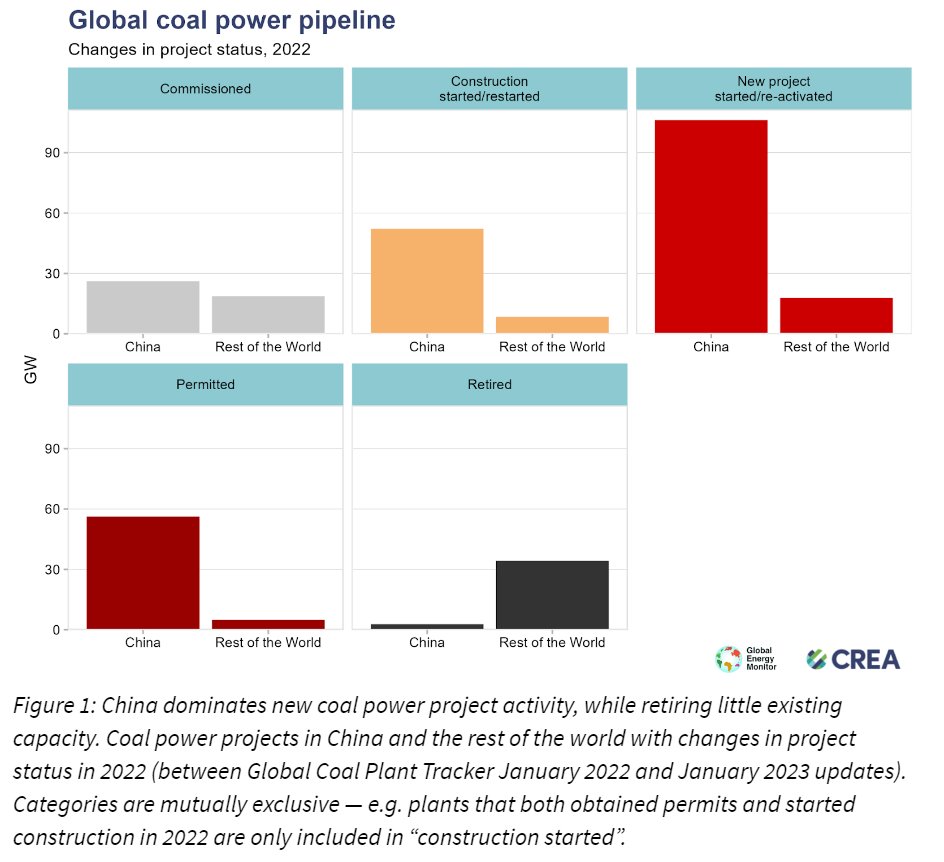
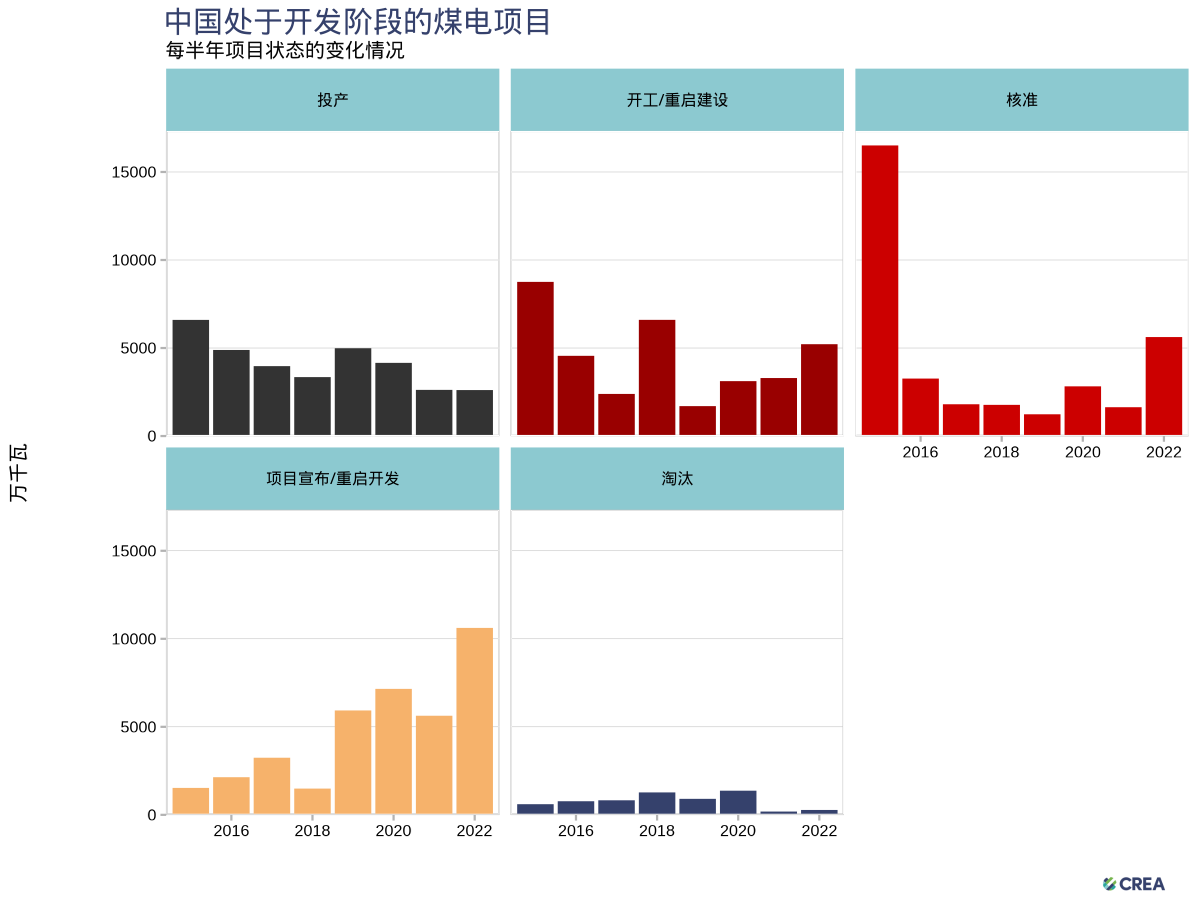
Chinese local governments permitted a staggering 106 gigawatts of new coal power capacity in 2022, equivalent to 100 large coal-fired power plants and the most since 2015. The amount of newly permitted capacity quadrupled from 2021.
Other coal power project activity accelerated as well, with 50% more construction starts & twice as much new capacity announced as in 2021. The capacity of coal power plants that started construction in China in 2022 was 6x as large as that of the rest of the world combined.
Read 25 tweets
Feb 26, 2023
Why did Germany increase coal consumption in 2022? It's the home stretch of Germany's nuclear phase-out, and for a couple of years, renewables growth didn't keep up with the amount of nuclear removed from the grid.
Just like with the rest of Europe, coal use stayed below pre-COVID trend.
Germany's renewables growth in the past decade has been impressive, but a lot has gone into replacing nuclear rather than fossil fuels. The good thing is that with the nuclear phase-out done, from next year on renewables growth will fully replace fossils.
Read 6 tweets
Feb 25, 2023
Here's how completely the "EU is going back to coal" reporting in 2022 misread the actual trends: coal consumption started rebounding in late 2020 from the COVID-19 lows. By 2022, the rebound was almost over and coal use never returned to pre-COVID trend.
chinadialogue.net/en/energy/ukra… Image
Fossil fuel prices skyrocketing after Russia started weaponizing gas supply to Europe in summer 2021 actually helped end the rebound in CO2 emissions sooner by lowering demand for electricity and gas. Power sector CO2 emissions and coal use started to fall in September 2022.
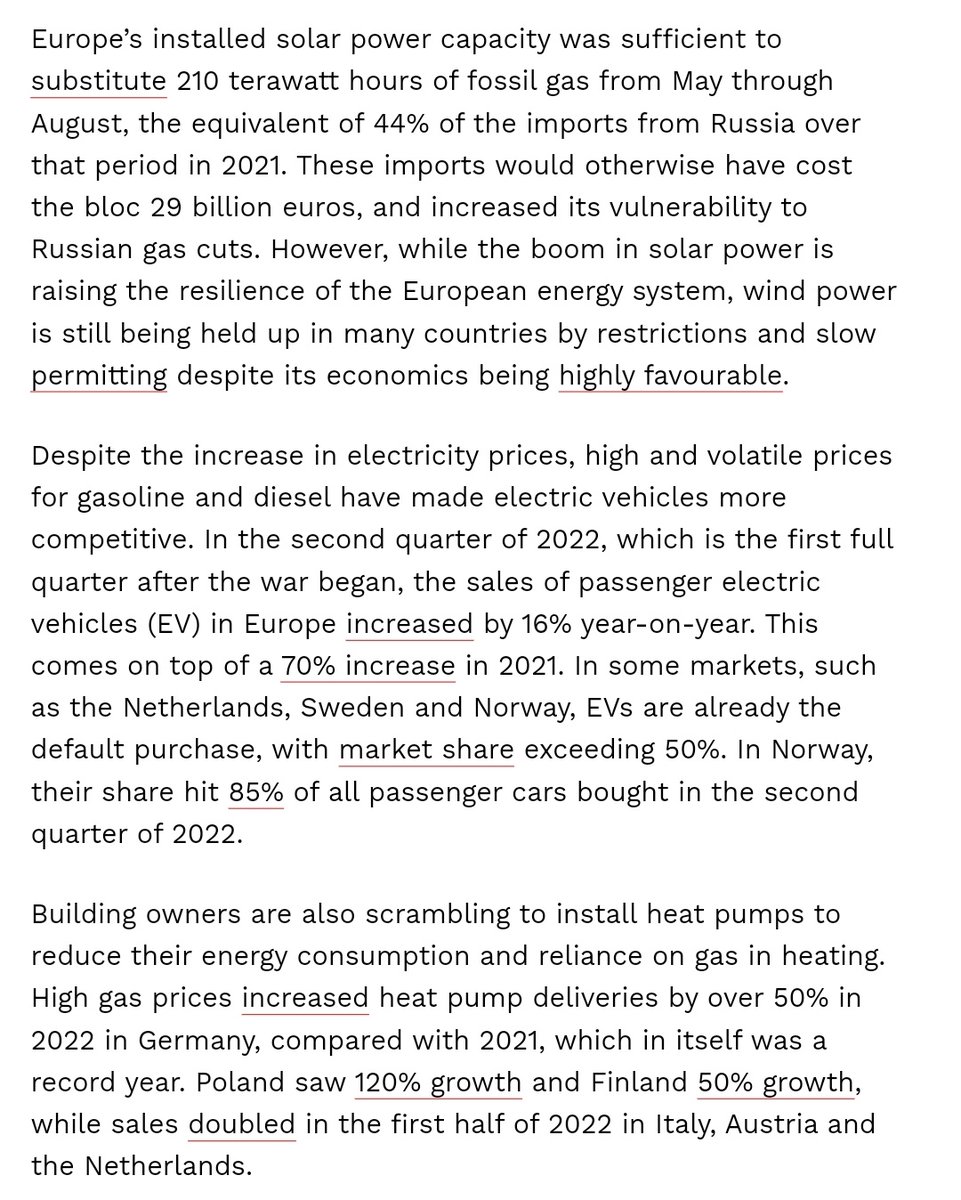
The fossil fuel price shock has driven record sales of solar panels, heat pumps and EVs across the EU, and government clean energy policies have been strengthened throughout the region. This will result in faster emissions reductions in the coming years. Image
Read 5 tweets

Did Thread Reader help you today?

Support us! We are indie developers!


This site is made by just two indie developers on a laptop doing marketing, support and development! Read more about the story.

Become a Premium Member ($3/month or $30/year) and get exclusive features!

Become Premium

Don't want to be a Premium member but still want to support us?

Make a small donation by buying us coffee ($5) or help with server cost ($10)

Donate via Paypal

Or Donate anonymously using crypto!

Ethereum

0xfe58350B80634f60Fa6Dc149a72b4DFbc17D341E copy

Bitcoin

3ATGMxNzCUFzxpMCHL5sWSt4DVtS8UqXpi copy

Thank you for your support!

Follow Us!

:(