Yesterday, @VitalikButerin published an insightful blog post about the interactions between blockchain and AI. This is a topic we've explored extensively at @Kleros_io, particularly from the perspective of dispute resolution.
Here is a thread detailing some of our findings. 👇
Here is a thread detailing some of our findings. 👇
https://twitter.com/VitalikButerin/status/1752291413503729751
In 2018, we launched a cryptoeconomic experiment titled 'Doges on Trial,' where the community was tasked with curating a list of Doge images.
We utilized pattern recognition software, and the AI generally performed well in identifying whether an image was a Doge. However, it encountered challenges in certain instances, such as this one, necessitating human intervention.
We utilized pattern recognition software, and the AI generally performed well in identifying whether an image was a Doge. However, it encountered challenges in certain instances, such as this one, necessitating human intervention.

Our findings were summarized in the article: “Collective vs. Artificial Intelligence: What We Learned by Sending Dogs to Court”
blog.kleros.io/decentralized-…
blog.kleros.io/decentralized-…
Since that time, our thesis has been that the future of dispute resolution will be divided among three primary technologies:
1) AI for simpler and more objective cases.
2) Decentralized justice for somewhat more complex cases that involve greater subjectivity.
3) Traditional dispute resolution methods for the most complex cases, including those requiring advanced legal reasoning.
1) AI for simpler and more objective cases.
2) Decentralized justice for somewhat more complex cases that involve greater subjectivity.
3) Traditional dispute resolution methods for the most complex cases, including those requiring advanced legal reasoning.
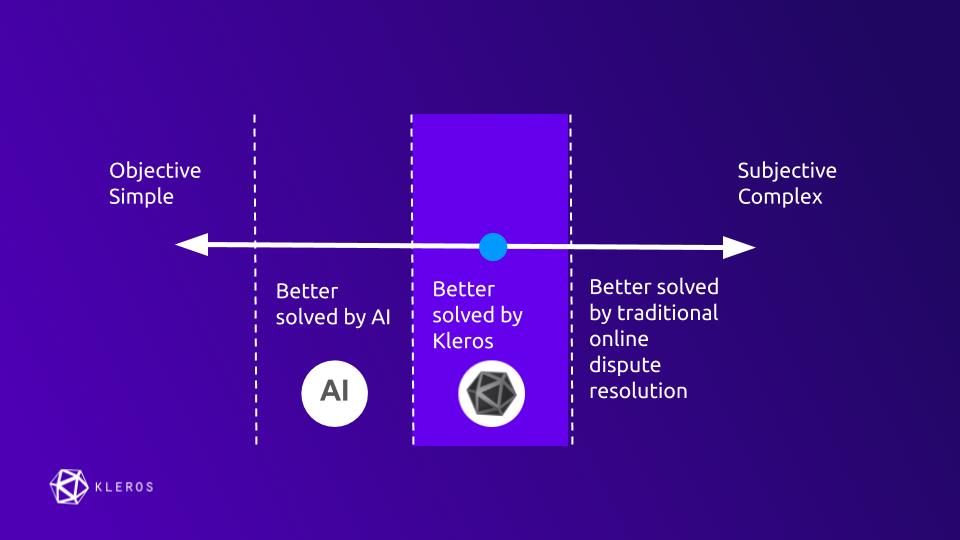
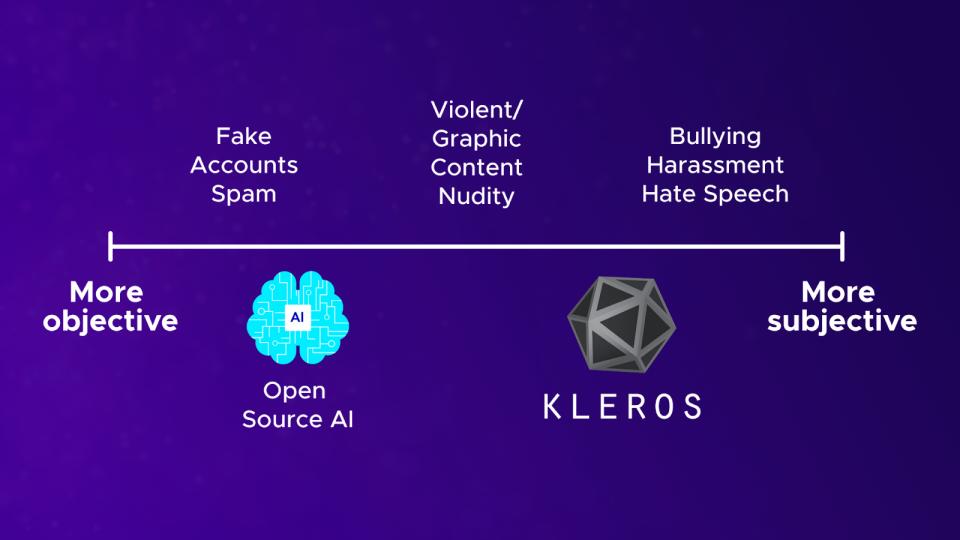
A good example of this is content moderation.
Social media platforms have devised algorithms to identify straightforward violations of terms and conditions, such as spam.
However, they still rely on human moderators for more intricate scenarios, like online harassment. Detecting such issues is more challenging for AI, as it involves understanding context and human emotions.
This is the layer where Kleros could help.
Moreover, companies like @Meta have established a kind of 'supreme court' to handle cases of even higher complexity, which require specialized training to evaluate morally charged situations which impact fundamental rights, such as free of speech.
Social media platforms have devised algorithms to identify straightforward violations of terms and conditions, such as spam.
However, they still rely on human moderators for more intricate scenarios, like online harassment. Detecting such issues is more challenging for AI, as it involves understanding context and human emotions.
This is the layer where Kleros could help.
Moreover, companies like @Meta have established a kind of 'supreme court' to handle cases of even higher complexity, which require specialized training to evaluate morally charged situations which impact fundamental rights, such as free of speech.
To learn more, check the talk “Decentralized Justice: Protecting Free Speech Online” I gave at the 2021 Ethereum Paris conference.
youtube.com/live/VVX_kNHYu…
youtube.com/live/VVX_kNHYu…
Here's a slide from that presentation which illustrates how I envision the application of various technologies for different types of use cases.
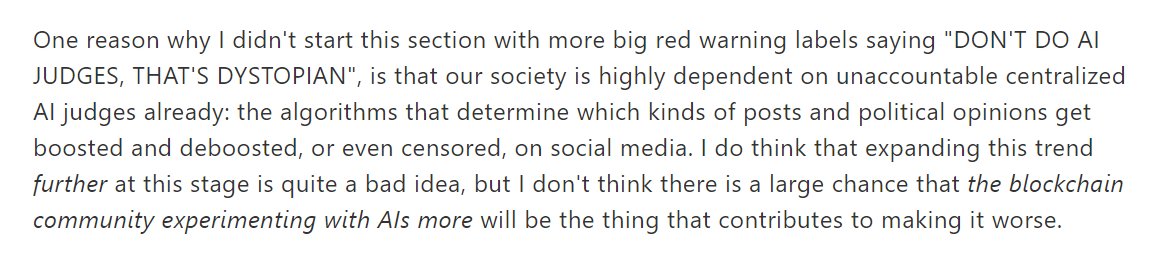
In his post, @VitalikButerin writes: "DON'T DO AI JUDGES, THAT'S DYSTOPIAN".
This is a topic we have long researched at Kleros.
This is a topic we have long researched at Kleros.
Machine learning models, when applied to dispute resolution, face two primary issues:
1) They may inherit biases from their training datasets.
2) They lack the ability to explain their decisions.
If your case is unsuccessful, it's crucial that you know that you had a 'fair trial' and that you understand the reasons why you lost.
However, machine learning models currently fail to provide either of these assurances.
1) They may inherit biases from their training datasets.
2) They lack the ability to explain their decisions.
If your case is unsuccessful, it's crucial that you know that you had a 'fair trial' and that you understand the reasons why you lost.
However, machine learning models currently fail to provide either of these assurances.
A justice system primarily reliant on algorithmic decisions would be termed an 'algocracy,' a concept coined by John Danaher.
These systems operate in manners that remain inaccessible or opaque to human reasoning and understanding.
link.springer.com/article/10.100…
These systems operate in manners that remain inaccessible or opaque to human reasoning and understanding.
link.springer.com/article/10.100…
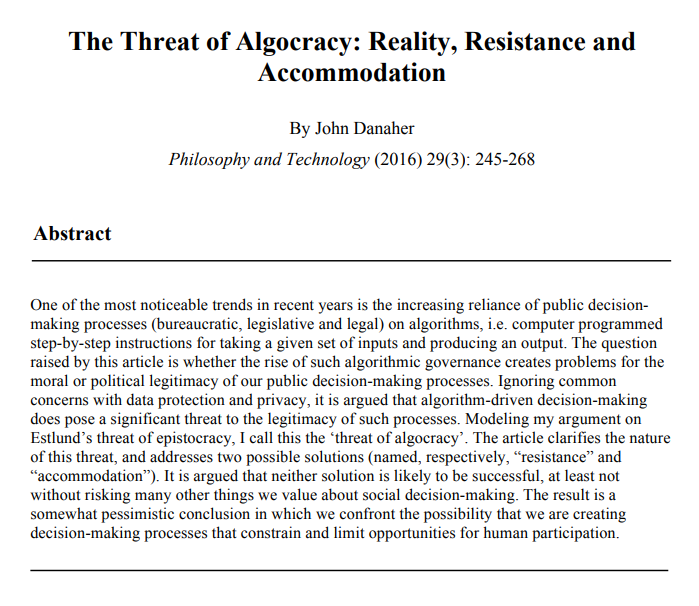
Due to this threat, regulatory frameworks such as the European Union's AI Act and the United States' AI Bill of Rights mandate human oversight in algorithmic decision-making.
But it's not that easy.
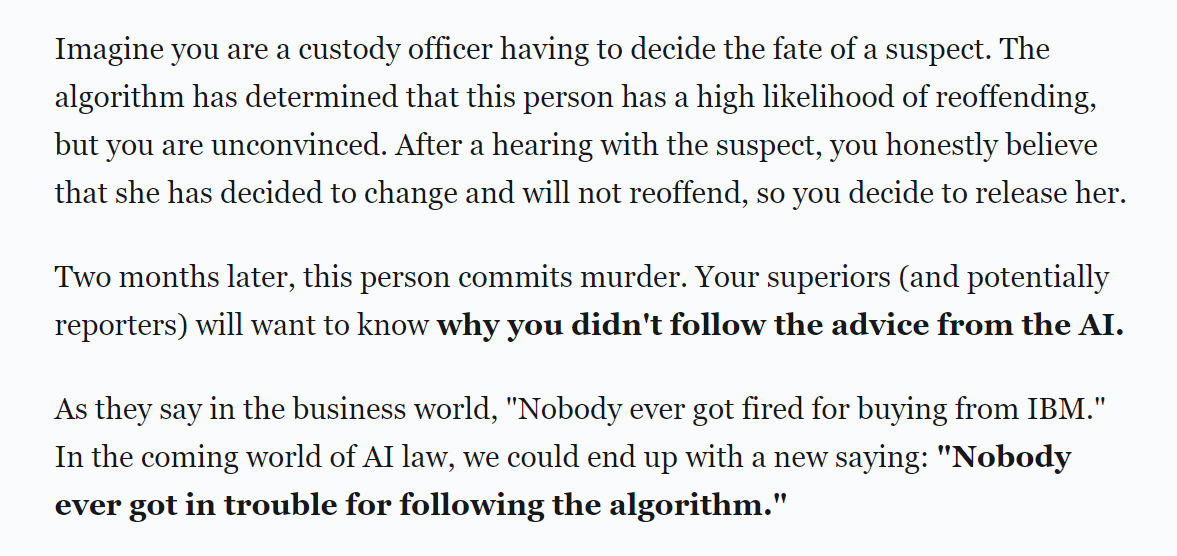
Even if humans are formally in control 'for compliance reasons', the actual decision-making power could ultimately reside with AI, as 'Nobody ever got into trouble for following the algorithm'.
Even if humans are formally in control 'for compliance reasons', the actual decision-making power could ultimately reside with AI, as 'Nobody ever got into trouble for following the algorithm'.
To prevent this, AI governance will play a critical role. And Kleros could make a big contribution to the mechanism design necessary to avoid descending into an algocracy.
For more information, I invite you to read 'Overcoming Algocracy: AI, Blockchain and Crowdsourcing for Designing Better Dispute Systems', a guest post I published in December 2023 in the newsletter of the @ABAesq.
blog.kleros.io/overcoming-alg…
For more information, I invite you to read 'Overcoming Algocracy: AI, Blockchain and Crowdsourcing for Designing Better Dispute Systems', a guest post I published in December 2023 in the newsletter of the @ABAesq.
blog.kleros.io/overcoming-alg…
The greatest benefits of AI are realized when it is integrated with human methods.
Our community member @robertgdean developed Harmony, the Kleros Mediator Bot. This GPT model functions as a mediator and transfers cases to Kleros courts when no settlement is reached.
Learn more here!
blog.kleros.io/harmony-the-kl…
Our community member @robertgdean developed Harmony, the Kleros Mediator Bot. This GPT model functions as a mediator and transfers cases to Kleros courts when no settlement is reached.
Learn more here!
blog.kleros.io/harmony-the-kl…
Combined with voice recognition, Harmony can give you a glimpse of what the future of dispute resolution might look like. 🤯
In summary, we have made significant progress since our early experiments with AI in 'Doges on Trial'.
AI in dispute resolution presents both advantages and risks.
However, when combined with human approaches, AI becomes a remarkable tool capable of greatly facilitating access to justice.
At Kleros, we are excited about the development of innovative dispute resolution systems that will contribute to improving access to justice!
AI in dispute resolution presents both advantages and risks.
However, when combined with human approaches, AI becomes a remarkable tool capable of greatly facilitating access to justice.
At Kleros, we are excited about the development of innovative dispute resolution systems that will contribute to improving access to justice!
• • •
Missing some Tweet in this thread? You can try to
force a refresh