
Yesterday Israeli forces disguised as medical staff and civilians reportedly entered a hospital in the West Bank and extra-judicially killed 3 wounded combatants. If true, this is a war crime, and possibly a crime against humanity. 🧵 aljazeera.com/news/2024/1/30…
First, the law of occupation and international humanitarian law/law of war apply *simultaneously* in Palestine. This means the occupier uses force in accordance with both police powers and military powers. It also means that international human rights law applies alongside IHL.
According to IHL and the Israeli Supreme Court (Justice Barak writing, the same ad hoc judge appointed in the ICJ genocide case), combatants who don't meet the requirements for lawful combatant status (see art 4(2)(a) of the third Geneva Convention) are, in effect, civilians.
For the relevant portions of the so-called Targeted Killings case, see: casebook.icrc.org/case-study/isr…
Another way of saying this is that they are unprivileged combatants or, to use U.S. war on terror parlance, so-called 'unlawful combatants'. This means that they lose their protection from targeting under IHL 'unless and for such time as they take a direct part in hostilities.'
For more on this, see the ICRC's customary IHL database here: ihl-databases.icrc.org/en/customary-i…
Crucially also, unprivileged combatants can be prosecuted for their very participation in hostilities. (Keep this in mind).
So, even *if* we accept that the combatants targeted in the hospital were unprivileged/'unlawful', we need to ask if they were taking a direct part in hostilities while in their hospital beds.
Note: the Targeted Killings case takes a narrow view of the 'for such time' component.
Note: the Targeted Killings case takes a narrow view of the 'for such time' component.
If the answer is 'no', then the killings are unlawful and criminal.
If the combatants targeted were injured, then they are considered 'hors de combat' and by definition not taking part in hostilities and must be protected from attack under the first Geneva Convention.
If the combatants targeted were injured, then they are considered 'hors de combat' and by definition not taking part in hostilities and must be protected from attack under the first Geneva Convention.
Israel has suggested the combatants were using the hospitals as 'shields' while they conducted planning for attacks. Even *if true*, this would not automatically remove their protected status.
cnn.com/2024/01/30/mid…
cnn.com/2024/01/30/mid…
Part of the protection due to these combatants flows from the specifically protected status of hospitals under IHL. Hospitals *themselves* are protected from attack unless they are being used to conduct acts harmful to the enemy.
For more: icrc.org/en/document/pr…
For more: icrc.org/en/document/pr…
It can get a little murky when a hospital becomes the site of an attack - as here - but is not itself the target of the attack. But what's clear is that special consideration must be had to the impacts of attacks that take place in hospitals.
Impacts on the civilian population are key to the proportionality analysis & impacts on the capacity of hospitals to fulfill their humanitarian purpose must also be assessed. This is why the U.S. has said it 'doesn't want to see firefights in hospitals': politico.com/news/2023/11/1…
Ok, so now let's assume -- and this is conceding *a lot* already, as you can see -- that the combatants were not protected in the hospital. Does this mean that they can be lawfully targeted using lethal force? Nope. Not so fast.
Let's go back to the Israeli Supreme Court. It said targeted killings are neither 'always permissible' nor are they 'always forbidden'. Barak writes: "Harming such civilians, even if the result is death, is permitted, on the condition that there is *no other less harmful means*."
(My emphasis added). What Justice Barak is doing here is recognizing that the right to life, protected under IHRL, still operates. In situations of occupation, maintaining public order means that kind of force used must be commensurate with the level of actual threat faced.
So while there is no affirmative obligation capture, rather than kill, combatants under IHL, the occupation framework creates this obligation where capture is feasible -- this is an example of the 'less harmful means' of addressing the threat that Justice Barak is talking about.
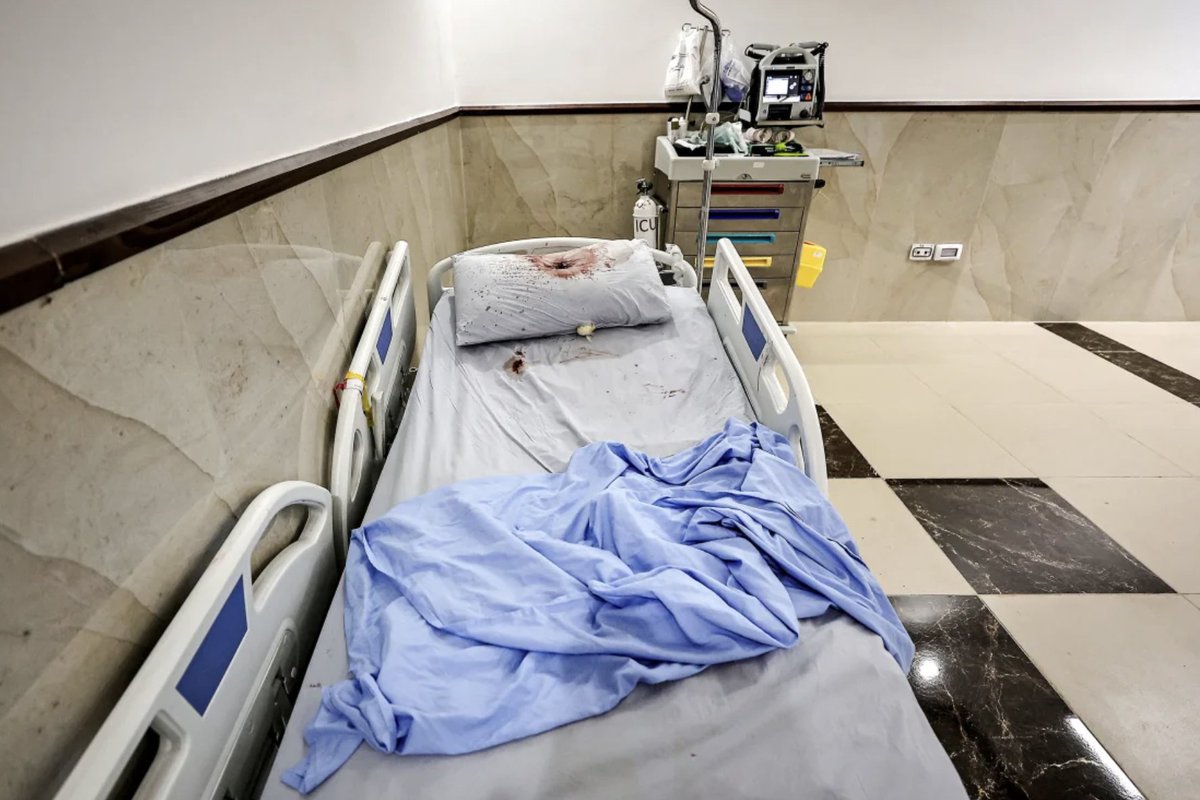
Now, let's apply the law to the facts. Take a look at this photo from the hospital in Jenin. It supports the hospital staff's claim that the combatants were killed while sleeping in their hospital beds. We must ask: was there a less harmful means? Could they have been captured? 
Note: I haven't even addressed the question of perfidy here, which has been ably dealt with by @JaninaDill. See:
https://x.com/JaninaDill/status/1752332461458051275?s=20
Note as well: Israel's practice has since departed from Justice Barak's ruling. It now says it can kill combatants based on mere membership in an armed group, regardless of their actual participation in hostilities. This is very controversial & inconsistent with IHRL obligations.
• • •
Missing some Tweet in this thread? You can try to
force a refresh





