Maksimologija Profile picture
Feb 2, 2024 9 tweets 3 min read Read on X
Since it's come up again, let's remember the Orthodox doctrine of the divine-human hypostasis of Christ.

A 🧵
1. Through the incarnation, the hypostasis of the Divine Logos assumed human nature.

— So the incarnate Logos is not only God by nature, but also man by nature.
2. Through the incarnation, the divine nature and the human nature are united without confusion.

— So the divine nature and human nature are not fused into some new hybrid “synthetic nature.”
3. Through the incarnation, the divine nature and the human nature are united without change.

— So the divine nature does not change into something it wasn't before.
— And the human nature does not change into something it wasn't before.
4. Through the incarnation, the divine nature and the human nature are united in the one hypostasis of the divine Logos.

— So, in the incarnate Logos, the hypostasis of the divine nature is one and the same as the hypostasis of the human nature.
5. The incarnation of the divine Logos did not create a new hypostasis.

— The hypostasis of the Logos is pre-eternal and did not begin to exist at the incarnation.
— No new hypostasis began to exist with the incarnation.
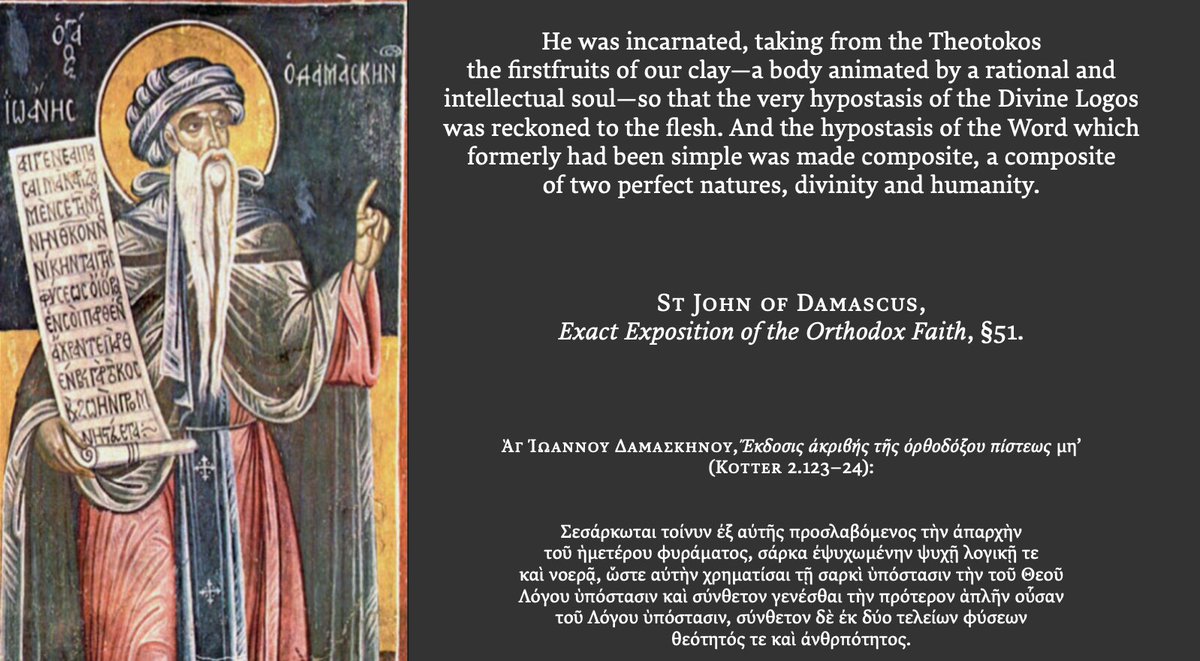
6. Through the incarnation, the hypostasis of the divine Logos became composite.

— Before the incarnation, the hypostasis of the Logos was simple, since it was in only one nature.
— After the incarnation, the hypostasis of the Logos is composite, since it is in two natures. Image
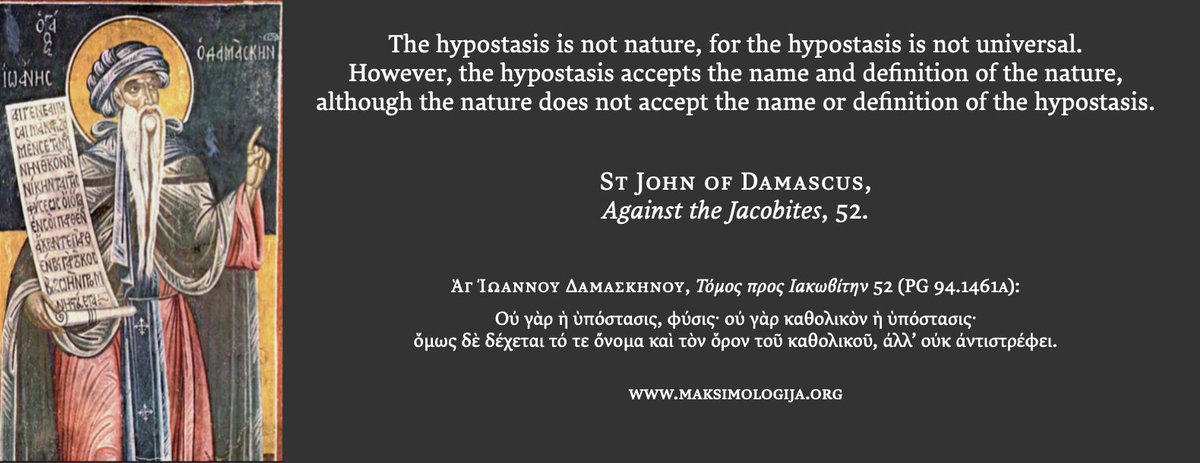
7. Through the incarnation, the hypostasis of the divine Logos became a divine-human hypostasis.

—The hypostasis takes the name of the nature.
—By nature, the incarnate Logos is both divine and human.
—So the hypostasis of the incarnate Logos is a divine-human hypostasis. Image
8. Through the incarnation, the hypostasis of the divine Logos became one of the hypostases of humanity.

— The hypostasis takes the name of the nature.
— The incarnate Logos is human by nature.
— So the one hypostasis of the incarnate Logos is one of the hypostases of humanity Image

• • •

Missing some Tweet in this thread? You can try to force a refresh

 

Keep Current with Maksimologija

Maksimologija Profile picture

Stay in touch and get notified when new unrolls are available from this author!

Read all threads

This Thread may be Removed Anytime!

PDF

Twitter may remove this content at anytime! Save it as PDF for later use!

Try unrolling a thread yourself!

how to unroll video
  1. Follow @ThreadReaderApp to mention us!

  2. From a Twitter thread mention us with a keyword "unroll"
@threadreaderapp unroll

Practice here first or read more on our help page!

More from @maksimologija

Nov 20, 2025
Since people are asking:

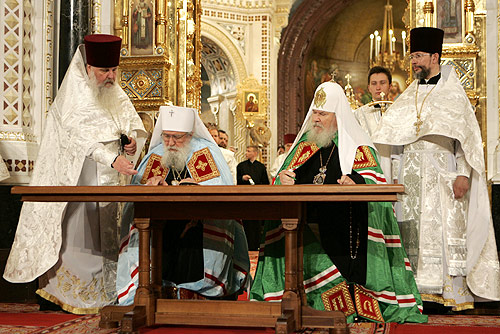
—Yes, ROCOR is in communion with the Moscow Patriarchate.
—No, ROCOR is not a part of the Moscow Patriarchate.
—And no (with only one obscure exception) ROCOR is not in any sense bound by the decisions of the Moscow Patriarchate.

A 🧵: Image
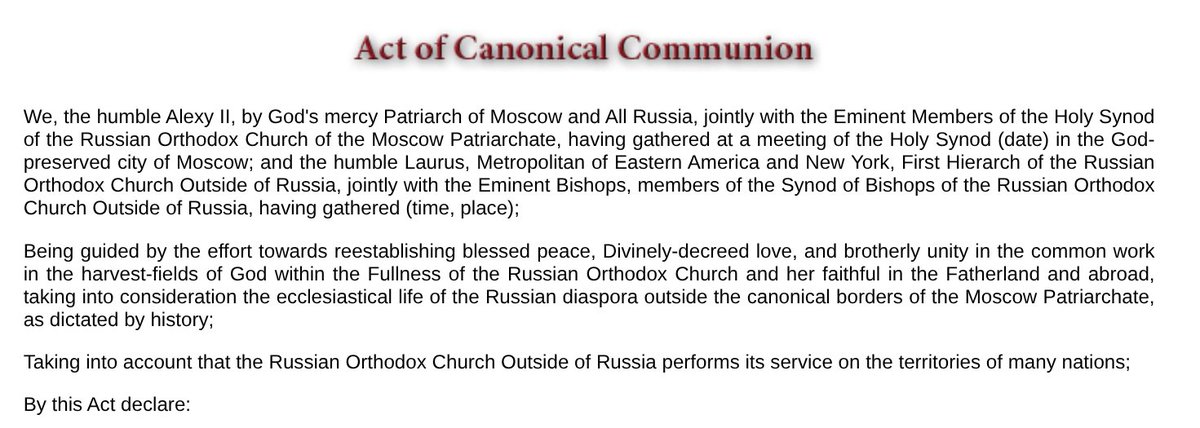
1. With the 2007 Act of Canonical Communion, ROCOR entered into communion with the Moscow Patriarchate.

This is obvious from the title of the Act: Image
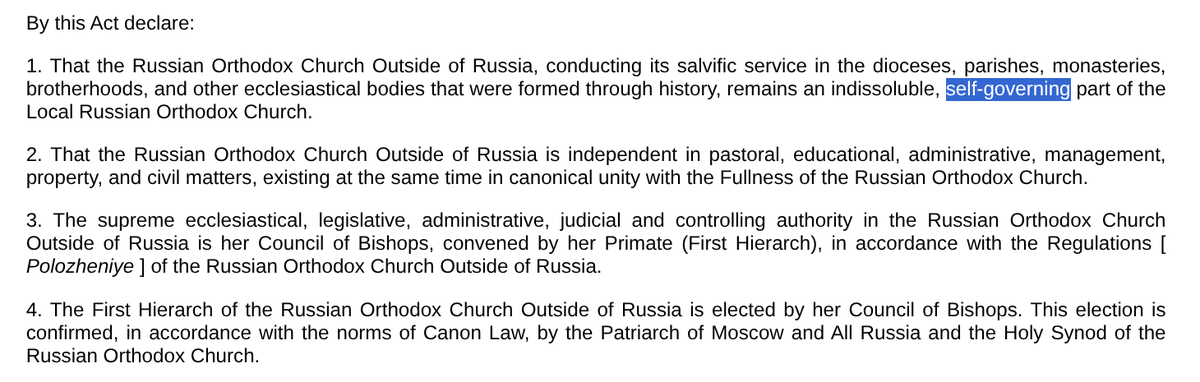
2. However, whilst ROCOR entered into communion with the MP, ROCOR remained SELF-GOVERNING. (I.e. it is not governed by Moscow, and hence is not a part of the MP.) This is made clear in Article 1 of the Act: Image
Read 11 tweets
Feb 20, 2025
Since @SifiReturned is determined to obfuscate, let's look more carefully at Patriarch Bartholomew's claim that, in the Orthodox Church, the Greek race is superior to Slavs. Image
First of all Patriarch Bartholomew's words are very clear.

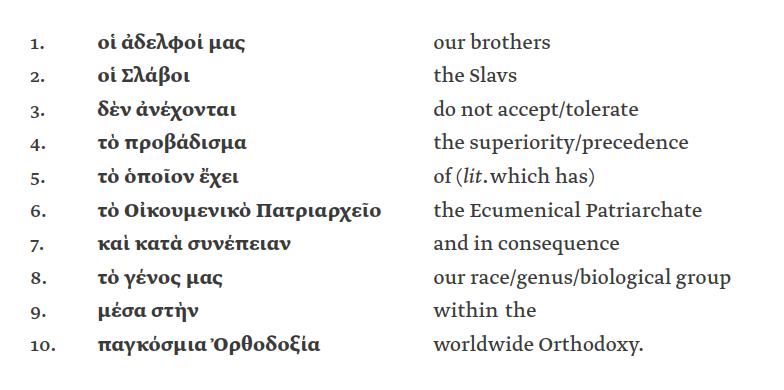
Den antechontai i adelfoi mas i Slavi, to provadisma to opion echei to Ikumeniko Patriarcheio kai kata synepeian to yenos mas, mesa stin pankosmia Orthodoxia

Hear his words; there's no mistake in the transcription:
Secondly, the grammar and meaning of his words are equally clear, and present no difficulties.

Here they are: Image
Read 21 tweets
Feb 18, 2025
Do you agree with Patriarch Bartholomew's declaration that, within the Orthodox Church, Slavs are racially inferior to Greeks? Image
Patriarch Bartholomew's comments were widely reported in the Greek media, but without any objection to his racial inferiorization of Slavs. Image
Image
Image
Image
Is it really possible to belong to a Church whose leading hierarch openly proclaims his own racial superiority over other ethnic groups, and whose racist claims are accepted unchallenged within that Church?
Read 8 tweets
Jul 4, 2024
We often hear universalists tell us that there could be no everlasting hell, because no creature could finally resist God as the ultimate good.

However, their argument suffers from more problems than they admit, and in fact we should reject it firmly and finally.

A 🧵 Image
According to the universalist:

—God has ordered things so that man will finally be unable to freely persist in the rejection of God.

—By nature, man longs for satisfaction through particular "configurations and resources". His freedom is subordinate to this. Image
Here, there are three main problems:

— the conception of freedom;
— the conception of God; and
— the absence of Christ.

Let's take a look.
Read 25 tweets
Dec 15, 2023
Does St Basil the Great say that the Son is the cause of the Holy Spirit?

A friendly critique of @MilitantThomist's recent apologetic. 🧵

youtube.com/live/hVTk-HXOc…
1. Recently, @MilitantThomist has been arguing that, in Contra Eunomium 3.1, St Basil the Great states the Son to be a cause of the Holy Spirit—& hence to affirm a filioquist triadology.

This argument has been effective against Dyerites, who have struggled to respond to it.
2. However, as MT's claim not only attacks Dyerism, but also poses a challenge to genuine Orthodoxy. So it seems worth offering a response to MT's claim.
Read 21 tweets
Aug 10, 2023
This is an interesting post about the Greek term Logos in the Gospel of John.

However, I see things rather differently, and so I'm going to present here a somewhat different account.

A critical 🧵:
1. In fact, the basic meaning of λόγος is not to do with speech at all. Rather, most basically and originally, a λόγος is a "gathering" or "collection".

(Indeed, the very element "...lect..." in "collection" is etymologically cognate to λόγος.)

Cf. λέγειν in Homer, Il. 23.239: Image
In this basic sense, a λόγος has a twofold aspect: it is both an assembly of things and a laying them out, so that they are both united and distinguished.

(Cf. how a coin collection is not just a unity of coins, but also a unity which displays the coins in their differences.)
Read 14 tweets

Did Thread Reader help you today?

Support us! We are indie developers!


This site is made by just two indie developers on a laptop doing marketing, support and development! Read more about the story.

Become a Premium Member ($3/month or $30/year) and get exclusive features!

Become Premium

Don't want to be a Premium member but still want to support us?

Make a small donation by buying us coffee ($5) or help with server cost ($10)

Donate via Paypal

Or Donate anonymously using crypto!

Ethereum

0xfe58350B80634f60Fa6Dc149a72b4DFbc17D341E copy

Bitcoin

3ATGMxNzCUFzxpMCHL5sWSt4DVtS8UqXpi copy

Thank you for your support!

Follow Us!

:(