Heatloss Profile picture
Feb 12, 2024 23 tweets 12 min read Read on X
The US Navy, like the US Air Force, wanted a better solution for bomber interception after the end of the Second World War.
The engineers at Naval Ordnance Test Station China Lake came up with a low-cost, simple, and highly reliable missile. The Sidewinder. 🧵 Image
A short admin note. I'm going to start by explaining the function of 9A/B, then do my best to track the changes between 9B to 9D, then cover the combat record of 9B and 9D, the development of SEAM and 9G/H, and maybe on to 9L. These different stages will be different threads.
First, AIM-9A/Sidewinder 1/Sidewinder Mk. 2 Mod 0. This version of the Sidewinder was mostly used for initial operational testing and evaluation, but the basics of Sidewinder guidance were pioneered here. (Two pictures are supplied because AIM-9A descriptions & depictions vary)
Image
Image
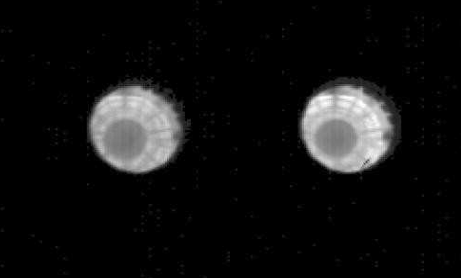
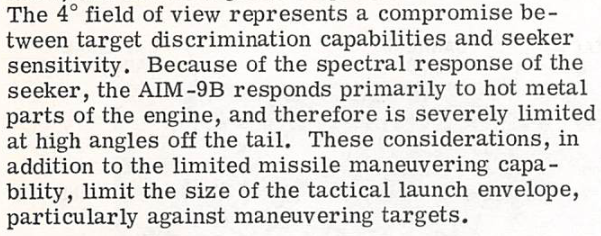
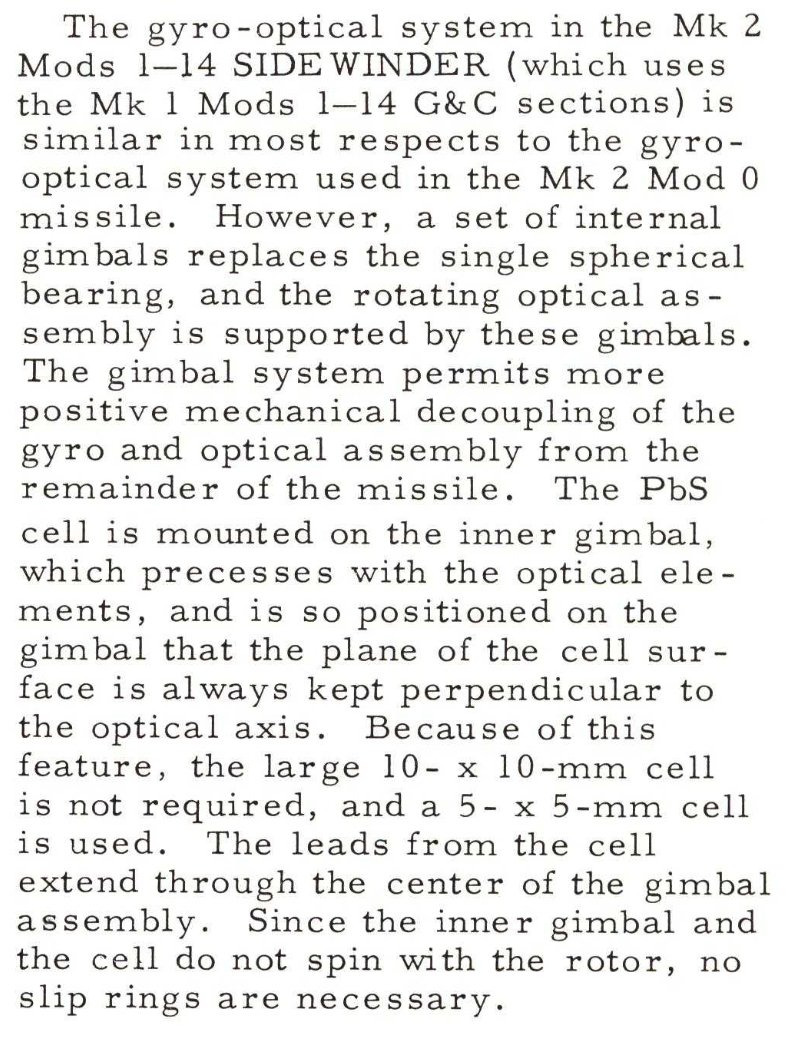
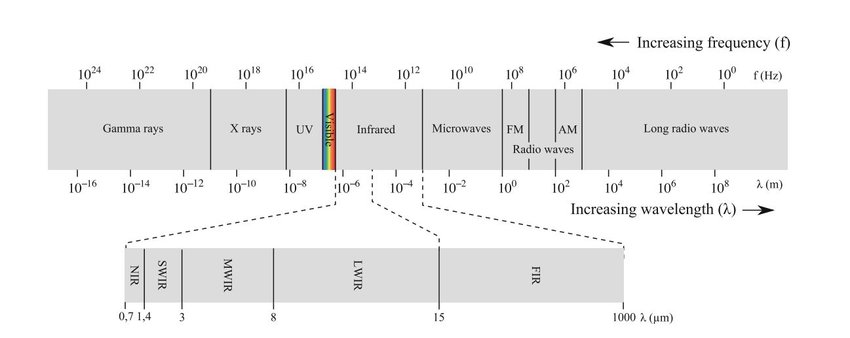
To explain the guidance loop, you need to know how the missile sees the target. The detector material used in the rear-aspect AIM-9s is Lead Sulfide, or PbS. When uncooled, it is sensitive in short-wave infrared. In SWIR, exhaust plumes are invisible, and engine metal is visible.

Image
Image
Image
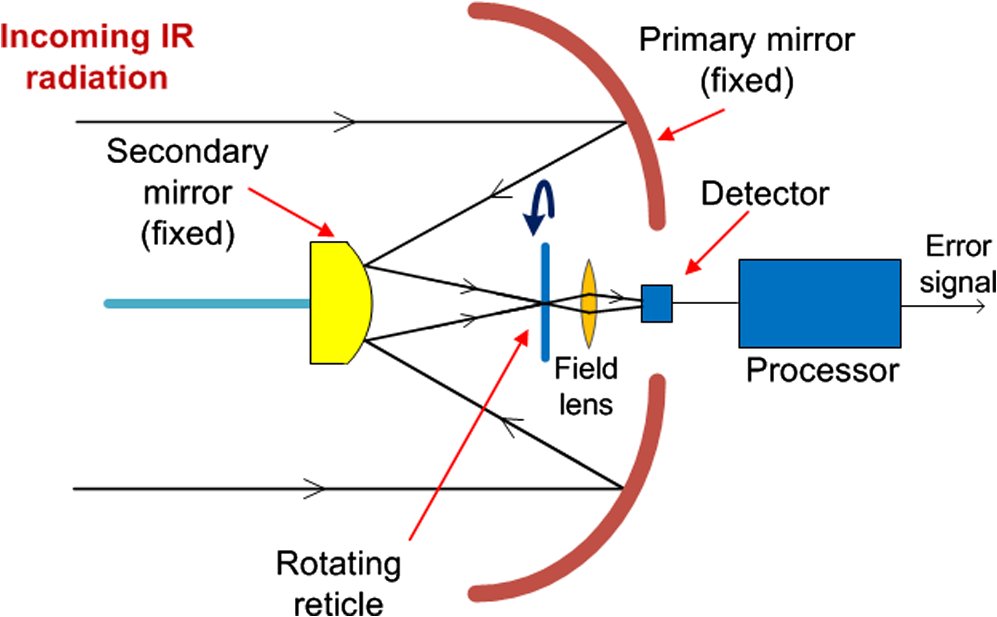
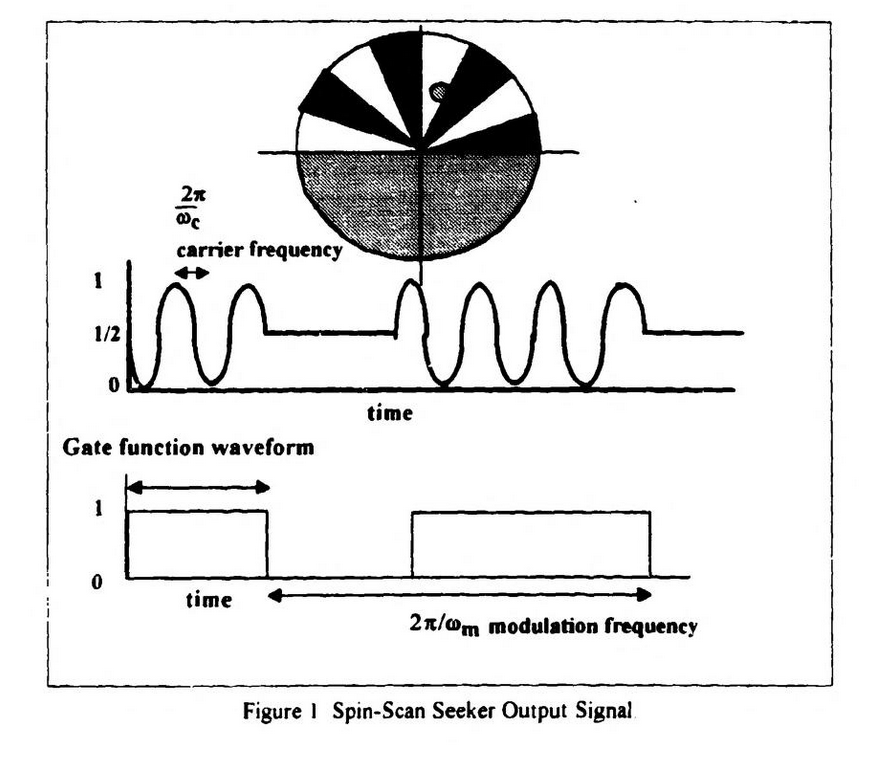
Now for the guidance system. These early Sidewinders used something called amplitude modulation. That reticle spins at a given rate set by the gyroscope-telescope assembly.
Image
Image
The logic here aims to turn the modulation waveform to zero. To do that, the target should be centered in the reticle, meaning that the transmission is 50% overall.

Image
Image
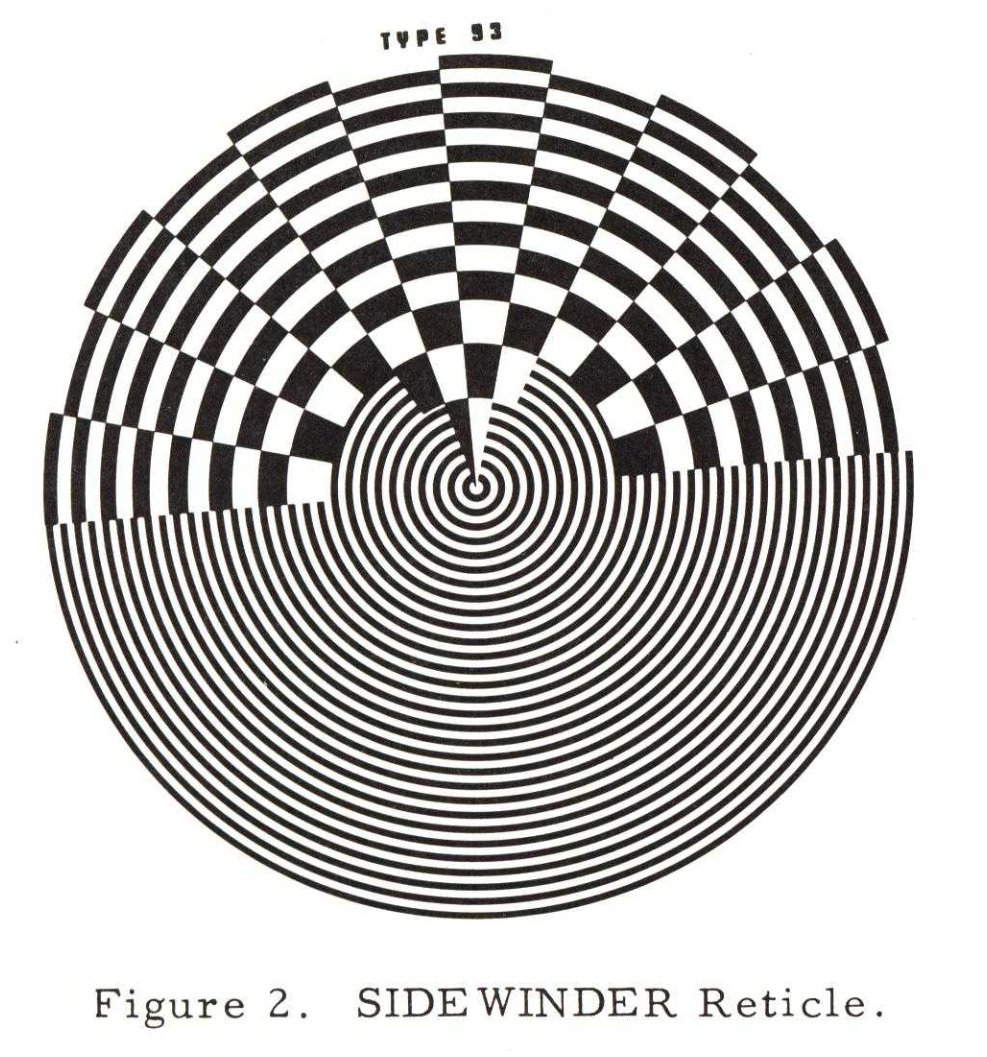
This is the reticle shared between AIM-9A and 9B, covering a 4° FOV. The checkering pattern significantly improves the rejection of false IR targets, such as clouds. Those produce a constant DC signal, like in the 50% coverage portion, and therefore are easier to filter out.
Image
Image
This reticle spins at 70hz, since the reticle is fixed to the telescope-gyro assembly. Image
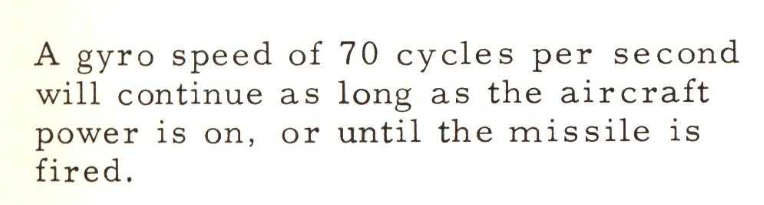
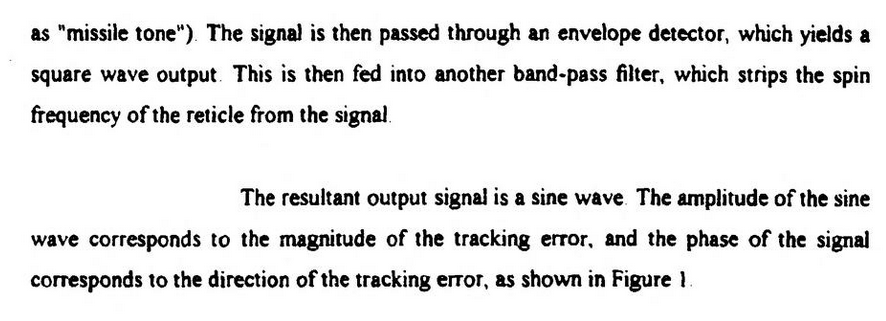
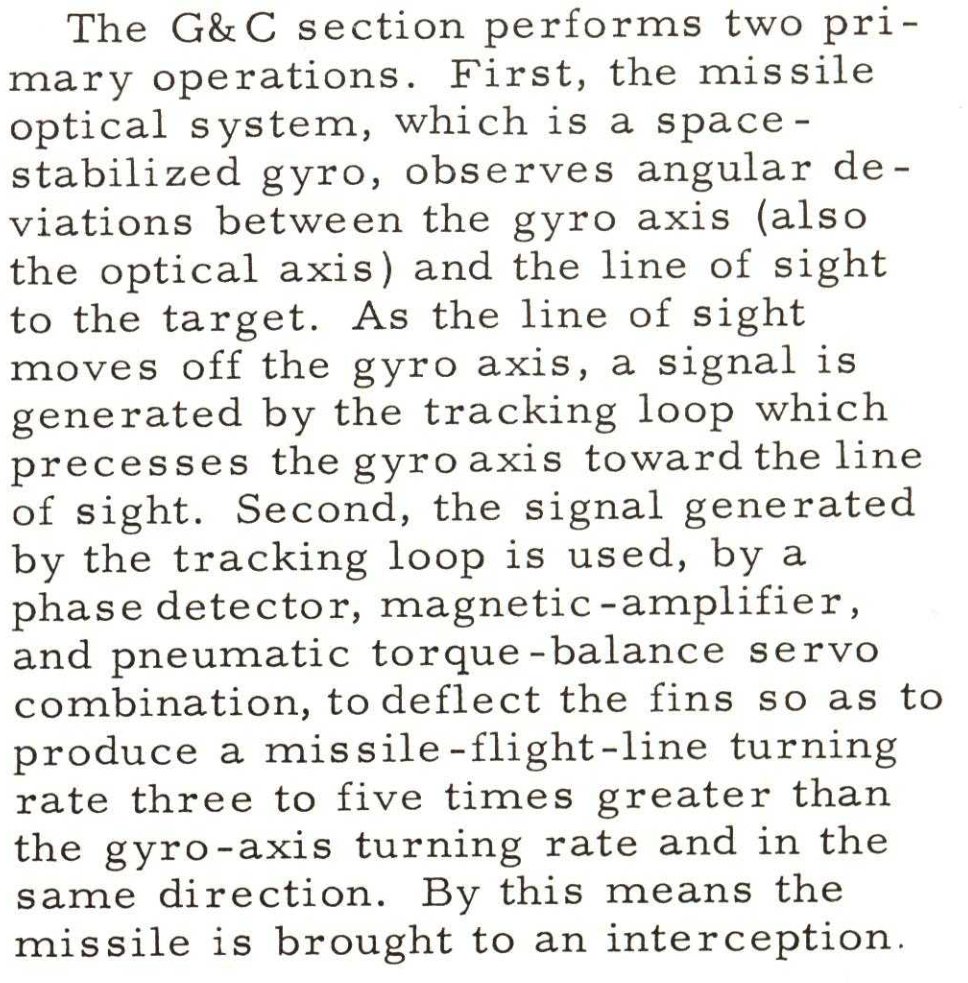
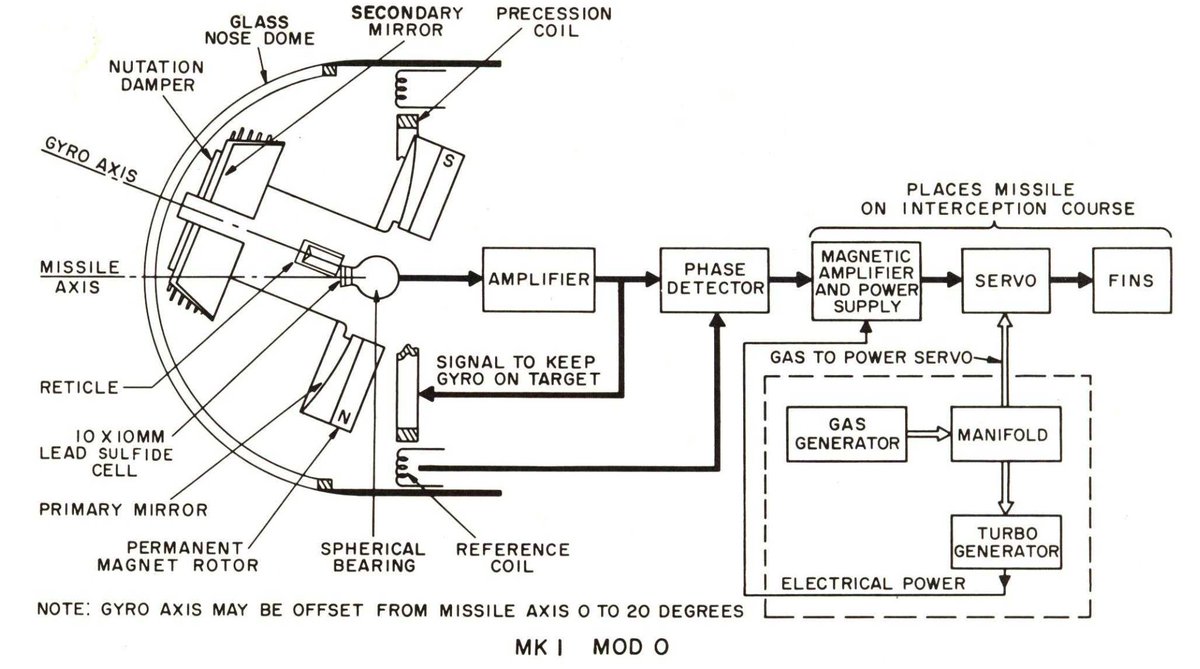
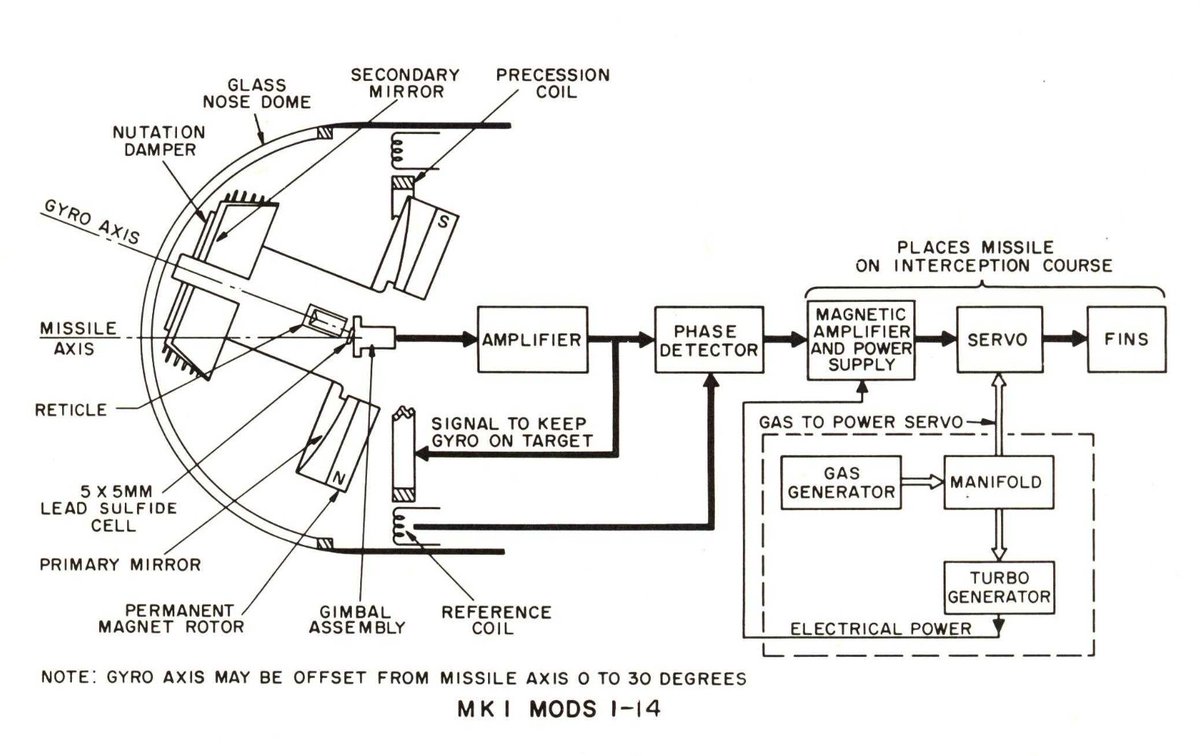
This is a basic block chart of AIM-9A's guidance and control section(GCS) and a description of how the seeker gyro produces steering commands. The commands that keep the gyro and the reticle centered also provide proportional steering commands.
Image
Image
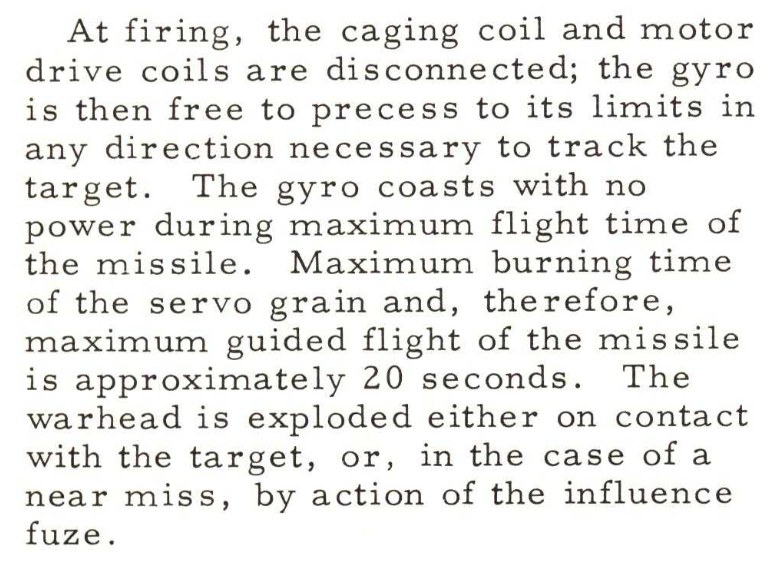
As the spinning reticle generates signals that keep the gyro centered on the target, these signals also move the canards to bring the missile into an intercept path. The angle between the sight line and the flight line remains constant, bringing the missile into the target.
Image
Image
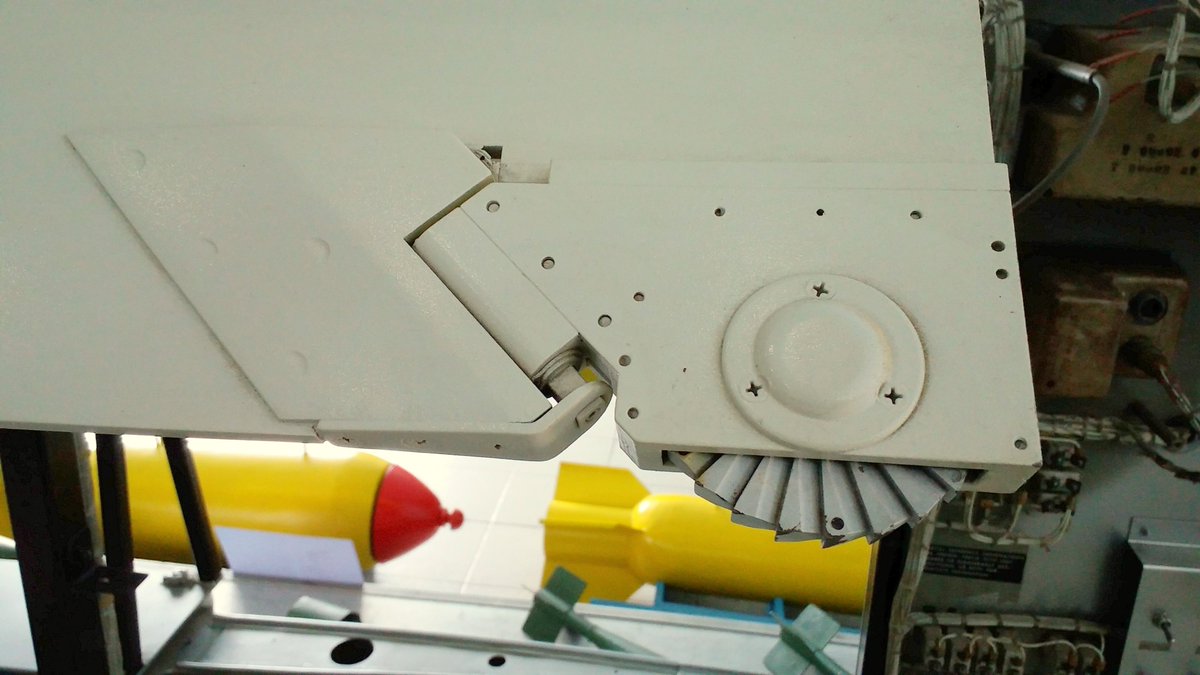
This guidance system is so simple because it does not require a separate guidance input for roll stabilization, like other missiles of the time did (the AIM-4, for example). This was made possible by some genius, who developed the rolleron. Image
As an aside, this is a Soviet R-3S. This appears to have the same rear fin and rolleron arrangement as the early Sidewinder 1A(9B).
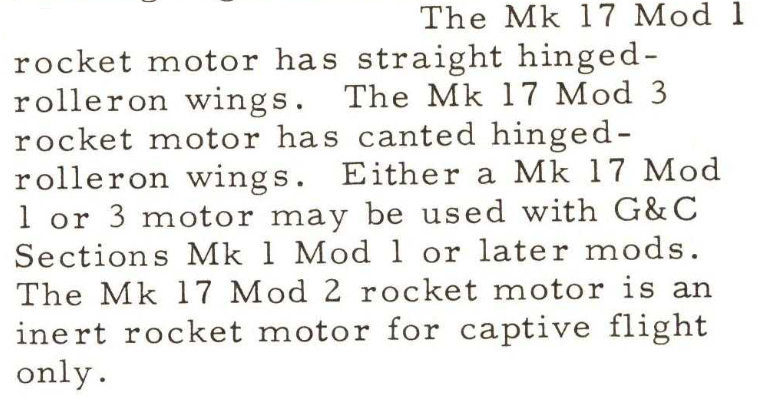
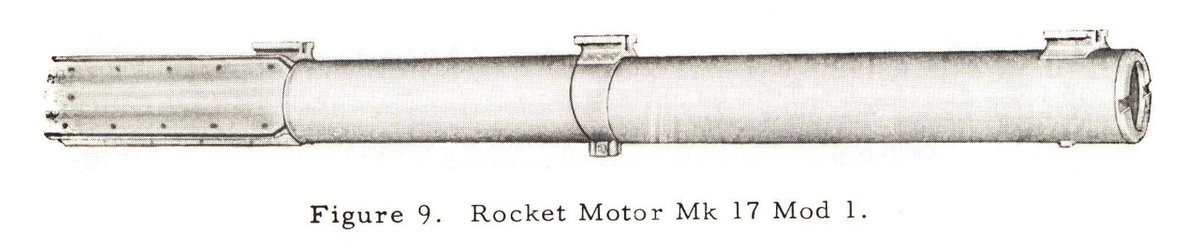
Taiwan was likely supplied with very early Mk 17 Mod 1 motors, which had these horizontally hinged rolleron mounts.
The rolleron is a notched metal wheel on a tab that spins in the airstream, creating a gyroscope. The missile has a tendency to roll for many reasons. As it tries to roll, these gyroscopes want to stay stationary, so they pivot the tabs in a direction that counteracts the roll. Image
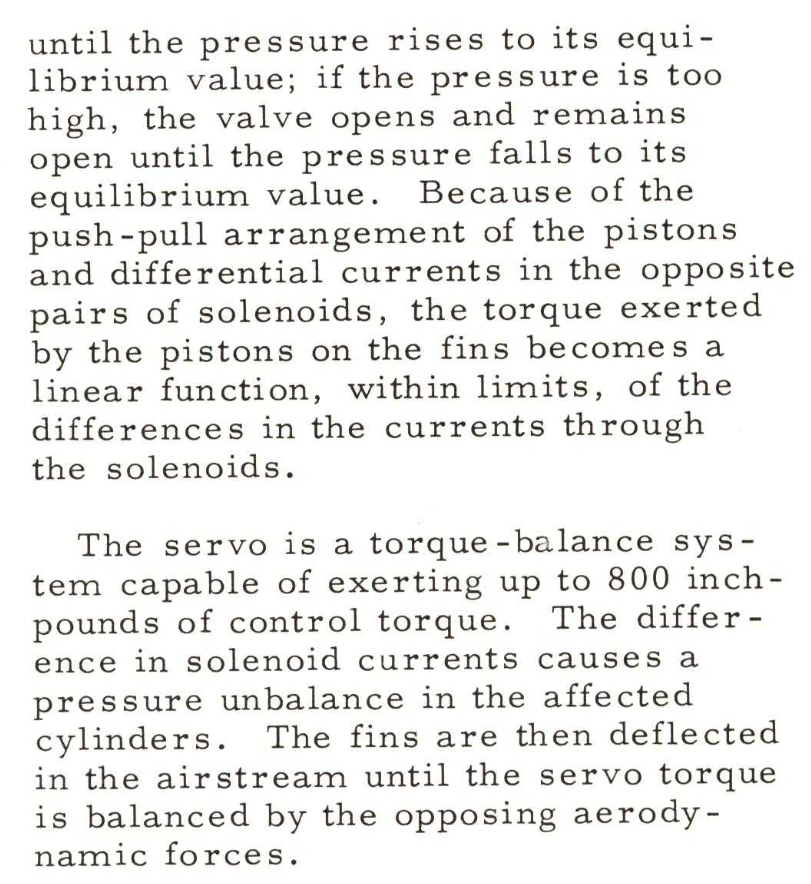
This section details the incredibly simple gas system and turbo-generator used to power the missile in flight and provide steering force to the fins.
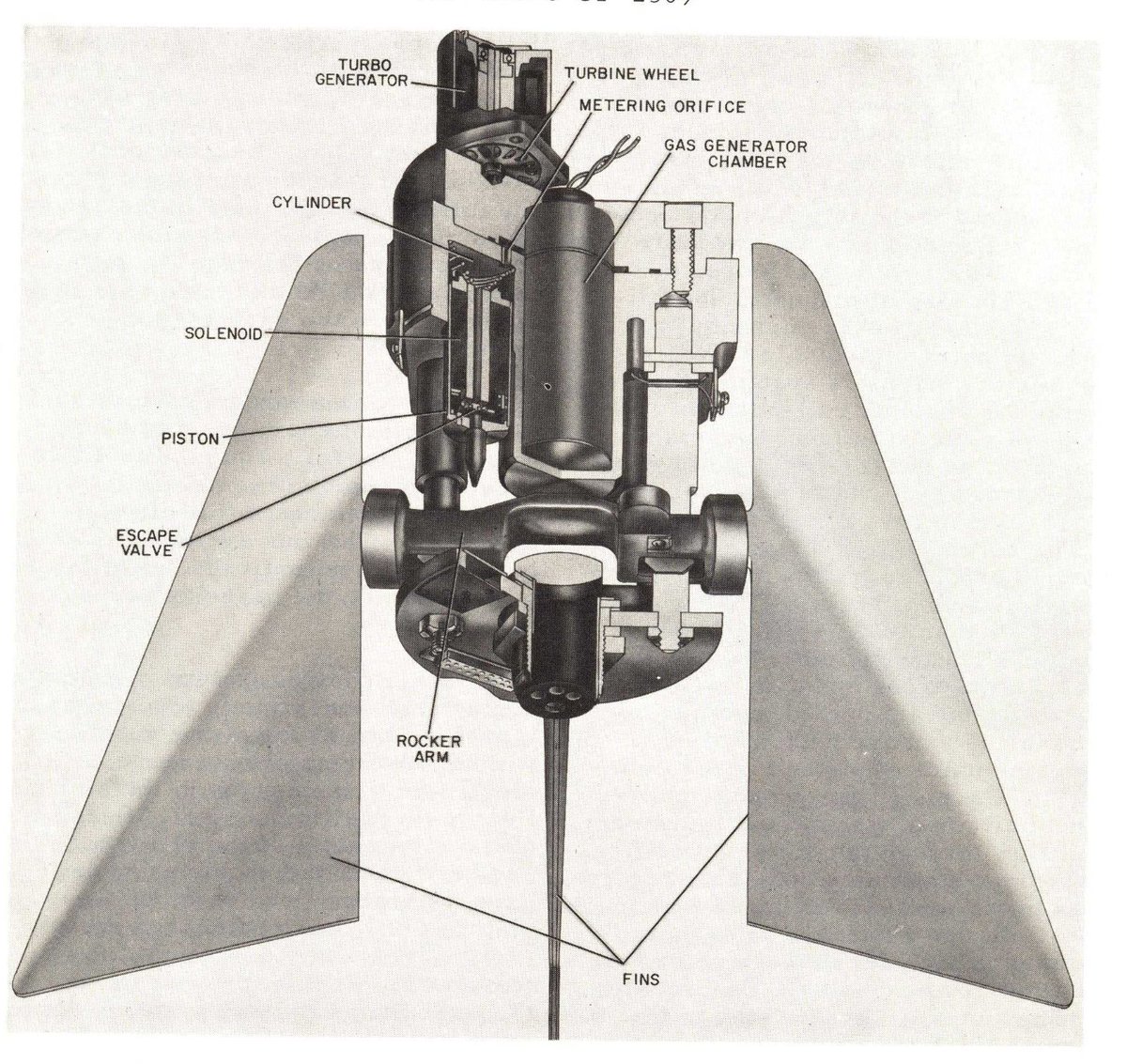
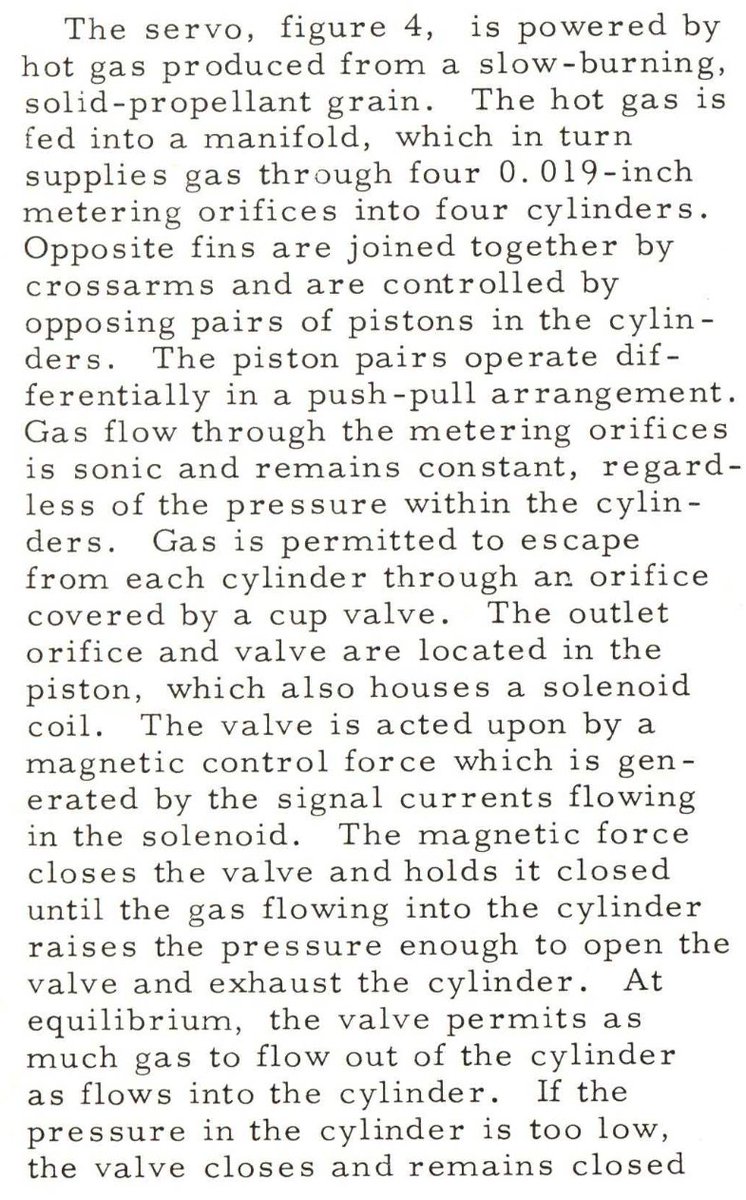
Image
Image
Image
These features were all present on the AIM-9A, and were carried over to the 9B(Sidewinder 1A/Mk. 2 Mod(s) 1-14). The biggest changes between 9A and 9B were the improved contact fuze, improved seeker, and angled fins of the Mk 17 motor as compared to the straight-finned Mk 15.
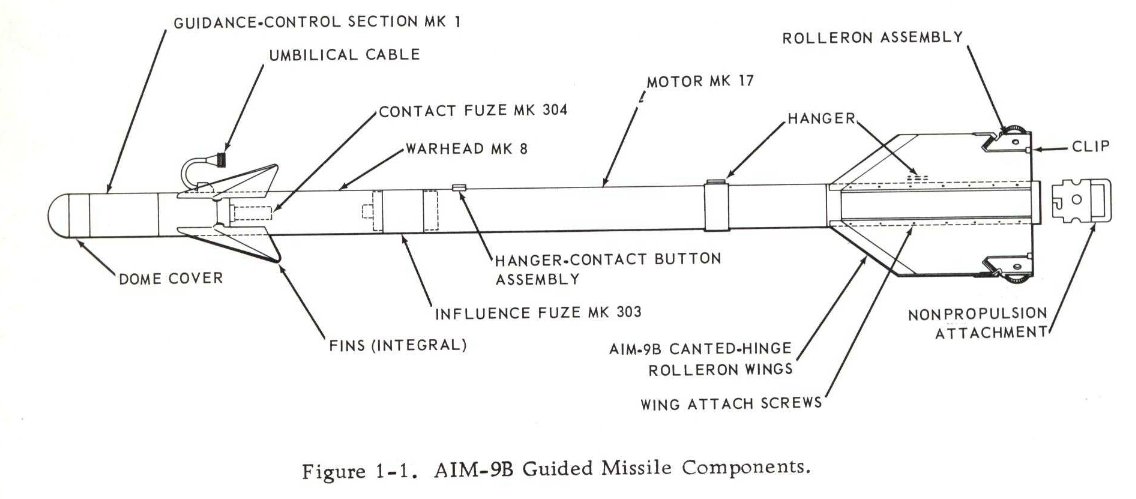
Image
Image
Image
The rollerons were changed from horizontal hinge to angled hinge with Mk 17 Mod 3 and up. This was limited to usage with the Guidance and Control Sections Mk 1 Mod 1, or the 9B GCS. Image
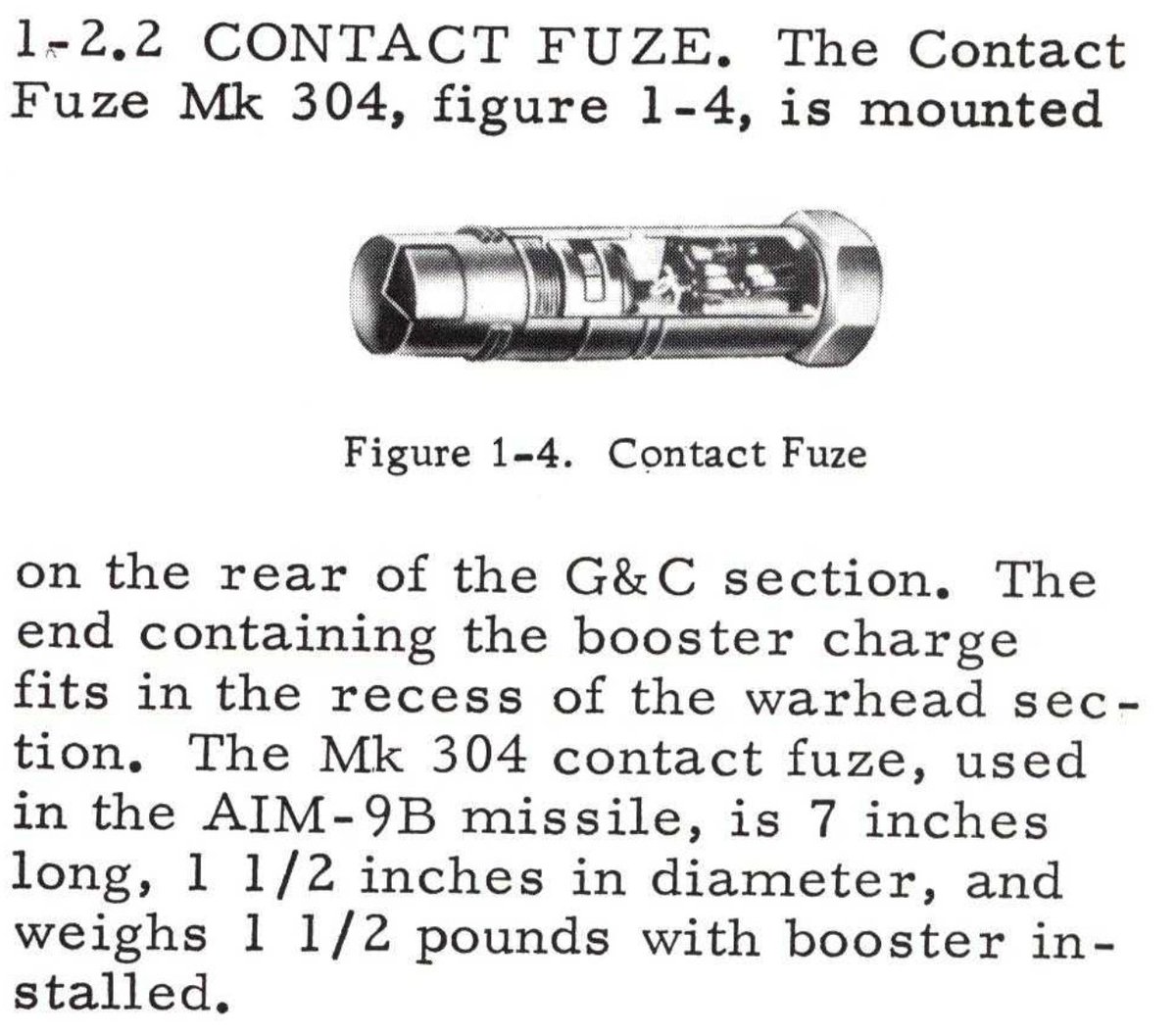
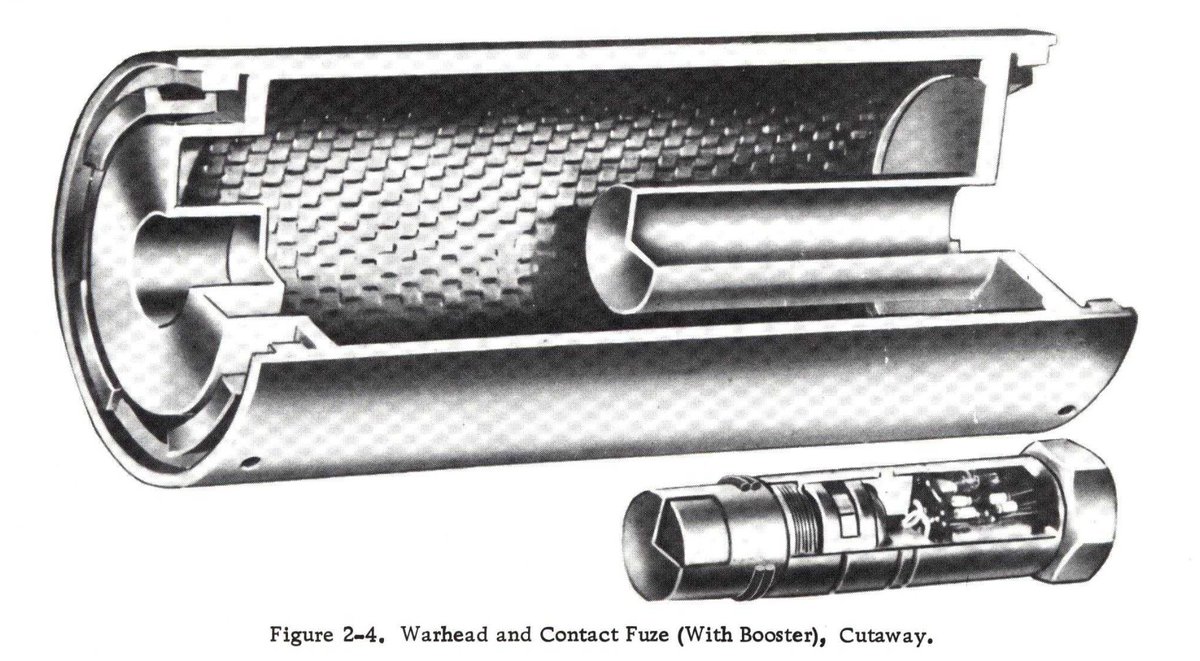
Working rearward on the missile, next is the contact fuze. In AIM-9A, this was a set of wires, that when broken on impact, would short to ground and trigger the warhead. In AIM-9B, it was a set of barium titanate crystals that would generate electricity on impact. Image
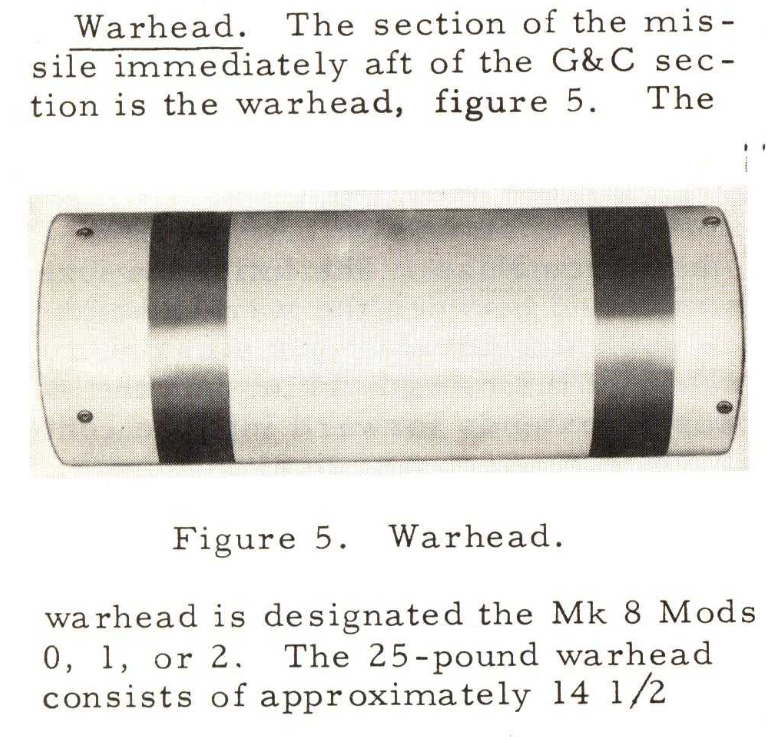
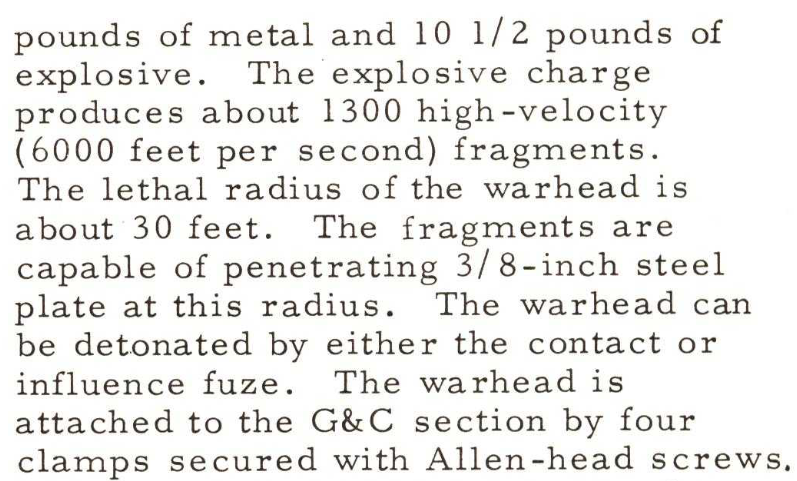
The warhead was a 25-pound blast-frag unit with 1,300 pre-formed square fragments.
Image
Image
Image
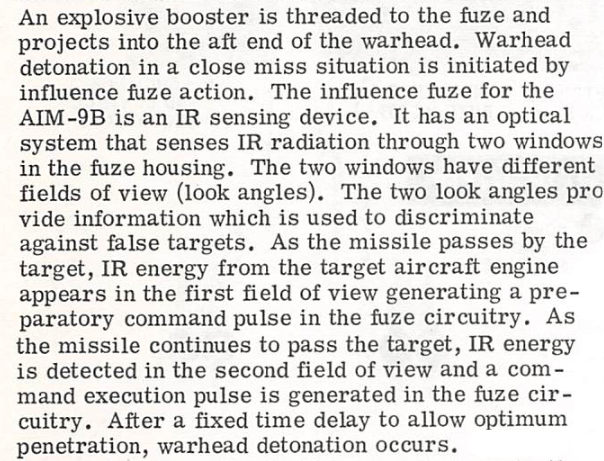
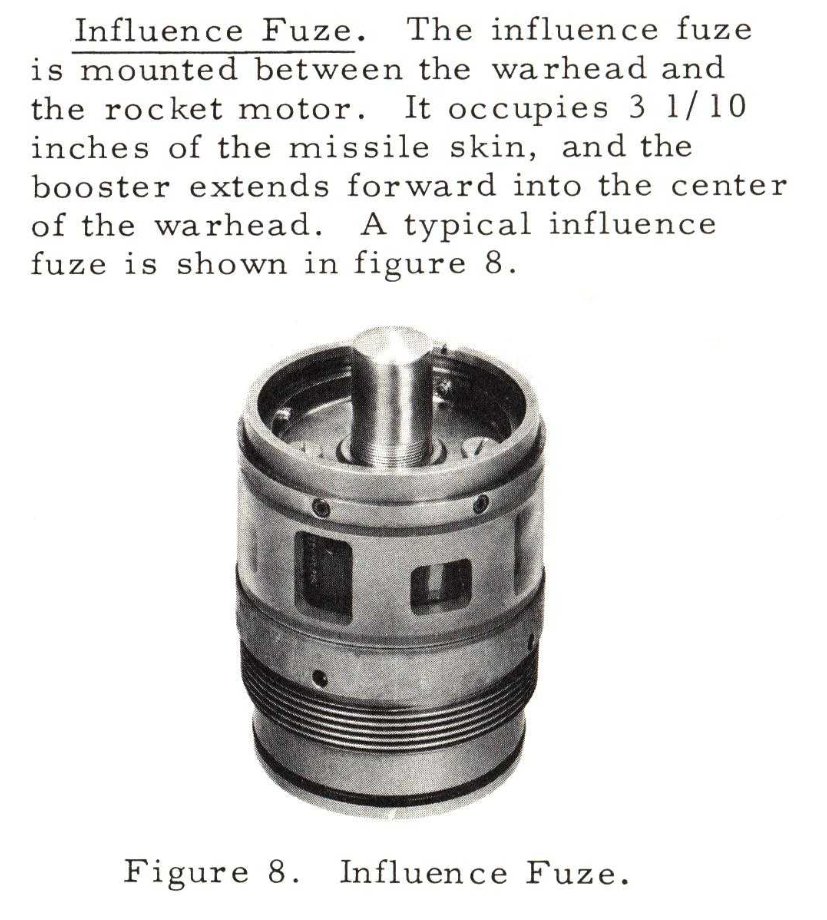
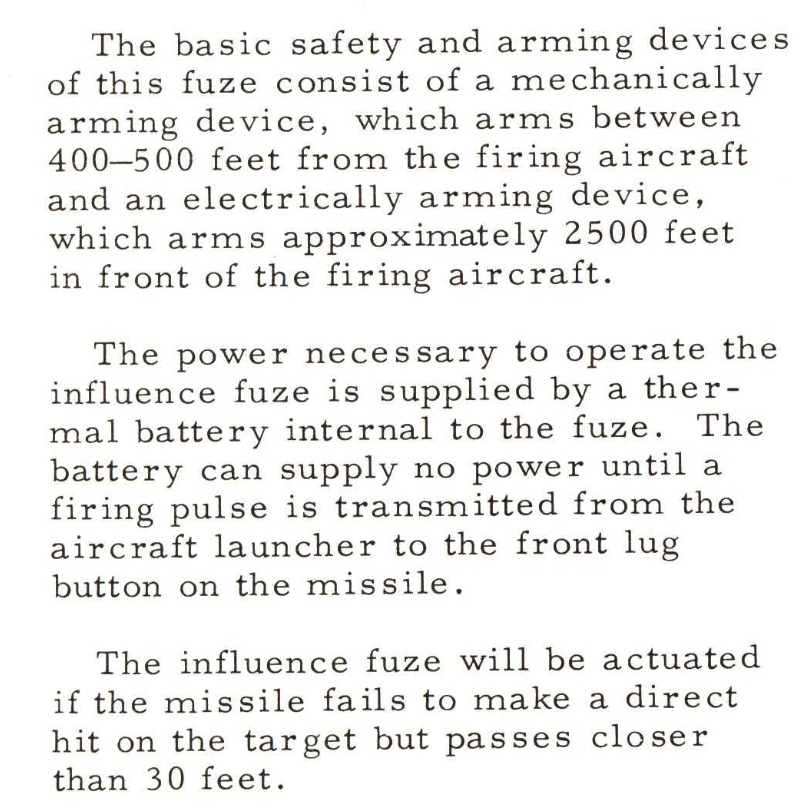
Behind the warhead was the Mk. 303 influence fuze. This was an IR-based unit, working in the same IR band as the seeker.
Image
Image
Image
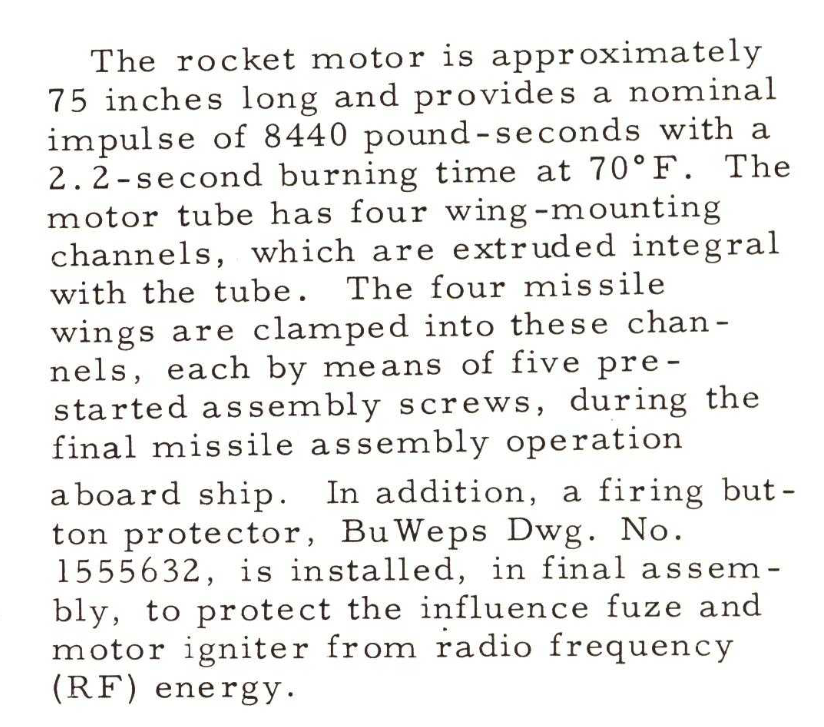
Finally, in the back was the rocket motor.
Image
Image
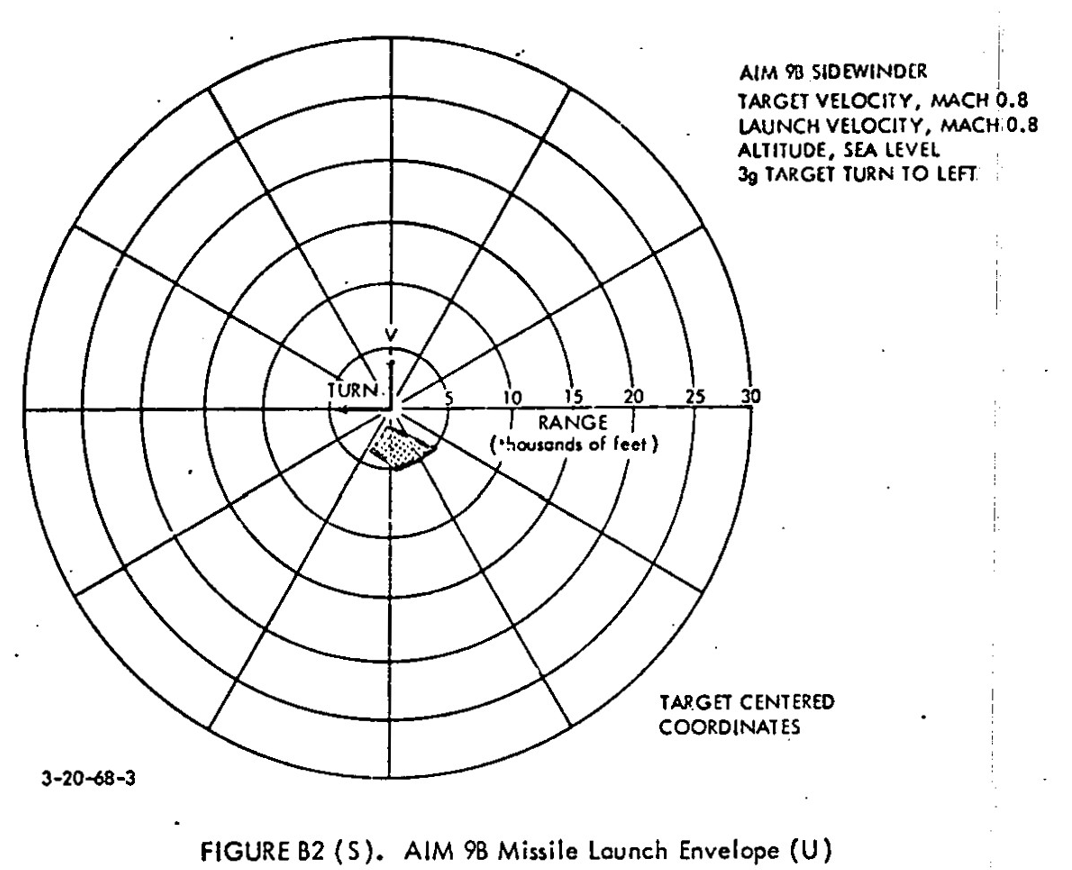
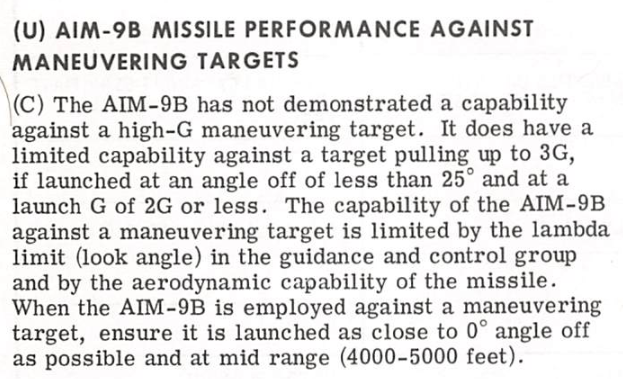
For all this engineering, the Sidewinder 1A's performance was unimpressive.

Image
Image
Image
Image
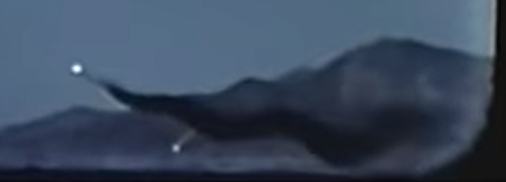
It also suffered from some guidance issues, such as overcorrection of spin-scanned inputs leading to the signature sidewinder "wobble" in flight. This tended to lower accuracy, especially against a maneuvering target, forcing reliance on the proximity fuze. Image
The program goals of Sidewinder were met, though. It was much lower cost than the Hughes Falcon, easier to produce and maintain, and easier to integrate onto existing fighters.
Nonetheless, engineers at NOTS China Lake were already developing a better Sidewinder. Image

• • •

Missing some Tweet in this thread? You can try to force a refresh

 

Keep Current with Heatloss

Heatloss Profile picture

Stay in touch and get notified when new unrolls are available from this author!

Read all threads

This Thread may be Removed Anytime!

PDF

Twitter may remove this content at anytime! Save it as PDF for later use!

Try unrolling a thread yourself!

how to unroll video
  1. Follow @ThreadReaderApp to mention us!

  2. From a Twitter thread mention us with a keyword "unroll"
@threadreaderapp unroll

Practice here first or read more on our help page!

More from @heatloss1986

Nov 25, 2025
Someone asked me to do a comparison of capabilities between F-35A and JAS-39E Gripen. A ton of material is classified but I will do my best here.
In short, Gripen is not even in the same class as F-35A. It isn't awful, but it is not a competitor with F-35. Image
Image
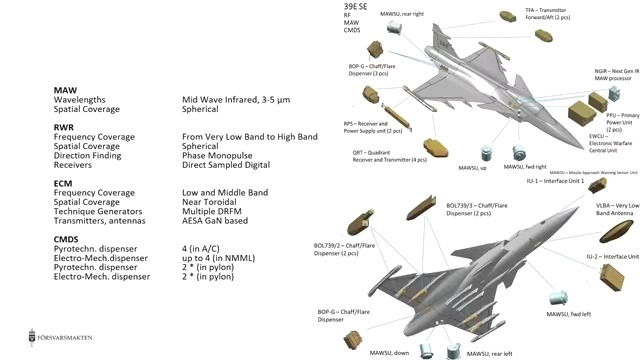
Let's start with one of the greatest advantages of the Gripen: its electronic warfare systems. The Gripen has a relatively robust signal receiver network across the aircraft, with several antennas capable of electronic attack, such as the wingtip pods and external jammers. Image
Image
Image
Image
The Gripen's wingtip pods provide an uncommon capability called "crosseye jamming." Crosseye jamming can create a positional false target in the horizontal or vertical plane, rather than just range. Image
Read 25 tweets
Jun 24, 2025
Optically guided missiles seem enticing until you realize the litany of problems with them. In this short thread, I'll explore a few.

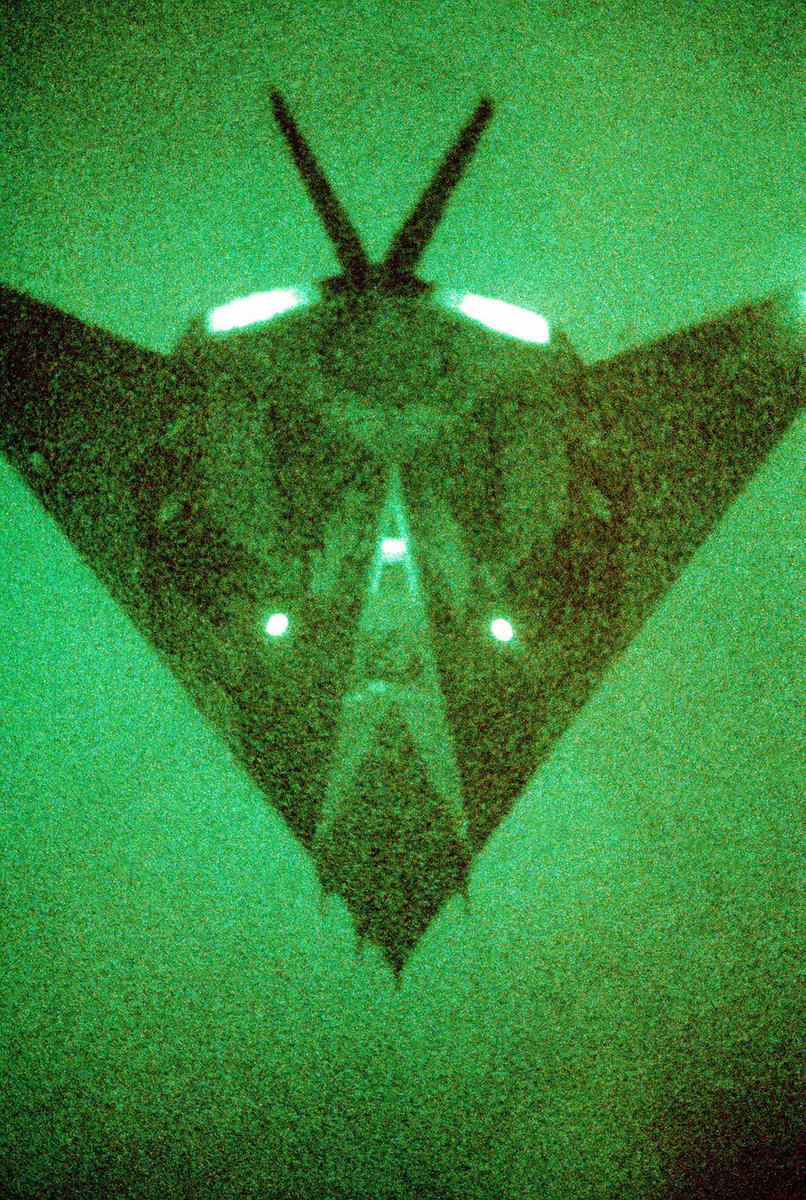
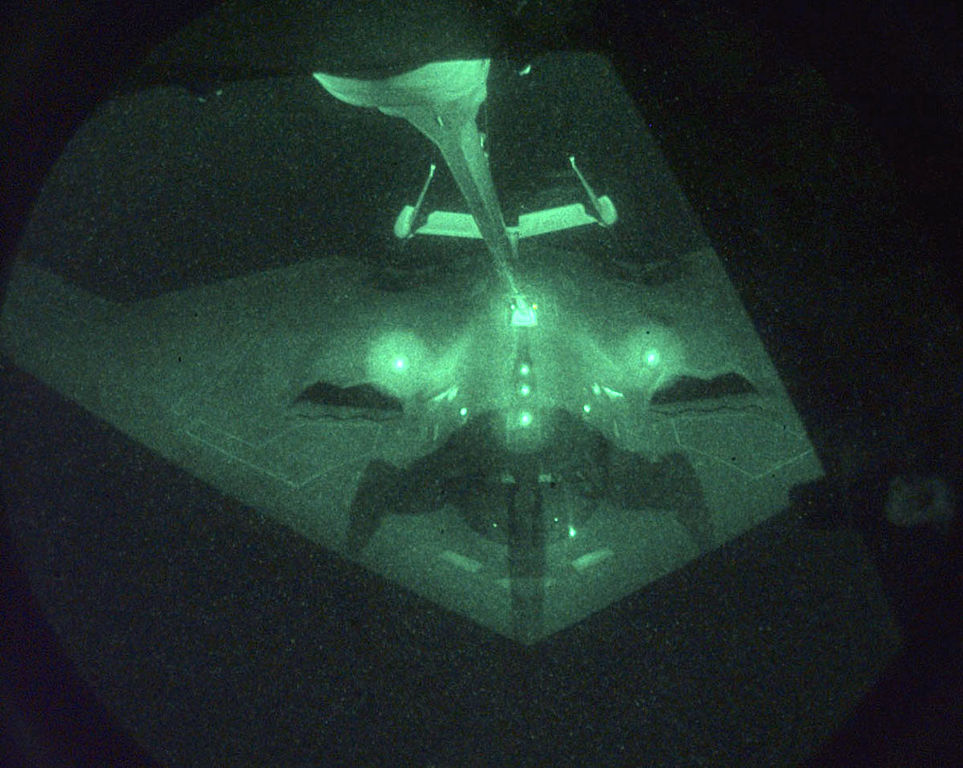
The first and easiest counter is to fly at night. F-117 Nighthawk combat missions were flown at night, as was Midnight Hammer with B-2 over Iran. Image
Image
If you want to try to optically track a target with damn near zero contrast, be my guest.

The Japanese Navy found that at night the human eye struggled to pick up ships over about five miles. A ship on the horizon is a significantly bigger target than a B-2 or F-117.
For a computer, greater signal to noise ratios are required to effectively track a target. This is why imaging infrared is preferable to optical contrast. Shown below is the last few seconds of flight of an AIM-9X.
This uses imaging infrared to detect and track the target.
Read 11 tweets
May 27, 2025
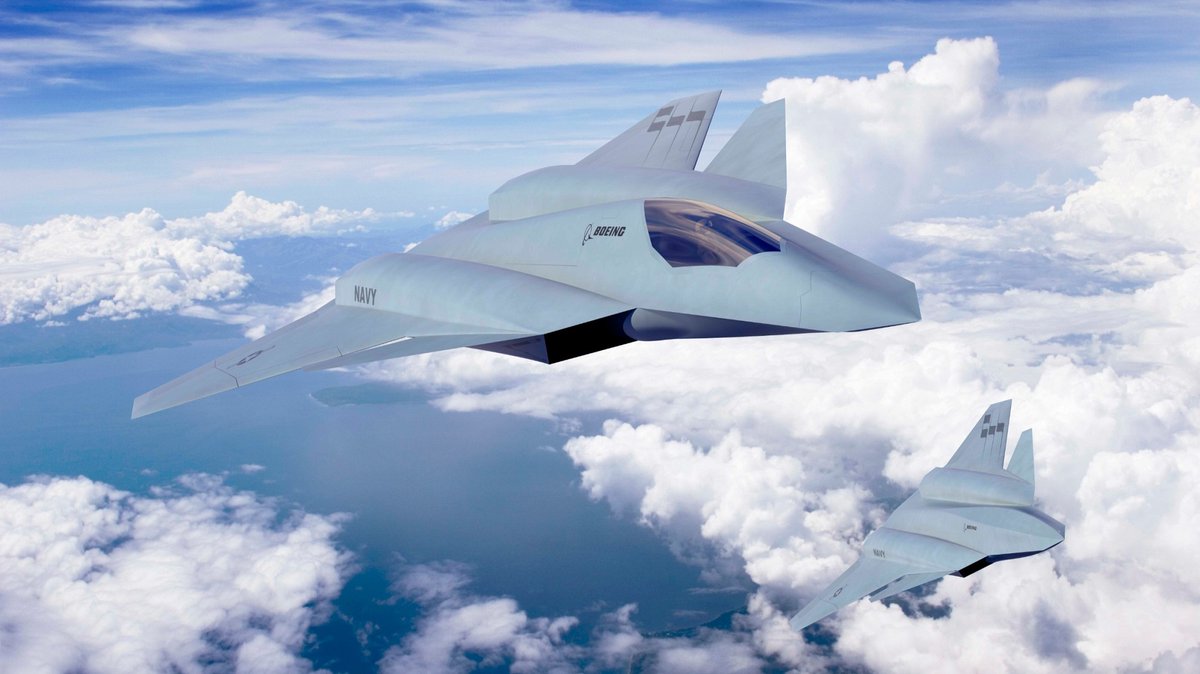
Since the end of the Cold War in 1991, the US Navy's ability to conduct air superiority and offensive strikes has been slowly diminishing. Today, we stand at an inflection point, where the F/A-XX program to deliver a new strike fighter to the Navy is in Jeopardy.
🧵 Image
This thread is a pitch for a congressional write-in campaign. The first part is a history of the degradation of the Navy's air wing. The second part is an analysis of a recent oversight hearing. The last post of this thread contains instructions for emailing your representatives.
In the 1980s, the A-6F was proposed for development. This was to be an updated A-6E including modern avionics, new engines, and AMRAAM. This would have provided the Navy with a relatively low cost program, retaining a two-seat crew with a large payload and good mission systems. Image
Read 24 tweets
May 12, 2025
Some very interesting stuff going on here with the Shenyang aircraft. 🧵

Exhaust appears visually similar to the F-22's with 2D thrust vectoring and shrouding. Wing shaping is nothing particularly special but seems good. Like JH-36, it retains some conventional control surfaces.
The all moving wingtips are a novel solution. I don't know what the trade offs are but they must be at least somewhat worth it. Potentially these are considered lower risk, higher strength, or more effective than the semi-morphing control surfaces on the JH-36. Image
The intake design is interesting. Unlike JH-36, which uses caret intakes underneath and uses a DSI above, the Shenyang aircraft uses what appears to be two DSIs below. The gear appears to fold sideways into a bay ABOVE the side bays, giving it a J-20-esque four bay arrangement. Image
Read 6 tweets
Apr 20, 2025
With the renewed interest in the Europa wars, this may be the best time to bring up the unusual short ranged missile developed for space-superiority craft.

The AIM-95E "Europa Agile," the only missile designed for operation in deep space AND within thin atmospheres.🧵 Image
First off, I apologize in advance for the lack of photos on this topic. All existing photos of Agile are of the ones designed in the 1970s for operation within Earth's atmosphere. Therefore, you will have to imagine some of these changes to the system.
The Agile for aerial use was cancelled in the mid 1970s after about $50m was wasted developing several different airframes and seekers. This spelled the end for the program as most know it, but this would only be the starting point for the Europa Agile. Image
Read 16 tweets
Apr 16, 2025
For my entire life I have been taught about the importance of effective searches. Since May 2024, I have fought with an unwanted feature that has made my experience worse.

A rant about "AI Overview," AI assisted search and their impact on using Google as a tool for research.🧵 Image
Google has billed these features as "taking the legwork out of searching" and "able to answer complex questions." This is a bald faced lie.
The AI has wasted more time than it has saved me, lied about results, and forced me to learn methods to get around it rather than to use it. Image
Image
Image
I do a lot of research using keywords that I need matched exactly. For example, right now, I was looking up the specific thrust of the General Electric F414 engine used in the X-59, an experimental plane in development for NASA. This should be a simple question to answer. Image
Image
Read 15 tweets

Did Thread Reader help you today?

Support us! We are indie developers!


This site is made by just two indie developers on a laptop doing marketing, support and development! Read more about the story.

Become a Premium Member ($3/month or $30/year) and get exclusive features!

Become Premium

Don't want to be a Premium member but still want to support us?

Make a small donation by buying us coffee ($5) or help with server cost ($10)

Donate via Paypal

Or Donate anonymously using crypto!

Ethereum

0xfe58350B80634f60Fa6Dc149a72b4DFbc17D341E copy

Bitcoin

3ATGMxNzCUFzxpMCHL5sWSt4DVtS8UqXpi copy

Thank you for your support!

Follow Us!

:(