Bo Winegard Profile picture
Feb 13, 2024 22 tweets 7 min read Read on X
1. I wrote about free will and retributive punishment, defending both against increasingly popular attacks from philosophers and public intellectuals such as Sam Harris and Robert Sapolsky.

aporiamagazine.com/p/in-defense-o…
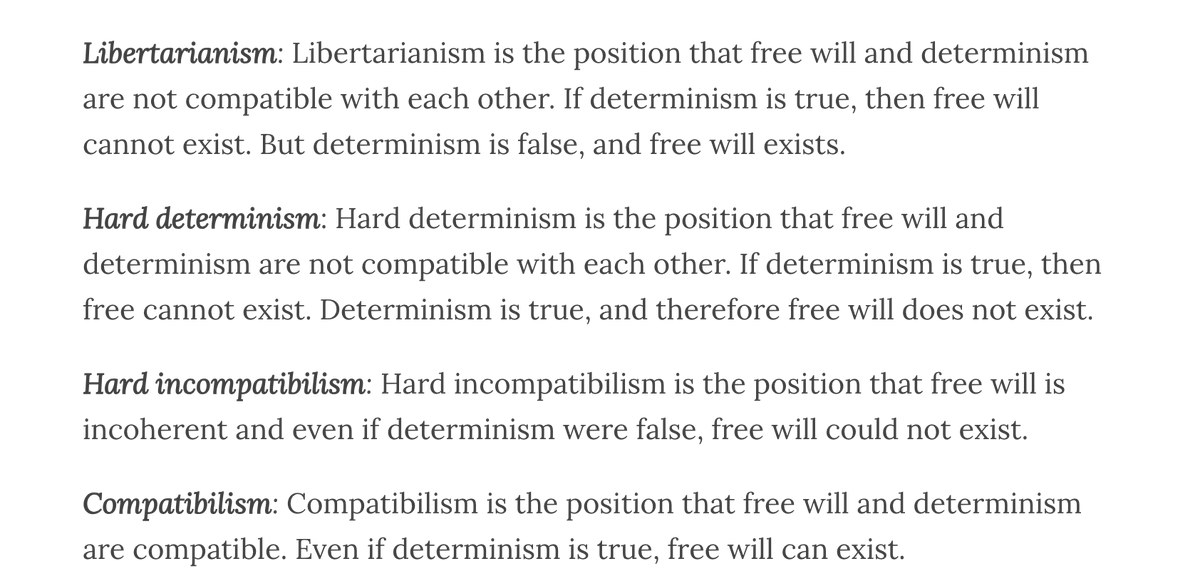
2. First, conceptual analysis, which can be boring and tedious, but is necessary in a debate as complicated and persistent as free will. There are four basic positions on free will: Libertarianism, hard determinism, hard incompatibilism, compatibilism. Image
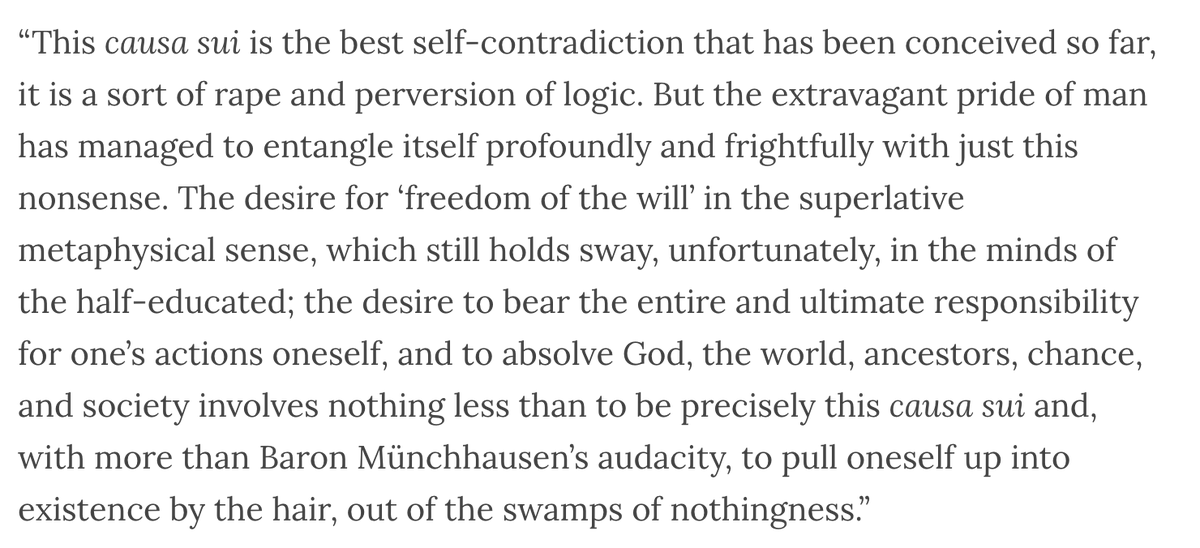
3. Libertarian free will is the most metaphysical, asserting that the determinism is untrue and that the self is a kind of uncaused cause, a source of real novelty in the universe. I find this implausible; in fact, I find it incoherent. Nietzsche wrote of it: Image
4. Not only is libertarian free will incomprehensible, it's also not even really free will. It's randomness, chaos, spontaneity. We should reject it because it is a metaphysical fantasy, and it does not enhance our understanding of humans or of moral responsibility. Image
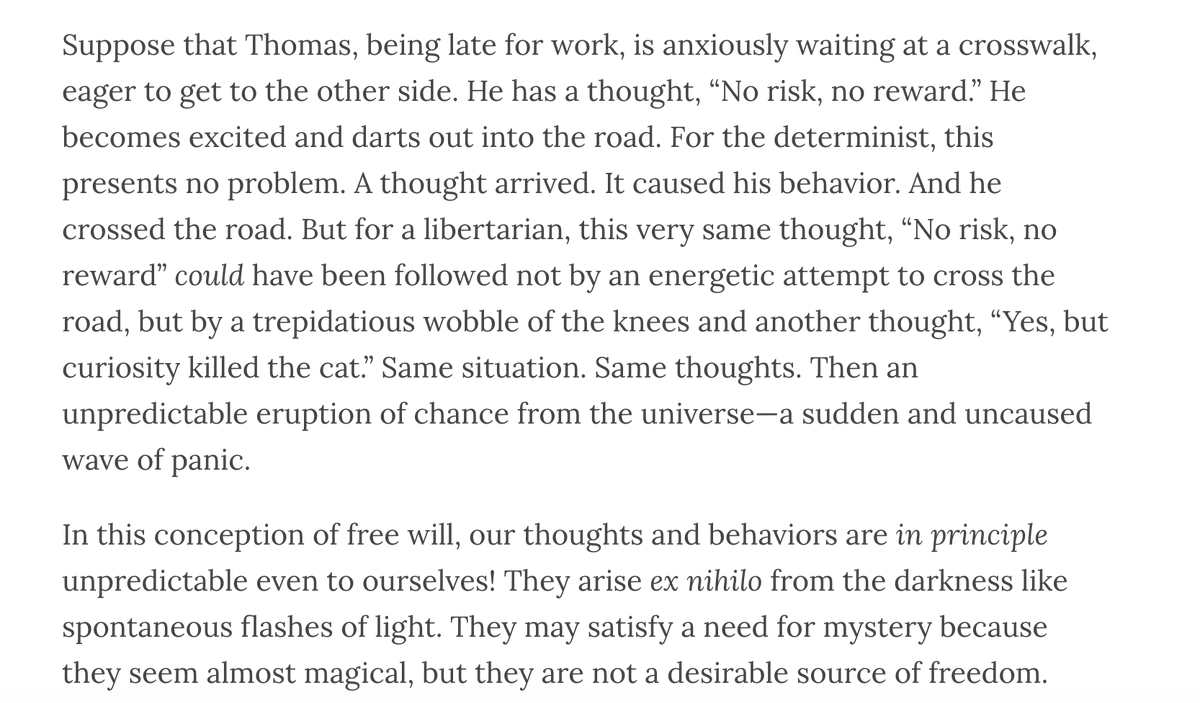
5. But, wait. Don't most people believe in a libertarian form of free will? Thus, if that form of free will is false, should we not eliminate free will? Certainly this is what Sam Harris contends. Immanuel Kant as well--he called compatibilism a wretched subterfuge. Image
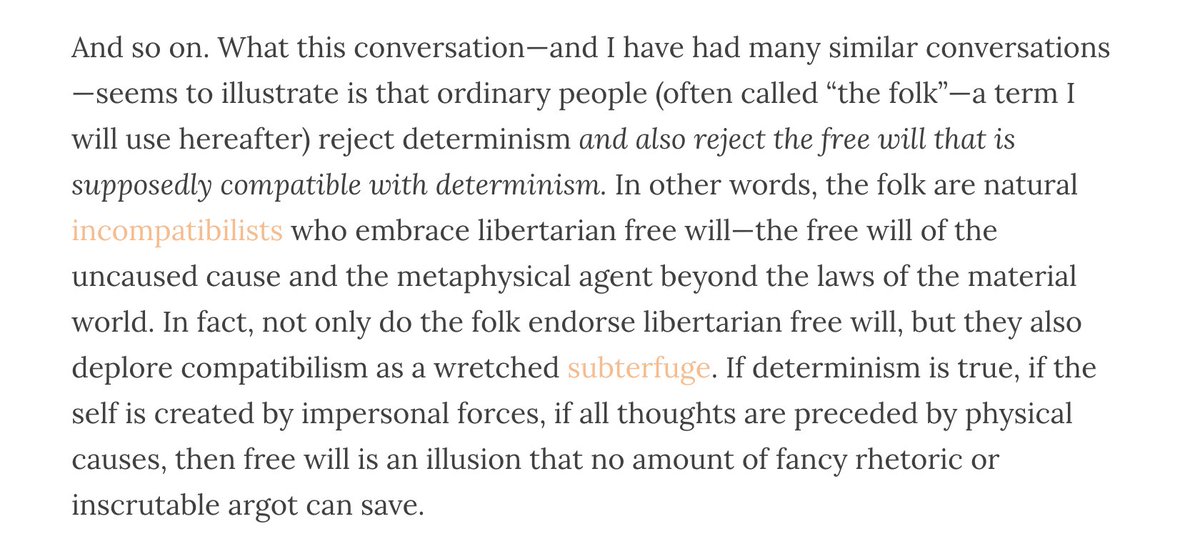
6. A large literature has explored the views of ordinary people ("the folk") and the results are mixed, which of course just provokes more debate. Some people think the folk are libertarians; and some people think they are compatibilists. My view is that they are both. Image
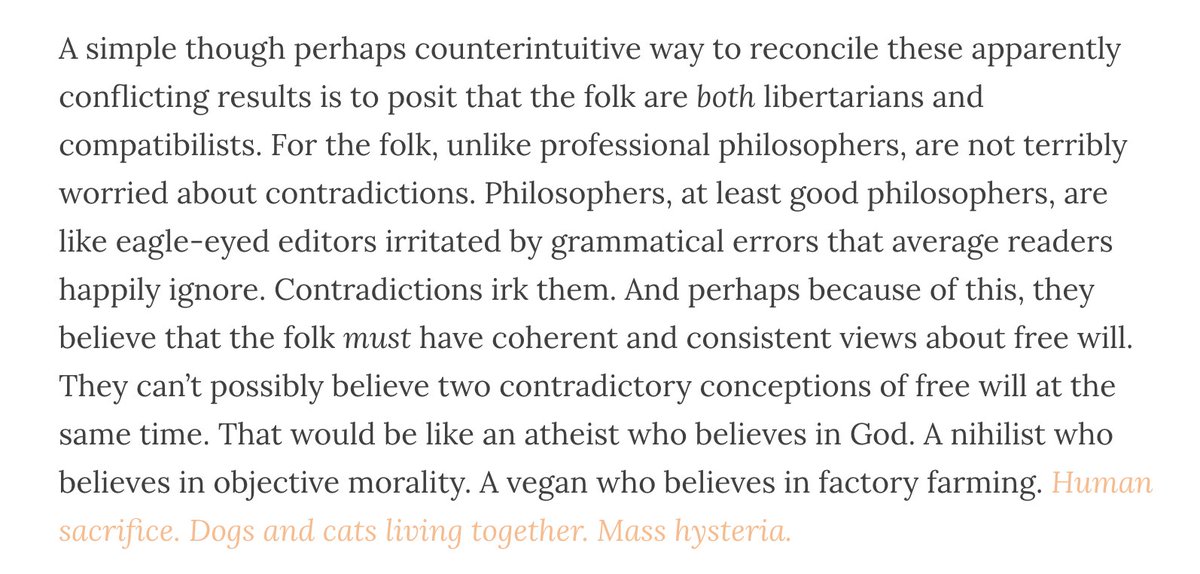
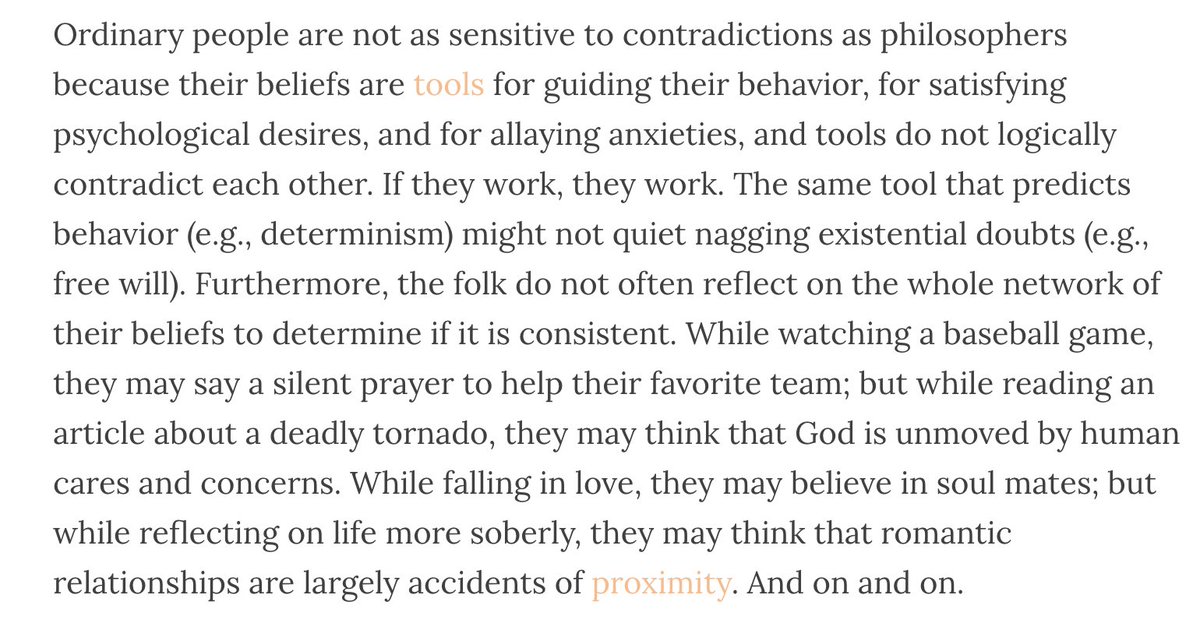
7. The folk often hold contradictory views about complicated concepts because beliefs are tools, not units in a logically coherent network of ideas. The folk are determinists and indeterminists, theists and materialists, romantics and pessimists, et cetera. Image
8. So, the important question is *Can we preserve a coherent and meaningful concept of free will?* And I think the answer is yes. Free will is a socially constructed, practical concept that helps to distinguish morally sensitive agents from other agents and entities. Image
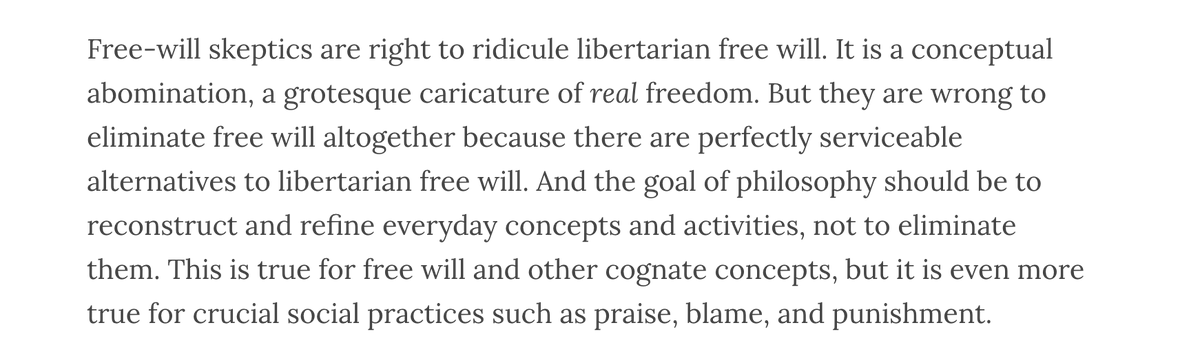
9. This may seem academic, but free will is a crucial idea, one with ramifications for punishment, moral responsibility, and existential purpose. It touches almost all aspects of the social world. Image
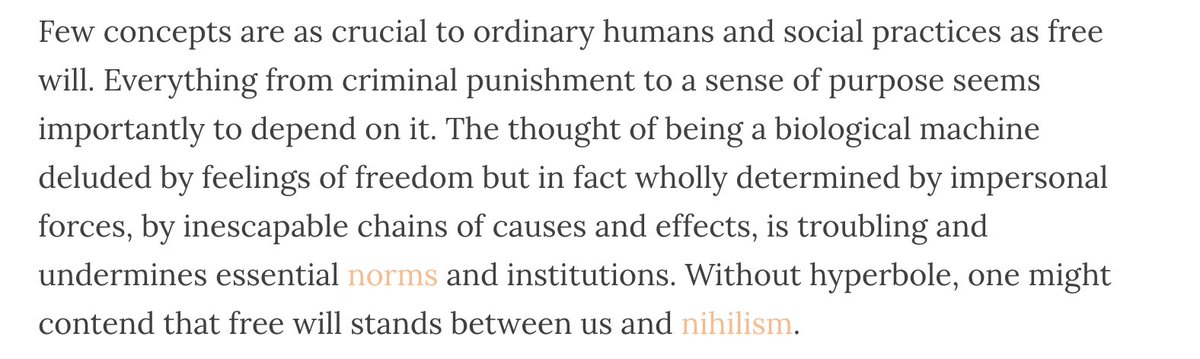
10. Some free-will skeptics, for example, contend that the rejection of free will should lead to a radical reconsideration of the criminal justice system. If nobody is truly responsible, then nobody "deserves" (in some ultimate sense) to be punished. Image
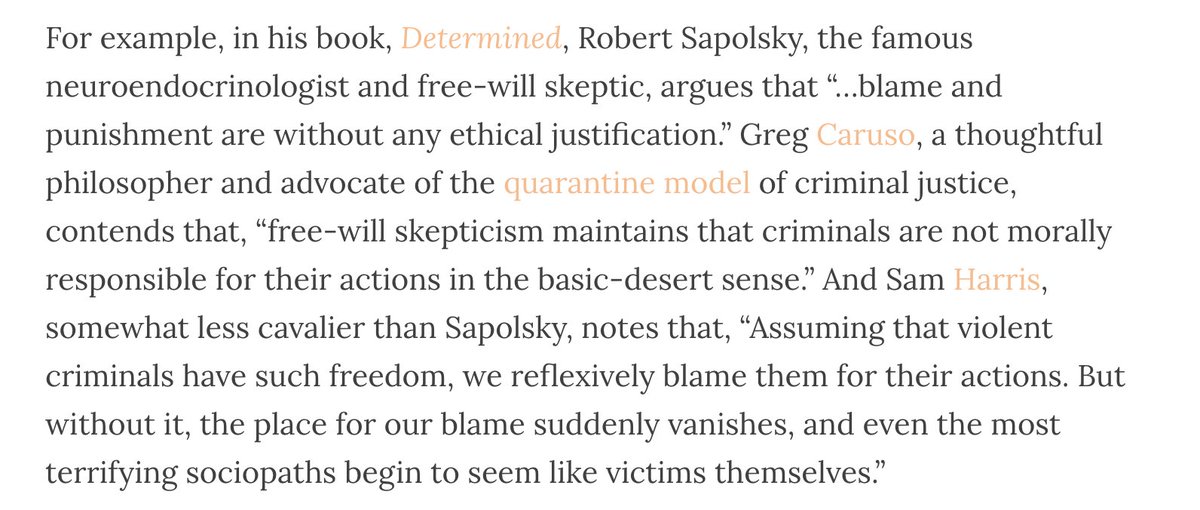
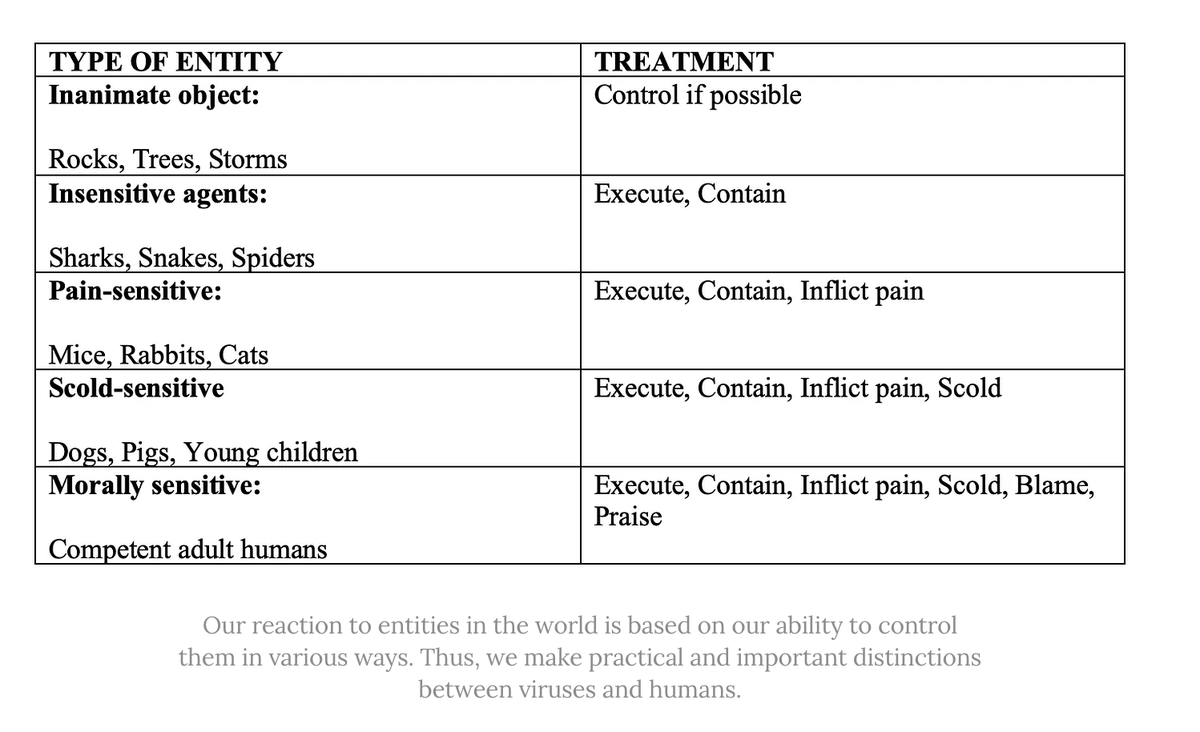
11. Of these skeptics, Robert Sapolsky is perhaps the most prominent and the most tendentious. His book, Determined, is highly readable but also incredibly superficial. In his view, we should not only eradicate retribution, but blame and praise! Image
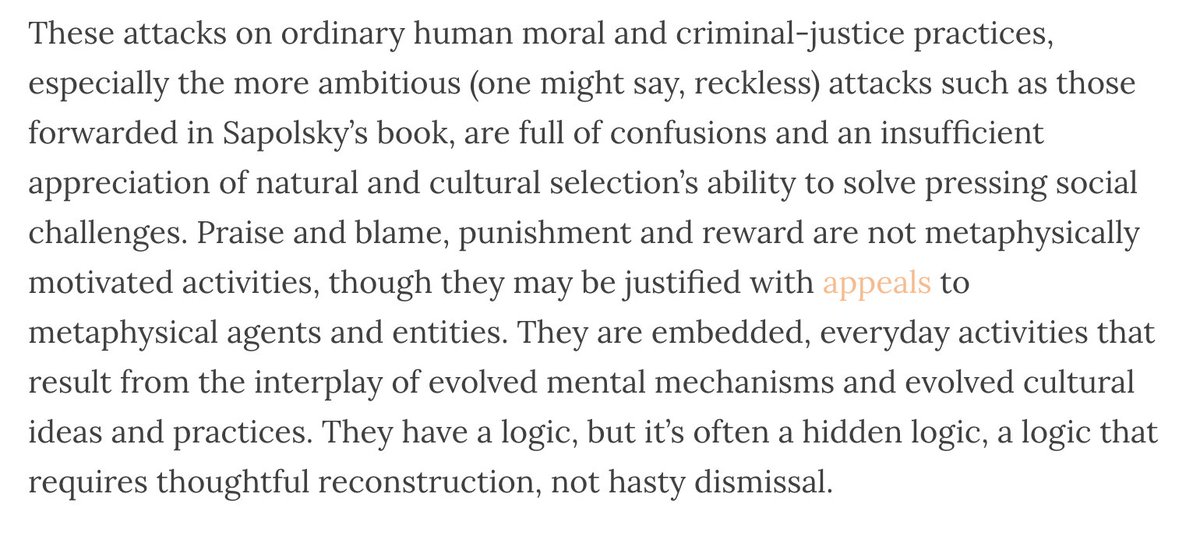
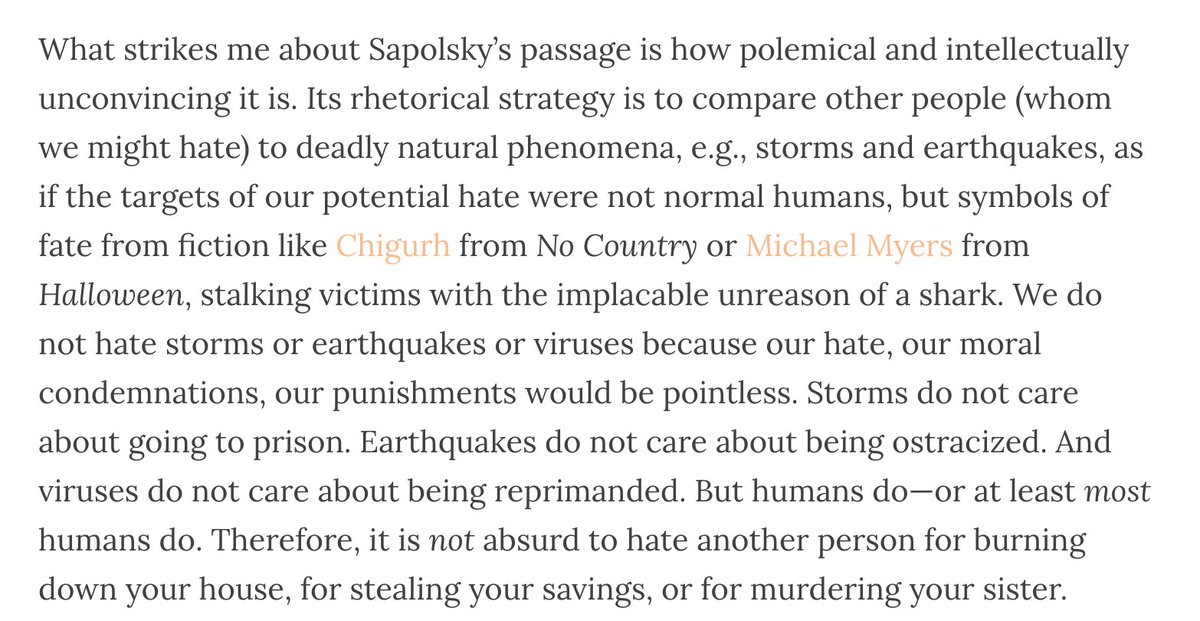
12. In general, when philosophers make up a concept such as "really real" or "ultimate responsibility," the concept is probably wrong or misleading. Responsibility is good enough. We don't need "ultimate" responsibility. And we have responsibility because we are moral agents. Image
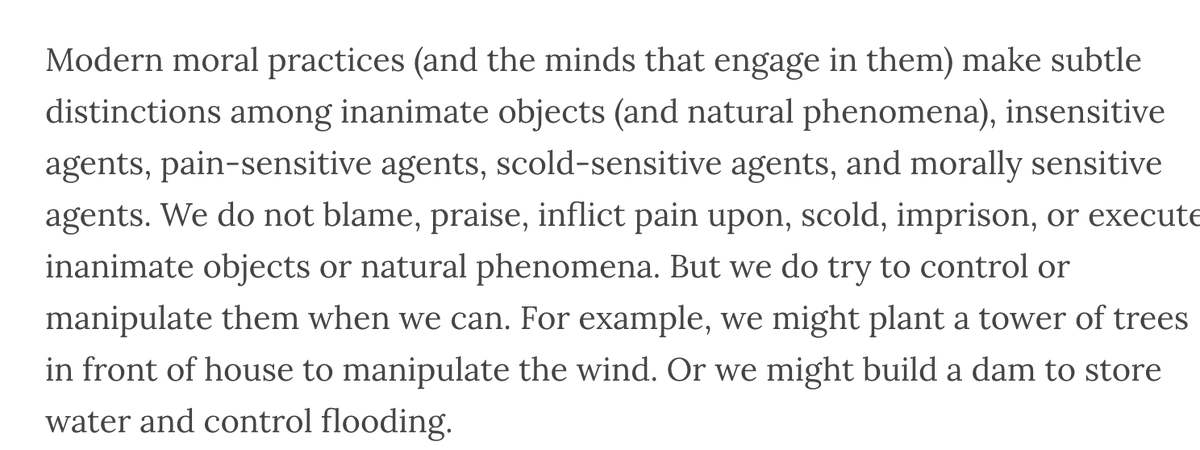
13. At time, Sapolsky becomes positively intoxicated with his view of "nothing but" reductionism and "dictatorial" determinism, asserting that hating another human is as sad as hating natural phenomena such as storms and plagues. Image

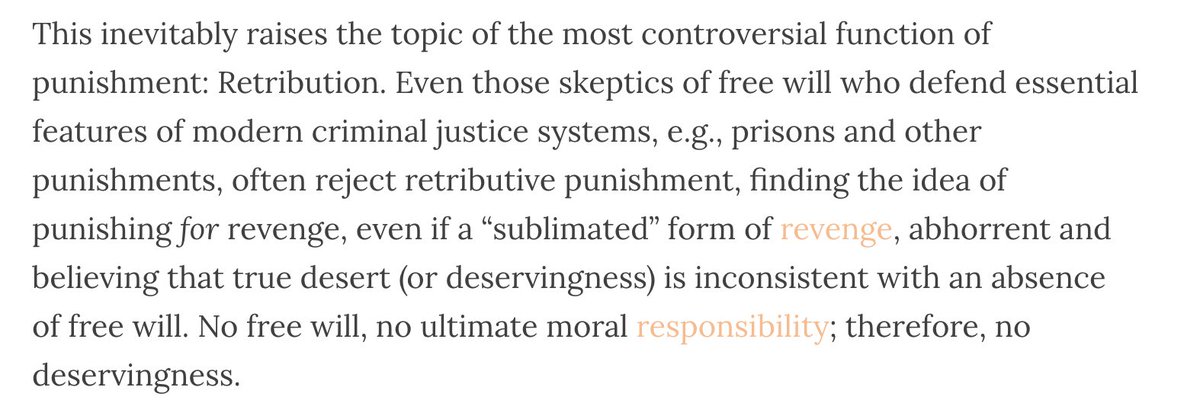
14. My initial reaction when I read this was shock, for there is an obvious difference between humans and storming skies: Humans are morally sensitive and skies are not. If you hate a human, he might change his behavior. A sky will not. Image
15. Our system of blame, praise, and punishment is not based on metaphysical speculations; it is based on emotions, inclinations, and cultural evolution. It may seem irrational to ultra-reductionists, but those who analyze it sympathetically find an impressive logic. Image
16. Many philosophers who are skeptical of free will, even those who are somewhat supportive of basic features of our criminal justice system, are also skeptical of retributive punishment, which they view as lacking justification (without free will). Image
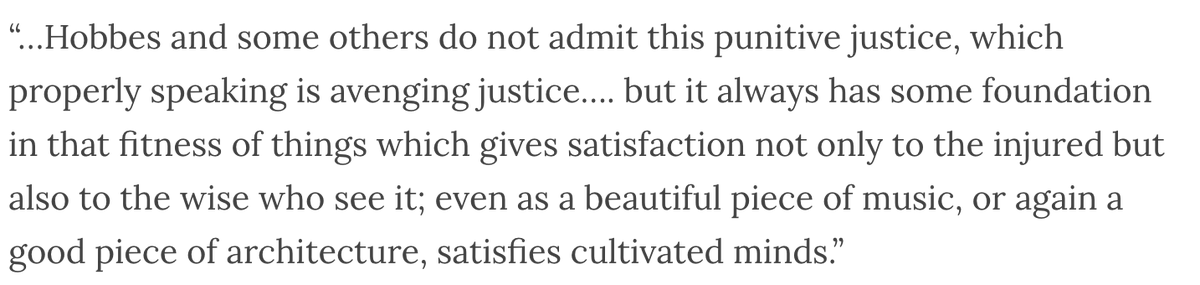
17. But in my view, retribution is a perfectly legitimate desire, one that men and women of good character and intellect have found satisfying in almost every civilization and context. As Gottfried Leibniz wrote: Image
18. This raises a meta question about philosophy: What is the goal? For some philosophers and intellectuals, the goal is to create a rigorous, logically coherent system, often one that derides the benighted masses for their ignorance. But my view is more conservative.
19. Philosophers should make sense of the wisdom of our embedded everyday practices. Sometimes these deserve criticism. But we should attempt to understand them sympathetically. And we should recognize that the world of humans is one of meaning--not one of abstractions. Image
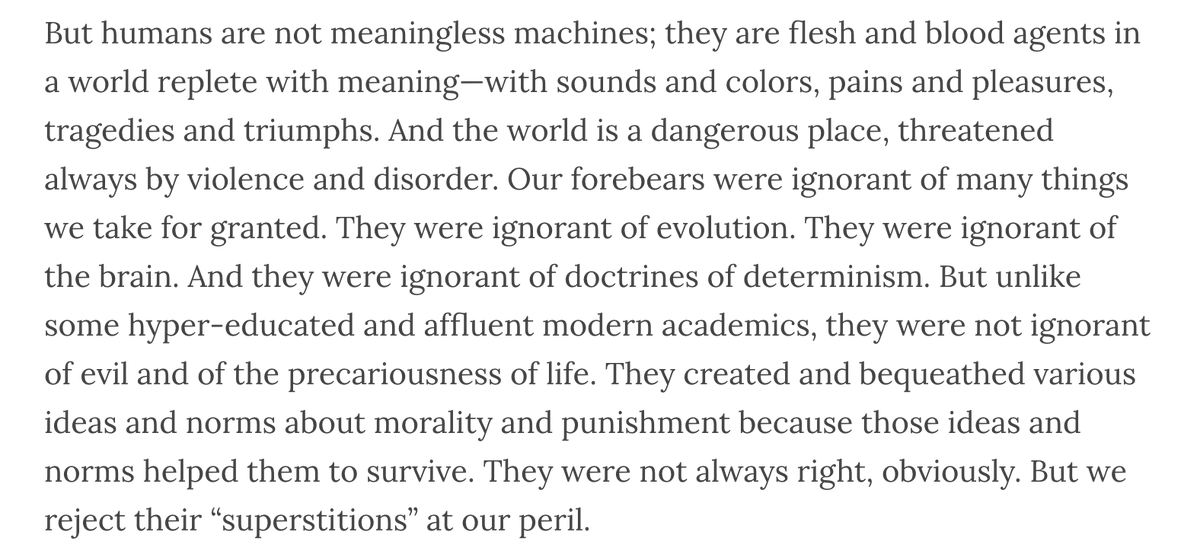
20. Scientism is an alluring doctrine. Indeed, I found it seductive for many years. But it is wrong. Science is awesome. It has improved our lives. Increased our knowledge. But is only one tool in the toolkit. We should not confuse scientific abstractions for reality.
21. Free will is not mysterious or metaphysical. It is a practical concept used by ordinary people. Dictatorial determinism is not helpful. The world is full of many causes, from colliding billiard balls to powerful emotions. The blueprint is not the building.
22. Love is not just chemicals; a symphony is not just notes; a cake is not just molecules. Moral agents exist. They make decisions. And they deserve to be punished or praised accordingly.

• • •

Missing some Tweet in this thread? You can try to force a refresh

 

Keep Current with Bo Winegard

Bo Winegard Profile picture

Stay in touch and get notified when new unrolls are available from this author!

Read all threads

This Thread may be Removed Anytime!

PDF

Twitter may remove this content at anytime! Save it as PDF for later use!

Try unrolling a thread yourself!

how to unroll video
  1. Follow @ThreadReaderApp to mention us!

  2. From a Twitter thread mention us with a keyword "unroll"
@threadreaderapp unroll

Practice here first or read more on our help page!

More from @EPoe187

Feb 8
(1) Many intellectuals, including Steven Pinker and Matt Yglesias, have argued that the taboo about discussing race and IQ is defensible, even wise. Some "liberals" have even argued that we should "ban" research on race and IQ. I strongly disagree.

aporiamagazine.com/p/race-and-iq-…
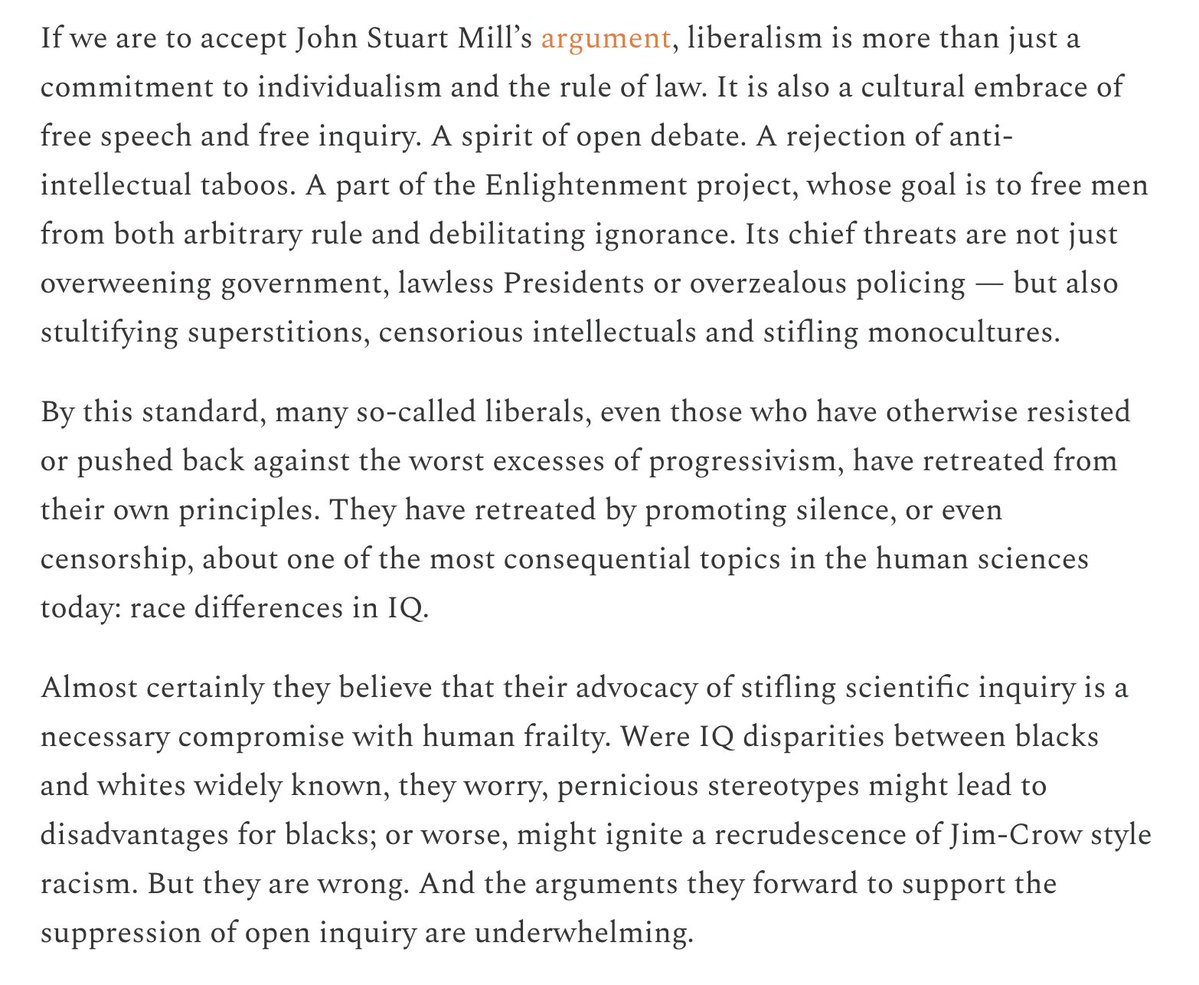
(2) These advocates of ignorance likely think they are compromising with human frailty. They fear that if knowledge of large IQ gaps between blacks and whites were well known, a recrudescence of racism would ensue. Maybe even a Jim Crow 2.0. They are wrong. Image
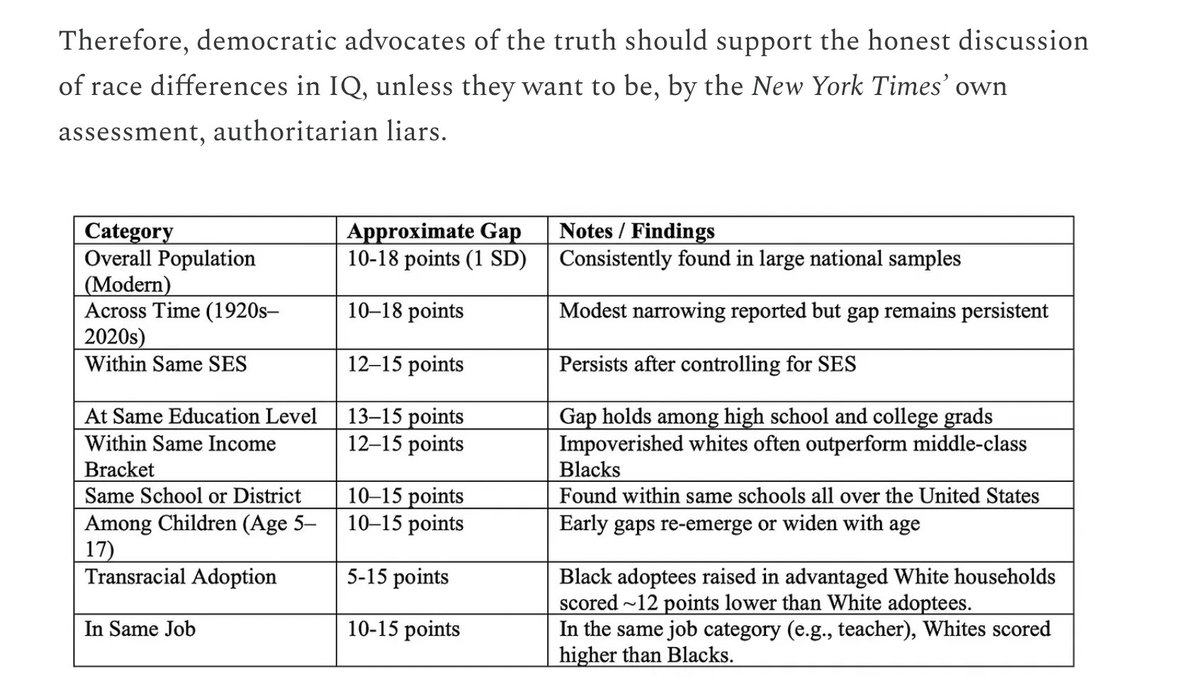
(3) The New York Times recently asserted that Truth is the dividing line between democracy and authoritarianism. Provocative, but defensible. If so, those who promote silence about race and IQ are authoritarians. No relevant expert debates the existence of large gaps. Image
Read 23 tweets
Dec 9, 2025
1.) Conservatives will often appeal to disgust when arguing that something is immoral. For example, promiscuous sex. Liberals often retort that disgust is irrelevant for morality. Conservatives are right. We should trust our disgust.

aporiamagazine.com/p/the-case-for…
2.) I make the case for disgust because (1) some disgusting things are just bad (2) disgust often alerts us to potential harms and (3) disgust facilitates the creation and expression of symbolic moral identity. Image
3.) The most straightforward argument is that some things are immoral simply because they are disgusting. No further argument needed. For example, public urination or pornographic displays. Ugly architecture. Grotesque behavior. Image
Read 15 tweets
Nov 10, 2025
1) Peter Singer is an intellectual colossus, a philosopher who is well known inside and outside the academy. And he's spectacularly wrong.

aporiamagazine.com/p/against-sing…
2) Singerism, as I see it, consists of three core commitments: utilitarianism, cosmopolitanism, and rationalism. Each is wrong or incomplete. Of these, utilitarianism is the most crucial. Image
3) Utilitarianism teaches that only pleasure and pain have intrinsic value. Nothing else matters morally. The right action is whatever increases pleasure and reduces suffering overall. Image
Read 22 tweets
Nov 2, 2025
1) Progressives have ruined the humans sciences. The latest example is Nature Reviews Psychology encouraging authors to include a "citation diversity statement." But the damage was already near total.

aporiamagazine.com/p/progressives…
2) What is a citation diversity statement? Well, it's essentially a letter confirming the authors' efforts to cite non-white, non-male, non-Western scholars. For progressives, diversity is a euphemism for "fewer white men." Image
3) Science is supposed to be meritocratic, though. Good papers get cited because they are good papers. Not because the authors are black disabled scholars. This policy is thus antithetical to the spirit of science. Image
Read 15 tweets
Oct 26, 2025
1) Feminization may not spell the end of the West, but it is almost certain to erode the traditional values that have long sustained its key institutions. In this essay, I address several objections raised to Helen Andrews’ argument on the feminization of public life.

aporiamagazine.com/p/what-helen-a…
2) In the New York Times, David French attacked Andrews' piece for heroizing men and denigrating women. He contended that Andrews was ignoring "even a cursory analysis" of history, pointing out that men have often created brutal cancel cultures that suppressed dissent. Image
3) This is a fallacious argument. That men have created many intolerant institutions is irrelevant to Andrews' claim. Men have also have created liberal democracies, science, rule of law, and the free press. Women likely cannot create similar institutions; men obviously can. Image
Read 21 tweets
Jun 23, 2025
(1) On average, Black Americans score substantially lower than White Americans on standardized tests of cognitive ability. This finding is well-established and largely uncontested in the academic literature.

aporiamagazine.com/p/sasha-gusev-…
(2) The only major question is about the cause (s) of these persistent disparities. Hereditarians argue that genetic factors play a significant role, while environment-only theorists contend that differences in physical, social, and cultural environments are the primary drivers. Image
(3) More than anyone else, Arthur Jensen established modern hereditarianism. In his 1969 article, "How Much Can We Boost IQ and Scholastic Achievement?," he argued compellingly that the environment-only hypothesis was implausible and that efforts to raise intelligence had failed. Image
Read 23 tweets

Did Thread Reader help you today?

Support us! We are indie developers!


This site is made by just two indie developers on a laptop doing marketing, support and development! Read more about the story.

Become a Premium Member ($3/month or $30/year) and get exclusive features!

Become Premium

Don't want to be a Premium member but still want to support us?

Make a small donation by buying us coffee ($5) or help with server cost ($10)

Donate via Paypal

Or Donate anonymously using crypto!

Ethereum

0xfe58350B80634f60Fa6Dc149a72b4DFbc17D341E copy

Bitcoin

3ATGMxNzCUFzxpMCHL5sWSt4DVtS8UqXpi copy

Thank you for your support!

Follow Us!

:(