
The FCC just ordered every broadcaster to start posting a race & gender scorecard that breaks down the demographics of their workforce.
Activists lobbied for this b/c they want to see businesses pressured into hiring people based on their race & gender.
Courts have already overturned the FCC *twice* for pressuring broadcasters into making hiring decisions in violation of the Constitution.
I dissent.
docs.fcc.gov/public/attachm…
Activists lobbied for this b/c they want to see businesses pressured into hiring people based on their race & gender.
Courts have already overturned the FCC *twice* for pressuring broadcasters into making hiring decisions in violation of the Constitution.
I dissent.
docs.fcc.gov/public/attachm…


The Civil Rights Act of 1964 requires that the government keep this type of data confidential when it is collected by the Equal Opportunity Employment Commission.
But the FCC goes another way—one that violates the Constitution, as courts already found in two prior FCC cases.
But the FCC goes another way—one that violates the Constitution, as courts already found in two prior FCC cases.
This is no benign disclosure regime either.
The evidentiary record makes clear that the FCC has chosen to publish these scorecards for one and only one reason—to ensure that businesses are targeted and pressured into making decisions based on a person’s race and gender.
The evidentiary record makes clear that the FCC has chosen to publish these scorecards for one and only one reason—to ensure that businesses are targeted and pressured into making decisions based on a person’s race and gender.
Let’s start with the FCC’s track record of pressuring broadcasters into discriminating on the basis of race and gender in violation of the equal protection guarantees of the Due Process Clause of the Fifth Amendment to the U.S. Constitution.
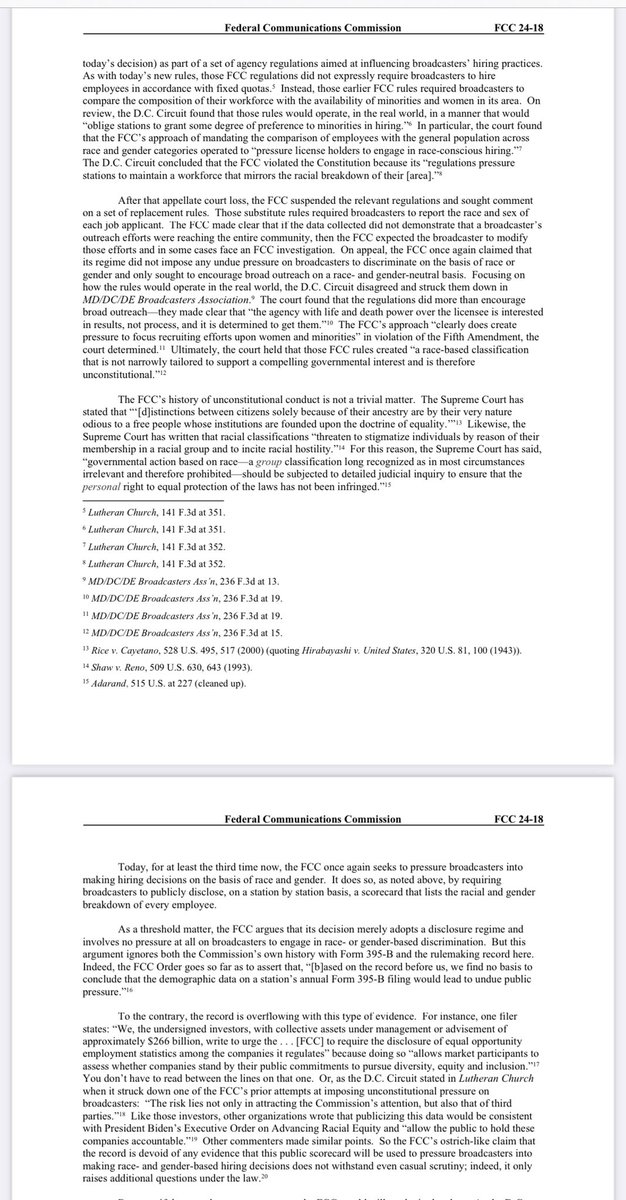
In Lutheran Church, the court reviewed an earlier FCC effort to use the same scorecard at issue here.
The court determined that the FCC’s decision in that case to mandate that broadcasters compare their employees with the general population in their area across race and gender categories operated to “pressure license holders to engage in race-conscious hiring.”
The court then concluded that the FCC had violated the Constitution because its “regulations pressure stations to maintain a workforce that mirrors the racial breakdown of their [area].”
The court determined that the FCC’s decision in that case to mandate that broadcasters compare their employees with the general population in their area across race and gender categories operated to “pressure license holders to engage in race-conscious hiring.”
The court then concluded that the FCC had violated the Constitution because its “regulations pressure stations to maintain a workforce that mirrors the racial breakdown of their [area].”
After that court loss, the FCC went back to the drawing board. But it drew up the same plan — to pressure broadcasters into hiring based on race and gender in violation of the Constitution.
As with the first set of rules, these second ones made clear that if a broadcaster’s workforce did not demonstrate that its outreach or recruitment efforts were reaching the entire community, then the FCC expected the broadcaster to modify those efforts and in some cases face an FCC investigation.
Focusing on how those rules would operate in the real world, the court found that the FCC’s regulations did more than encourage broad outreach—they made clear that “the agency with life and death power over the licensee is interested in results, not process, and it is determined to get them.”
The FCC's approach “clearly does create pressure to focus recruiting efforts upon women and minorities” in violation of the Fifth Amendment, the court determined.
Thus, the FCC secured a second and deserved L.
As with the first set of rules, these second ones made clear that if a broadcaster’s workforce did not demonstrate that its outreach or recruitment efforts were reaching the entire community, then the FCC expected the broadcaster to modify those efforts and in some cases face an FCC investigation.
Focusing on how those rules would operate in the real world, the court found that the FCC’s regulations did more than encourage broad outreach—they made clear that “the agency with life and death power over the licensee is interested in results, not process, and it is determined to get them.”
The FCC's approach “clearly does create pressure to focus recruiting efforts upon women and minorities” in violation of the Fifth Amendment, the court determined.
Thus, the FCC secured a second and deserved L.
The FCC's history of unconstitutional conduct is not a trivial matter.
The Supreme Court has stated that “[d]istinctions between citizens solely because of their ancestry are by their very nature odious to a free people whose institutions are founded upon the doctrine of equality.”
Likewise, the Supreme Court has written that racial classifications “threaten to stigmatize individuals by reason of their membership in a racial group and to incite racial hostility.”
The Supreme Court has stated that “[d]istinctions between citizens solely because of their ancestry are by their very nature odious to a free people whose institutions are founded upon the doctrine of equality.”
Likewise, the Supreme Court has written that racial classifications “threaten to stigmatize individuals by reason of their membership in a racial group and to incite racial hostility.”
The FCC takes an ostrich-like approach to this third go around with rules that pressure broadcasters.
The FCC simply asserts that “we find no basis to conclude that the demographic data on a station’s annual Form 395-B filing would lead to undue public pressure.”
No evidence?
The FCC simply asserts that “we find no basis to conclude that the demographic data on a station’s annual Form 395-B filing would lead to undue public pressure.”
No evidence?
The record is overflowing with it.
For instance, one filer states:
“We, the undersigned investors, with collective assets under management or advisement of approximately $266 billion, write to urge the . . . [FCC] to require the disclosure of equal opportunity employment statistics among the companies it regulates” because doing so “allows market participants to assess whether companies stand by their public commitments to pursue diversity, equity and inclusion.”
You don’t have to read between the lines on that one.
For instance, one filer states:
“We, the undersigned investors, with collective assets under management or advisement of approximately $266 billion, write to urge the . . . [FCC] to require the disclosure of equal opportunity employment statistics among the companies it regulates” because doing so “allows market participants to assess whether companies stand by their public commitments to pursue diversity, equity and inclusion.”
You don’t have to read between the lines on that one.
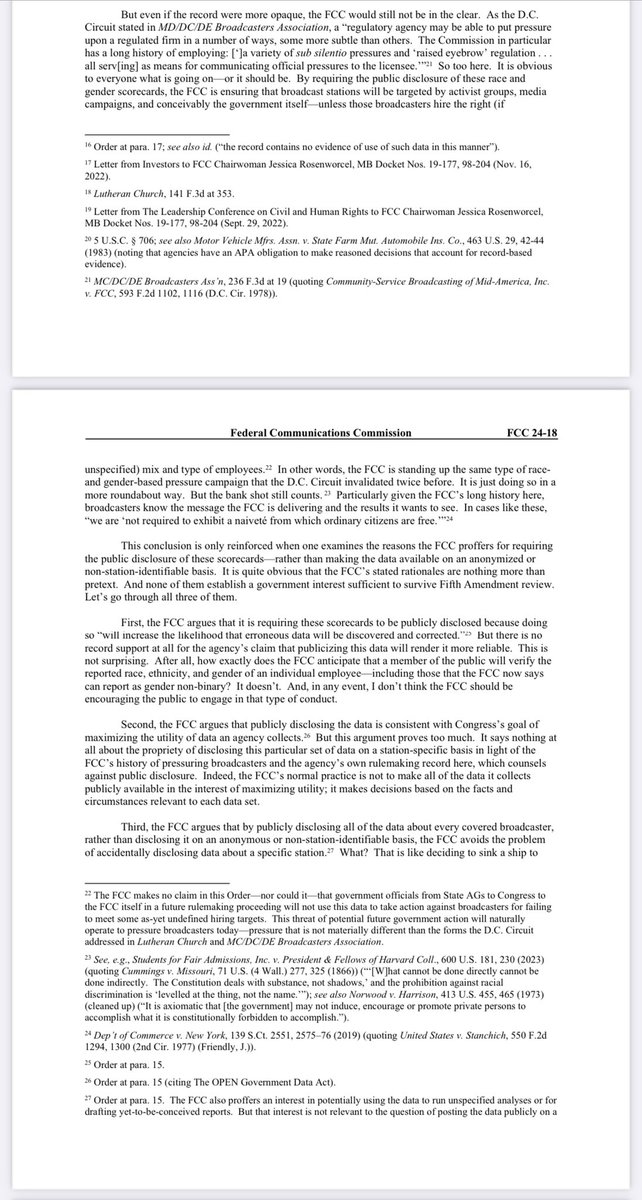
It is obvious to everyone what is going on here—or it should be.
By requiring the public disclosure of these race & gender scorecards, the FCC is ensuring that broadcasters will be targeted—and pressured—by activist groups, media campaigns, & predictably the government itself.
By requiring the public disclosure of these race & gender scorecards, the FCC is ensuring that broadcasters will be targeted—and pressured—by activist groups, media campaigns, & predictably the government itself.
Indeed the only justifications the FCC offers for publicly posting these scorecards are what we would call pure pretext in the discrimination context.
First, the FCC claims that it is publishing these scorecards to “increase the likelihood that erroneous data will be discovered and corrected.”
But that makes no sense. How exactly does the FCC anticipate that a member of the public will verify the reported race, ethnicity, and gender of particular employees at a business—including those that the FCC now says can report as gender non-binary?
It doesn’t. And, in any event, I don’t think the FCC should be encouraging people to engage in that type of conduct.
But that makes no sense. How exactly does the FCC anticipate that a member of the public will verify the reported race, ethnicity, and gender of particular employees at a business—including those that the FCC now says can report as gender non-binary?
It doesn’t. And, in any event, I don’t think the FCC should be encouraging people to engage in that type of conduct.
For another, the FCC argues that it is publicly disclosing this demographic data to eliminate the risk that it might leak out accidentally one day.
What?
That is like deciding to scuttle a ship to avoid the risk that it might spring a leak someday.
What?
That is like deciding to scuttle a ship to avoid the risk that it might spring a leak someday.
• • •
Missing some Tweet in this thread? You can try to
force a refresh






