The @NHSEngland landmark decision to stop using puberty blockers for gender dysphoric youth raises a key question: what do we know about the effects of puberty blockers on adolescent development?
Prof. Sallie Baxendale explored this question at @segm_ebm 2023 conference./1🧵
"Extraordinary claims demand extraordinary evidence" wrote Prof. Baxendale in a piece describing her research. "The only extraordinary evidence here is the gaping chasm of knowledge, or even apparent curiosity, of the clinicians who continue to chant 'safe and completely reversible' as they prescribe these medications to the children in their care." /2 unherd.com/2024/02/why-di…
Following the preview of her research at @segm_ebm conference, Prof. Baxendale published her findings about the known effects of puberty blockers
on neuropsychological function in a peer-reviewed journal.
Prof. Baxendale later shared that in her 3 decades of academic publishing, the submission of the paper was truly a unique experience. She was not concerned that the paper had been rejected 3 times prior to being accepted. Rather, it was the nature of the rejections, which appeared to be ideologically driven. /3 onlinelibrary.wiley.com/doi/full/10.11…
Dr. Baxendale's full presentation at @segm_ebm NYC 2023 conference is available below. We will also highlight some key moments in the rest of this thread. /4
Dr. Baxendale explores what happens when critical windows of brain development are missed, starting with her "surprise" at the assertion made by proponents of youth transitions that puberty blockers are "completely reversible." /5
Prof. Baxendale challenges the claim that puberty can be paused & resumed:
“If you deprive the brain of any input during the critical windows of opportunity, the brain will move on and whatever it was that was supposed to be developing, doesn't develop properly.” /6
The process of pruning in the brain, which occurs during adolescence, is critical. It strengthens the executive function & social cognition. This process is hormonally driven: it depends on the pubertal stage, not on age. When puberty is stopped, brain development is affected./7
Prof. Baxendale's research was motivated by her surprise at the assertions by gender clinicians that "one can just pause puberty and then pick up 2-3 years later and nothing would happen," as this contradicted "everything we know about other windows of opportunity." /8
Dr. Baxendale found a paucity of studies on the effects of puberty blockers on human brains, so she turned to animal studies. What she found was that puberty blockers have “a detrimental impact on learning and the development of social behaviors and responses to stress." /9
Turning her attention to human studies, Prof. Baxendale found very few. Two studies were for the use of puberty blockers for early-onset puberty, and 3 were about stopping normally-timed puberty for gender-dysphoric youth. Several (low quality) studies signaled a drop in IQ. /10
Dr. Baxendale found no evidence that “you can pause a developmental stage and then restart it and everything will be okay.” Given all that is known about adolescent brain development, Dr. Baxendale asked a key question:
“How has this been allowed to develop as a treatment?”/11
The @NHSEngland's decision to restrict the use of puberty blockers to clinical research, finalized this month, vindicates Prof. Baxendale, Dr. Biggs, and other researchers in the UK and worldwide who have been sounding the alarm about the proliferation of puberty blockers in general medical settings without an adequate evidence base. /12
The full lecture by Prof. Baxendale at SEGM's NYC 2023 conference is profiled on our website and our YouTube channel. See links below. /end
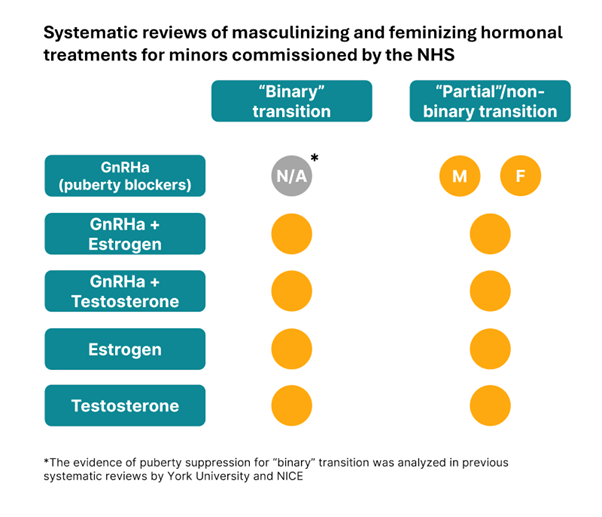
📢NHS England just published 10 new systematic evidence reviews on PB and CSH for binary and “non-binary” youth. Because of the weak evidence, the NHS paused new cross-sex hormones prescriptions and is conducting a 90-day consultation to review evidence for a potential permanent ban. /1
Of the 10 new evidence reviews, 8 cover masculinizing & feminizing hormones, with and without GnRH analogues, for “binary” and “partial”/NB transition. Two additional reviews examine GnRH monotherapy specifically for male and female youth who ID as NB. /2
The new reviews add to a list of now over 20 systematic reviews, all of which come to the conclusion: evidence is insufficient to support the practice of pediatric medical gender transition.
Puberty blockers are already permanently banned in the UK in both public (NHS) and private settings. Cross-sex hormones for minors were still technically allowed but with significant restrictions implemented post-Cass as we described in our spotlight.
The March NHS England announcement indicates a permanent ban on puberty blocker in the NHS settings is being considered. Whether or not it will be extended to private settings is as yet unknown. The consultation period for the proposed NHS ban ends on June 7, 2026. /3
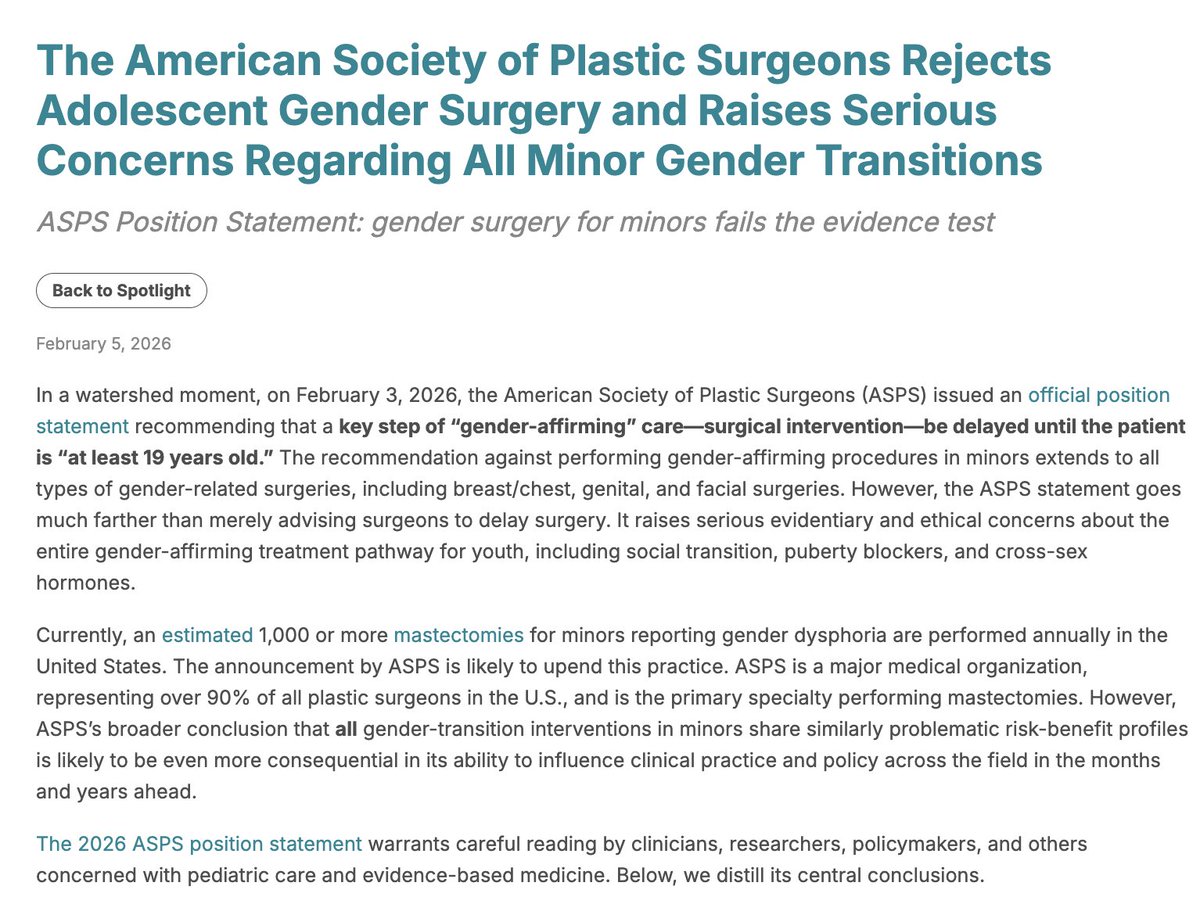
🚨 In a watershed moment, the American Society of Plastic Surgeons has put an end to youth gender surgeries. But a far bigger story is what this implies for the rest of "gender-affirming care," from social transition to puberty blockers & hormones—as our new analysis explains. /1
About 1,000+ mastectomies for gender-dysphoric minors are performed each year in the U.S, most done by plastic surgeons. The ASPS statement suggests this practice will be upended. But the analysis that ASPS offers for the rest of the transition pathway signals far more profound changes are likely to come.
The ASPS asserts that all steps in youth transition—from social transition and puberty blockers to cross-sex hormones and surgery— are interconnected; that all share similarly problematic risk–benefit profiles; and the risk compounds with each subsequent step.
This puts other medical associations on notice. At the very least, they have to review and adjust their own positions—or justify why they continue to stand by a practice that is not evidence-based and is profoundly ethically challenged. /2
It is no accident that plastic surgeons are the first professional association to take a strong stance against a key intervention in the "gender-affirming" care pathway for youth.
1. Unlike endocrine interventions, where physical changes unfold gradually and the extent of irreversibility may only become clear over time, surgery is universally understood as irreversible from the outset. When the risk–benefit ratio is unfavorable, surgeons have no gray area to retreat into—they must decide whether to operate. 2. Because surgery is typically the final step in the transition pathway, surgeons inherit the cumulative risks and uncertainties of the upstream interventions. That vantage point likely contributed to why the professional association representing plastic surgeons was among the first to recognize the full scope of the problem. 3. Most importantly, plastic surgery is unusual among medical specialties in routinely providing both elective cosmetic procedures and medically necessary care. This positions plastic surgeons to distinguish between interventions that are medically indicated and those that may primarily offer patient satisfaction without improving health outcomes. /3
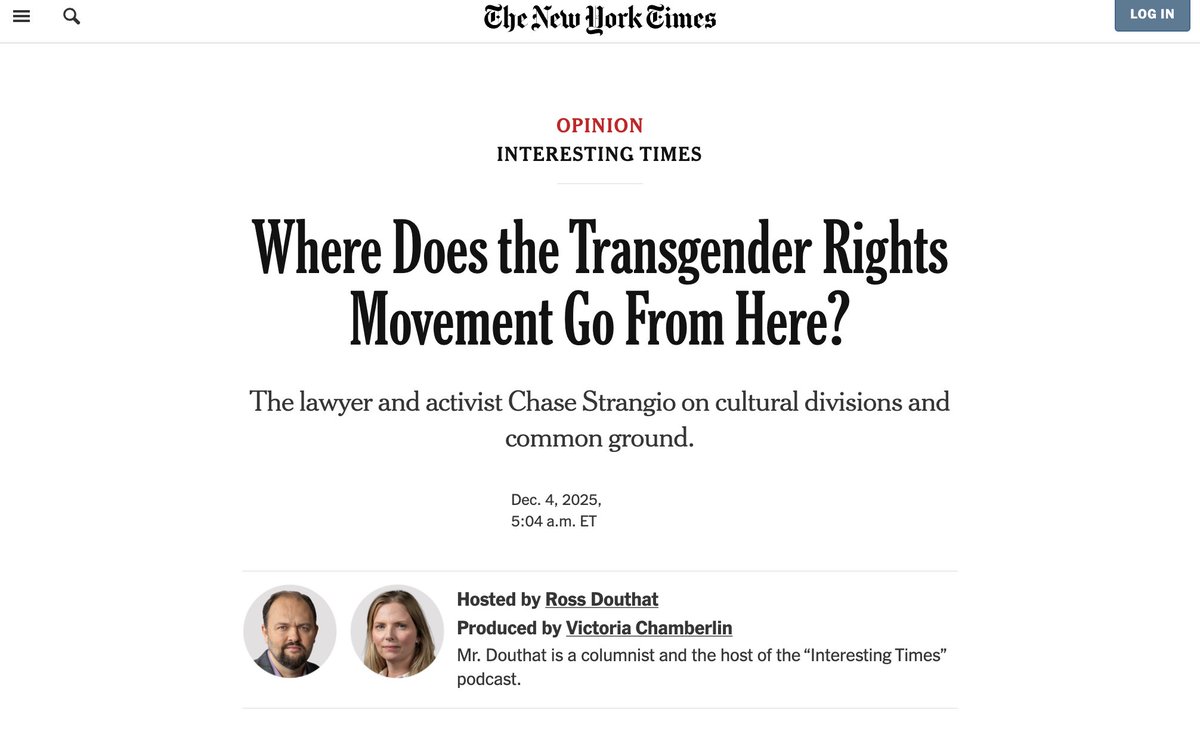
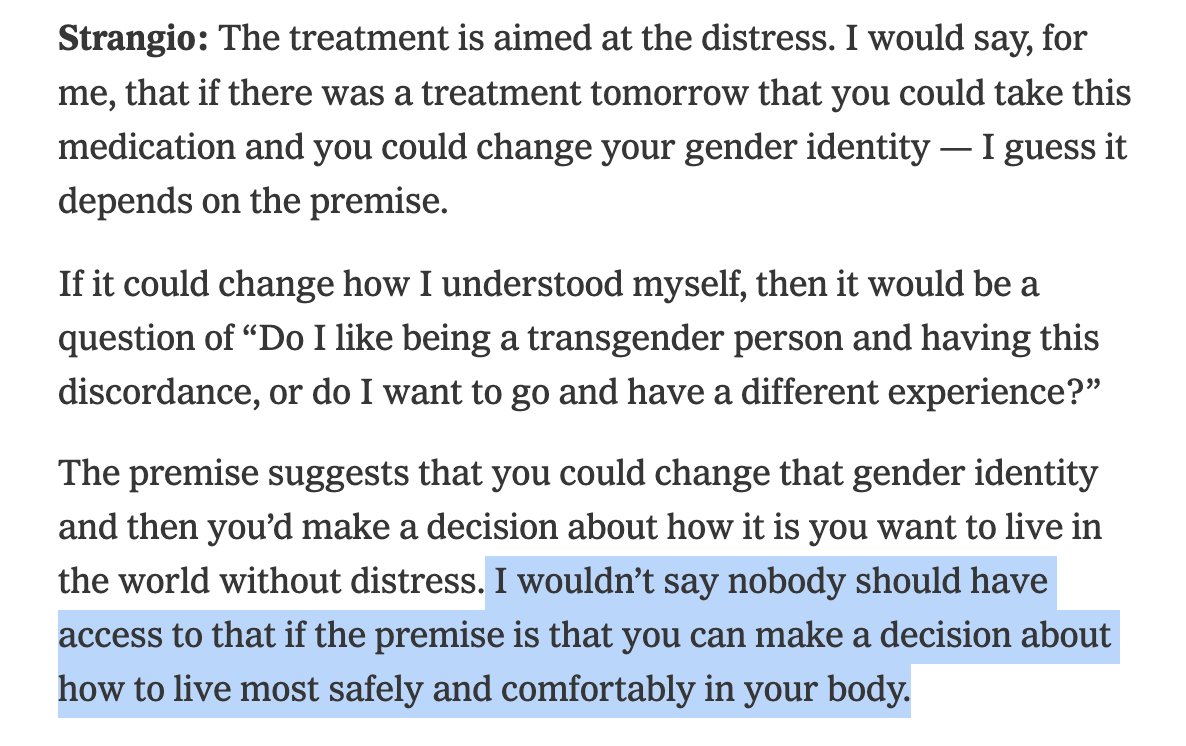
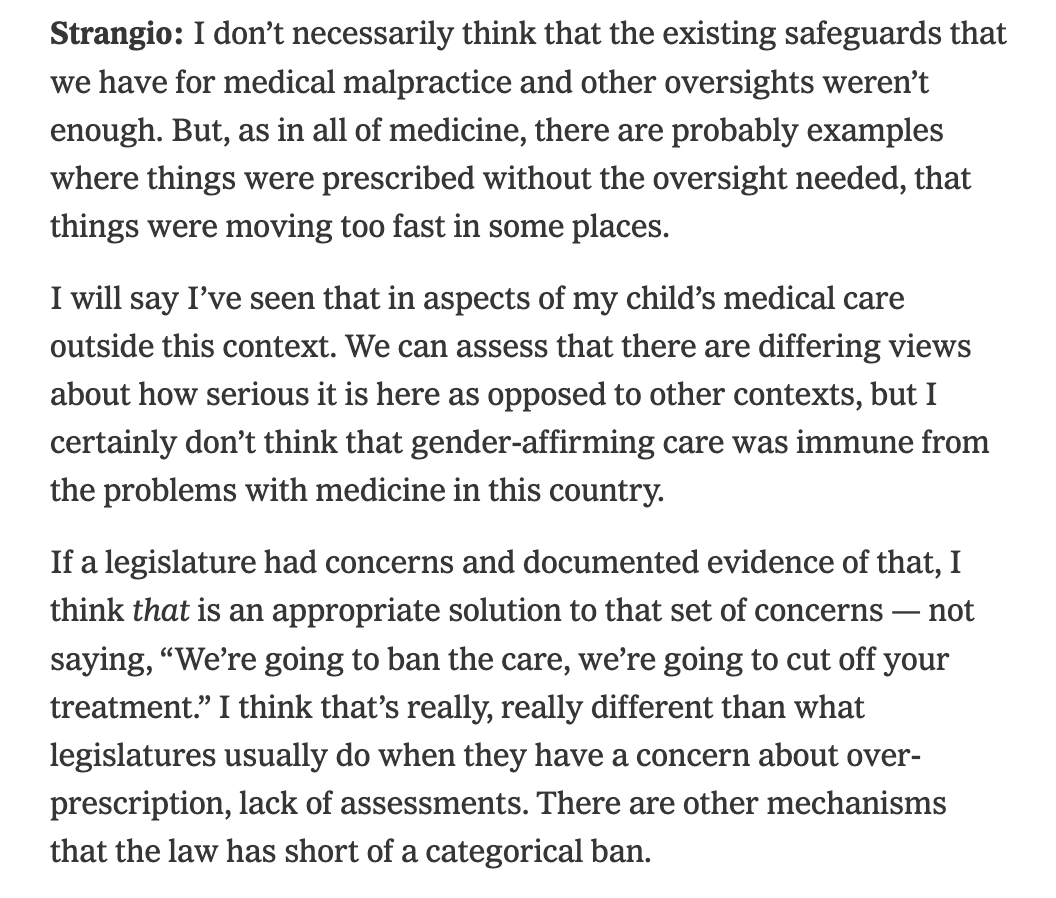
A must-listen/read interview between @DouthatNYT and Chase Strangio in the NYT today. While the tone toward critics of youth gender transition is more collegial, Strangio still misstates the evidence, claiming hormones are proven to significantly reduce distress & suicidality. /1
When pressed on psychotherapy for gender dysphoria, Strangio concedes it should be available, and does NOT level the charge of "conversion therapy." Still, Strangio conflates therapy with changing identity. Letting go of one's drive to medicalize has no such requirement. /2
Strangio laments that states imposed restrictions on youth transitions without a chance for more measured steps. But professionals (incl. @segm_ebm, @JuliaMasonMD1 ) have pleaded for years with @AmerAcadPeds and other medical organizations to course-correct, only to be ignored./3
Medical societies have replaced merit, empiricism, and open inquiry with fashionable political orthodoxies advanced under the banner of social justice, argues a new paper in the American Journal of Medicine. Our experience with @AmerAcadPeds supports this troubling observation:🧵
Medical societies are accountable to their members, yet they often ignore their members' preferences, instead superimposing their own agendas, the authors point out.
SEGM's @JuliaMasonMD1 experienced this first-hand when she, along with a group of fellow pediatricians, tried to convince the @AmerAcadPeds to align its recommendations for treating gender-dysphoric youth with systematic reviews of evidence. The AAP policy promotes gender transition of minors as the first-line treatment of gender dysphoria, yet systematic reviews do not find any trustworthy evidence of benefit of youth transitions.
While short- or long-term benefits are uncertain, biological harms such as infertility/sterility, bone health impairment, and likely adverse effects on brain development are much more certain. /2
For several years, a group of pediatricians committed to the long-term health and well-being of gender-dysphoric youth followed AAP's due process to introduce resolutions calling on their medical society to evaluate the evidence and to update its outdated, non-evidence-based policy.
Even when a resolution was upvoted by the majority of participating pediatricians, rising to the top-5 based on positive member engagement, the AAP leadership refused to discuss the resolution during the leadership meeting. /3
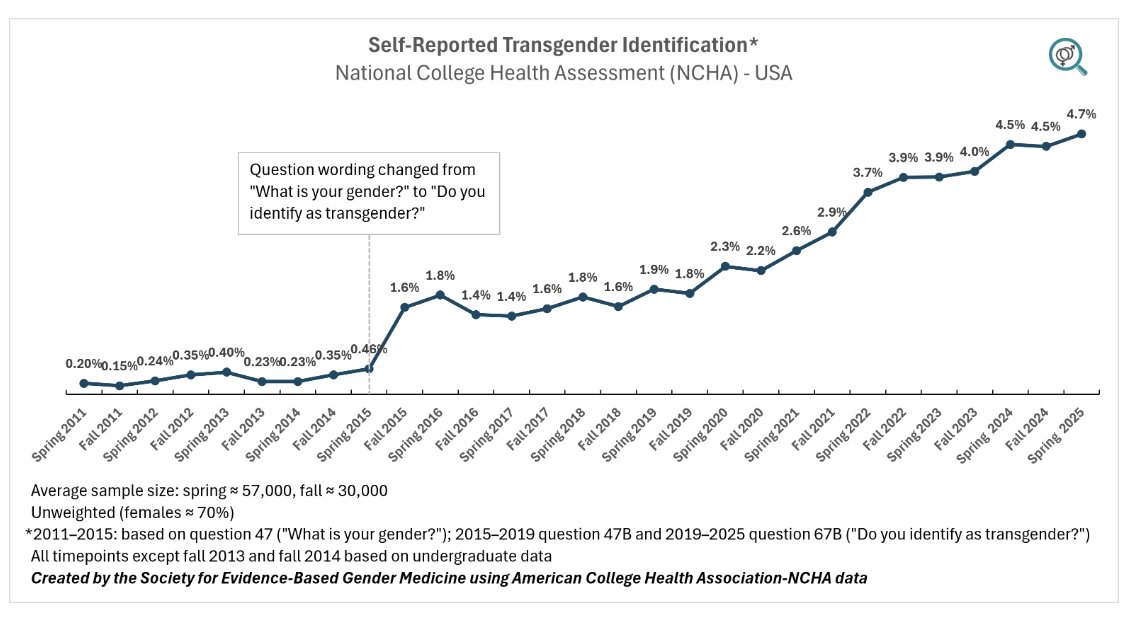
Recent claims of a “free fall” in youth trans identities may have been greatly exaggerated. A sample of 45K+ students shows trans & nonbinary identities at an all-time high. The claimed drop may stem from flawed weighting and poorly designed survey questions. SEGM's analysis⬇/1
Per the NCHA data, in 2025, 8% of women & nearly 5% of men attending U.S colleges had a non-"cisgender" identity. While there is no evidence of a drop in transgender/nonbinary identities, the data suggest that we may be approaching a plateau. /2
Youth with "nonbinary"- type identities far outnumber those who identify as "trans men" or "trans women." Since 2022, the nonbinary numbers have leveled off, leading to an overall "trans identification" plateau— just as the cross-sex identity, esp. FtM, is still increasing./3
The new study from the early Dutch cohort of puberty suppressed youth will require substantial analysis, but several important preliminary points can be made. /1
👉To cut to the chase, the study cannot answer the key question of whether early pubertal blockade (at Tanner stage 2) leads to worse adult sexual outcomes, because there were only 5 cases of early puberty blockade.
To increase the sample, the authors lumped early puberty (Tanner 2) with mid puberty (Tanner 3). The resulting sample (n=17) was still too small, and it was not possible to perform statistical analysis comparing sexual function outcomes of early/mid puberty suppression with later pubertal suppression (Tanner 4/5).
Therefore, no conclusions can be made about the effects of earlier vs. later pubertal suppression on future sexual function, and it is unclear how the authors concluded that early PB has no adverse effects on sexual function. /2
👉The only conclusion that can be made with some degree of confidence is that puberty-suppressed individuals have high rates of sexual dysfunction in adulthood (at average age 29). About 30% have not been sexually active in a year. In addition, 50% of males (MtF) and 58% of females (FtM) reported having one or more sexual dysfunction.
Not all typical domains of sexual dysfunction are accounted for in the study. There is no reporting on pain during sexual activity - previous studies have shown this is a frequent problem identified in transgender people after gender affirming medical treatment. Thus, this study may seriously underestimate sexual dysfunction.
Still, assuming the respondents' answers focused on recent sexual experiences as adults, the reported rate of sexual dysfunction (50-58%) compares unfavorably to the general Dutch population, where only 7%–17% report sexual dysfunction in the last 12 months (see table below).
However, even that cannot be assumed, since the respondents were asked if they had *ever had sexual difficulties, which means such difficulties may have occurred at any stage in their life: during puberty blockade; while on cross-sex hormones pre-surgery, immediately post-surgery, or well after the surgery.
Failure to differentiate between the stages when the sexual difficulties occurred is a major methodological limitation which makes the data shared by the authors extremely challenging to interpret. /3 rutgers.nl/wp-content/upl…