In Ek's excellent new @JPolEcon piece on migrants to Sweden, he reports a "significant dispersion in human capital across countries [of origin] with a 90/10 percentile ratio of 3.2."
So, which are at the 90th percentile?
The ethics review board wouldn't let him tell us.
🧵:
So, which are at the 90th percentile?
The ethics review board wouldn't let him tell us.
🧵:

The screenshot above is from his ReadMe file here, part of a ZIP that includes all of the replication data.
These words should be enough to find the files via a Google search:
"Replication Data for: Cultural Values and Productivity"
These words should be enough to find the files via a Google search:
"Replication Data for: Cultural Values and Productivity"

You can see the replication folder includes the cross-country data in an Excel file-- with countries listed by number, not name.
"FodelseLandnamn" translates to "Birth country name," so that might have been the one column Ek was required to change by the Lund ethics board.
"FodelseLandnamn" translates to "Birth country name," so that might have been the one column Ek was required to change by the Lund ethics board.


I'm glad economists are usually still allowed to candidly, openly report their findings.
Candid scholarly inquiry into the nature and causes of the wealth of nations can enrich humanity.
I'm sorry to see the Lund ethics board becoming a barrier to such scholarly inquiry.
Candid scholarly inquiry into the nature and causes of the wealth of nations can enrich humanity.
I'm sorry to see the Lund ethics board becoming a barrier to such scholarly inquiry.
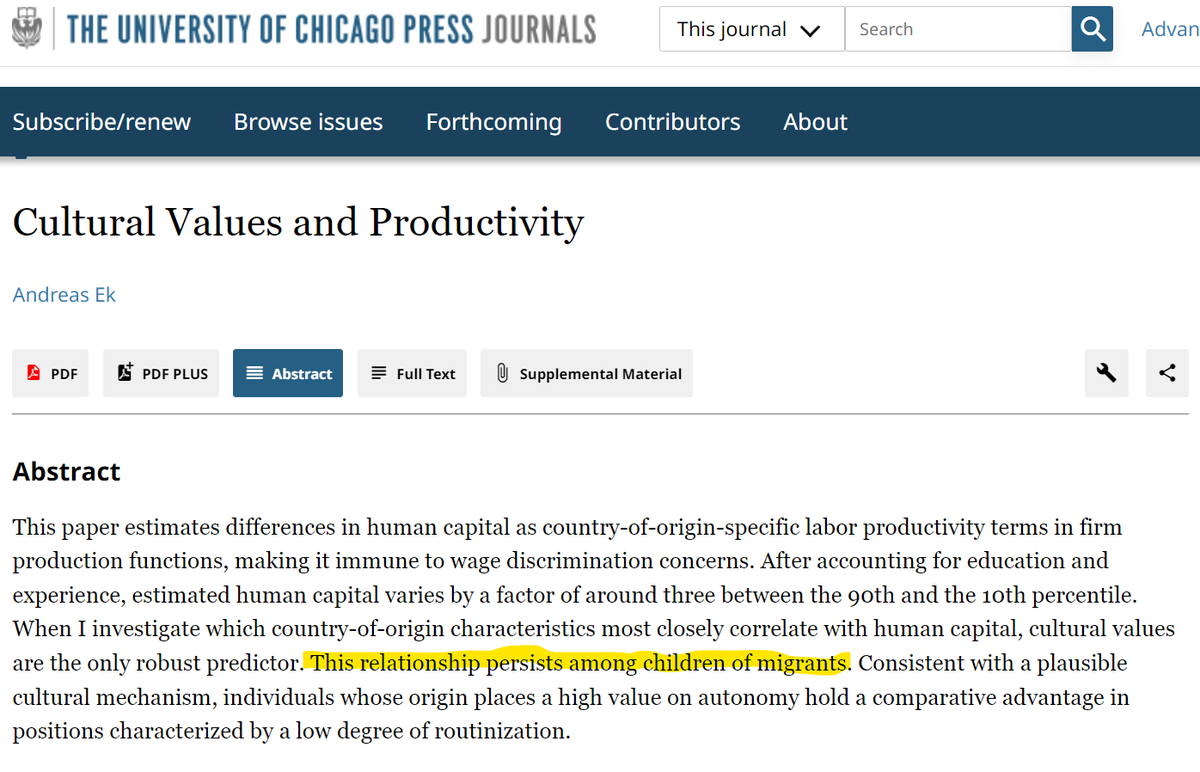
Ek's excellent new paper in @JPolEcon is an important contribution to cultural transplant theory.
He finds evidence that economically important cultural differences migrate and persist.
My one hope is that future researchers receive official permission for full candor.
~fin~
He finds evidence that economically important cultural differences migrate and persist.
My one hope is that future researchers receive official permission for full candor.
~fin~
Coda:
From Ek's @JPolEcon paper itself:
"To obtain the release of country (and parents’ country) of birth at a more detailed level than Statistics Sweden normally allows, I have agreed to the condition that no results are presented with individual countries named."
From Ek's @JPolEcon paper itself:
"To obtain the release of country (and parents’ country) of birth at a more detailed level than Statistics Sweden normally allows, I have agreed to the condition that no results are presented with individual countries named."
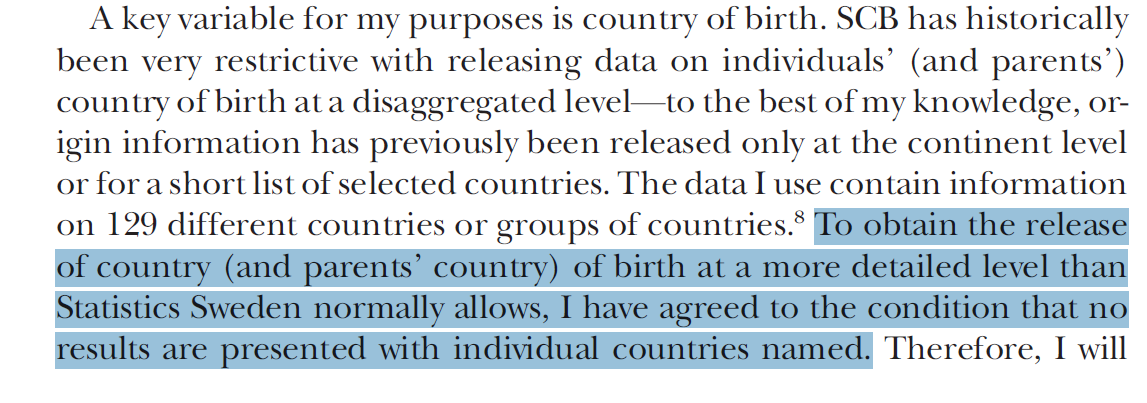
"Therefore, [because of the requirements unfortunately imposed by others] I will present only results that are related to country characteristics and never point to specific countries."

• • •
Missing some Tweet in this thread? You can try to
force a refresh