Special counsel Jack Smith has filed his response to Judge Cannon's request for preliminary jury instructions regarding the Presidential Records Act in Trump's classified documents case.
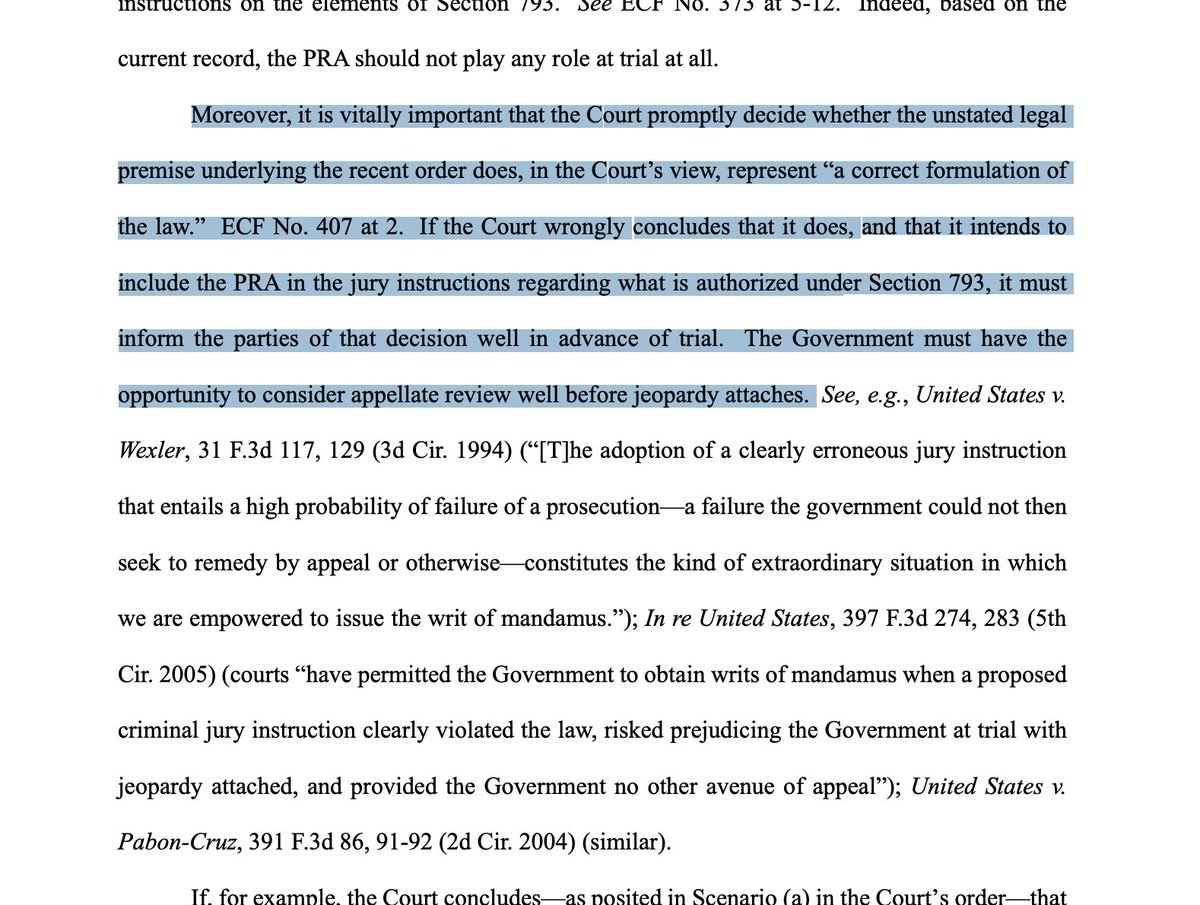
Cannon asked both Trump & the special counsel to "engage with" two "competing scenarios" involving potential jury instructions regarding the impact of the PRA on Trump's charges.
"Both scenarios rest on an unstated and fundamentally flawed legal premise," special counsel writes.
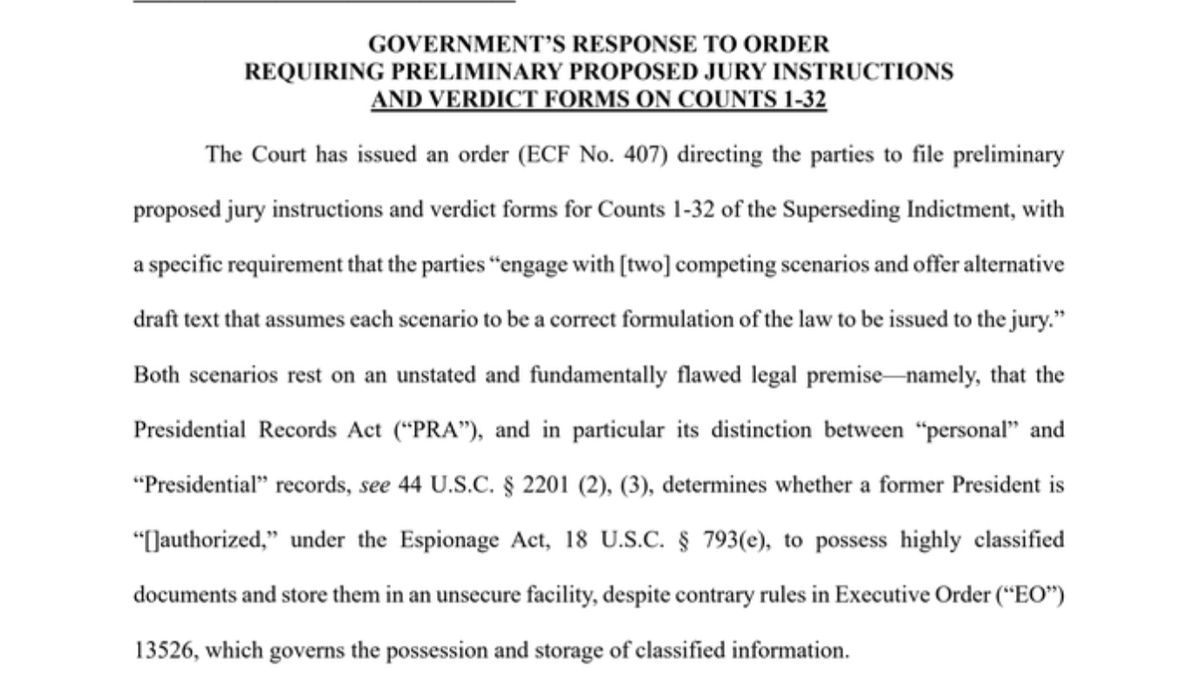
The special counsel implores Cannon to inform the parties of her decision on jury instructions "well in advance of trial."
"The Government must have the opportunity to consider appellate review well before jeopardy attaches."
Trump also filed his own response on preliminary jury instructions regarding the Presidential Records Act.
1. Halligan presented the original indictment with three counts against Comey. The grand jury deliberated for roughly two hours and took a vote.
2. After deliberations, the foreperson informed the EDVA grand jury coordinator that there were not enough votes to indict on Count 1 of the three-count indictment.
However, the entire document was then marked as though the GJ declined to return an indictment on all counts.
🧵 NEW: A federal judge ruled against the Trump administration.
Then the harassment began.
Six credible threats to his life.
Pizzas sent to his home in the name of Judge Esther Salas’s murdered son, Daniel.
More than 400 “vile” calls to his chambers—including this voicemail:
The voicemail was played aloud during an event hosted by Speak Up for Justice.
The recipient—Judge John McConnell—publicly detailed the threats he has endured in recent months.
“It’s the one time that actually shook my faith in the judicial system and the rule of law,” he said.
At the event, Judge McConnell was joined by several fellow members of the federal judiciary—marking a rare instance in which sitting judges publicly addressed the threats and harassment they have faced.
NEW: Kilmar Abrego Garcia’s lawyers seek permission to file an amended complaint in his civil case in Maryland.
Among other things, the amended complaint “includes Abrego Garcia's first-hand account of torture and mistreatment at CECOT…”
Here’s Abrego Garcia’s amended complaint.
It alleges that he “was subjected to severe mistreatment upon arrival at CECOT, including but not limited to severe beatings, severe sleep deprivation,
inadequate nutrition, and psychological torture..”
“In Cell 15, Plaintiff Abrego Garcia and 20 other Salvadorans were forced to kneel from approximately 9:00 PM to 6:00 AM, with guards striking anyone who fell from exhaustion. During this time, Plaintiff Abrego Garcia was denied bathroom access and soiled himself…”
But I need to talk about my 4-year-old niece, Hope. She has a rare disease. A drug called elamipretide helped her survive.
But the FDA recently denied its approval.
Now her access to the medication is at risk. We're urging @FDA to reconsider🧵
This is Hope.
Hope was born with an ultra-rare genetic disorder called MLS syndrome. She is deaf and blind.
She also has a heart condition called cardiomyopathy, which makes it difficult for her heart to pump blood.
Last year, Hope’s heart function dropped so severely that doctors warned she might need a heart transplant.
As a last resort, her medical team at Children’s Hospital of Philadelphia recommended elamipretide, an experimental drug developed for ultra-rare mitochondrial disorders like hers.
“It is my understanding that DOGE contacted [the Justice Management Division] this afternoon and instructed them to terminate the contract,” Sirce Owen, the acting director of the Executive Office of Immigration Review, wrote on April 3.
NEW: Fourth Circuit shoots down the Trump administration’s efforts to appeal order requiring it to facilitate the return of Kilmar Abrego Garcia.
“We shall not micromanage the efforts of a fine district judge attempting to implement the Supreme Court’s recent decision.”
“It is difficult in some cases to get to the very heart of the matter. But in this case, it is not hard at all. The government is asserting a right to stash away residents of this country in foreign prisons without the semblance of due process..”
“[The government] claims in essence that because it has rid itself of custody that there is nothing that can be done. This should be shocking not only to judges, but to the intuitive sense of liberty that Americans far removed from courthouses still hold dear..”