TWITTER FILES - BRAZIL
Brazil is engaged in a sweeping crackdown on free speech led by a Supreme Court justice named Alexandre de Moraes.
De Moraes has thrown people in jail without trial for things they posted on social media. He has demanded the removal of users from social media platforms. And he has required the censorship of specific posts, without giving users any right of appeal or even the right to see the evidence presented against them.
Now, Twitter Files, released here for the first time, reveal that de Moraes and the Superior Electoral Court he controls engaged in a clear attempt to undermine democracy in Brazil. They:
— illegally demanded that Twitter reveal personal details about Twitter users who used hashtags he did not like;
— demanded access to Twitter’s internal data, in violation of Twitter policy;
— sought to censor, unilaterally, Twitter posts by sitting members of Brazil’s Congress;
— sought to weaponize Twitter’s content moderation policies against supporters of then-president @jairbolsonaro
The Files show: the origins of the Brazilian judiciary’s demand for sweeping censorship powers; the court’s use of censorship for anti-democratic election interference; and the birth of the Censorship Industrial Complex in Brazil.
TWITTER FILES - BRAZIL was written by @david_agape_ @EliVieiraJr & @shellenberger
We presented these findings to de Moraes, to the Supreme Court (STF), and to the High Electoral Court (TSE). None responded.
Let’s get into it...
Brazil is engaged in a sweeping crackdown on free speech led by a Supreme Court justice named Alexandre de Moraes.
De Moraes has thrown people in jail without trial for things they posted on social media. He has demanded the removal of users from social media platforms. And he has required the censorship of specific posts, without giving users any right of appeal or even the right to see the evidence presented against them.
Now, Twitter Files, released here for the first time, reveal that de Moraes and the Superior Electoral Court he controls engaged in a clear attempt to undermine democracy in Brazil. They:
— illegally demanded that Twitter reveal personal details about Twitter users who used hashtags he did not like;
— demanded access to Twitter’s internal data, in violation of Twitter policy;
— sought to censor, unilaterally, Twitter posts by sitting members of Brazil’s Congress;
— sought to weaponize Twitter’s content moderation policies against supporters of then-president @jairbolsonaro
The Files show: the origins of the Brazilian judiciary’s demand for sweeping censorship powers; the court’s use of censorship for anti-democratic election interference; and the birth of the Censorship Industrial Complex in Brazil.
TWITTER FILES - BRAZIL was written by @david_agape_ @EliVieiraJr & @shellenberger
We presented these findings to de Moraes, to the Supreme Court (STF), and to the High Electoral Court (TSE). None responded.
Let’s get into it...
“We are… pushing back against the requests...”
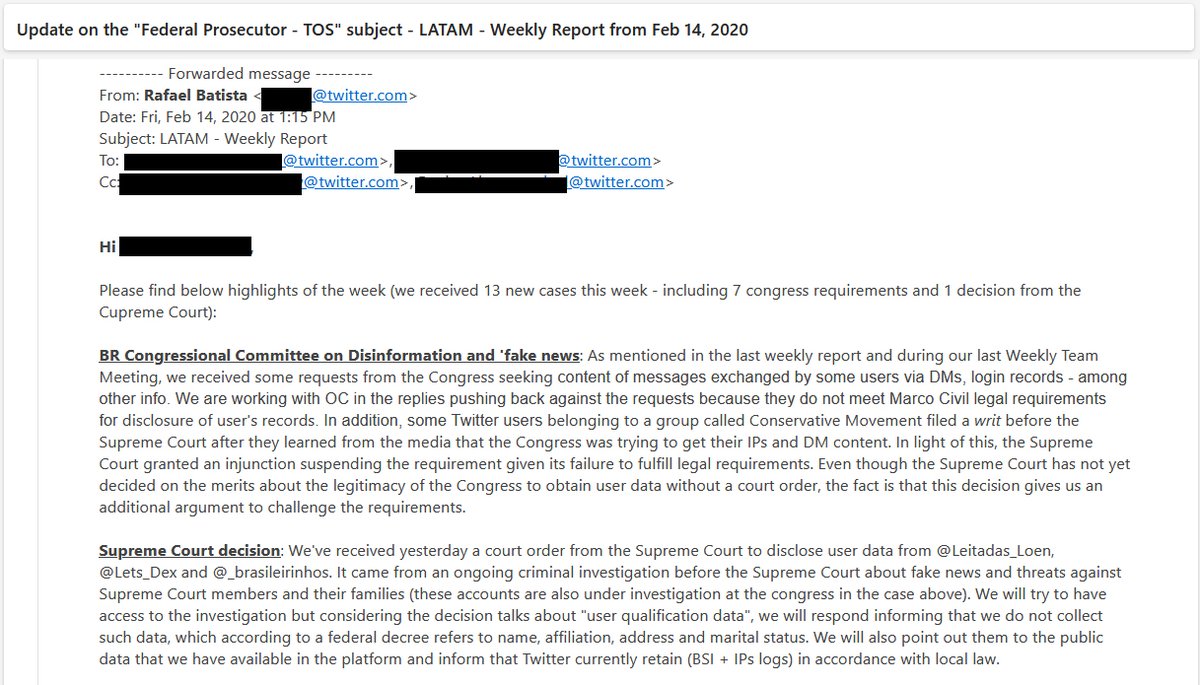
On February 14, 2020, Twitter’s legal counsel in Brazil, Rafael Batista, emailed his colleagues to describe a hearing in Congress on “Disinformation and 'fake news’”
Batista revealed that members of Brazil’s Congress had asked Twitter for the “content of messages exchanged by some users via DMs” as well as “login records - among other info.”
Batista said, “We are… pushing back against the requests,” which were illegal, “because they do not meet [Brazilian Internet law] Marco Civil legal requirements for disclosure of user's records.”
Batista noted that some conservative Twitter users had gone to the Supreme Court “after they learned from the media that the Congress was trying to get their IPs and DM content. In light of this, the Supreme Court granted an injunction suspending the requirement given its failure to fulfill legal requirements.”
On February 14, 2020, Twitter’s legal counsel in Brazil, Rafael Batista, emailed his colleagues to describe a hearing in Congress on “Disinformation and 'fake news’”
Batista revealed that members of Brazil’s Congress had asked Twitter for the “content of messages exchanged by some users via DMs” as well as “login records - among other info.”
Batista said, “We are… pushing back against the requests,” which were illegal, “because they do not meet [Brazilian Internet law] Marco Civil legal requirements for disclosure of user's records.”
Batista noted that some conservative Twitter users had gone to the Supreme Court “after they learned from the media that the Congress was trying to get their IPs and DM content. In light of this, the Supreme Court granted an injunction suspending the requirement given its failure to fulfill legal requirements.”
CONTEXT: Brazil’s Supreme Court and Superior Electoral Court
Seven justices comprise Brazil’s Superior Electoral Court (TSE).
Three of those justices are also members of the Supreme Court (STF).
One of them, Alexandre de Moraes, presides over the TSE.
Here's background on the rise of Brazil's Censorship Industrial Complex by @david_agape_
Seven justices comprise Brazil’s Superior Electoral Court (TSE).
Three of those justices are also members of the Supreme Court (STF).
One of them, Alexandre de Moraes, presides over the TSE.
Here's background on the rise of Brazil's Censorship Industrial Complex by @david_agape_
https://x.com/shellenberger/status/1752432671144497367?s=20
“Google, Facebook, Uber, WhatsApp and Instagram provide registration data and phone numbers without court order”
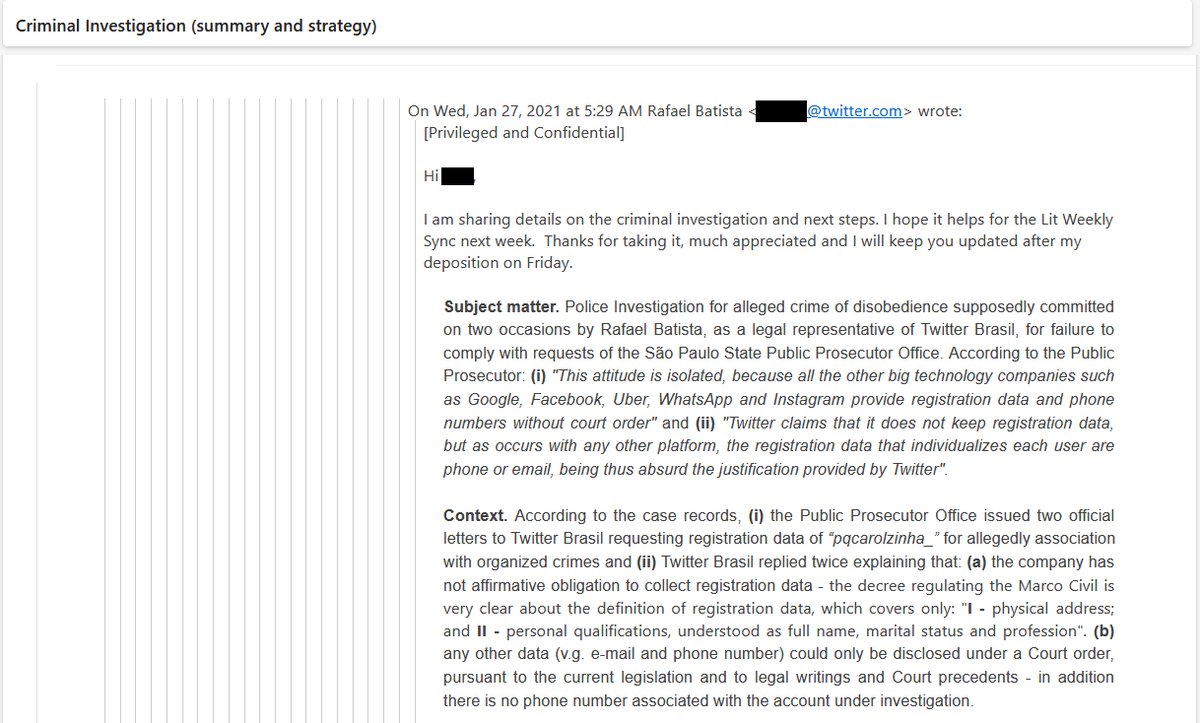
On January 27, 2021, Batista emailed his colleagues about a police investigation against him for refusing to give personal Twitter user data to the São Paulo State Public Prosecutor Office.
The Prosecutor claimed that Twitter’s “attitude is isolated, because all the other big technology companies such as Google, Facebook, Uber, WhatsApp, and Instagram provide registration data and phone numbers without a court order."
But Twitter “has not [sic] affirmative obligation to collect registration data” explained Batista to the prosecutor and “there is no phone number associated with the account under investigation.”
On January 27, 2021, Batista emailed his colleagues about a police investigation against him for refusing to give personal Twitter user data to the São Paulo State Public Prosecutor Office.
The Prosecutor claimed that Twitter’s “attitude is isolated, because all the other big technology companies such as Google, Facebook, Uber, WhatsApp, and Instagram provide registration data and phone numbers without a court order."
But Twitter “has not [sic] affirmative obligation to collect registration data” explained Batista to the prosecutor and “there is no phone number associated with the account under investigation.”
“This is the first time an actual criminal investigation was filed against an employee”
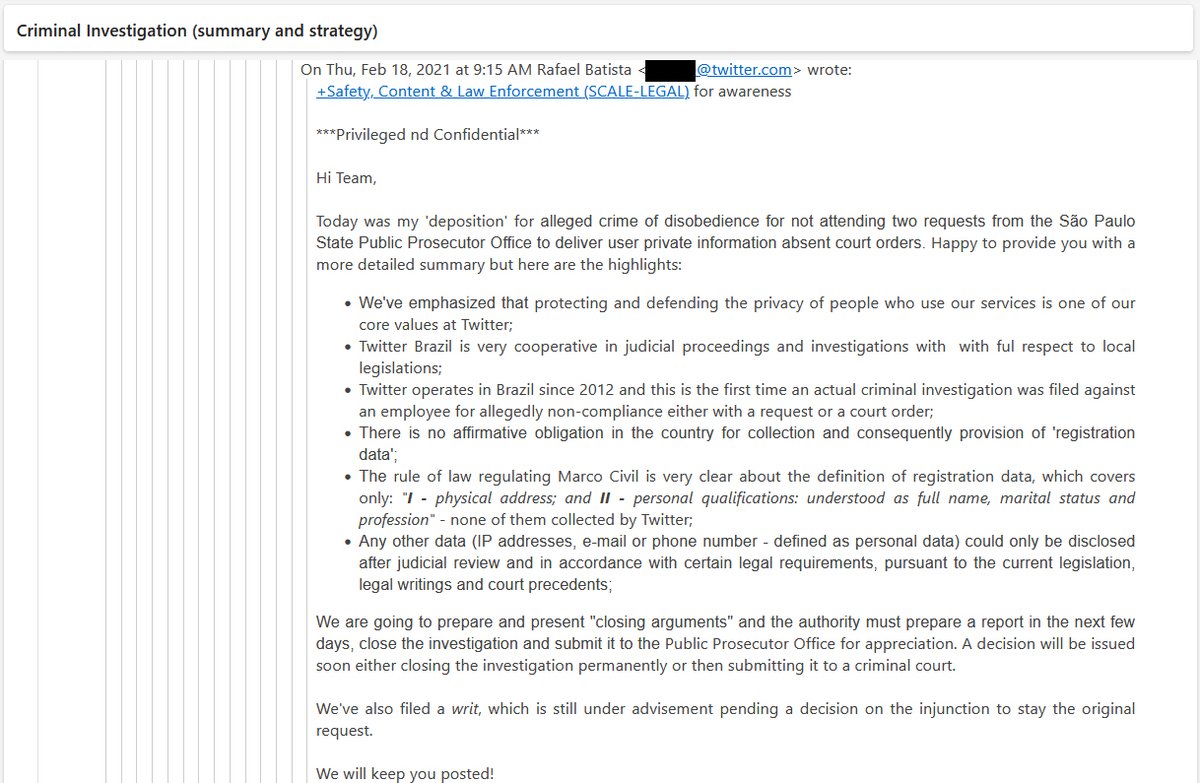
On February 18, 2021, Batista emailed his colleagues again to report back on his deposition. He said he told the prosecutor that “Twitter operates in Brazil since 2012 and this is the first time an actual criminal investigation was filed against an employee for allegedly non-compliance either with a request or a court order.”
Batista said he pointed out that “There is no affirmative obligation in the country for collection and consequently provision of 'registration data'."
Moreover, Brazil’s Internet privacy law, “Marco Civil… covers only: "I - physical address; and II - personal qualifications: understood as full name, marital status and profession" - none of them collected by Twitter.”
On February 18, 2021, Batista emailed his colleagues again to report back on his deposition. He said he told the prosecutor that “Twitter operates in Brazil since 2012 and this is the first time an actual criminal investigation was filed against an employee for allegedly non-compliance either with a request or a court order.”
Batista said he pointed out that “There is no affirmative obligation in the country for collection and consequently provision of 'registration data'."
Moreover, Brazil’s Internet privacy law, “Marco Civil… covers only: "I - physical address; and II - personal qualifications: understood as full name, marital status and profession" - none of them collected by Twitter.”
“We are unfortunately living strange times in Brazil.”
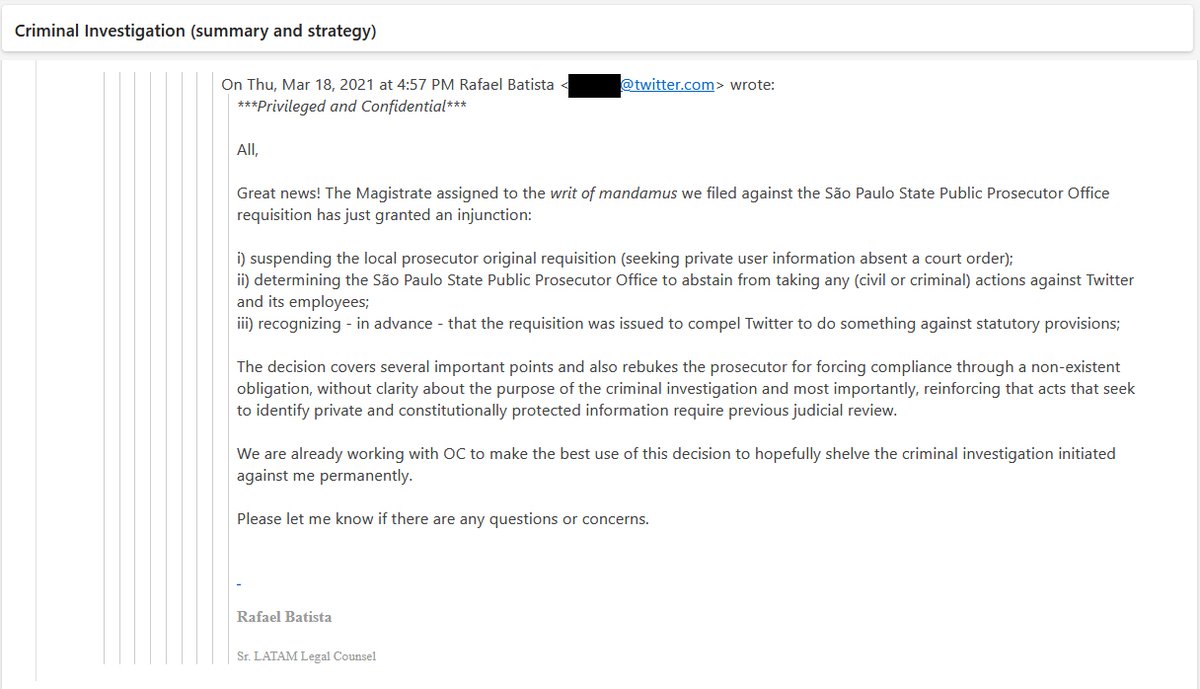
One month later, on March 18, Batista emailed his colleagues again, this time with, “Great news!” A judge rejected the prosecutor’s request for “private user information absent a court order” and also “rebukes the prosecutor for forcing compliance through a non-existent obligation, without clarity about the purpose of the criminal investigation and most importantly, reinforcing that acts that seek to identify private and constitutionally protected information require previous judicial review.”
A colleague of Batista, Regina Lima, replied to his email saying, “What Rafa forgot to mention is that the employee under threat here was him, the matter continued to escalate in a dangerous way and his resilience throughout the process was amazing.”
She added, “We are unfortunately living strange times in Brazil. We are seeing a concerning trend on aggressive law enforcement requests and court orders restricting fundamental rights.”
One month later, on March 18, Batista emailed his colleagues again, this time with, “Great news!” A judge rejected the prosecutor’s request for “private user information absent a court order” and also “rebukes the prosecutor for forcing compliance through a non-existent obligation, without clarity about the purpose of the criminal investigation and most importantly, reinforcing that acts that seek to identify private and constitutionally protected information require previous judicial review.”
A colleague of Batista, Regina Lima, replied to his email saying, “What Rafa forgot to mention is that the employee under threat here was him, the matter continued to escalate in a dangerous way and his resilience throughout the process was amazing.”
She added, “We are unfortunately living strange times in Brazil. We are seeing a concerning trend on aggressive law enforcement requests and court orders restricting fundamental rights.”

“An unfortunate and surprising update”
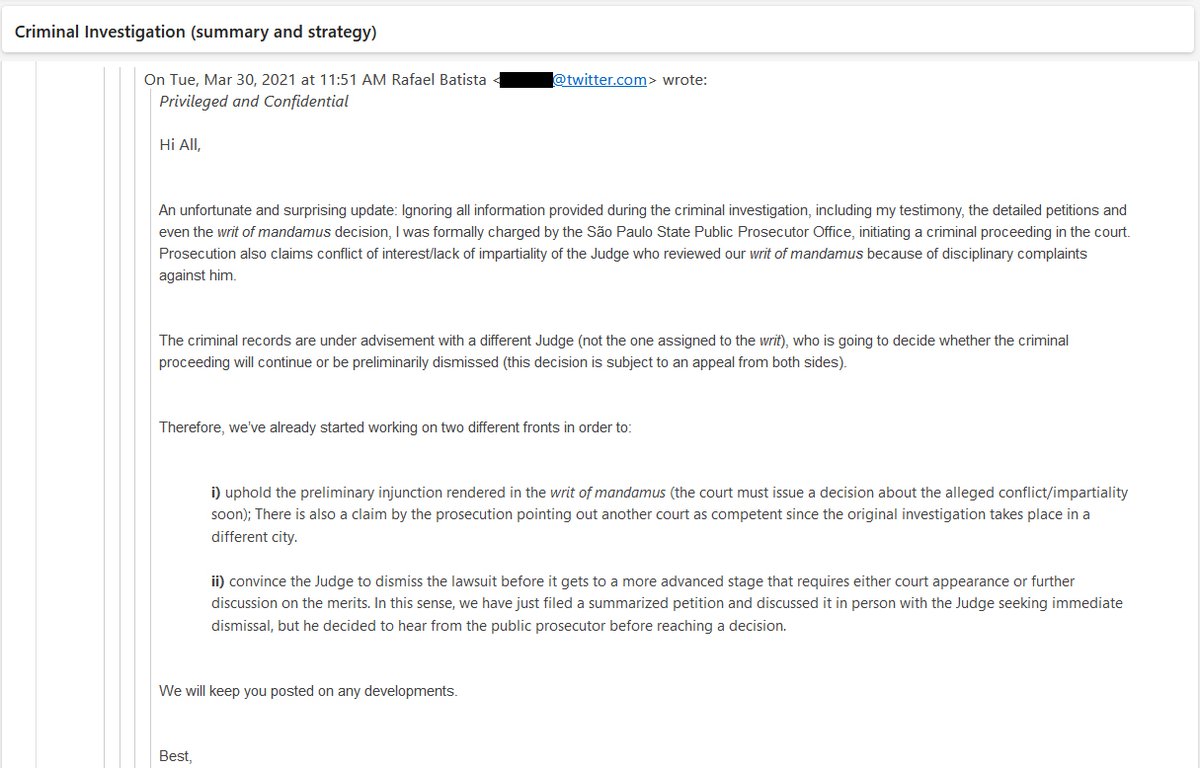
Then, on March 30, Batista emailed his colleagues again with “An unfortunate and surprising update”: the São Paulo State Public Prosecutor Office was back on the attack, “initiating a criminal proceeding” and claiming a “conflict of interest/lack of impartiality of the Judge.”
One week later, on April 5, 2021, Batista emailed his colleagues to say, “I am happy to share that we had great and relieving news…. The criminal court preliminary dismissed the charges against me mainly because it was not possible to identify any element of crime in my conduct.”
The ruling was because Twitter does not collect “registration data” of its users and the Marco Civil “clearly states that access to protected information such email - personal data - could only be done through specific judicial review.”
Then, on March 30, Batista emailed his colleagues again with “An unfortunate and surprising update”: the São Paulo State Public Prosecutor Office was back on the attack, “initiating a criminal proceeding” and claiming a “conflict of interest/lack of impartiality of the Judge.”
One week later, on April 5, 2021, Batista emailed his colleagues to say, “I am happy to share that we had great and relieving news…. The criminal court preliminary dismissed the charges against me mainly because it was not possible to identify any element of crime in my conduct.”
The ruling was because Twitter does not collect “registration data” of its users and the Marco Civil “clearly states that access to protected information such email - personal data - could only be done through specific judicial review.”

“Google Brazil… weakens our stance on privacy since we have always pushed back…
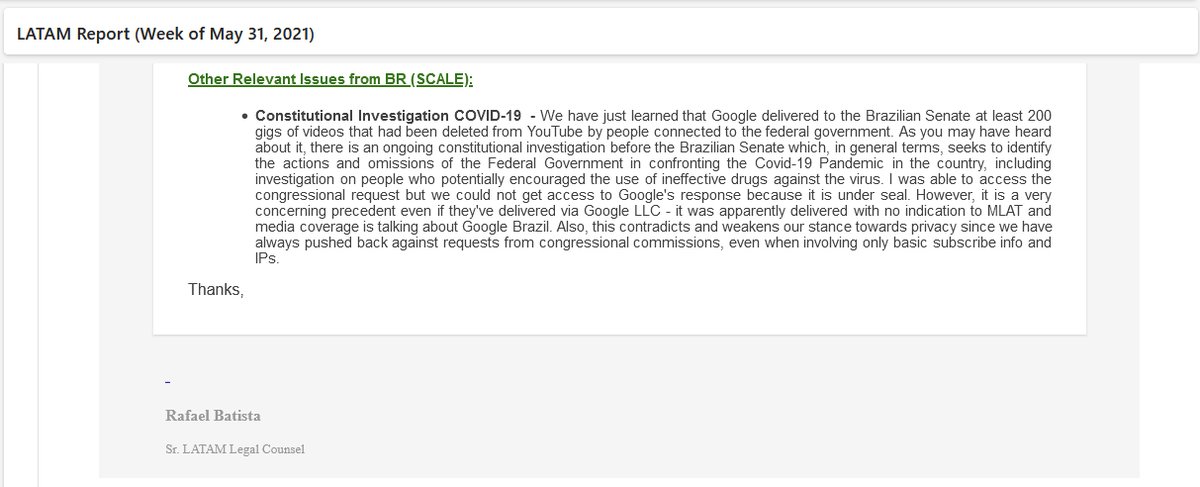
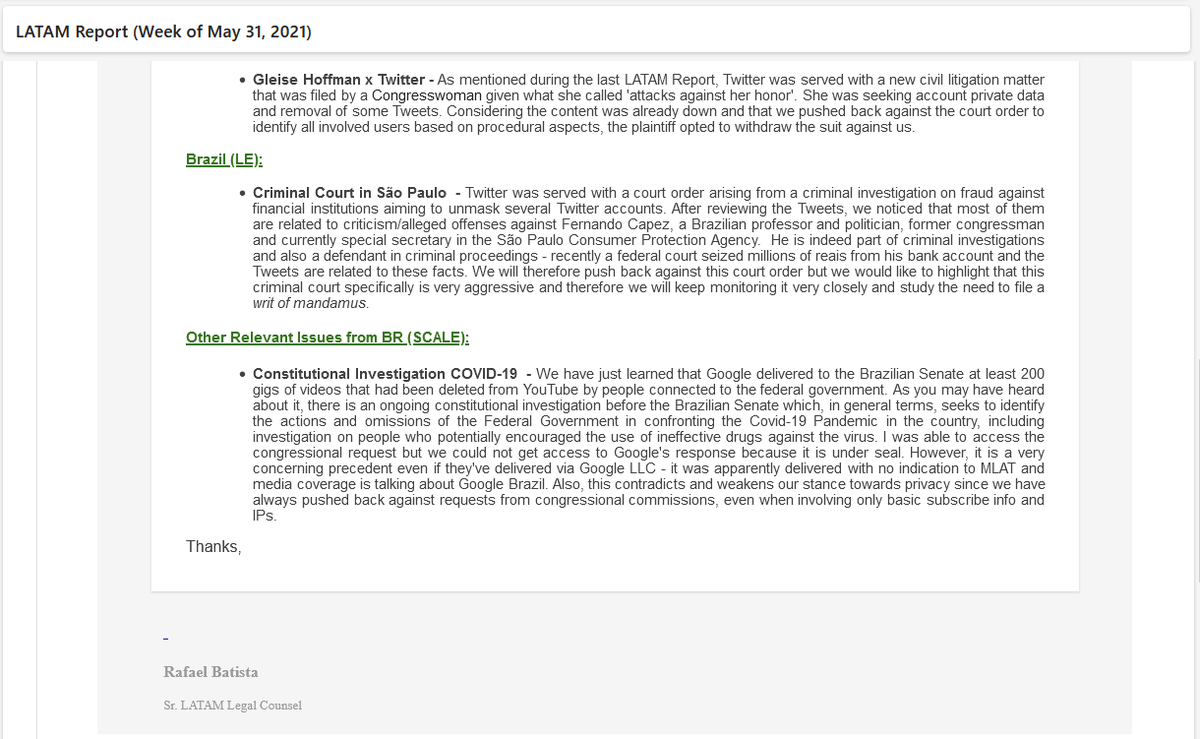
On May 31, 2021, Batista wrote to his colleagues to lament that “Google delivered to the Brazilian Senate at least 200 gigs of videos that had been deleted from YouTube by people connected to the federal government” related to a Brazilian Senate investigation of the government’s response to COVID-19.
Batista called Google’s actions “a very concerning precedent… that contradicts and weakens our stance towards privacy since we have always pushed back against requests from congressional commissions, even when involving only basic subscribe info and IPs….”
In the same email, Batista noted that a member of Congress named Gleisi Hoffmann, who presides over Lula da Silva’s Workers’ Party, and who had sued Twitter for “attacks against her honor,” seeking “private data and removal of some Tweets,” had finally dropped her lawsuit.
On May 31, 2021, Batista wrote to his colleagues to lament that “Google delivered to the Brazilian Senate at least 200 gigs of videos that had been deleted from YouTube by people connected to the federal government” related to a Brazilian Senate investigation of the government’s response to COVID-19.
Batista called Google’s actions “a very concerning precedent… that contradicts and weakens our stance towards privacy since we have always pushed back against requests from congressional commissions, even when involving only basic subscribe info and IPs….”
In the same email, Batista noted that a member of Congress named Gleisi Hoffmann, who presides over Lula da Silva’s Workers’ Party, and who had sued Twitter for “attacks against her honor,” seeking “private data and removal of some Tweets,” had finally dropped her lawsuit.
"Unmask several Twitter accounts..."
In the same email, Batista noted that a court in São Paulo had demanded that Twitter “unmask several Twitter accounts… related to criticism/alleged offenses against Fernando Capez, a Brazilian professor and politician, former congressman and currently special secretary in the São Paulo Consumer Protection Agency” who was “a defendant in criminal proceedings - recently a federal court seized millions of reais from his bank account and the Tweets are related to these facts. We will therefore push back against this court order…”
In the same email, Batista noted that a court in São Paulo had demanded that Twitter “unmask several Twitter accounts… related to criticism/alleged offenses against Fernando Capez, a Brazilian professor and politician, former congressman and currently special secretary in the São Paulo Consumer Protection Agency” who was “a defendant in criminal proceedings - recently a federal court seized millions of reais from his bank account and the Tweets are related to these facts. We will therefore push back against this court order…”
“We won't deliver any name at this stage…”
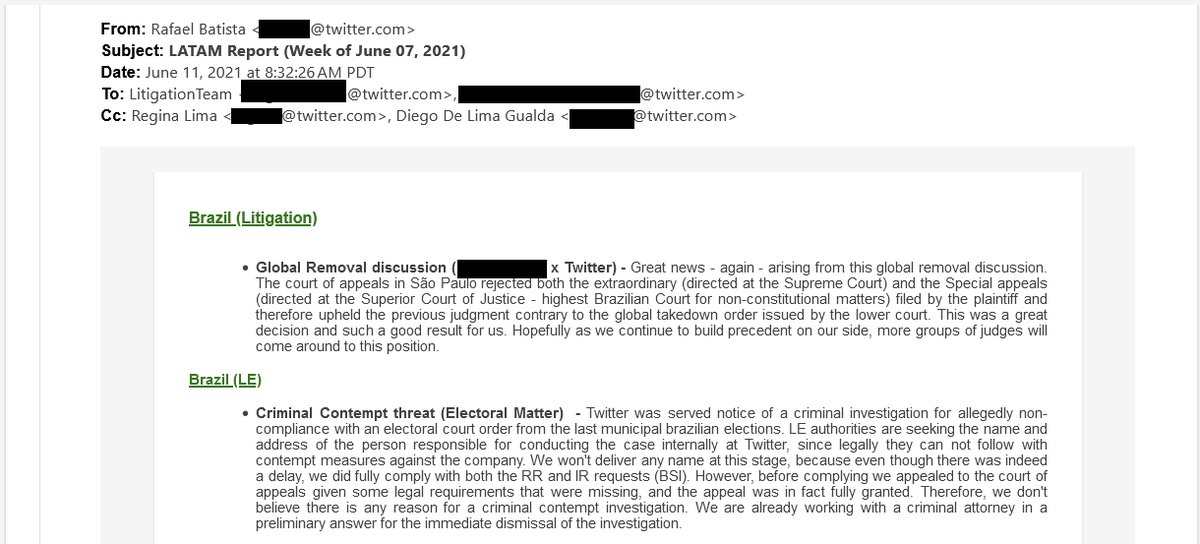
On June 11, 2021, Batista emailed his colleagues to say that the government had opened a criminal investigation against Twitter and that Brazilian “authorities are seeking the name and address of the person responsible for conducting the case internally at Twitter…”
Batista reassured his colleagues: “We won't deliver any name at this stage…”
On June 11, 2021, Batista emailed his colleagues to say that the government had opened a criminal investigation against Twitter and that Brazilian “authorities are seeking the name and address of the person responsible for conducting the case internally at Twitter…”
Batista reassured his colleagues: “We won't deliver any name at this stage…”
“Even though the complaint is legitimate, the requests are unreasonable”
Batista emailed his colleagues on June 14, 2021, to say that “Twitter was served last year with a 'complaint notice', which now was turned into a civil investigation against us.”
Batista explained that “The complaint was brought by Djamila Ribeiro, a Brazilian philosopher and journalist after racist offenses/hate crimes directed to her (no specific content has been provided though). Among several requests, she is seeking: i) monitoring measures of all trending topics to avoid offensive content especially against black woman; ii) disclosure of user information without court orders in racially motivated crimes; iii) message triggers in a regular basis informing people about ethical and legal parameters of responsibility for what is published on social networks; iv) standard messages/texts about such ethical and legal parameters to new users; v) payment of collective moral damages. “
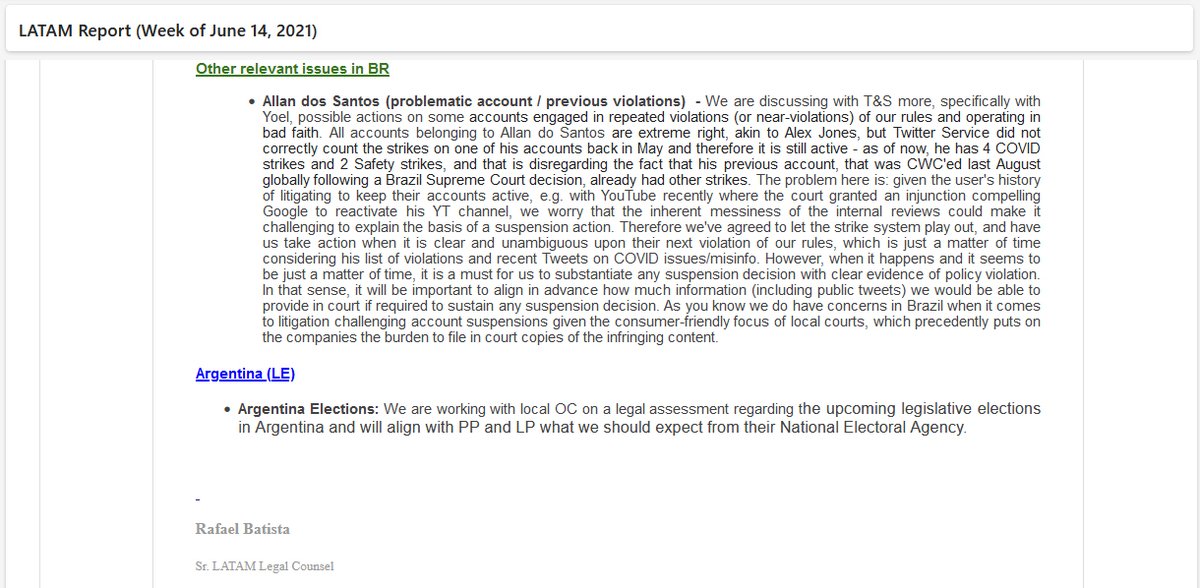
Another case related to an “extreme right” blogger “akin to Alex Jones” named Allan dos Santos. Twitter wanted to suspend the user, explained Batista, but “the user's history of litigating to keep their accounts active… we worry that the inherent messiness of the internal reviews [at Twitter] could make it challenging to explain the basis of a suspension action. Therefore we've agreed to let the strike system play out, and have us take action when it is clear and unambiguous upon their next violation of our rules, which is just a matter of time considering his list of violations and recent Tweets on COVID issues/misinfo…”
Batista emailed his colleagues on June 14, 2021, to say that “Twitter was served last year with a 'complaint notice', which now was turned into a civil investigation against us.”
Batista explained that “The complaint was brought by Djamila Ribeiro, a Brazilian philosopher and journalist after racist offenses/hate crimes directed to her (no specific content has been provided though). Among several requests, she is seeking: i) monitoring measures of all trending topics to avoid offensive content especially against black woman; ii) disclosure of user information without court orders in racially motivated crimes; iii) message triggers in a regular basis informing people about ethical and legal parameters of responsibility for what is published on social networks; iv) standard messages/texts about such ethical and legal parameters to new users; v) payment of collective moral damages. “
Another case related to an “extreme right” blogger “akin to Alex Jones” named Allan dos Santos. Twitter wanted to suspend the user, explained Batista, but “the user's history of litigating to keep their accounts active… we worry that the inherent messiness of the internal reviews [at Twitter] could make it challenging to explain the basis of a suspension action. Therefore we've agreed to let the strike system play out, and have us take action when it is clear and unambiguous upon their next violation of our rules, which is just a matter of time considering his list of violations and recent Tweets on COVID issues/misinfo…”

Information “related to @CarlosBolsonaro (president's son)”
On July 2, 2021, Batista reported on an information request “related to @CarlosBolsonaro (president's son) - We received an official letter from the federal police supported by a court order seeking registration data from @CarlosBolsonaro. Therefore, we are working on a reply where we will push back as follow (i) Twitter does not collect registration data - which under BR definition refers to personal data such as professional qualification, address and full name; (ii) it is not possible to provide data relating to a specific tweet - no IP available; (iii) even if it were possible, the legal retention period of logs in BR are 6 months and it has already been exceeded - Tweets are from 2018; and (iv) the profile @CarlosBolsonaro is a verified account."
On July 2, 2021, Batista reported on an information request “related to @CarlosBolsonaro (president's son) - We received an official letter from the federal police supported by a court order seeking registration data from @CarlosBolsonaro. Therefore, we are working on a reply where we will push back as follow (i) Twitter does not collect registration data - which under BR definition refers to personal data such as professional qualification, address and full name; (ii) it is not possible to provide data relating to a specific tweet - no IP available; (iii) even if it were possible, the legal retention period of logs in BR are 6 months and it has already been exceeded - Tweets are from 2018; and (iv) the profile @CarlosBolsonaro is a verified account."

“There is a strong political component with this investigation”
On August 18, 2021, Batista emailed his colleagues to say that the Superior Electoral Court has demanded that the accounts of “heavy supporters of President Bolsonaro” who “have been constantly engaging in coordinated attacks against members of the Supreme Court” and “Superior Electoral Court… The court order is focused on the demonetization of these accounts - from different platforms…”
These demands appeared to be politically motivated to target pro-Bolsonaro sentiment.
“Even though this obligation initially does not touch us, the court also determined Twitter, YouTube, Twitch TV, Instagram and Facebook to: i) refrain from algorithmically suggesting profiles and videos of political content discrediting the electoral system (legitimacy of elections) in association with those users/accounts and also ii) identify the origin of specific content (we have not been served with any specific Tweet URLs).”
Twitter’s Head of Legal Diego de Lima Gualda, a colleague of Batista’s, responded saying, “There is a strong political component with this investigation and the court is trying to put pressure for compliance.”
On August 18, 2021, Batista emailed his colleagues to say that the Superior Electoral Court has demanded that the accounts of “heavy supporters of President Bolsonaro” who “have been constantly engaging in coordinated attacks against members of the Supreme Court” and “Superior Electoral Court… The court order is focused on the demonetization of these accounts - from different platforms…”
These demands appeared to be politically motivated to target pro-Bolsonaro sentiment.
“Even though this obligation initially does not touch us, the court also determined Twitter, YouTube, Twitch TV, Instagram and Facebook to: i) refrain from algorithmically suggesting profiles and videos of political content discrediting the electoral system (legitimacy of elections) in association with those users/accounts and also ii) identify the origin of specific content (we have not been served with any specific Tweet URLs).”
Twitter’s Head of Legal Diego de Lima Gualda, a colleague of Batista’s, responded saying, “There is a strong political component with this investigation and the court is trying to put pressure for compliance.”


The “court wants to identify account handles… and also somehow reduce engagement”
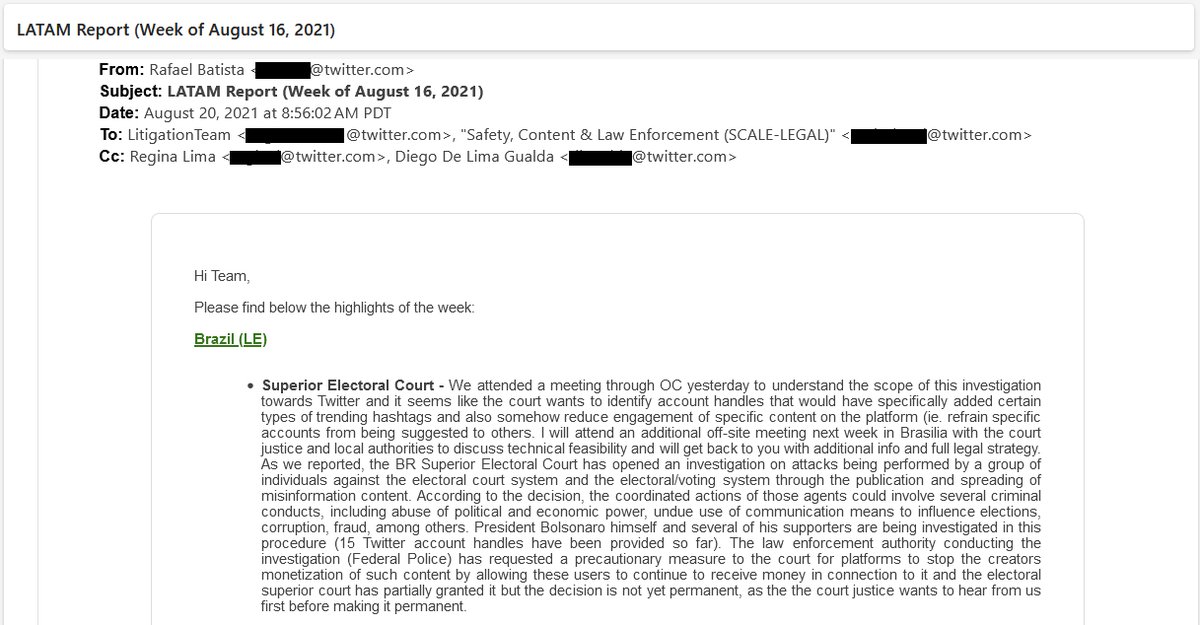
Two days later, On August 20, 2021, Batista reported some alarming news about new demands from the Superior Electoral Court (TSE).
Batista reported that “it seems like the court wants to identify account handles that would have specifically added certain types of trending hashtags and also somehow reduce engagement of specific content on the platform (ie. refrain specific accounts from being suggested to others.”
This represented a significant escalation in the court’s anti-democratic efforts.
Batista noted that “President Bolsonaro himself and several of his supporters are being investigated in this procedure (15 Twitter account handles have been provided so far).”
Two days later, On August 20, 2021, Batista reported some alarming news about new demands from the Superior Electoral Court (TSE).
Batista reported that “it seems like the court wants to identify account handles that would have specifically added certain types of trending hashtags and also somehow reduce engagement of specific content on the platform (ie. refrain specific accounts from being suggested to others.”
This represented a significant escalation in the court’s anti-democratic efforts.
Batista noted that “President Bolsonaro himself and several of his supporters are being investigated in this procedure (15 Twitter account handles have been provided so far).”
“We are going to push back”
Brazil’s High Electoral Court (TSE), which de Moraes controls, also demanded that Twitter reveal the identities of users. On October 25, 2021, Twitter’s senior legal counsel, Rafael Batista, emailed his colleagues to let them know that the TSE was “compelling us to track down and unmask users who used specific hashtags.”
The TSE’s request was illegal, noted Batista, and so Twitter would resist the court’s order. Batista said that Twitter was “going to push back” because there was “no evidence of illegality in the use of hashtags” and because the TSE was demanding “mass and indiscriminate disclosure of private user data, which characterizes a violation of privacy and other constitutional rights."
Brazil’s High Electoral Court (TSE), which de Moraes controls, also demanded that Twitter reveal the identities of users. On October 25, 2021, Twitter’s senior legal counsel, Rafael Batista, emailed his colleagues to let them know that the TSE was “compelling us to track down and unmask users who used specific hashtags.”
The TSE’s request was illegal, noted Batista, and so Twitter would resist the court’s order. Batista said that Twitter was “going to push back” because there was “no evidence of illegality in the use of hashtags” and because the TSE was demanding “mass and indiscriminate disclosure of private user data, which characterizes a violation of privacy and other constitutional rights."

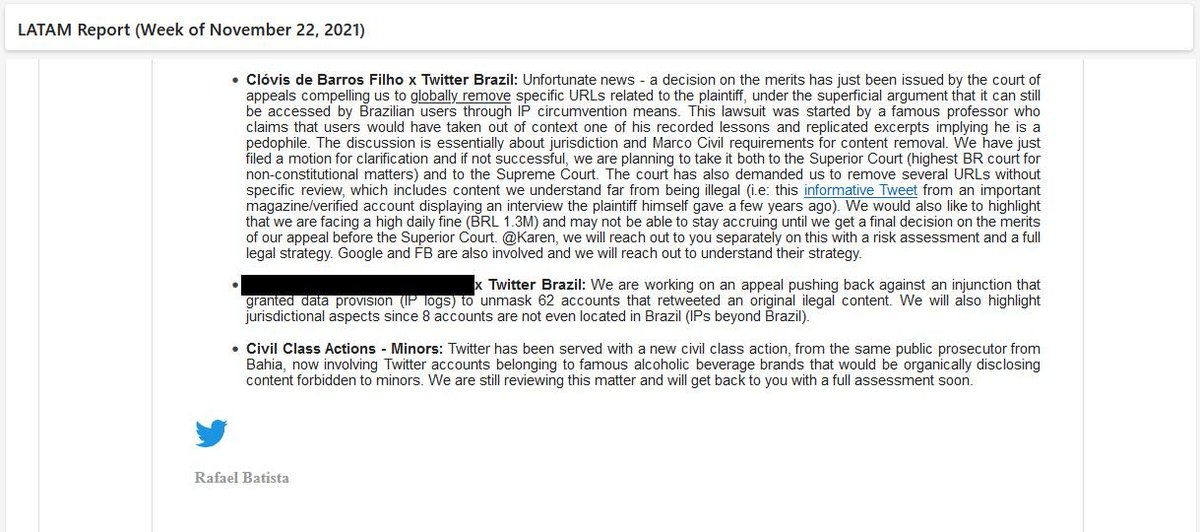
On November 26, 2021, the courts of Brazil issued sweeping censorship demands.
A court of appeals orders Twitter to “globally remove,” not just in Brazil, “specific URLs related to the plaintiff.”
The court claimed that Brazilians could find other ways to see the content, such as through a VPN, which masks a user’s location.
The court also sought to know the identities of users who were not in Brazil.
In another case, Twitter was “pushing back against an injunction that granted data provision (IP logs) to unmask 62 accounts that retweeted an original illegal content…” Of the 62 accounts, “8 accounts are not even located in Brazil…”
A court of appeals orders Twitter to “globally remove,” not just in Brazil, “specific URLs related to the plaintiff.”
The court claimed that Brazilians could find other ways to see the content, such as through a VPN, which masks a user’s location.
The court also sought to know the identities of users who were not in Brazil.
In another case, Twitter was “pushing back against an injunction that granted data provision (IP logs) to unmask 62 accounts that retweeted an original illegal content…” Of the 62 accounts, “8 accounts are not even located in Brazil…”
The Police are “under a lot of pressure from the Superior Electoral Court”
In March 2022, Twitter’s Head of Legal for Latin America saaid that he met with “the judge,” referring to de Moraes. He said he was surprised to find there the Federal Police (Brazil’s FBI) and technical court staff working on the hashtag investigation.
TSE pushed for private user data under the justification of “exceptional circumstances” and wanted to use Twitter as a crime precognition machine to “anticipate potential illegal activities.”
Two months later, Gualda said that the Federal Police “is under a lot of pressure from the Superior Electoral Court to provide tangible results for this investigation (remembering that in this procedure the Federal Police is supporting an investigation that is conducted by the Superior Electoral Court itself).”
In March 2022, Twitter’s Head of Legal for Latin America saaid that he met with “the judge,” referring to de Moraes. He said he was surprised to find there the Federal Police (Brazil’s FBI) and technical court staff working on the hashtag investigation.
TSE pushed for private user data under the justification of “exceptional circumstances” and wanted to use Twitter as a crime precognition machine to “anticipate potential illegal activities.”
Two months later, Gualda said that the Federal Police “is under a lot of pressure from the Superior Electoral Court to provide tangible results for this investigation (remembering that in this procedure the Federal Police is supporting an investigation that is conducted by the Superior Electoral Court itself).”


“There is no reason for this lawsuit to be under court secrecy.”
Leading up to the 2022 presidential election in Brazil, TSE made censorship demands to prevent citizens from commenting on election policies and procedures.
On March 30, 2022, the day after de Moraes took office as president of the TSE, the TSE mandated Twitter to, within a week and under the threat of a daily fine of 50,000 BRL (US$ 10,000), supply data on the monthly trend statistics for the hashtags #VotoImpressoNAO (“PrinteVoteNo”) and #VotoDemocraticoAuditavel (“DemocraticAuditableVote”).
Additionally, the TSE demanded subscription information and IP addresses of users who used the hashtag #VotoDemocraticoAuditavel in 2021. Brazilians wanted to debate printouts to enhance their unique voting machines, but the TSE wasn’t happy about their cause and pressured Twitter to give up their personal data.
In an e-mail sent in November 2022, a Twitter lawyer detailed actions taken by Moraes and TSE during the presidential race. The judge wouldn’t explain why he ordered Twitter to remove Evangelical pastor André Valadão’s (@andrevaladao) entire account under a heavy fine.
Twitter “filed an appeal against the order”, pointing out they didn’t know why they were being ordered to do so, but complying. TSE would threaten Twitter to comply “in 1 hour” under an hourly fine of BRL 100,000 [US$ 20,000] to censor an inactive account for disinformation committed elsewhere.
TSE also targeted elected House members Carla Zambelli (@Zambelli2210) & Marcel van Hattem (@marcelvanhattem) for alleged misinformation, threatening a fine of BRL 150,000 (US$ 30,000) if Twitter did not comply within 1 hour. Twitter pushed back. Among other objections, it argued that “there is no reason for this lawsuit to be under court secrecy.”
Leading up to the 2022 presidential election in Brazil, TSE made censorship demands to prevent citizens from commenting on election policies and procedures.
On March 30, 2022, the day after de Moraes took office as president of the TSE, the TSE mandated Twitter to, within a week and under the threat of a daily fine of 50,000 BRL (US$ 10,000), supply data on the monthly trend statistics for the hashtags #VotoImpressoNAO (“PrinteVoteNo”) and #VotoDemocraticoAuditavel (“DemocraticAuditableVote”).
Additionally, the TSE demanded subscription information and IP addresses of users who used the hashtag #VotoDemocraticoAuditavel in 2021. Brazilians wanted to debate printouts to enhance their unique voting machines, but the TSE wasn’t happy about their cause and pressured Twitter to give up their personal data.
In an e-mail sent in November 2022, a Twitter lawyer detailed actions taken by Moraes and TSE during the presidential race. The judge wouldn’t explain why he ordered Twitter to remove Evangelical pastor André Valadão’s (@andrevaladao) entire account under a heavy fine.
Twitter “filed an appeal against the order”, pointing out they didn’t know why they were being ordered to do so, but complying. TSE would threaten Twitter to comply “in 1 hour” under an hourly fine of BRL 100,000 [US$ 20,000] to censor an inactive account for disinformation committed elsewhere.
TSE also targeted elected House members Carla Zambelli (@Zambelli2210) & Marcel van Hattem (@marcelvanhattem) for alleged misinformation, threatening a fine of BRL 150,000 (US$ 30,000) if Twitter did not comply within 1 hour. Twitter pushed back. Among other objections, it argued that “there is no reason for this lawsuit to be under court secrecy.”


“Unusual requests …. compelling us to provide… user data based on hashtag mentions”
On August 17, 2022, a member of Twitter’s legal team emailed the groups saying that Twitter “received a new court order” relating to “an inquiry with the aim to identify individuals/groups behind a potential coordination of efforts to attack the institutions and the electoral system across different platforms. President Bolsonaro himself is investigated in this process…”
She added, “We have received several unusual requests coming from this inquiry, the most recent relevant one compelling us to provide an undetermined amount of user data based on hashtag mentions. The hashtags concern a mobilization around the elections - roughly translated as #PrintedVoteNO; #DemocraticAuditableVote and #BarrosoInJail - Barroso is the former TSE President….According to the report we currently have, there were 182 tweets in the period of interest… We need the content, user handles and respective BSI data asap…”
On August 17, 2022, a member of Twitter’s legal team emailed the groups saying that Twitter “received a new court order” relating to “an inquiry with the aim to identify individuals/groups behind a potential coordination of efforts to attack the institutions and the electoral system across different platforms. President Bolsonaro himself is investigated in this process…”
She added, “We have received several unusual requests coming from this inquiry, the most recent relevant one compelling us to provide an undetermined amount of user data based on hashtag mentions. The hashtags concern a mobilization around the elections - roughly translated as #PrintedVoteNO; #DemocraticAuditableVote and #BarrosoInJail - Barroso is the former TSE President….According to the report we currently have, there were 182 tweets in the period of interest… We need the content, user handles and respective BSI data asap…”

“TSE’s request is clearly abusive”
“TSE’s request is clearly abusive”, Brazilian attorney and legal scholar Hugo Freitas @hugofreitas_r told us, when asked about the situation.
“Posting hashtags to promote legislative changes is completely appropriate for a democracy and it’s no crime predicted by Brazilian law.”
“TSE’s request is clearly abusive”, Brazilian attorney and legal scholar Hugo Freitas @hugofreitas_r told us, when asked about the situation.
“Posting hashtags to promote legislative changes is completely appropriate for a democracy and it’s no crime predicted by Brazilian law.”
Three months after de Moraes became TSE’s president in August 2022, he demanded censorship.
Despite the fact that posting hashtags does not violate any specific legal statutes, Twitter complied with the court's demands to avoid substantial fines.
Brazil’s high court and Twitter removed political speech and penalized users for debating policies. In this way, the court appears to have interfered in a major presidential election.
Despite the fact that posting hashtags does not violate any specific legal statutes, Twitter complied with the court's demands to avoid substantial fines.
Brazil’s high court and Twitter removed political speech and penalized users for debating policies. In this way, the court appears to have interfered in a major presidential election.
Today: Fake News Bill For Censorship
Today, Brazil’s Censorship Industrial Complex is demanding that Congress pass “Fake News” censorship legislation. The bill would hold social media companies hostage if they didn’t comply with vague censorship requirements. The bill doesn’t define what “fake news” or “disinformation” are.
What the Fake News bill would do is require social media platforms to pay news outlets for the right to distribute their content. This is the exact same approach being pushed by governments in Australia and Canada.
De Moraes, the TSE, and Brazil’s Supreme Court openly lobbied for the legislation.
The public revolted against the censorship bill, and Congress stalled the bill in May 2023.
Then, in February of this year, the TSE unilaterally implemented the legislation, usurping the role of Congress.
Today, Brazil’s Censorship Industrial Complex is demanding that Congress pass “Fake News” censorship legislation. The bill would hold social media companies hostage if they didn’t comply with vague censorship requirements. The bill doesn’t define what “fake news” or “disinformation” are.
What the Fake News bill would do is require social media platforms to pay news outlets for the right to distribute their content. This is the exact same approach being pushed by governments in Australia and Canada.
De Moraes, the TSE, and Brazil’s Supreme Court openly lobbied for the legislation.
The public revolted against the censorship bill, and Congress stalled the bill in May 2023.
Then, in February of this year, the TSE unilaterally implemented the legislation, usurping the role of Congress.
No Free Speech In An Election
TSE’s censorship is an attack on the democratic process. Elections can remain free and fair only if the public is able to debate and question election laws, systems, and results. If there ever is electoral fraud in Brazil, nobody will be allowed to talk about it, if de Moraes gets his way.
For centuries, candidates have complained that the election was stolen. Hillary Clinton claimed this in 2016, Stacey Abrams claimed this in 2018, President Donald Trump claimed this in 2020, and President Jair Bolsonaro claimed this in 2022.
De Moraes wants to make such speech illegal and punish social media platforms that don’t censor it.
TSE’s censorship is an attack on the democratic process. Elections can remain free and fair only if the public is able to debate and question election laws, systems, and results. If there ever is electoral fraud in Brazil, nobody will be allowed to talk about it, if de Moraes gets his way.
For centuries, candidates have complained that the election was stolen. Hillary Clinton claimed this in 2016, Stacey Abrams claimed this in 2018, President Donald Trump claimed this in 2020, and President Jair Bolsonaro claimed this in 2022.
De Moraes wants to make such speech illegal and punish social media platforms that don’t censor it.
The Solution: First Amendment-Level Protections For Brazil
Two legal scholars, Hugo Freitas and André Marsiglia, @hugofreitas_r and @marsiglia_andre , recently introduced new free speech legislation aimed at bringing free speech protections in Brazil to the same high standard as is held in the United States. The bill is a “Declaration of Rights of Freedom of Expression in Brazil.”
The bill seeks to proclaim a Declaration of Free Speech Rights in Brazil, which, if enacted, would roughly align Brazilian law to that of the United States in this regard.
It proposes to repeal the criminalization of speech in all but the most extreme instances, such as true threats or incitement to imminent lawless action. In contrast, conducts such as blasphemy, contempt of authority or certain forms of hate speech and disinformation would cease to be criminalized. The protection of political speech is especially emphasized.
In tort cases, the bill seeks to reduce judicial discretion by laying out clearer standards for assessing if the speech is protected or crosses into illegal conduct. In particular, the bill repeals provisions that have been used by prosecutors and private associations to retaliate against speech by claiming compensatory damages, under allegations such as that it has caused offense to an unknown number of listeners or tarnished the reputation of broad categories of people.
Finally, the bill concerns itself with more modern forms of censorship targeting the internet. A blanket ban is imposed on the practice, now frequent in Brazil, of government blocking the access to specific social media accounts in response to speech.
More subtle forms of internet censorship are also addressed. The government is barred from censoring speech indirectly under the guise of content moderation by private platforms, following in the footsteps of recent court decisions in the US. The bill reaffirms the provisions already in place in Brazilian legislation exempting social media platforms from liability for the speech of its users in response to attempts by the government to revoke those provisions so as to force social media companies to censor preemptively according to government wishes.
/END
Two legal scholars, Hugo Freitas and André Marsiglia, @hugofreitas_r and @marsiglia_andre , recently introduced new free speech legislation aimed at bringing free speech protections in Brazil to the same high standard as is held in the United States. The bill is a “Declaration of Rights of Freedom of Expression in Brazil.”
The bill seeks to proclaim a Declaration of Free Speech Rights in Brazil, which, if enacted, would roughly align Brazilian law to that of the United States in this regard.
It proposes to repeal the criminalization of speech in all but the most extreme instances, such as true threats or incitement to imminent lawless action. In contrast, conducts such as blasphemy, contempt of authority or certain forms of hate speech and disinformation would cease to be criminalized. The protection of political speech is especially emphasized.
In tort cases, the bill seeks to reduce judicial discretion by laying out clearer standards for assessing if the speech is protected or crosses into illegal conduct. In particular, the bill repeals provisions that have been used by prosecutors and private associations to retaliate against speech by claiming compensatory damages, under allegations such as that it has caused offense to an unknown number of listeners or tarnished the reputation of broad categories of people.
Finally, the bill concerns itself with more modern forms of censorship targeting the internet. A blanket ban is imposed on the practice, now frequent in Brazil, of government blocking the access to specific social media accounts in response to speech.
More subtle forms of internet censorship are also addressed. The government is barred from censoring speech indirectly under the guise of content moderation by private platforms, following in the footsteps of recent court decisions in the US. The bill reaffirms the provisions already in place in Brazilian legislation exempting social media platforms from liability for the speech of its users in response to attempts by the government to revoke those provisions so as to force social media companies to censor preemptively according to government wishes.
/END
• • •
Missing some Tweet in this thread? You can try to
force a refresh