
🧵PART 1 of my thoughts on the Supreme Court of Florida's decision in Planned Parenthood v. State, where the court receded from decades of precedent holding that our state constitution's explicit right of privacy included the right to an abortion. 1/25acis-api.flcourts.gov/courts/68f021c…
The core of the court's decision is that, when Florida's voters adopted the privacy clause in 1980, they would not have understood it to encompass abortion.
This is not a defensible application of originalism. 2/25
This is not a defensible application of originalism. 2/25
First, my bona fides: I wrote a law review article explaining in detail why "an honest originalist analysis leads to the ... conclusion" that the privacy clause included a right to abortion. 3/25papers.ssrn.com/abstract=41873…
1) ORIGINALISM: The dominant version of originalism today is called public meaning originalism. 4/25
PMO holds that the meaning of a constitutional provision at the time it was adopted controls. What would the public more likely than not have understood the language of the provision to mean? See Brown v. Ent. Merch. Ass'n (U.S. 2011) (Thomas, J., dissenting). 5/25
More specifically, we focus on what the reasonably well-informed speaker of the English language in 1980 Florida would have understood the text to mean. See Thompson v. DeSantis (Fla. 2020) (per Muniz, J.); Conage v. U.S. (Fla. 2022) (per Muniz, C.J.). 6/25
As leading originalist Michael Paulsen has written: "The answer to any such question of constitutional textual meaning lies in seeking the original public meaning that a word, term, or phrase would have had, ... [7/25]
... in *the linguistic and cultural–political context* in which it was used, to reasonably well-informed speakers and readers of the English language at the time." Paulsen, Plausibility of Personhood, OSLJ (2012), 8/25papers.ssrn.com/sol3/papers.cf…
Chief Justice Muniz recognized this principle at oral argument. He suggested that the connection between Roe v. Wade and privacy "was part of, sort of the, our cultural kind of lexicon." 9/25
Now I turn to a discussion of certain features of the Florida supreme court's opinion, starting in this Part 1 with the court's textual analysis. 10/25
2) TEXTUAL ANALYSIS: Article I, section 23, of the Florida Constitution states: 11/25 

a) The overall problem is that there are many components here. Yet the court paid them scant attention: four double-spaced pages. In contrast, in SCOTUS's decision in D.C. v. Heller (2008), that court spent over 20 single-spaced pages discussing each component of the 2A. 12/25
For a complete analysis of the text, see pp. 109-121 of my article, 13/25papers.ssrn.com/sol3/papers.cf…
b) The first specific issue is the court's application of our constitution's title-body clause, article X, s. 12(h). First pic is the provision; second is the court's discussion. 14/25

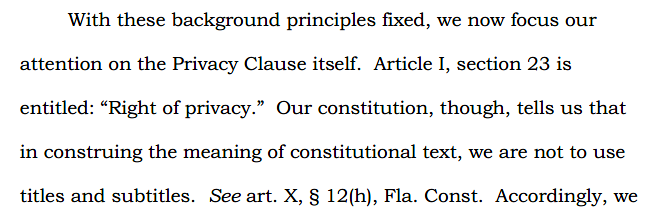
While accurate, the court ignores a critical piece of evidence of OPM: the ballot title and summary actually in front of voters in the voting booth. Both the title and summary use the exact wording of the clause's title: "right of privacy." 15/25

Obviously, this is important context in determining how best to interpret the text of the clause, narrowly or broadly. 16/25
c) The court observed that the privacy clause does not mention abortion. That's true. But the clause doesn't mention *any* specific protections at all. The breadth of the language is clear evidence that the clause is not to be interpreted narrowly. 17/25
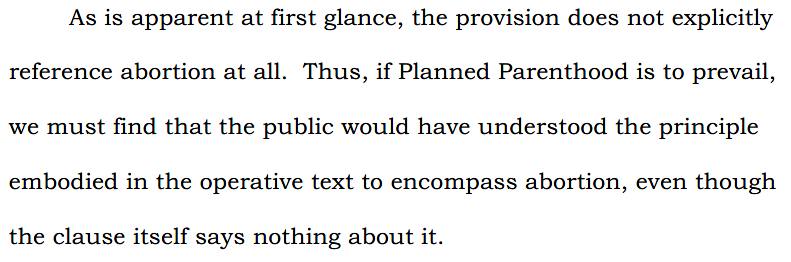
d) These two points segue into the court's problematic discussion of dictionary definitions. As Scalia & Garner warn in Reading Law p. 418 (2012): "Because common words typically have more than one meaning, you must use the context in which a given word appears ... [18/25]
to determine its aptest, most likely sense." The court did not do that here, instead incongruously choosing the narrowest definitions to define the key terms in a broadly worded constitutional provision. 19/25
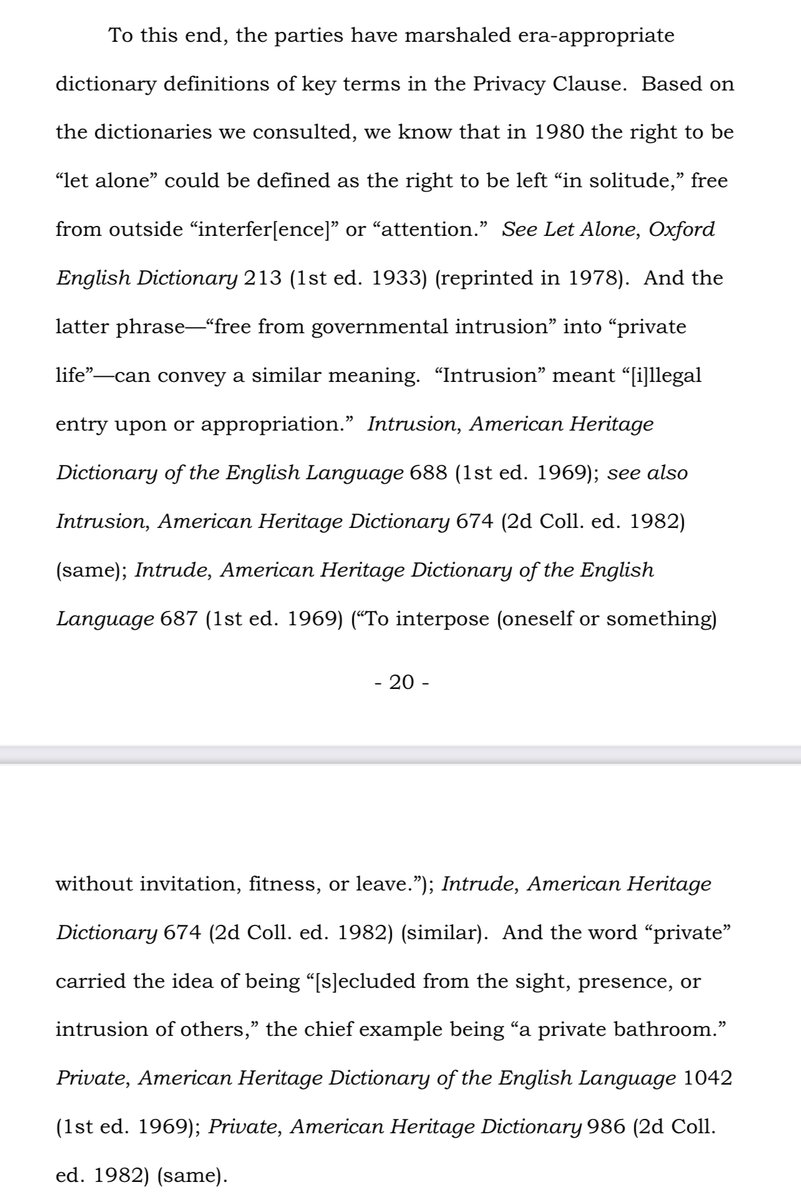
This ungenerous choice of definitions allows the court to then say: 20/25
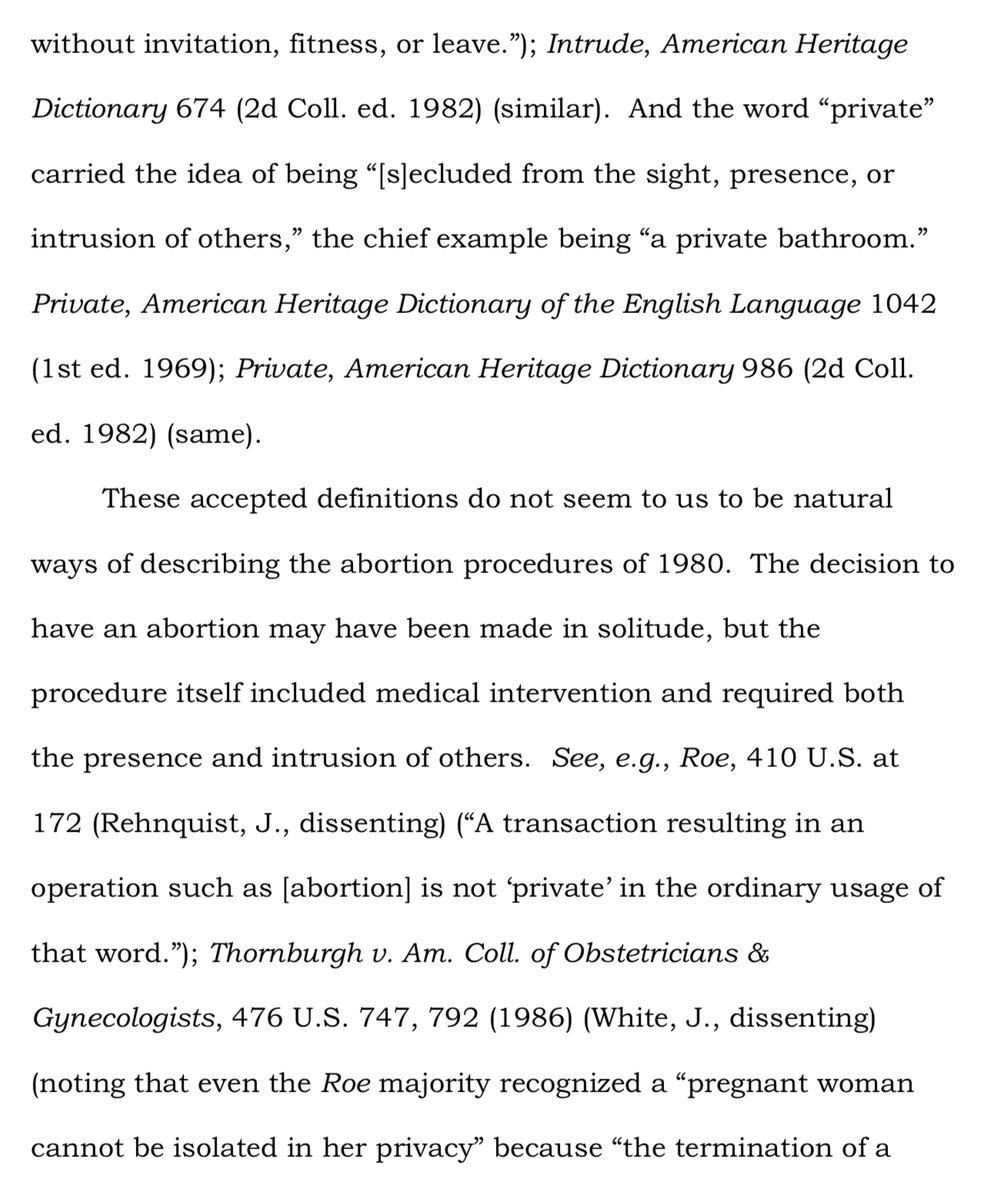

Here, Justice Labarga's dissent is right. The most important point: "In the interest of patient privacy, medical matters, including countless forms of medical procedures, are broadly afforded confidentiality protections with narrowly tailored exceptions." 21/25
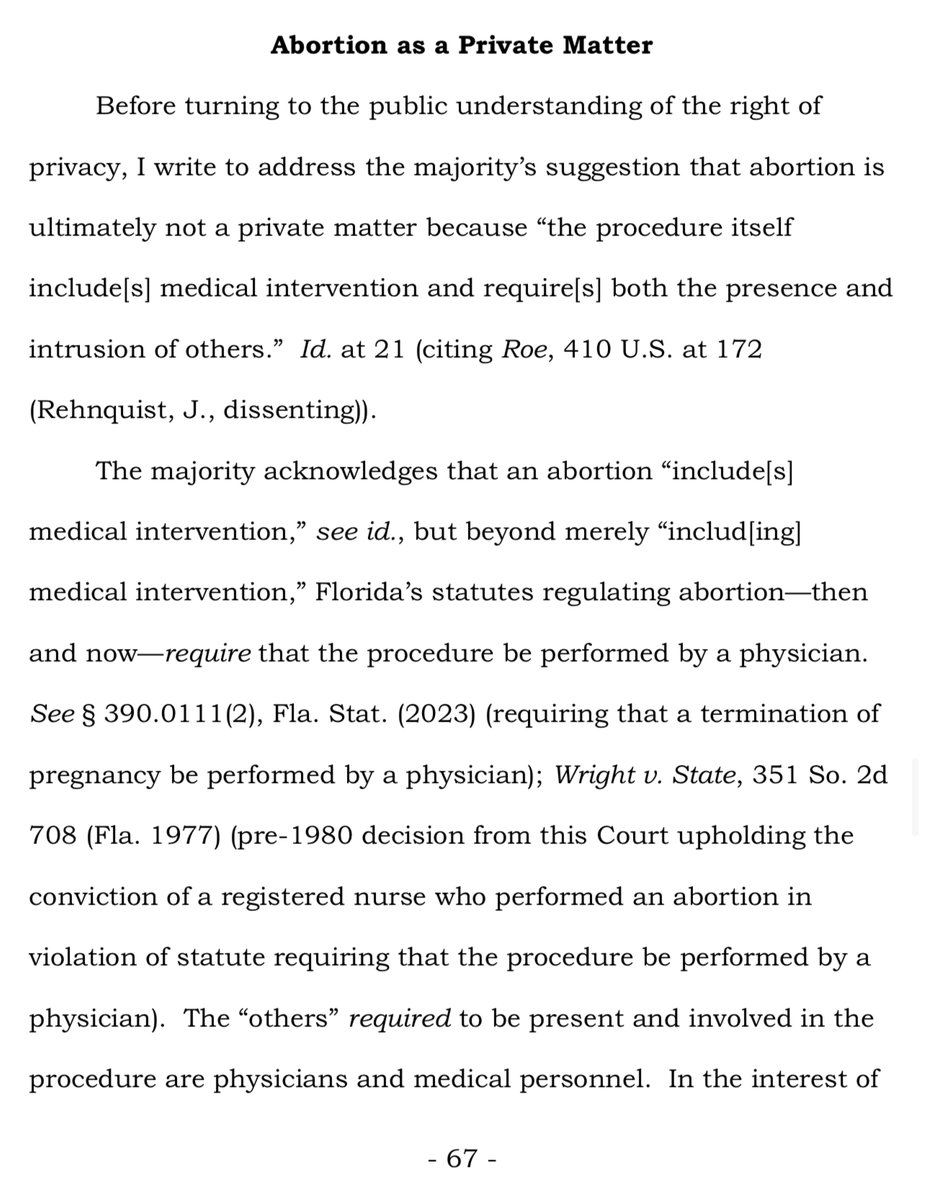

While some think abortion is a public event b/c it involves more than 1 person, that's just not how the majority would perceive the matter, from decision to procedure. Doctor-patient confidentiality has ancient origins. Higgins, History, CFP (1989), 22/25ncbi.nlm.nih.gov/pmc/articles/P…
e) The final part of the court's textual analysis involves the second sentence of the privacy clause. This is a soft variation of abortion opponents' argument that the second sentence confirms that the first meant only informational privacy. 23/25


As I said in my law review article, such a reading allows the second sentence to override the meaning of the first sentence, whereas it is simply a limited qualification on the first. What the court does is allow the second sentence to cast shade on the first. 24/25
In sum, the court took facially broad language and, in its brief interpretation of the text, narrowed the privacy clause's fair reading.
NEXT: Thoughts on the court's analysis of the general historical background of the phrases in the privacy clause. 25/25
NEXT: Thoughts on the court's analysis of the general historical background of the phrases in the privacy clause. 25/25
P.S. As a consequence of this unjustifiably narrow interpretation—“abortion doesn’t seem to fit w/in the text’s meaning”—the court imposes a burden to present historical evidence that conclusively establishes the clause included abortion. The court set plaintiffs up to fail.
@threadreaderapp please unroll
• • •
Missing some Tweet in this thread? You can try to
force a refresh





