In the Guanxi Cultural Revolution, official records show between 100,000 - 150,000 people were killed, by methods like live burial, drowning, boiling alive, and disemboweling.
Local offices of the Communist party sponsored cannibalism. Public records show at least 137 people were eaten by Communist Party Members, though some scholars claim there are at least 421 named people who were eaten.
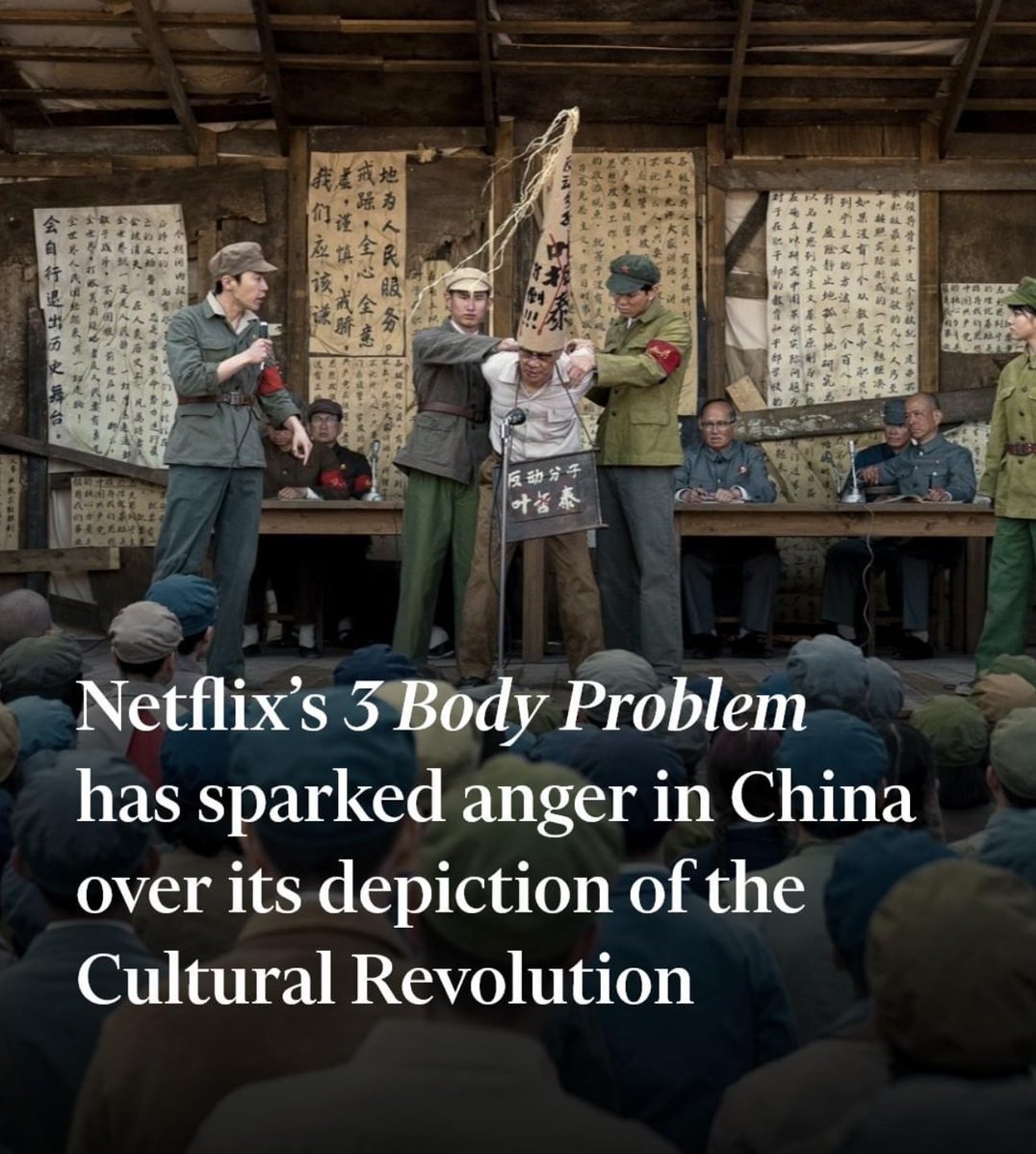
This scene from Three Body Problem might've been based off the story of Wu Fushang.
In 1968, "a geography instructor named Wu Shufang (吴树芳) was beaten to death by students at Wuxuan Middle School. Her body was carried to the flat stones of the Qian River where another teacher was forced at gunpoint to rip out the heart and liver. Back at the school the pupils barbecued and consumed the organs."
Song Yongi, Chinese Historian working at Calstate LA, documents:
"Independent researchers in Guangxi counted a total of 421 people who were eaten. There were reports of cannibalism across 27 counties in Guangxi; that's two-thirds of all the counties in Guangxi. There was one man who was said to be in the so-called fifth category, who was beaten to death where he stood. He had two kids, one of 11 and one of 14. The local officials and armed militia said that it was important to eradicate such people, and so they not only killed those two children: they ate them too. This took place in Pubei county, Guangxi, where 35 people were killed and eaten in total. Most of them were rich landowners and their families. There was one landowner called Liu Zhengjian whose entire family was wiped out. He had a 17-year-old daughter, Liu Xiulan, who was gang-raped by nine people [for 19 times] who then ripped open her belly, and ate her liver and breasts. There were so many incidents like this."
Frank Dikotter, professor and chair of humanities at the University of Hong Kong states "it is not enough to eliminate your class enemy. You have to eat his heart, so there are very well-documented cases of ritual cannibalism. There was a hierarchy in the consumption of class enemies. Leaders feasted on the heart and liver, mixed with pork, while ordinary villagers were allowed only to peck at the victims' arms and thighs."
The Cultural Revolution in total killed between one and two million people and lasted for ten years, between 1967 and 1977. It was initiated by Mao Zedong to purge the country of political dissidents.
In 1981 there began an investigation into the cannibalism in Guanxi. In Wuxuan County where at least 38 people were eaten, fifteen participants were prosecuted, receiving up to 14 years in prison, while ninety-one members of the Chinese Communist Party (CCP) were expelled from the party and thirty-nine non-party officials were either demoted or had a salary cut.
This is Communism. Millions dead to purge political dissidents, boiling people alive, and cannibalism. The punishment? A salary cut.
Local offices of the Communist party sponsored cannibalism. Public records show at least 137 people were eaten by Communist Party Members, though some scholars claim there are at least 421 named people who were eaten.
This scene from Three Body Problem might've been based off the story of Wu Fushang.
In 1968, "a geography instructor named Wu Shufang (吴树芳) was beaten to death by students at Wuxuan Middle School. Her body was carried to the flat stones of the Qian River where another teacher was forced at gunpoint to rip out the heart and liver. Back at the school the pupils barbecued and consumed the organs."
Song Yongi, Chinese Historian working at Calstate LA, documents:
"Independent researchers in Guangxi counted a total of 421 people who were eaten. There were reports of cannibalism across 27 counties in Guangxi; that's two-thirds of all the counties in Guangxi. There was one man who was said to be in the so-called fifth category, who was beaten to death where he stood. He had two kids, one of 11 and one of 14. The local officials and armed militia said that it was important to eradicate such people, and so they not only killed those two children: they ate them too. This took place in Pubei county, Guangxi, where 35 people were killed and eaten in total. Most of them were rich landowners and their families. There was one landowner called Liu Zhengjian whose entire family was wiped out. He had a 17-year-old daughter, Liu Xiulan, who was gang-raped by nine people [for 19 times] who then ripped open her belly, and ate her liver and breasts. There were so many incidents like this."
Frank Dikotter, professor and chair of humanities at the University of Hong Kong states "it is not enough to eliminate your class enemy. You have to eat his heart, so there are very well-documented cases of ritual cannibalism. There was a hierarchy in the consumption of class enemies. Leaders feasted on the heart and liver, mixed with pork, while ordinary villagers were allowed only to peck at the victims' arms and thighs."
The Cultural Revolution in total killed between one and two million people and lasted for ten years, between 1967 and 1977. It was initiated by Mao Zedong to purge the country of political dissidents.
In 1981 there began an investigation into the cannibalism in Guanxi. In Wuxuan County where at least 38 people were eaten, fifteen participants were prosecuted, receiving up to 14 years in prison, while ninety-one members of the Chinese Communist Party (CCP) were expelled from the party and thirty-nine non-party officials were either demoted or had a salary cut.
This is Communism. Millions dead to purge political dissidents, boiling people alive, and cannibalism. The punishment? A salary cut.
Here's some more snippets from news outlets as the stories became known internationally (from wikipedia)
1993, Newsweek: ""[t]he accounts were harrowing. Principals killed in schoolyards by students, then cooked and eaten. Government-run cafeterias displaying human bodies hanging from meat hooks and dishing them out to employees ... Documents smuggled out of China last week described atrocities of the Cultural Revolution in grotesque detail."
In 1993, The New York Times stated that "[t]he incidents reported from Guangxi were apparently the most extensive episodes of cannibalism in the world in the last century or more. They were also different from any others in that those who took part were not motivated by hunger or psychopathic illness. Instead, the actions appeared to be ideological: the cannibalism, which the documents say took place in public, was often organized by local Communist Party officials, and people
In 1996, The Washington Post stated, after Zheng Yi published his book that "[t]he party wants to block any deep-going analysis of the role played by the late Chairman Mao Zedong and numerous party members. Full disclosure of the truth might destroy what little legitimacy the party still clings to."
In 2001, Time stated that "Mao Zedong's Cultural Revolution was an eruption of ideological fervor, mass hysteria and outright brutality that left an estimated 10 million Chinese dead and ruined the lives of millions more. Now tales of even more horrible excesses from the years between 1966 and 1976 are coming to light: allegations of cannibalism, involving hundreds of men and women who violated mankind's most powerful taboo in the name of revolutionary purity."
In 2013, People's Net, the official media of the Chinese Communist Party, as well as some other Chinese media reprinted an article from China Youth Daily, which stated that during the Cultural Revolution "in some places such as Guangxi, the hearts and livers of people were eaten after they were beaten to death, and, surprisingly, such cannibalism was prevalent in that region!" The article further stated, "throughout the human history of the 20th century, was there any country that had experienced the Cultural Revolution like ours? The only comparable time was Nazi Germany. However, up to this date, we do not even have a decent review or reflection on this period of history ... The society that does not reflect on the Cultural Revolution is perhaps still a tribe of cannibalism. Such a tribe, no matter how beautiful its people look and how modernized its civilization appears, is still a tribe of cannibalism without humanity."
1993, Newsweek: ""[t]he accounts were harrowing. Principals killed in schoolyards by students, then cooked and eaten. Government-run cafeterias displaying human bodies hanging from meat hooks and dishing them out to employees ... Documents smuggled out of China last week described atrocities of the Cultural Revolution in grotesque detail."
In 1993, The New York Times stated that "[t]he incidents reported from Guangxi were apparently the most extensive episodes of cannibalism in the world in the last century or more. They were also different from any others in that those who took part were not motivated by hunger or psychopathic illness. Instead, the actions appeared to be ideological: the cannibalism, which the documents say took place in public, was often organized by local Communist Party officials, and people
In 1996, The Washington Post stated, after Zheng Yi published his book that "[t]he party wants to block any deep-going analysis of the role played by the late Chairman Mao Zedong and numerous party members. Full disclosure of the truth might destroy what little legitimacy the party still clings to."
In 2001, Time stated that "Mao Zedong's Cultural Revolution was an eruption of ideological fervor, mass hysteria and outright brutality that left an estimated 10 million Chinese dead and ruined the lives of millions more. Now tales of even more horrible excesses from the years between 1966 and 1976 are coming to light: allegations of cannibalism, involving hundreds of men and women who violated mankind's most powerful taboo in the name of revolutionary purity."
In 2013, People's Net, the official media of the Chinese Communist Party, as well as some other Chinese media reprinted an article from China Youth Daily, which stated that during the Cultural Revolution "in some places such as Guangxi, the hearts and livers of people were eaten after they were beaten to death, and, surprisingly, such cannibalism was prevalent in that region!" The article further stated, "throughout the human history of the 20th century, was there any country that had experienced the Cultural Revolution like ours? The only comparable time was Nazi Germany. However, up to this date, we do not even have a decent review or reflection on this period of history ... The society that does not reflect on the Cultural Revolution is perhaps still a tribe of cannibalism. Such a tribe, no matter how beautiful its people look and how modernized its civilization appears, is still a tribe of cannibalism without humanity."
They sure did!

• • •
Missing some Tweet in this thread? You can try to
force a refresh