William Aird Profile picture
Apr 5 6 tweets 2 min read Read on X
1/6

TRANSFUSION AS IRON THERAPY

Yesterday I posted a poll showing CBC data from a patient with severe iron deficiency anemia and asked: assuming she receives 4 units pRBCs (which of course would be excessive here), does she need iron therapy on top of that?

70% answered YES. Image
2/6

Each unit of RBC contains about 250 mg Fe. So she will have received about 1000 mg of Fe, not far off from her total needs. However, such is iron is bound up in Hb inside the donor RBCs and is not readily accessible for erythropoiesis. Image
3/6

I ran through some rough numbers (see graphic):

1. Oral iron will deliver about 20 mg Fe to the bone marrow each day.
4/6

2. IV iron will deliver its full payload (Fe sequestered in a carbohydrate shell) to macrophages, where Fe will leach out and be slowly released to the bone marrow (I can't find data on how much is released daily, but presumably >20 mg since response to IV Is faster vs PO).
5/6

3. RBCs have a turnover of about 1%/day. So if 1 L pRBCs are transfused (4 units), 10 ml will be endocytosed and processed by macrophages each day, releasing 10 mg Fe/day for use by the bone marrow (these numbers gradually diminish over time as donor cells are destroyed).
6/6

Bottom line: while transfused RBCs provide a depot of iron, it is too little (unless >3-4 units are given) and its release is too slow to meet the demands of patients with severe iron deficiency in a timely manner - thus, such patients should also receive supplemental Fe.

• • •

Missing some Tweet in this thread? You can try to force a refresh

 

Keep Current with William Aird

William Aird Profile picture

Stay in touch and get notified when new unrolls are available from this author!

Read all threads

This Thread may be Removed Anytime!

PDF

Twitter may remove this content at anytime! Save it as PDF for later use!

Try unrolling a thread yourself!

how to unroll video
  1. Follow @ThreadReaderApp to mention us!

  2. From a Twitter thread mention us with a keyword "unroll"
@threadreaderapp unroll

Practice here first or read more on our help page!

More from @WilliamAird4

Mar 31
1/4

CORTICOSTEROIDS IN ITP

I tweeted a poll asking whether you would treat a patient with newly diagnosed ITP with high-dose dexamethasone (HD-DXM) or prednisone (PRED).

57% chose HD-DXM. Image
2/4

I have done a deep dive into this question, and found that compared with PDN, HD-DXM:

1. Achieves higher and faster initial response
2. Is associated with less bleeding
3. Has fewer adverse effects
4. Has comparable response at 6 months Image
3/4

When you add to that:

1. The ease of administering 4 days of HD-DXM vs. > 4 wks of PRED

2. The cumbersome nature of the taper schedule for PRED

... I don't get why this is even debatable (OK, no deaths have been reported in either arm, so maybe we're splitting hairs).
Read 4 tweets
Mar 21
1/4

IGNORE THE MCH!

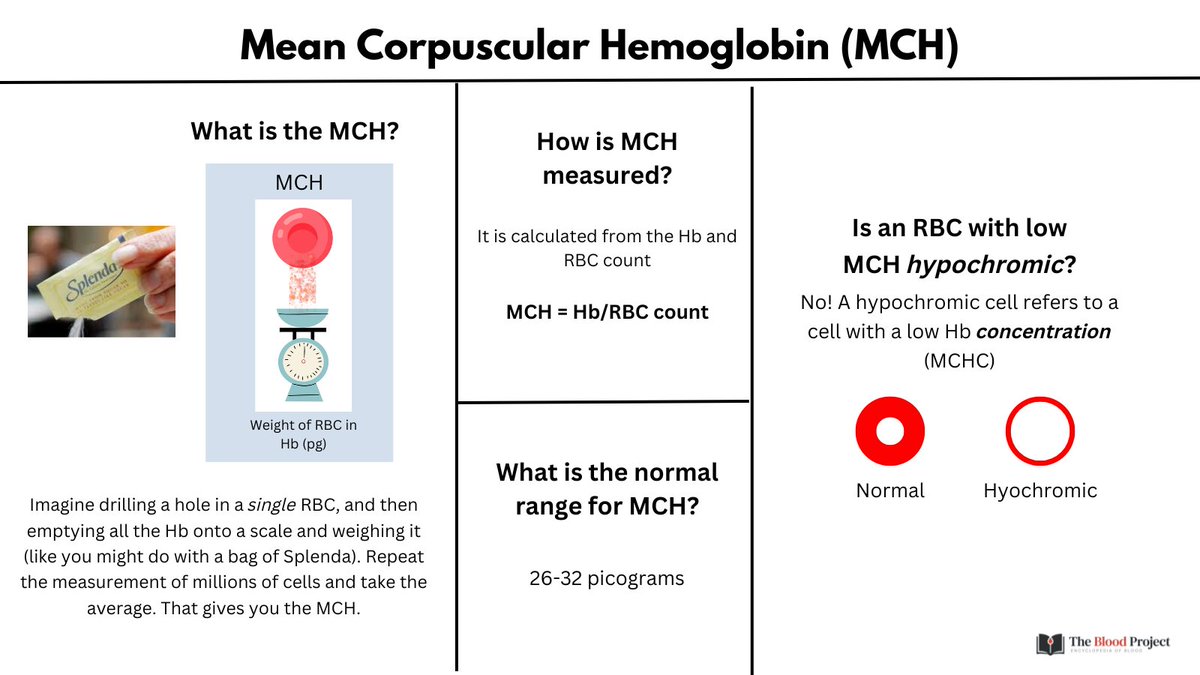
I don't know about you, but our institution provides the mean corpuscular hemoglobin (MCH) with the CBC.

Not only is it a virtually useless (and redundant) parameter, but it often gets confused with the much more meaningful MCHC. Image
2/4

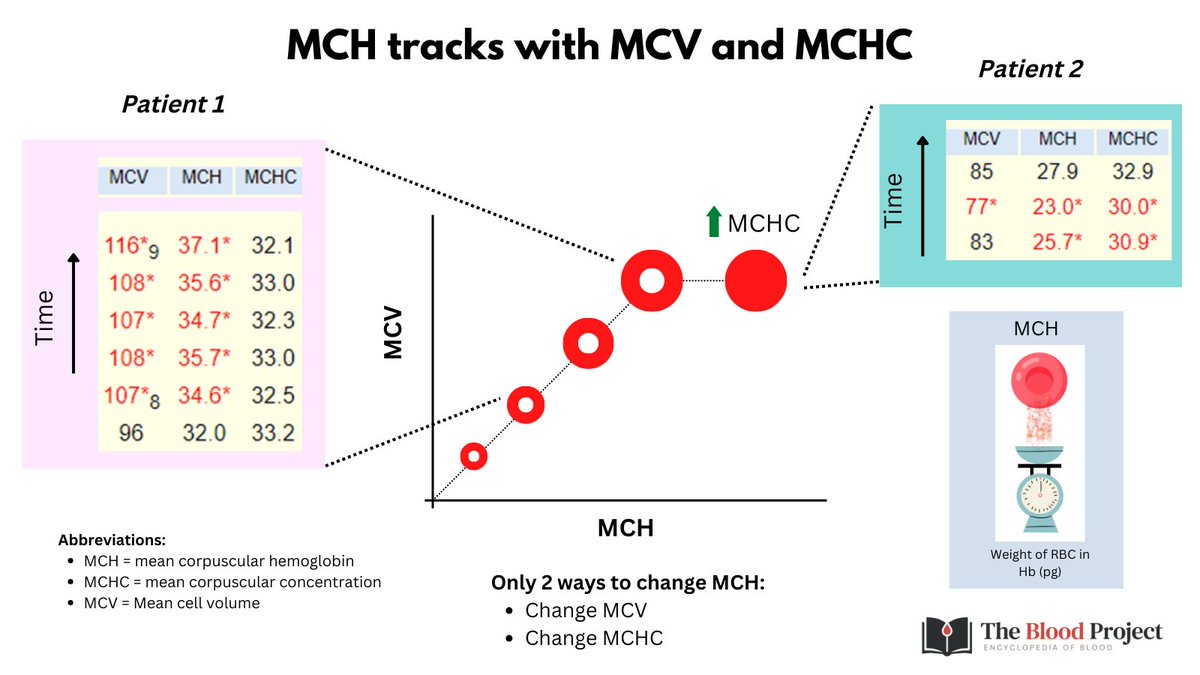
The MCH is the ave weight of the RBC in Hb (reported in pg). In contrast to the MCHC, it has no place in diagnostic algorithms for anemia.

MCH tracks with the MCV and MCHC (MCH = MCV x MCHC; MCV has the largest effect because % deviation is far greater than with the MCHC). Image
3/4

MCH has been said to be a surrogate marker for MCV. But if we have the MCV in hand, why do we need a surrogate marker?

There are really only two situations in which the MCH yields additional information to the MCV and MCHC: Image
Read 4 tweets
Mar 19
1/4

DEFINITION OF ANEMIA

Yesterday, I posted a poll showing Hb 10.4 and Hct 41 and asked whether or not the patient had anemia.

About 62% of respondents answered YES.

That is the CORRECT answer. Image
2/4

Anemia is best defined by the Hb because patients with anemia have a deficit in oxygen carrying capacity. Hb binds and carries oxygen. The Hct, by contrast, is a function of cell size (MCV) and RBC count. It is impervious to the contents of the RBC. Image
3/4

RBCs could contain Swiss cheese for all the Hct cares. The Hb and Hct happen to correlate with each other only because RBCs package Hb.

This patient has severe iron deficiency (the only other explanation for the discordant Hb/Hct [i.e. low MCHC] would be thal major). Image
Read 4 tweets
Feb 20
1/12

PERNCIOUS ANEMIA AND ENDOSCOPY

I posted a poll yesterday asking whether you would refer a patient with pernicous anemia (PA) to a gastroenterologist for consideration of upper endoscopy.

Most of you answered YES. Image
2/12

There is no evidence that initial or surveillance endoscopy affects the outcome of patients with PA.

That being said, most GI practice guidelines recommend endoscopy, whereas the sole hematology guideline (BSH) does not.
3/12

All recommendations are consensus based. The justification for endoscopy is that PA is a manifestation of chronic autoimmune gastritis and that the latter is associated with an increased risk of carcinoid tumors and gastric adenocarcinoma. Image
Read 12 tweets
Feb 19
1/7

CASE

Yesterday, I posted a time series of CBCs and reticulocyte counts and asked a series of questions.

Let's address each question in turn. Image
2/7

Q1. Describe the CBC on 2/11.
A1. Leukocytosis (WBC > 11 x 10^9/L) with normocytic, normochromic anemia (Hb < 12-13 g/dL, MCV 80-100 fL, MCHC 32-36 g/dL), anisocytosis (RDW-SD > 46 fL) and thrombocytosis (PLT > 400 x 10^9/L). Image
3/7

Q2. Why does the MCV increase?
A2. There are only two ways to acutely increase the MCV above normal: reticulocytosis and in vitro artifact. In this case, the retic count is increasing, accounting for the new macrocytosis. Image
Read 7 tweets
Feb 17
1/5

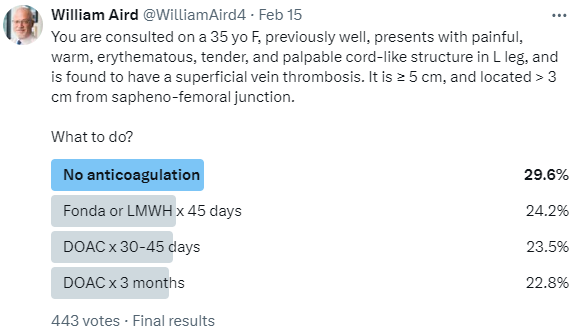
SVT - TO ANTICOAGULATE OR NOT TO ANTICOAGULATE

I posted a poll asking whether and how you would anticoagulate a patient with superficial vein thrombosis (SVT) of the leg. There was a pretty even split in votes between the 4 options. Image
2/5

Most respondents chose to anticoagulate, though there was no clear consensus on the type/duration of anticoagulation.

In fact, clinical practice guidelines would recommend anticoagulating this patient with either fondaparinux or rivaroxaban for 45 days. Image
3/5

Guideline recommendations for treating patients with SVT of the leg depend on:

1. The proximity of the clot is to the junction with the deep vein.

2. The length of the clot.

3. Whether there are severe symptoms and/or higher than normal risk factors for extension. Image
Read 5 tweets

Did Thread Reader help you today?

Support us! We are indie developers!


This site is made by just two indie developers on a laptop doing marketing, support and development! Read more about the story.

Become a Premium Member ($3/month or $30/year) and get exclusive features!

Become Premium

Don't want to be a Premium member but still want to support us?

Make a small donation by buying us coffee ($5) or help with server cost ($10)

Donate via Paypal

Or Donate anonymously using crypto!

Ethereum

0xfe58350B80634f60Fa6Dc149a72b4DFbc17D341E copy

Bitcoin

3ATGMxNzCUFzxpMCHL5sWSt4DVtS8UqXpi copy

Thank you for your support!

Follow Us!

:(