Good morning from New York.
We're gearing up for the second day of jury selection in Trump's criminal case in New York. Some nine jurors passed through the initial screening round, though none are empaneled, yet.
I'm reporting live from the courthouse every day. Follow here.
We're gearing up for the second day of jury selection in Trump's criminal case in New York. Some nine jurors passed through the initial screening round, though none are empaneled, yet.
I'm reporting live from the courthouse every day. Follow here.
Per pool at 8:34 a.m. ET:
"Motorcade is on the move."
"Motorcade is on the move."
For my written reporting:
I will periodically fire off quick dispatches, and longer analytical pieces, on the trial for @Just_Security.
You can find the former category here. (Bookmark it!)
A more analytical dive here. justsecurity.org/daily-courtroo…
justsecurity.org/94560/trump-tr…
I will periodically fire off quick dispatches, and longer analytical pieces, on the trial for @Just_Security.
You can find the former category here. (Bookmark it!)
A more analytical dive here. justsecurity.org/daily-courtroo…
justsecurity.org/94560/trump-tr…
Throughout the trial, I'll report what I saw in the courtroom after proceedings adjourn on @MSNBC's @TheLastWord with @Lawrence. Be sure to tune in!
Last night, we discussed how the judge threaded the needle on Trump's pre-trial rulings.
ICYMI msnbc.com/the-last-word/…
Last night, we discussed how the judge threaded the needle on Trump's pre-trial rulings.
ICYMI msnbc.com/the-last-word/…
8:50 a.m. ET:
"Motorcade has arrived," per CNN's @JWinterNY in the press pool
"Motorcade has arrived," per CNN's @JWinterNY in the press pool
9:21 a.m.
"Prosecutors from the Manhattan DA’s office have arrived in the courtroom, carrying a couple boxes of documents," per pooler @StewartBishop
"Prosecutors from the Manhattan DA’s office have arrived in the courtroom, carrying a couple boxes of documents," per pooler @StewartBishop
A reminder:
During jury selection, seating inside the main courthouse is severely constrained, and only a handful of pool reporters will observe from the actual courtroom.
Those positions rotate, and most of us observe voir dire via CCTV.
Access expands come trial time.
During jury selection, seating inside the main courthouse is severely constrained, and only a handful of pool reporters will observe from the actual courtroom.
Those positions rotate, and most of us observe voir dire via CCTV.
Access expands come trial time.
That's because the hundreds of potential jurors, in smaller increments of less than 100, fill up the seating in the pews of the gallery.
Proceedings are scheduled to start at 9:30 a.m., "sharp," every day, per the judge's instructions.
We're a minute away from that deadline.
Proceedings are scheduled to start at 9:30 a.m., "sharp," every day, per the judge's instructions.
We're a minute away from that deadline.
Right on time, Trump entered the courtroom at 9:30 a.m.
"While he walked down the aisle, he winked at one of the court officers and mouthed 'how are you?'" per pooler @eorden.
"He looked straight ahead as he walked, then took a seat at the defense table."
"While he walked down the aisle, he winked at one of the court officers and mouthed 'how are you?'" per pooler @eorden.
"He looked straight ahead as he walked, then took a seat at the defense table."
Trump is seated between his attorneys Todd Blanche and Emil Bove, who are both alumni of the Southern District of New York's U.S. Attorney's office.
Well, some 10 minutes later, that 9:30 a.m. "sharp" is now just an aspirational memory.
Standby.
Standby.
"All rise."
Justice Juan Merchan takes the bench, and the attorneys for the parties register their appearances.
Justice Juan Merchan takes the bench, and the attorneys for the parties register their appearances.
Merchan explains the 15 minute delay: "waiting on some jurors."
They are still waiting on three jurors, of whom two were in the box.
One, who reported flu-like symptoms, has been excused.
They are still waiting on three jurors, of whom two were in the box.
One, who reported flu-like symptoms, has been excused.
A potential juror who self-reported that he may have "unconscious bias" because of Republican relatives has been excused.
Another juror self-reports that he thought about it and may not be able to be impartial.
Excused.
Excused.
A potential juror says she dated a lawyer for a while.
"It ended... fine," she adds, with a slight pause, to fairly uproarious laughter in the overflow room.
"It ended... fine," she adds, with a slight pause, to fairly uproarious laughter in the overflow room.
Another potential juror answers in response to this question.
"I feel that no one is above the law."
"I feel that no one is above the law."

This juror says that he's read "Art of the Deal," "How to Be Rich," and struggles with the third, to laughter in the overflow room.
Another juror:
"I believe that no one is above the law."
Third response of its kind.
"I believe that no one is above the law."
Third response of its kind.
In response to a question asking her opinion about Trump's treatment in the case, she says that she believes Trump's being treated "fairly."
After conceding that she may not be able to be impartial, she is excused.
After conceding that she may not be able to be impartial, she is excused.
With the jury out of the room, Trump agrees that he has waived his right to be present at sidebars. That solves a logistical problem involving Secret Service raised by the judge on Monday.
Press pool dispatch via @EOrden:
"Trump appeared to be looking at the prospective jurors in the jury box as they each answered 'yes' to Steinglass’s question about whether they would be able to return a guilty verdict. Trump tilted his head once or twice as they were answering."
This is from the ADA's questioning, and he also made clear the jurors must hold prosecutors to their burden of proof.
"Trump appeared to be looking at the prospective jurors in the jury box as they each answered 'yes' to Steinglass’s question about whether they would be able to return a guilty verdict. Trump tilted his head once or twice as they were answering."
This is from the ADA's questioning, and he also made clear the jurors must hold prosecutors to their burden of proof.
Note—
Prosecutors and the defense each have 30 minutes to conduct voir dire.
Questioning for the People: Joshua Steinglass
For Trump: Todd Blanche
Prosecutors and the defense each have 30 minutes to conduct voir dire.
Questioning for the People: Joshua Steinglass
For Trump: Todd Blanche
Asked about his feelings about Trump, a juror tells attorney Todd Blanche:
"If we were sitting in a bar, I'd be happy to tell you."
But the juror says that his political views are not relevant to this criminal case.
"They're apples and oranges."
"If we were sitting in a bar, I'd be happy to tell you."
But the juror says that his political views are not relevant to this criminal case.
"They're apples and oranges."
The juror then discloses that he's Democrat, but he adds again that this affiliation is not relevant.
"It does not matter what my view is [...] I can compartmentalize."
"It does not matter what my view is [...] I can compartmentalize."
A juror tells Blanche that he was a "big fan of 'The Apprentice.'"
He says there were things he agreed with and disagreed with about Trump.
He says there were things he agreed with and disagreed with about Trump.
Blanche keeps pressing jurors on their options about Trump.
Another responds: "He was our president," adding he agreed with and disagreed with certain things about him.
Another responds: "He was our president," adding he agreed with and disagreed with certain things about him.
Another:
"I agree with the others about separating politics" from what goes on in this courtroom.
"I agree with the others about separating politics" from what goes on in this courtroom.
Another:
Any feelings about him are "inconsequential" to this trial.
"Feelings are not facts."
Any feelings about him are "inconsequential" to this trial.
"Feelings are not facts."
Another, with a genuine tone of wonder:
"I find him fascinating!"
"I find him fascinating!"
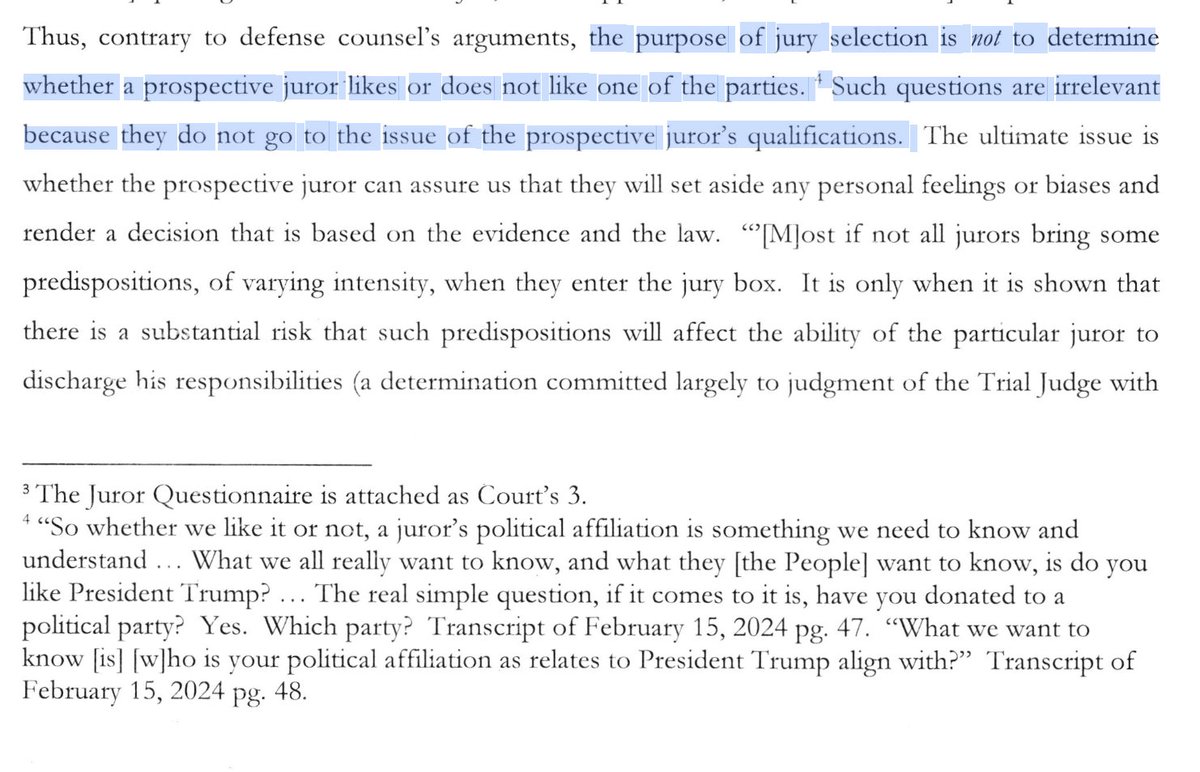
Justice Merchan before this began:
"[T]he purpose of jury selection is not to determine
whether a prospective juror does or does not like one of the parties. Such questions are irrelevant because they do not go to the issue of the prospective juror's qualifications."
Several jurors seem to agree.
"[T]he purpose of jury selection is not to determine
whether a prospective juror does or does not like one of the parties. Such questions are irrelevant because they do not go to the issue of the prospective juror's qualifications."
Several jurors seem to agree.
Todd Blanche quips that it might be difficult to talk about Trump: "He's right here."
A potential juror interjects mid-sentence:
"I don't think it's difficult. Not to cut you off."
A potential juror interjects mid-sentence:
"I don't think it's difficult. Not to cut you off."
Another potential juror says of Trump:
"He speaks his mind. He stirs the pot."
She says that "everyone judges him for speaking his mind."
She adds later: "I wanna say some things, but my mother said, 'Be nice!'"
"He speaks his mind. He stirs the pot."
She says that "everyone judges him for speaking his mind."
She adds later: "I wanna say some things, but my mother said, 'Be nice!'"
Questioning by attorneys for both parties has ended.
The jurors exit the courtroom for the parties to begin their next round of screening.
The jurors exit the courtroom for the parties to begin their next round of screening.
Typo:
* a Democrat, or Democratic
* a Democrat, or Democratic
• • •
Missing some Tweet in this thread? You can try to
force a refresh