Jon Hawkes Profile picture
Apr 17 21 tweets 9 min read Read on X
A brief summary🧵of the Manned Ground Vehicle (MGV) element of the aspirational US Army Future Combat Systems (FCS) programme. A bit of a "what they almost got" for the US Army of the late 90s and early 00s. Image
MGV was a common family of AFV that were bold in their vision - baseline 24 ton hull (later upped to c.30t) with hybrid drive & CRT track, loads of data & sensor fusion, a lot of automation (most variants were 2-man crews), with less passive armour and more smart solutions. Image
A few more details of the core base platform that the family would build on. Lots of bold capabilities that many 2020s AFV still lack, and all with the strategic benefits of a single common platform across an entire Army fleet, which are substantial. Image
As mentioned, survivability was being sought not by heavy and bulky passive armour, but by signature management systems, APS, an applique B kit armour (incl. an underbody V-belly addon), and keeping crew to 2 in the hull for most variants. Image
By 2020s standards where 🇺🇸 XM30 is fielding 50 mm and many users mounting 40 mm (incl. 🇬🇧/🇫🇷 40 mm CT), it wasn't desperately exciting, with the 30 mm MK44 Bushmaster II selected. It was an uplift over Bradley's 25 mm and was in part selected to minimise weight and size, though
Image
Image
The variants that made up the MGV family, then:
XM1201 Reconnaissance and Surveillance Vehicle (RSV) was the replacement for M3 Bradley, with all the modern trappings of a recce AFV, including a sensor mast, small UGV and two UAVs. Image
XM1202 Mounted Combat System (MCS) was the tank variant, still mounting 120 mm (using the composite XM360 gun with autoloader) rather than a larger calibre, with direct and indirect fire modes using smart ammunition. Crew would still be just two people in the hull Image
XM1202 would fire XM1111 Mid-Range Munition, a 120mm beyond line of sight (BLOS) family that would come in 2 version - MRM-KE and MRM-CE, kinetic penetrator and HEAT respectively. Both were boosted by rocket motor and guided to target with autonomous or semi-active laser guidance Image
XM1203 Non-Line of Sight Cannon (NLOS-C) was the 155 mm artillery variant, with a high RoF and boatloads of automation from the XM2001 Crusader. (old thread here for more on the Crusader efforts that never came to be, especially the reload vehicle: )
Image
The NLOS-C was one of the few examples that saw real steel tested extensively, with 8 demonstrators having completed a fair amount of live fire testing in 2008/9 prior to its cancellation. NLOS-C actually outlived the MGV effort due to its maturity, but only by a few months.

Image
Image
Image
XM1204 Non-Line of Sight Mortar (NLOS-M) was the 120 mm mortar, firing a breech loading weapon operated by 2 crew, with a further 2 crew (driver/commander) in the front of the vehicle. Oddly lacking in automation compared to the NLOS-C, and felt like it lacked a bit of ambition. Image
Given how aspirational the rest of FCS was, its weird NLOS-M was so average in its spec. Compare to a modern system like NEMO or better yet AMOS (both of which have been around some considerable time now!) and it just feels an odd one out.

Image
Image
Image
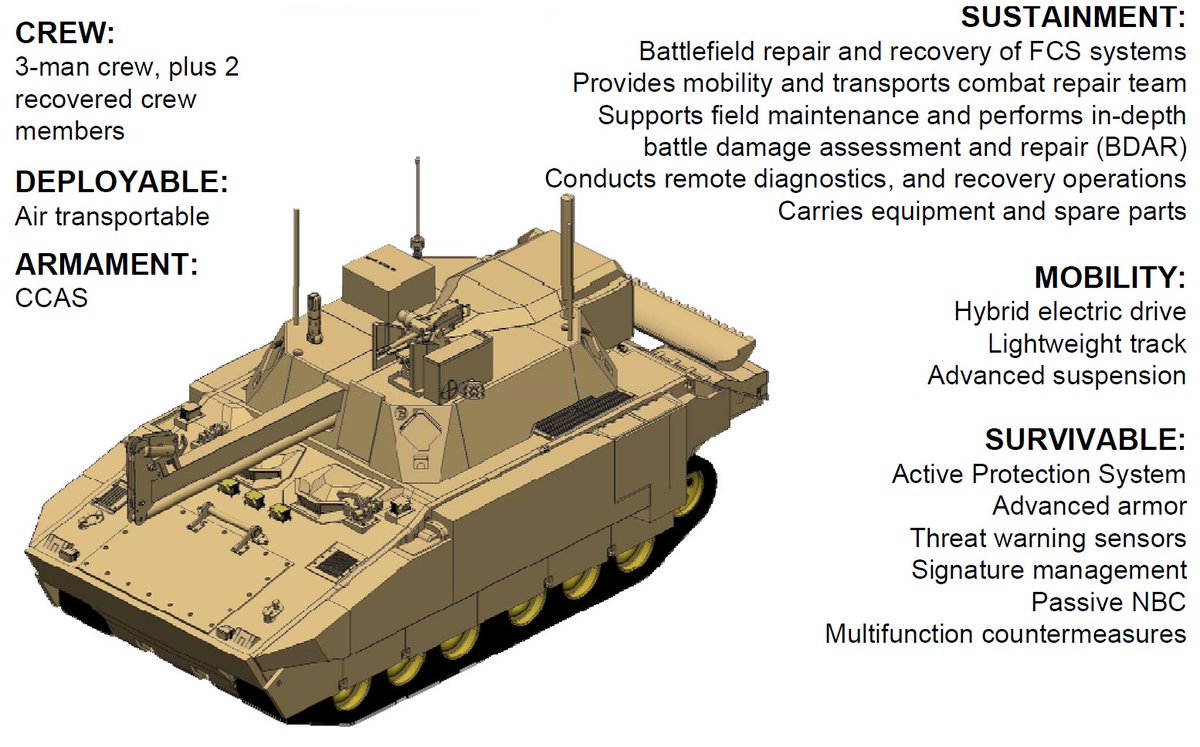
XM1205 Field Recovery and Maintenance Vehicle (FRMV) is the ARV of the family (ARV and AEV are always the best variants), with a crew of 3 plus space for 3 passengers from recovered vehicles. Turret mounted crane and a bunch of the usual winches and gear for recovery and repair.
Image
Image
XM1206 Infantry Carrier Vehicle (ICV) is the IFV of the bunch, actually very closely aligned to the XM1201 RSV just with less recce gear and more dismount capacity, which was 9-soldiers plus the 2-person crew. Image
Dogged determination to get a 9-person capacity is part of what would drive relentless size problems of US IFV efforts throughout the 90s and early 00s, with the subsequent GCV programme finally giving up and cancelling efforts with undelivered prototypes sat at around 85 tons.

Image
Image
Image
XM1207 Medical Vehicle–Evacuation (MV-E) and XM1208 Medical Vehicle–Treatment (MV-T) are the standard pair of medical variants, one for purely extraction and immediate life support, the latter with more equipment for deeper treatment. Both with crew of 4 + 4 patients. Image
XM1209 Command and Control Vehicle (C2V) is, again, a fairly standard variant - providing space for 2 crew plus 4 staff officers to conduct C2 duties. Lots of fancy C4 kit to fuse data across formations, and generic references to a few hosted UAVs for situational awareness Image
Ultimately it was all cancelled due to changes in priorities as a post- 9/11 US Army evolved, and today there has still been no collective or partial acquisition of any of these capabilities, with the Bradley, Abrams and Co. all still in service, but at least several... Image
...susbtantial upgrades along since then. The main thrust of effort since FCS' MGV has been to keep trying to replace Bradley, which led from FCS MGV through the GCV, NGCV, OMFV, and now XM30 MICV efforts.
American Rheinmetall and GDLS are in the final running for XM30 following a downselect in June last year, will be interesting to see if c.7th time is the charm for the US getting a new IFV... /end
Image
Image

• • •

Missing some Tweet in this thread? You can try to force a refresh

 

Keep Current with Jon Hawkes

Jon Hawkes Profile picture

Stay in touch and get notified when new unrolls are available from this author!

Read all threads

This Thread may be Removed Anytime!

PDF

Twitter may remove this content at anytime! Save it as PDF for later use!

Try unrolling a thread yourself!

how to unroll video
  1. Follow @ThreadReaderApp to mention us!

  2. From a Twitter thread mention us with a keyword "unroll"
@threadreaderapp unroll

Practice here first or read more on our help page!

More from @JonHawkes275

Mar 7
A long-requested (long) overview of the UK’s wheeled vehicle strategy – the Land Mobility Programme (LMP) and Boxer Strategic Pipeline (BSP).
Its actually rather good as a plan, being well considered, framed in reality and funded. Well done Army! Image
So, broad strokes. LMP and BSP form a full spectrum of wheeled vehicle capability for the Army. LMP comprises three strands – Light Utility, Light Protected Mobility, and Medium Protected Mobility. Boxer sits above as a de-facto Heavy Protected Mobility of sorts Image
In all we are talking a 20-year pipeline of >12,000 vehicles with a combined budget likely well over £7Bn. This is also the big test whether MoDs new Integrated Procurement Model is all talk or not – buy simple and fast, iterate and export, or not. Image
Read 46 tweets
Feb 23
1/ 2024 is shaping up to be a bit of a year of the Leopard, a brief summary of plans afoot to make even more Leopard 2 users and variants a reality, which is always a good thing.
An open-ended, non-exhaustive list of actual & speculative users going on as of February 2024: Image
2/ 🇮🇹 Italy: Leopard 2A8
The Italians are looking at a medium-term successor to the Ariete (pictured), despite that tank still being in the midst of an MLU, with long term aspirations to join MGCS (or whatever emerges when it finally gives up). Image
3/ They plan to do a lot of the work domestically, building at a Leonardo production line in La Spezia and fitting with Italian industry components including sights, radios, C2 suite and potentially domestic manufactured barrel for L55A1 gun.
Anticipated production run: 130x 2A8.
Read 18 tweets
Feb 14
1/ Japan's Future Amphibious Technology Research (FAT-R). The oft-overlooked work to really push the envelope of AAV tech that is actually making some great strides in the background.

A short summary 🧵 Image
2/ A quick background of Amphibious Assault Vehicles (AAVs). Since the DUKW and LVT in the 1940s, there has been a niche for AFV capable of swimming when afloat and transitioning to land movement seamlessly to transport and support an opposed landing and inland movement.
Image
Image
3/ In the contemporary space the only meaningful example is the AAV7 (previously LVTP7), in service since 1972 and still the only vehicle of its type (ack that there are some peripheral amphibious AFV like ACV/SUPERAV, AMV and others, but nothing that was from the outset an AAV). Image
Read 22 tweets
Feb 9
1/ A short summary of 🇪🇸's Leopard 2E upgrade plans.

Spain bought 219 Leopard 2E (local name Leopardo 2E), which are broadly speaking a 2A6 analogue with the Strv 122/2A6HEL roof armour and some unique to Spain C4 gear (LINCE BMS, Indra licence-built TI optics etc) Image
2/ The initial plan was to manage obsolescence and reduce some of the maintenance burden - in recent years the training has been curtailed simply because funding for spares and consumables wasn't there, so they are rather keen to minimise outdated elements.
3/ However, some money has been found somewhere, and so the upgrade plan has expanded into a multi-phase approach. Phase 1 will result in the Leopard 2E M1, and remains on the original plan - obsolescence management and sustainment efficiencies. IOC is planned for 2029. Image
Read 12 tweets
Jan 23
1/ UKs Challenger 3 prototype now a real steel bit of kit, going into trials within the next few weeks. Imagery from #IAV2024 courtesy of @Janes own @Rivet_Counter

A few of the usual objections/critiques/comments flying around on twitter this week - a mini thread of responses to Image
2/ The design remains unchanged at the overall design level from that which I summarised 3 years ago at contract award in this thread:
3/ Critique: "Its not got APS". Yes it does, we've seen pics & videos of Trophy tested on mock turrets. Remember CR3 is "fitted for but not with" APS so prototype not having it means v little. This kind of testing would not be expected to have more than ballast to simulate APS Image
Read 8 tweets
Oct 16, 2023
1/ A much requested 🧵 thread on the confused and misunderstood topic of Challenger 2/3’s engine and just how many horses are, or can be fit under the deck of these tanks. Short answer – there is no 1,500 hp uplift for CR2 or CR3. Image
2/ There *could* be a lift to 1,500 hp but there are major technical obstacles and there is no intent to do it. There is be a mid-ground to be found that is being looked at outside committed programmes.
3/ First establish the as-is: CR2 is fitted with the original 1998 powerpack consisting of a Perkins CV12-6A V-12 diesel engine and David Brown TN54E epicyclic transmission, plus a monster cooling system. Image
Read 40 tweets

Did Thread Reader help you today?

Support us! We are indie developers!


This site is made by just two indie developers on a laptop doing marketing, support and development! Read more about the story.

Become a Premium Member ($3/month or $30/year) and get exclusive features!

Become Premium

Don't want to be a Premium member but still want to support us?

Make a small donation by buying us coffee ($5) or help with server cost ($10)

Donate via Paypal

Or Donate anonymously using crypto!

Ethereum

0xfe58350B80634f60Fa6Dc149a72b4DFbc17D341E copy

Bitcoin

3ATGMxNzCUFzxpMCHL5sWSt4DVtS8UqXpi copy

Thank you for your support!

Follow Us!

:(