Good morning from New York.
We're seven sworn jurors into the process in Trump's criminal trial. Could we get the full 12-person panel today, save for the alternates?
Follow again for more voir dire, and see my chat with @Lawrence on Tuesday's session msnbc.com/the-last-word/…
We're seven sworn jurors into the process in Trump's criminal trial. Could we get the full 12-person panel today, save for the alternates?
Follow again for more voir dire, and see my chat with @Lawrence on Tuesday's session msnbc.com/the-last-word/…
First off:
On the first day, Justice Merchan read out a list of 41 names related to the case—not all witnesses.
For @Just_Security, @NormEisen spearheaded a breakdown of these names, with research from @JNKGoodman and me.
Bookmark this resource justsecurity.org/94696/trump-cr…
On the first day, Justice Merchan read out a list of 41 names related to the case—not all witnesses.
For @Just_Security, @NormEisen spearheaded a breakdown of these names, with research from @JNKGoodman and me.
Bookmark this resource justsecurity.org/94696/trump-cr…
Trump has sat down at the defense table, more alert than we have seen him so far.
He appeared to be talking on his phone, until his attorney Todd Blanche made a cellphone gesture toward him, and he got off the phone.
He appeared to be talking on his phone, until his attorney Todd Blanche made a cellphone gesture toward him, and he got off the phone.
Proceedings were about to start a bit early, but there isn't a court reporter present.
Justice Merchan had attorneys for both sides approach for a sidebar, for undisclosed reasons.
Justice Merchan had attorneys for both sides approach for a sidebar, for undisclosed reasons.
Per @DevlinBarrett, in the press pool:
Trump's aide Jason Miller and campaign spokesman Steven Cheung are present in the courtroom.
Trump's aide Jason Miller and campaign spokesman Steven Cheung are present in the courtroom.
The judge announces:
Juror #2, the nurse who announced "no one is above the law," expressed concerns about her ability to be fair, after being sworn in on Tuesday.
Juror #2, the nurse who announced "no one is above the law," expressed concerns about her ability to be fair, after being sworn in on Tuesday.
She's brought into the courtroom:
Juror #2: "I definitely have concerns now." [...]
"Yesterday alone, I had friends, colleagues and family push things to my phone, questioning my identity as a juror."
She is excused.
Juror #2: "I definitely have concerns now." [...]
"Yesterday alone, I had friends, colleagues and family push things to my phone, questioning my identity as a juror."
She is excused.
Merchan addresses the press:
He says revealing too many juror details "defeats the purpose" of anonymity.
"The press is certainly able and permitted to write about anything that's on the record, because it's on the record."
He says revealing too many juror details "defeats the purpose" of anonymity.
"The press is certainly able and permitted to write about anything that's on the record, because it's on the record."
Merchan:
"But I'm directing that the press simply applies common sense."
In an extraordinary order, the judge directs reporters not to report physically and audibly identifying information about the jury.
"But I'm directing that the press simply applies common sense."
In an extraordinary order, the judge directs reporters not to report physically and audibly identifying information about the jury.
Prosecutors complain that the most identifying information may be Question 3A: "Who is your current employer?"
They want more generalized answers to that question.
The defense says they need that information.
Merchan agrees.
He directs the press not to report that.
They want more generalized answers to that question.
The defense says they need that information.
Merchan agrees.
He directs the press not to report that.
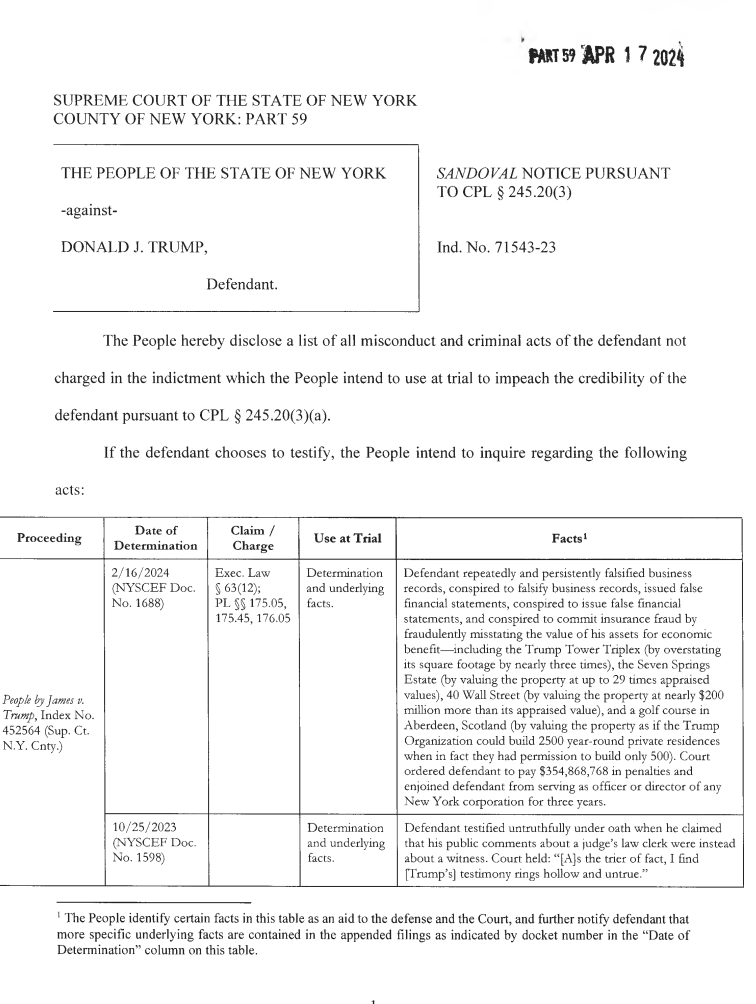
Assistant District Attorney Christopher Conroy proposes a new order to show cause, telling the judge that Trump "violated the order seven more times."
"It's ridiculous. It's got to stop."
He wants to add seven more violations to next week's contempt hearing.
"It's ridiculous. It's got to stop."
He wants to add seven more violations to next week's contempt hearing.
Questions emerge about Juror #4, who called Trump "fascinating and mysterious."
ADA Steinglass says a person with the same name had been arrested in Westchester for tearing down political ads.
ADA Steinglass says a person with the same name had been arrested in Westchester for tearing down political ads.
Steinglass says that he's not sure it's the same person, but it merits an inquiry.
So we started the day with seven jurors. We're now at six.
Next up, five?
Next up, five?
A quick note:
The press likely will be scrutinizing the language of the Merchan's order directing, in his words, that reporters refrain from disclosing physically identifying information about potential jurors.
So if there's a Batson challenge — alleging a juror was stricken based on race or another protected characteristic — reporters may not be able to tell you why.
The press likely will be scrutinizing the language of the Merchan's order directing, in his words, that reporters refrain from disclosing physically identifying information about potential jurors.
So if there's a Batson challenge — alleging a juror was stricken based on race or another protected characteristic — reporters may not be able to tell you why.
Analysis:
Concerns about the privacy and safety of anonymous jurors in the historic first prosecution of a former U.S. president are serious, sparking serious conversations about journalism ethics in most newsrooms.
At the same time, trust and accountability about the system depends on responsible reporting on how the process works—beyond the stereotypes about the New York jury pool.
There are good reasons to know about the diversity and fairness of the panel, while protecting juror security.
Most responsible reporters and news organizations have been grappling about how to balance these objectives.
Now, back to the news.
Concerns about the privacy and safety of anonymous jurors in the historic first prosecution of a former U.S. president are serious, sparking serious conversations about journalism ethics in most newsrooms.
At the same time, trust and accountability about the system depends on responsible reporting on how the process works—beyond the stereotypes about the New York jury pool.
There are good reasons to know about the diversity and fairness of the panel, while protecting juror security.
Most responsible reporters and news organizations have been grappling about how to balance these objectives.
Now, back to the news.
A first:
One woman informed the court that she read the book by Mark Pomerantz, the ex-special prosecutor who resigned from DA Bragg's office frustrated about his (erroneous) perception that he would not indict Trump.
One woman informed the court that she read the book by Mark Pomerantz, the ex-special prosecutor who resigned from DA Bragg's office frustrated about his (erroneous) perception that he would not indict Trump.
Laughter in the press overflow room at the mention of the Pomerantz book.
This potential juror:
"I believe that no one is above the law."
Fourth one to say that.
"I believe that no one is above the law."
Fourth one to say that.
A potential juror says that she read "the first 10 pages" of Michael Cohen's book "Disloyal."
Juror #4 has been excused.
And then there were five...
And then there were five...
A potential juror:
“I firmly believe in innocent until proven guilty — again, just as a lawyer.”
Two attorneys are already on the jury.
“I firmly believe in innocent until proven guilty — again, just as a lawyer.”
Two attorneys are already on the jury.
A fifth potential juror has said that he's read Trump's "Art of the Deal."
(The fourth appeared to indicate that he only read passages.)
(The fourth appeared to indicate that he only read passages.)
A potential juror from Italy is excused after disclosing that he followed a lot of news about Silvio Berlusconi, the country's serially prosecuted ex-prime minister.
It affects his ability to be fair, he says.
Gone.
It affects his ability to be fair, he says.
Gone.
"All rise."
Court is back in session.
Court is back in session.
Assistant DA Joshua Steinglass kicks off voir dire of the jury.
He has 30 minutes.
"This case has nothing to do with your personal politics, or feelings about a political issue."
He has 30 minutes.
"This case has nothing to do with your personal politics, or feelings about a political issue."
The female attorney who described her in-depth knowledge of the case earlier expressed concerns about her impartiality.
“I’m worried that I know too much. I know academically as a lawyer that I can put it aside, but I’m worried that it will seep in at some point.”
“I’m worried that I know too much. I know academically as a lawyer that I can put it aside, but I’m worried that it will seep in at some point.”
The prosecutor thanks her for her candor.
One of the potential jurors met one of Trump's lawyers, Susan Necheles, through her husband some 15 years ago.
ADA Steinglass illustrates a legal concept, accessory liability, with an analogy about a hypothetical hit-man — the point of which, he adds, is to see whether they can follow the law.
Steinglass illustrates another legal concept about tacit agreements—which appears less hypothetical. He notes alleged conspiracies aren't always explicit as saying:
“Hey, let’s commit election fraud! Let’s pull the wool over the voters’ eyes in order to get elected.”
“Hey, let’s commit election fraud! Let’s pull the wool over the voters’ eyes in order to get elected.”
After this remark, the defense objects, and the judge overrules.
The DA's theory of the case is that Trump disguised payments to cover-up his alleged affair with Stormy Daniels in order influence the 2016 presidential election.
The DA's theory of the case is that Trump disguised payments to cover-up his alleged affair with Stormy Daniels in order influence the 2016 presidential election.
Leading voir dire for Trump's defense this round is Susan Necheles
Attorney Todd Blanche led the last two rounds.
Attorney Todd Blanche led the last two rounds.
Necheles prods one of the potential jurors about her social media activity.
She says she hasn't posted much about Trump "recently."
"Since the whole COVID situation [...] politics seems like a nasty thing to be posting about during a national crisis."
She says she hasn't posted much about Trump "recently."
"Since the whole COVID situation [...] politics seems like a nasty thing to be posting about during a national crisis."
A potential juror tells Trump's attorney:
“I disagree with most of his policies,” referring to the former president.
“I disagree with most of his policies,” referring to the former president.
Necheles notes that Trump tends to inspire strong opinions, describing the concept of implicit bias.
“We wouldn’t allow someone who has a strong dislike for a certain type of people to sit on a jury of that type of person.”
“We wouldn’t allow someone who has a strong dislike for a certain type of people to sit on a jury of that type of person.”
Asked her opinions about Trump, a potential juror supplies a New York answer:
"I’ve got opinions. I’m born and raised in Brooklyn and New York."
She sprinkles in a New York story — seeing Trump and Marla Maples shopping for "baby things."
"I’ve got opinions. I’m born and raised in Brooklyn and New York."
She sprinkles in a New York story — seeing Trump and Marla Maples shopping for "baby things."
She suggests that experiences like that shape her opinions and perceptions about Trump both ways.
Another potential juror says flatly of Trump:
"I don't have strong opinions about him, but I don't like his persona."
She adds that it won't affect her ability to be impartial.
"I don't have strong opinions about him, but I don't like his persona."
She adds that it won't affect her ability to be impartial.
In a comical moment, the potential juror says that it doesn't matter because she also doesn't like some of her co-workers.
The judge doesn't hear her, and asks her to repeat that.
She does, sheepishly.
Overflow room roars with laughter.
The judge doesn't hear her, and asks her to repeat that.
She does, sheepishly.
Overflow room roars with laughter.
(The point was that she could set aside her views about Trump, just as she does about those co-workers.)
But she really doesn't like Trump.
"He's very selfish and self-serving, and I don't really appreciate that."
"He's very selfish and self-serving, and I don't really appreciate that."
Another potential juror expresses similar sentiments about Trump.
"I tend not to agree with a lot of his politics and decisions as a president."
But she says she's reflected about that and is confident she can be "totally neutral."
"I tend not to agree with a lot of his politics and decisions as a president."
But she says she's reflected about that and is confident she can be "totally neutral."
She says that she doesn't post politics about social media, and prodded about whether she can be fair, answers without skipping a beat: "100%."
• • •
Missing some Tweet in this thread? You can try to
force a refresh