Let’s talk a little about PULPITIS.
There’s so much attention placed on gum disease these days due to a lot of anecdata on falling teeth and inflamed gingiva in individuals with long COVID.
Oral structures are pretty complex though and just like not everything is about…
There’s so much attention placed on gum disease these days due to a lot of anecdata on falling teeth and inflamed gingiva in individuals with long COVID.
Oral structures are pretty complex though and just like not everything is about…
COVID, not everything is about gum disease either.
The tooth itself is supplied by blood vessels and nerves, all enclosed in the part called the “pulp”. The upper portion that supplies the crown is called the “pulp chamber “. The lower part is called the “root canal”….
The tooth itself is supplied by blood vessels and nerves, all enclosed in the part called the “pulp”. The upper portion that supplies the crown is called the “pulp chamber “. The lower part is called the “root canal”….

When dental caries, a.k.a. tooth decay, affects a tooth, your dentist will usually do a filling in order to prevent decay from progressing.
There are instances though when decay is left untreated and left to reach the pulp. …
There are instances though when decay is left untreated and left to reach the pulp. …
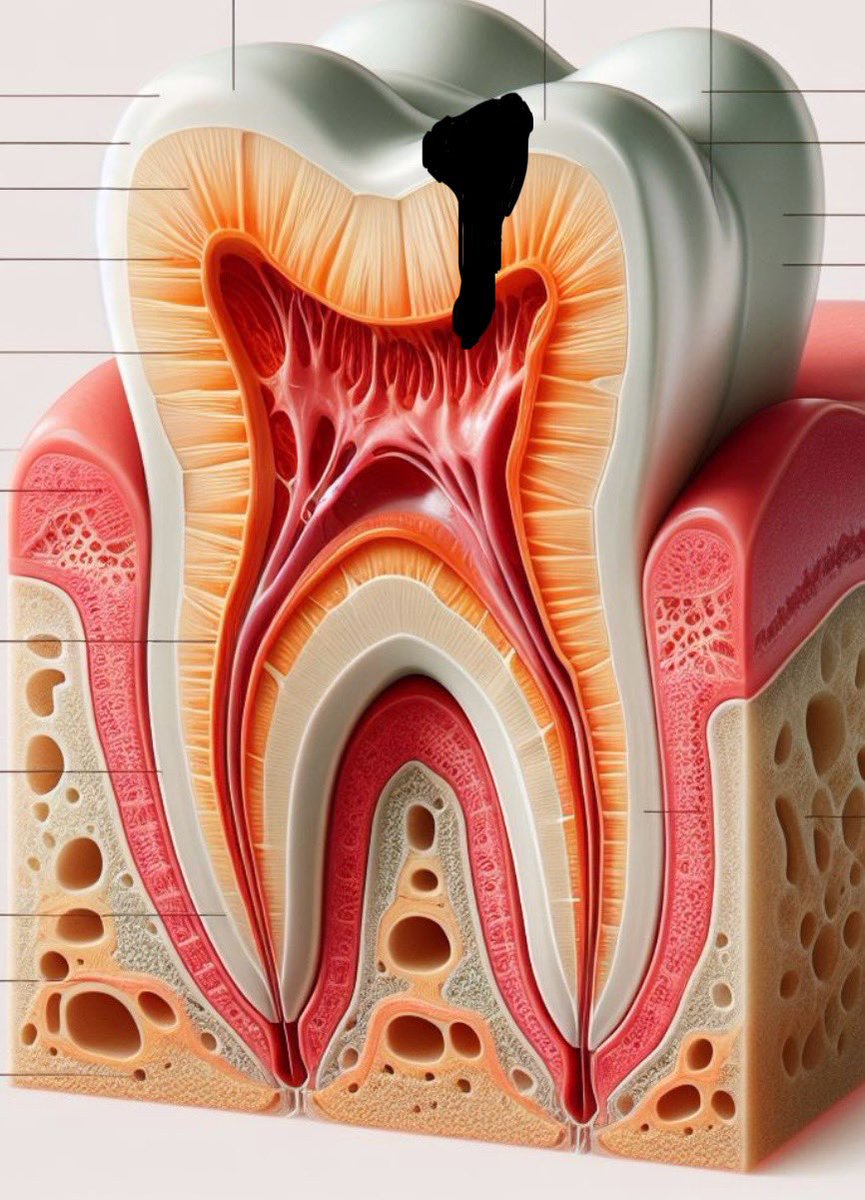
When decay reaches the pulp, it causes pulpitis.
In pinpoint lesions, pulpitis may be reversible, in which case the dentist may try to address the condition using medicaments and fillings.
The pulp though, unlike other body parts, is an enclosed chamber. …
In pinpoint lesions, pulpitis may be reversible, in which case the dentist may try to address the condition using medicaments and fillings.
The pulp though, unlike other body parts, is an enclosed chamber. …
Because of this, inflammation in the pulp is usually hard to resolve resulting in most cases of pulpitis being irreversible.
This is when root canal therapy becomes the only treatment option available.
The thing with irreversible pulpitis is that it can cause …
This is when root canal therapy becomes the only treatment option available.
The thing with irreversible pulpitis is that it can cause …
Devitalization of the pulp when inflammation continues for a long time. Devitalization means that the blood vessels and the nerves that supply the tooth undergo necrosis. In the simplest of terms, a devitalized tooth is a “dead tooth”.
Devitalized teeth lose …
Devitalized teeth lose …
Sensation (yes, no sensitivity or pain) and they also become very fragile due to loss of blood supply. This makes the tooth prone to fracture and breakage without necessarily getting avulsed.
(Avulsion or “teeth falling out” is caused by resorption of bone surrounding…
(Avulsion or “teeth falling out” is caused by resorption of bone surrounding…
The tooth. Tooth support comes from the bone that surrounds it.)
What does this all have to do with long COVID?
Although there are no studies out yet on this, capillary rarefaction has been reported as a consequence of a Covid infection. Capillaries make up the blood supply to…
What does this all have to do with long COVID?
Although there are no studies out yet on this, capillary rarefaction has been reported as a consequence of a Covid infection. Capillaries make up the blood supply to…
The pulp. Limiting blood supply to the pulp could be one reason for devitalization of the tooth.
Aside from this, the pulp highly relies on NK cells and T-cells for its immune response. (Barely any B-cells in pulpal tissue) …
researchgate.net/publication/19…
Aside from this, the pulp highly relies on NK cells and T-cells for its immune response. (Barely any B-cells in pulpal tissue) …
researchgate.net/publication/19…
It’s been relatively established by now that immune dysregulation, involving T-cells and NK cells, happens during COVID infection…
nature.com/articles/s4142…
nature.com/articles/s4142…
It has also been noted that immune dysregulation and prolonged inflammation happens in individuals with long COVID. …
nature.com/articles/s4159…
nature.com/articles/s4159…
Given these circumstances, IMO, it is possible for devitalization of teeth to happen in patients after a Covid infection even in the absence of severe dental caries.
This, ofc, goes without saying that studies have to be made to prove the point despite mechanisms in place….
This, ofc, goes without saying that studies have to be made to prove the point despite mechanisms in place….
Additional caveat: anecdata is anecdata. Before saying that tooth fracture from devitalization is because of COVID, other possible causes such as poor oral hygiene and severe dental caries need to be ruled out.
Tooth devitalization is different from dental caries which, IMO,…
Tooth devitalization is different from dental caries which, IMO,…
may also result from COVID due to dysbiosis and/or decreased salivary flow. Although unaddressed caries may lead to pulpal infection, it’s again important to note that these are two different pathologies with distinct pathological pathways. (End)
• • •
Missing some Tweet in this thread? You can try to
force a refresh