Taken together, they looked at 103 scientific papers. They found only two - or around 2% - were high quality. But they also included the moderate research in their conclusions.
3/8
Around 40% - 43 papers - was considered of low quality, and so was not used to form the systematic reviews' conclusions.
4/8
Dr Cass told us she was “angry” that misinformation was spreading about the review.
"Adults who deliberately spread misinformation about this topic are putting young people at risk, and in my view that is unforgivable."
5/8
Cass: "We're certainly not saying that no-one is going to benefit from these treatments, and I myself have spoken to young people who definitely do appear to have benefited."
6/8
Cass: "But what we need to understand is what's happening to the majority of people who've been through these treatments, and we just don't have that data.”
7/8
Cass: "I certainly wouldn't want to embark on a treatment where somebody couldn't tell me with any accuracy what percentage chance there was of it being successful, and what the possibilities were of harms or side effects."
8/8
Are only 4% of estates subject to inheritance tax? With speculation that Jeremy Hunt might be considering cutting or even abolishing inheritance tax, More or Less decided to look at the figures. 1/10
The 4% figure is a real figure from 2020-21, though it’s now gone up slightly to about 5%. This means only 1 in 20 estates currently pay inheritance tax. 2/10
But why is the figure so low? This is mainly because of the complicated system of allowances that we have. 3/10
Do Grant Shapps’ claims about the environmental impact of North Sea Gas stack up? A More or Less thread. 1/10
At the start of August, Grant Shapps - then Secretary of State for Energy Security and Net Zero - was questioned on The World at One about the environmental impact of the government’s decision to award over a hundred new licences to drill for oil and gas in the North Sea. 2/10
Grant Shapps argued that importing Liquefied Natural Gas (or LNG) from abroad would be worse for the environment than gas sourced from the UK’s North Sea fields, saying it would ‘import four times the carbon’. 3/10
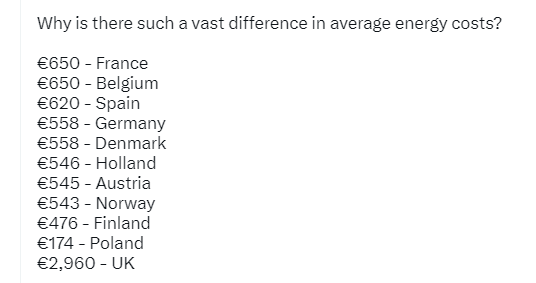
You may have seen a version of this tweet, which seems to claim that energy costs in the UK are many times more expensive than the rest of Europe - over four times as much as the next two countries, Belgium and France.
Here’s why that tweet is wildly misleading. A thread 🧵1/10
What do the figures on the tweet refer to? Average bills? Gas prices? It’s not clear.
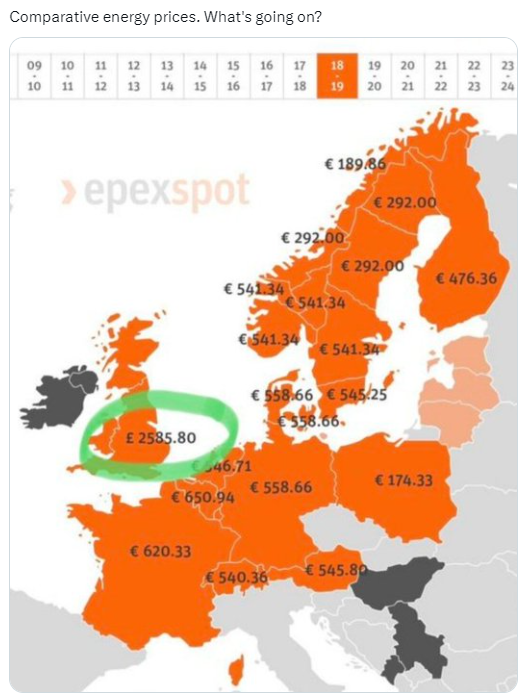
Let’s look at the source for these figures, which we’ve tracked down to something called ‘Epex Spot’, as you can see from another version of the tweet. 2/10
Epex Spot is a wholesale electricity market, a place where energy suppliers and producers go to buy and sell electricity.
This is what these figures refer to - wholesale prices for a megawatt hour of electricity. 3/10
In the last half of 2022, the UK recorded 26,000 more deaths than it would normally expect - that’s a 9% excess, and a worrying trend.
But more recent data show the number of ‘excess deaths’ has been declining. So have we turned a corner?
A thread🧵 1/9
First, we need to remember just how bad the end of 2022 was.
Across the UK, large waves of flu and Covid peaked in late December and A&E departments saw historically dire waiting times. 2/9
Excess deaths were similarly alarming - as the crisis moved into the new year, we saw between three and four thousand excess deaths per week in England and Wales.
Scotland and Northern Ireland also saw high levels of excess mortality. 3/9
What’s going on with ambulance response times in England? How long does it take an ambulance to reach you? The data tell an astonishingly bad story. 1/10
Ambulance response times fall under four categories. Let’s look at the most serious: category one. It includes cardiac arrest or severe allergic reaction - essentially those most serious conditions, often where a patient needs to be resuscitated. 2/10
NHS England aims to respond to these calls in 7 minutes. It’s been missing this target for a long time, but in December the mean average response was the longest it’s ever taken - almost 11 minutes. 3/10