Good morning from New York.
When this photo was taken at the White House in July 2017, Pecker said, Trump asked him: "How's Karen [McDougal] doing?"
Will Trump's lawyer try to undermine it on cross-ex today? Follow along to find out. 🧵
When this photo was taken at the White House in July 2017, Pecker said, Trump asked him: "How's Karen [McDougal] doing?"
Will Trump's lawyer try to undermine it on cross-ex today? Follow along to find out. 🧵
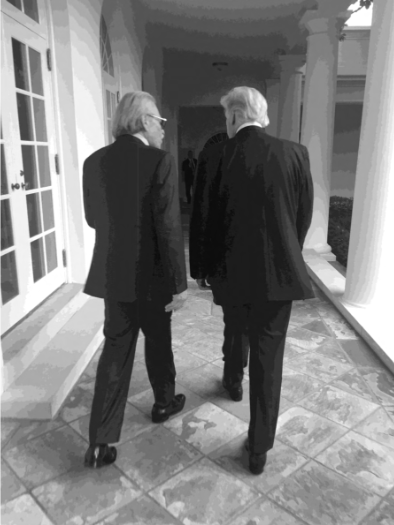
According to the testimony, Trump gave Pecker a "thank you dinner," and Pecker brought along the Enquirer's then-editor-in-chief Dylan Howard.
Pecker said he replied to Trump's inquiry about McDougal:
"She's doing well. She's quiet. Everything is going good."
Pecker said he replied to Trump's inquiry about McDougal:
"She's doing well. She's quiet. Everything is going good."

Now
Trump entered the courtroom in his usual slow stroll and perturbed disposition.
He let out a slight exhale as he reached the defense table before sitting down.
Trump entered the courtroom in his usual slow stroll and perturbed disposition.
He let out a slight exhale as he reached the defense table before sitting down.
Present in the gallery again today:
Trump advisor Boris Epshteyn.
Trump advisor Boris Epshteyn.
"All rise."
Justice Juan Merchan enters the courtroom and goes to the bench.
He announces that the next hearing on the latest alleged gag order violations has been rescheduled for Thursday.
Justice Juan Merchan enters the courtroom and goes to the bench.
He announces that the next hearing on the latest alleged gag order violations has been rescheduled for Thursday.
Correction:
Trial will not break early today.
The jury was initially going to have an early lunch recess for a hearing, but that plan was abandoned after it was determined that there was no need for a hearing.
Trial will not break early today.
The jury was initially going to have an early lunch recess for a hearing, but that plan was abandoned after it was determined that there was no need for a hearing.
Connecting the threads here.
https://x.com/KlasfeldReports/status/1783852985103081573
Bove says he will address it at the start of cross ex today.
Steinglass also suggests that Bove had been muddying the water when questioning Pecker about his interviews with law enforcement.
The prosecutor wants Bove to specify which law enforcement meetings — federal or state — in his questions.
The prosecutor wants Bove to specify which law enforcement meetings — federal or state — in his questions.
Pecker enters and takes the stand.
"All rise."
The jury is entering.
The jury is entering.
Justice Merchan instructs the jury that the law "permits" prosecutors to speak to witnesses before trial.
It's a "normal part" of preparing for trial, "as long as it's not suggested that the witness depart" from saying the truth.
Bove begins cross-ex.
It's a "normal part" of preparing for trial, "as long as it's not suggested that the witness depart" from saying the truth.
Bove begins cross-ex.
As promised before the proceedings began, Bove apologizes to Pecker for the "confusion" in his question about seeing Hope Hicks.
Bove questions Pecker more about Hope Hicks, and his meeting with federal prosecutors on July 2018.
When Bove gets close to the same territory that got him in trouble on Thursday, prosecutors object.
Sustained.
When Bove gets close to the same territory that got him in trouble on Thursday, prosecutors object.
Sustained.
Pecker agrees with Bove's suggestions that running the stories was beneficial to AMI — and standard operating procedure.
Q: There's already negative public information in the public domain about Ben Carson, and you ran it in the National Enquirer.
A: Yes.
A: Yes.
Bove shows all of the negative headlines about Ben Carson. The defense attorney notes that The Guardian reported on malpractice claims about Carson.
Pecker agrees.
Pecker agrees.
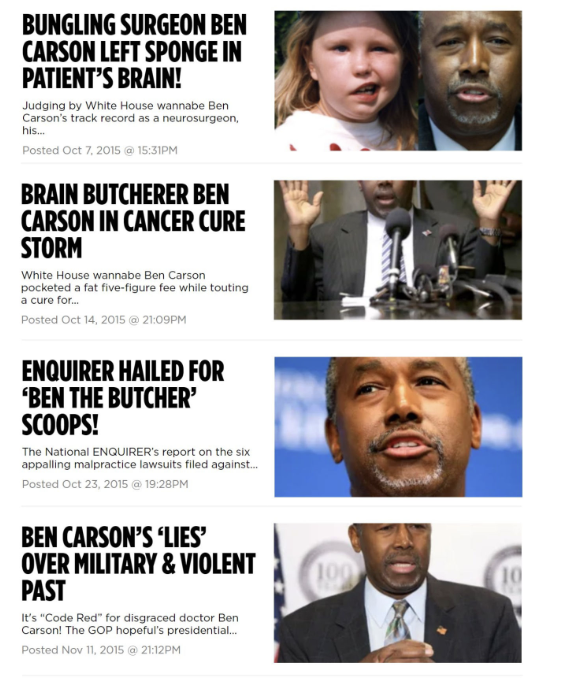
Bove shows Pecker an exhibit of The Guardian article where the photo of the child in the above screenshot originally ran. theguardian.com/us-news/2015/m…
Bove asks a series of questions about the value of The National Enquirer drawing from a network of sources that they cultivated.
Bove shows Pecker this passage from a WSJ article:
"Since last year, the Enquirer has supported Mr. Trump's presidential bid, endorsing him and publishing negative articles about some of his opponents.'
He appears to suggest the public knew about the tabloid's support.
"Since last year, the Enquirer has supported Mr. Trump's presidential bid, endorsing him and publishing negative articles about some of his opponents.'
He appears to suggest the public knew about the tabloid's support.
Pecker confirms that neither Trump nor Cohen ever paid him any money for either the Sajudin or McDougal stories.
Trump's attorney pivots to Sajudin's story.
Q: If this story was true, it was worth a lot of money, right?
A: Yes.
Pecker agrees with Bove's characterization that it would have been the "biggest National Enquirer story ever."
Q: If this story was true, it was worth a lot of money, right?
A: Yes.
Pecker agrees with Bove's characterization that it would have been the "biggest National Enquirer story ever."
Context:
Pecker also testified during direct examination that, even if it was verified, the Enquirer would have sat on the story until after the election.
Pecker also testified during direct examination that, even if it was verified, the Enquirer would have sat on the story until after the election.
Pecker agrees that Sajudin threatened to sell the story elsewhere, and that affected the sky-high price tag on the story.
Trump's lawyer suggests that Pecker signed the deal because he believed there was a small possibility that it was true.
Q: You could not walk away from that possibility, however small that might be?
Pecker agrees.
Q: You could not walk away from that possibility, however small that might be?
Pecker agrees.
Bove tells Pecker that Karen McDougal did not want to publish her story, but rather to restart her career.
Pecker agrees.
Pecker agrees.
Bove tries to complicate Pecker's story about Trump's phone call about Karen McDougal.
During the case, Pecker said Trump asked whether a Mexican group wanted to buy it for $8 million. Pecker dispelled the rumor, but told him to buy it.
But Bove elicits another detail.
During the case, Pecker said Trump asked whether a Mexican group wanted to buy it for $8 million. Pecker dispelled the rumor, but told him to buy it.
But Bove elicits another detail.
Asked by Trump's attorney, Pecker agrees that he recalls telling Trump: "It is my understanding that [McDougal] doesn't want her story published."
The defense likely will use the concession to suggest there wasn't a motive to catch-and-kill her account.
The defense likely will use the concession to suggest there wasn't a motive to catch-and-kill her account.
Re-up:
Pecker's testimony on this conversation from Thursday. Trump repeated the rumor about the purported $8M offer from a Mexican group.
Pecker didn't believe it, but he told Trump to pay (much less) for it.
Pecker's testimony on this conversation from Thursday. Trump repeated the rumor about the purported $8M offer from a Mexican group.
Pecker didn't believe it, but he told Trump to pay (much less) for it.
https://x.com/KlasfeldReports/status/1783495898611253532
Bove flags the portion of McDougal's licensing agreement focusing on her career.
She negotiated:
* a monthly column in Star
* a monthly column in Ok
* four posts a month in Radar online
* posing for covers on Men's Fitness and Muscle & Fitness Hers
... and more.
She negotiated:
* a monthly column in Star
* a monthly column in Ok
* four posts a month in Radar online
* posing for covers on Men's Fitness and Muscle & Fitness Hers
... and more.

The subtext is clear:
McDougal was focused on her career, not actually telling her story, the defense suggests.
McDougal was focused on her career, not actually telling her story, the defense suggests.
Pecker agrees with the Trump attorney's statement that the agreement had a legitimate business purpose.
Q: When you told Michael Cohen that the agreement was "bulletproof," you meant it, right?
A: Yes, I did.
Q: Because you had legal advice.
A: Yes.
A: Yes, I did.
Q: Because you had legal advice.
A: Yes.
Bove asks a string of questions about Pecker relying on the advice of his lawyers, sparking two objection from the prosecution table.
Both sustained.
Both sustained.
After Pecker described Keith Davidson as a "major" attorney, Bove quipped: "Stipulated," sparking loud laughter in the court.
So loud, the court officers respond: "Quiet down!"
So loud, the court officers respond: "Quiet down!"
Pecker also agrees with the proposition that he was also a big source for The Enquirer.
At the defense table, Trump sits slouch, eyes apparently closed, and his head tilted slightly up and aimed at nobody.
Make of that what you will.
Make of that what you will.
The jury appears to be more attentive.
Bove pivots to Pecker's reluctance to get involved in the Stormy Daniels: "You wanted nothing to do with it," the attorney recalled.
Q: And you were speaking for the company and for yourself?
A: Yes.
Q: And you were speaking for the company and for yourself?
A: Yes.
Bove pivots to Dylan Howard telling Pecker that Daniels had not been paid.
Pecker agrees that he was surprised Howard was still talking about that, and angry at him for keeping up with it.
Pecker agrees that he was surprised Howard was still talking about that, and angry at him for keeping up with it.
On Thursday, Pecker testified that he was brought into a Trump's meeting with Comey, Spicer, Priebus and Pompeo, all talking about the then-breaking Ft. Lauderdale shooting in 2017.
Trump joked to the group that Pecker "probably knows more than anybody else in this room."
Trump joked to the group that Pecker "probably knows more than anybody else in this room."
"Unfortunately, they didn't laugh," Pecker recalled on Thursday, referring to the group's reaction to Trump's joke.
But the jurors did — and the transcript recorded it:
"(Whereupon, the jurors laugh.)"
But the jurors did — and the transcript recorded it:
"(Whereupon, the jurors laugh.)"
Bove tried to ask a question about this anecdote, but how he did it prompted an objection from the prosecution table.
Sustained.
Sustained.
Bove asks Pecker about his testimony that Trump told him: "I want to thank you for the doorman story, the doorman situation."
The Trump lawyer suggests Pecker that he got it wrong, but the witness holds firm.
Q: Was that a mistake?
A: No.
The Trump lawyer suggests Pecker that he got it wrong, but the witness holds firm.
Q: Was that a mistake?
A: No.
Pecker also testified that Trump told him: "I want to thank you for handling the McDougal situation."
But Bove doesn't appear to ask Pecker about that.
But Bove doesn't appear to ask Pecker about that.
Morning recess.
Bove estimates that he has a little less than an hour left of cross-ex.
Prosecutors expect to have redirect.
Bove estimates that he has a little less than an hour left of cross-ex.
Prosecutors expect to have redirect.
Justice Merchan is back on the bench.
Trump is seated between his attorneys, more animated than previously.
The witness enters and returns to the stand.
Trump is seated between his attorneys, more animated than previously.
The witness enters and returns to the stand.
"All rise."
The jury is entering.
The jury is entering.
Jurors typically have not glanced at anyone at the defense and prosecution tables — eyes straight forward — as they processed to the jury box.
Cross-ex resumes.
Bove turns to Pecker's meetings with prosecutors.
Pecker pushes back at Trump's lawyers suggestion that the meetings were "stressful," but he acknowledges that he wanted it to be over as soon as possible.
Bove turns to Pecker's meetings with prosecutors.
Pecker pushes back at Trump's lawyers suggestion that the meetings were "stressful," but he acknowledges that he wanted it to be over as soon as possible.
The defense displays AMI's non-prosecution agreement with SDNY.
Bove suggests that there were problems with the company's assets at the time. There were discussions with the Hudson News Group to acquire the National Enquirer.
Bove suggests that there were problems with the company's assets at the time. There were discussions with the Hudson News Group to acquire the National Enquirer.
Q: You knew that to consummate that deal, you had to finalize the investigations, correct?
A: Yes, uh... (pause) yes.
A: Yes, uh... (pause) yes.
Pecker concedes that put some pressure on the negotiations.
"From the tabloid's standpoint, that would have added on to the stress of the transaction," he says.
"From the tabloid's standpoint, that would have added on to the stress of the transaction," he says.
Pecker, sounding more hesitant than usual, notes the transaction could have closed subject to the investigations being completed.
"There was no drop dead date, that it had to be completed by a certain time," he notes.
"There was no drop dead date, that it had to be completed by a certain time," he notes.
Q: If AMI had been indicted, that would have affected the value of its assets?
A: Uh, yes.
A: Uh, yes.
Prompted by Trump's lawyer, Pecker notes that AMI was never charged or prosecuted.
Yesterday, Pecker testified: "We admitted to a campaign violation."
But Bove notes "there is no violation in this agreement."
"In this agreement, no," Pecker says.
Yesterday, Pecker testified: "We admitted to a campaign violation."
But Bove notes "there is no violation in this agreement."
"In this agreement, no," Pecker says.
Bove highlights the passage of the non-prosecution agreement stating the federal government "will not criminally prosecute" AMI.
Asked whether there's an admission to a campaign financial violation in the agreement, Pecker answers: "No."
Asked whether there's an admission to a campaign financial violation in the agreement, Pecker answers: "No."
Trump's lawyer pushes Pecker to say that he didn't understand money to be part of the Trump Tower meeting agreement.
But Pecker pushes back:
"There was a discussion that I was going to be the eyes and ears of the campaign," including notifying Cohen of women selling stories.
But Pecker pushes back:
"There was a discussion that I was going to be the eyes and ears of the campaign," including notifying Cohen of women selling stories.
Pecker suggests the latter led to the payoffs to the women.
A long sidebar conference follows.
After it ends, Bove asks Pecker about his meeting with the Manhattan DA's office in October 2019.
After it ends, Bove asks Pecker about his meeting with the Manhattan DA's office in October 2019.
The line from Trump's attorney sparked an objection, which was initially overruled, until prosecutors asked for a sidebar.
After the huddle, Bove moved on to another topic.
After the huddle, Bove moved on to another topic.
Correction:
Bove picks apart a hairsplitting detail from notes from the meeting. The discrepancy is whether Pecker said AMI was "buying" or "purchasing" accounts of "women selling stories."
Pecker notes that "buying" and "purchasing" mean the same thing.
Bove picks apart a hairsplitting detail from notes from the meeting. The discrepancy is whether Pecker said AMI was "buying" or "purchasing" accounts of "women selling stories."
Pecker notes that "buying" and "purchasing" mean the same thing.
The detail was a bit too fine-tuned for this under-caffeinated reporter during the Friday session.
I deleted and corrected earlier tweets botching the quotation.
I deleted and corrected earlier tweets botching the quotation.
Connecting the two threads here.
https://x.com/KlasfeldReports/status/1783891690404696504
Cross-ex ends.
Assistant DA Joshua Steinglass begins his redirect.
Assistant DA Joshua Steinglass begins his redirect.
The prosecutor asks about Karen McDougal's contract and Pecker's testimony that its "true purpose" was to smother her story.
Pecker agrees with the prosecutor's statement that the purpose of the provisions about McDougal's career was to establish "plausible deniability."
Pecker agrees with the prosecutor's statement that the purpose of the provisions about McDougal's career was to establish "plausible deniability."
Steinglass shows Pecker this provision of AMI's non-prosecution agreement.
"AMI's principal purpose into entering into the agreement was to suppress the model's story so as to prevent it from influencing the election."
Pecker agrees this was true.
"AMI's principal purpose into entering into the agreement was to suppress the model's story so as to prevent it from influencing the election."
Pecker agrees this was true.
Steinglass asks Pecker about his subsequently abandoned plan to assign Karen McDougal's life rights to Michael Cohen.
This exhibit from yesterday memorializes the plan, which was to be executed through Cohen's shell company Resolution Consultants LLC.
This exhibit from yesterday memorializes the plan, which was to be executed through Cohen's shell company Resolution Consultants LLC.
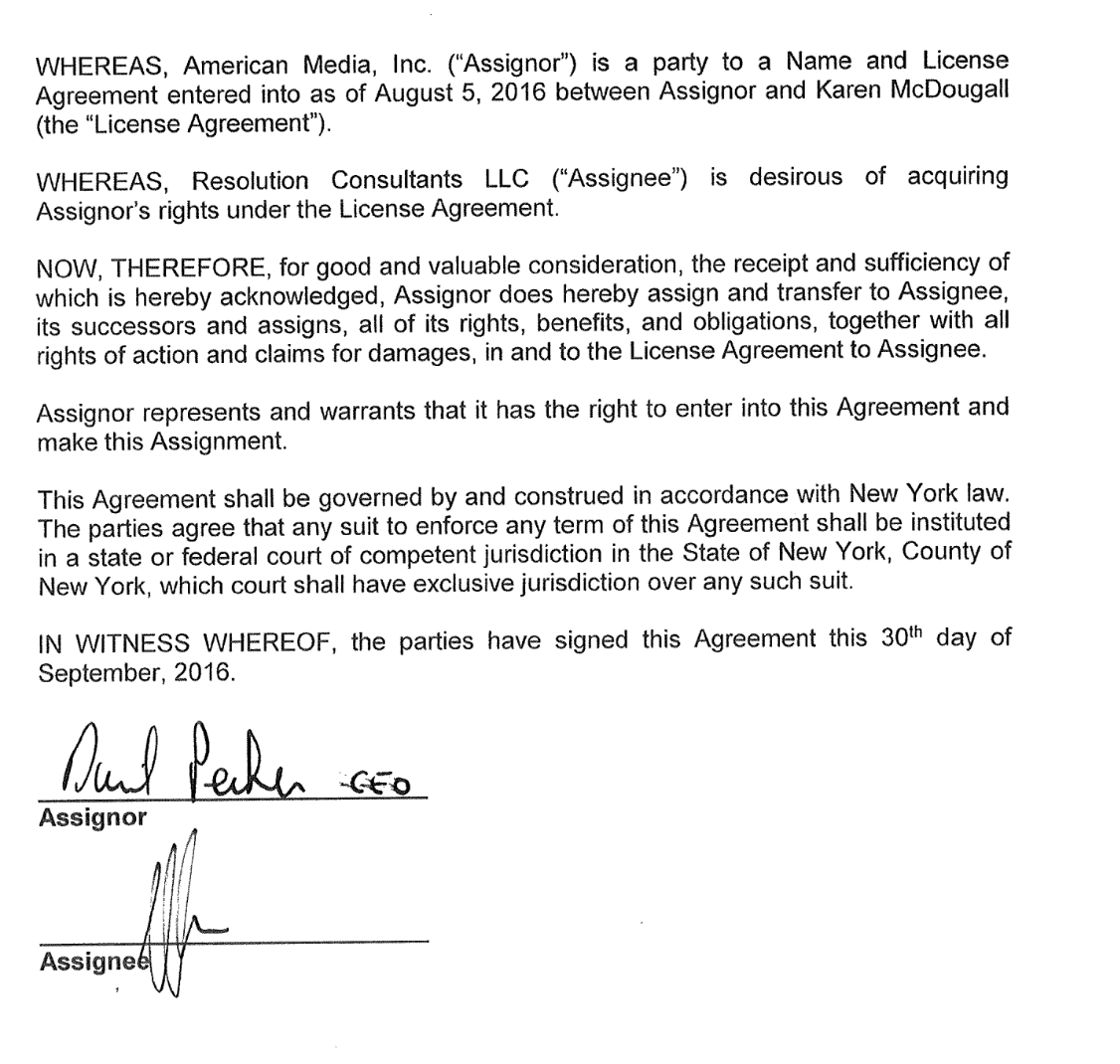
As the exhibit shows, the deal was signed, but Pecker says he pulled out of the plan after meeting with AMI's general counsel.
Steinglass prompts the witness to agree that assigning McDougal's story to Cohen wasn't in McDougal's contract.
Steinglass prompts the witness to agree that assigning McDougal's story to Cohen wasn't in McDougal's contract.
ADA Steinglass: Was it your understanding that when AMI entered into this agreement that AMI admitted that the conduct that it admitted violated federal election law?
Pecker: Yes.
Pecker: Yes.
The prosecutor returns to AMI's agreement with doorman Dino Sajudin, asking Pecker about whether it was the company's "standard" agreement to lock up a source.
Pecker said on cross-ex, and now, that it was standard.
But it was amended, the prosecutor notes.
Pecker said on cross-ex, and now, that it was standard.
But it was amended, the prosecutor notes.
Q: Is it standard for AMI to be consulting with a presidential candidate's fixer about amendments about a source agreement?
A: No.
A: No.
The amended agreement added a $1 million liquidated damages clause.
Asked if that was "standard," Pecker answers no.
Asked why he added it then, Pecker says it was at Cohen's request.
Asked if that was "standard," Pecker answers no.
Asked why he added it then, Pecker says it was at Cohen's request.
Pecker testifies that he was aware of Cohen's activities on behalf of the Trump campaign, even though he insisted he wasn't a part of it.
The prosecutor turns to Pecker's testimony that AMI had been involved with "hundreds of thousands" of NDAs.
Asked how many of those NDAs involved coordinating with the campaign of a presidential candidate, Pecker replies it's the only one.
Asked how many of those NDAs involved coordinating with the campaign of a presidential candidate, Pecker replies it's the only one.
Prosecutor: "Why did AMI spend money to silence [Arnold] Schwartzenegger's accusers?"
Pecker responds that Schwartzenegger was critical to the bodybuilding industry, as well as the supplement industry, and two of their magazines.
Pecker responds that Schwartzenegger was critical to the bodybuilding industry, as well as the supplement industry, and two of their magazines.
The defense latched onto this testimony to suggest that AMI's conduct was standard operating procedure, but Steinglass has Pecker point out the differences.
Schwartzenegger benefited AMI's bottom line, and the episode familiarized it with the campaign-finance repercussions.
Schwartzenegger benefited AMI's bottom line, and the episode familiarized it with the campaign-finance repercussions.
Steinglass notes that Pecker was friends with Trump.
Before the Trump Tower meeting in August 2015, AMI did not institutionally attack Trump's political rivals, and Pecker never acted as his "eyes and ears."
Before the Trump Tower meeting in August 2015, AMI did not institutionally attack Trump's political rivals, and Pecker never acted as his "eyes and ears."
Steinglass notes that Pecker did not use the phrase "catch and kill," but the prosecutor prompts the witness to explain what he agreed to do about "women selling stories" at that Trump Tower meeting.
Pecker's answer describes the process for quashing the stories.
Pecker's answer describes the process for quashing the stories.
Lunch recess.
Good afternoon from New York.
Trump is back at the defense table, and we're waiting for the judge to return to the bench.
Trump is back at the defense table, and we're waiting for the judge to return to the bench.
Cross ex resumes:
The prosecutor asks about whether the Enquirer's circulation includes everyone glancing at headlines at supermarket checkout counters.
Pecker says no.
The prosecutor asks about whether the Enquirer's circulation includes everyone glancing at headlines at supermarket checkout counters.
Pecker says no.
The prosecutor showed Pecker a passage from a WSJ article dated Nov. 4, 2016:
"Quashing stories that way is known in the tabloid world as 'catch and kill.'"
Pecker agrees he probably learned about the phrase from the article, not prosecutors.
"Quashing stories that way is known in the tabloid world as 'catch and kill.'"
Pecker agrees he probably learned about the phrase from the article, not prosecutors.
On Stormy Daniels' story, Pecker reiterates that he did not want AMI to have anything to do with a "porn star."
Pecker said he wasn't going to print it, or buy it, or have anything to do with it, referring to Stormy's story.
He was still, however, going to fulfill his obligation to tell Cohen about it.
He was still, however, going to fulfill his obligation to tell Cohen about it.
Prosecutor Steinglass turns to the questions on cross-ex about alleged discrepancy in notes from the FBI interview.
Bove suggested Pecker didn't mention Trump thanking him for the "doorman situation," but Steinglass says the notes reflect that he did.
Bove suggested Pecker didn't mention Trump thanking him for the "doorman situation," but Steinglass says the notes reflect that he did.
Q: Was it the truth then?
A: Yes.
Q: Is it the truth now?
A: Yes.
Q: Do you believe that you have ever been inconsistent on this point?
A: No.
A: Yes.
Q: Is it the truth now?
A: Yes.
Q: Do you believe that you have ever been inconsistent on this point?
A: No.
Asked whether anyone from the New York District Attorney's office ever asked him to do anything other than tell the truth, Pecker answers no.
Redirect ends.
Trump's attorney starts re-cross.
Redirect ends.
Trump's attorney starts re-cross.
Trump's attorney Emil Bove pushes back at the characterization of Enquirer stories as "attack ads": They were "headlines," Bove says.
Pecker agrees.
Pecker agrees.
Before the lunch recess, Pecker agreed with the prosecutor that McDougal's story was "Enquirer gold."
Bove notes that Pecker believed that McDougal did not really want to sell her story, as much as she wanted to restart her career.
Bove notes that Pecker believed that McDougal did not really want to sell her story, as much as she wanted to restart her career.
Bove notes that McDougal had a lengthy career before the AMI agreement, including as a Playboy model and other credits.
Q: There was real value to her brand, correct?
A: I wouldn't say that there was a value to her brand to a media company.
Q: There was real value to her brand, correct?
A: I wouldn't say that there was a value to her brand to a media company.
Asked if he believes Trump cares about his family, Pecker responds: "Of course I do."
Bove asks if he believes the proceedings are stressful to Trump's family.
Prosecution: Objection
Judge: Sustained.
With that, Pecker's testimony concludes.
Bove asks if he believes the proceedings are stressful to Trump's family.
Prosecution: Objection
Judge: Sustained.
With that, Pecker's testimony concludes.
Up next: Rhona Graff, who was Trump's executive assistant for decades.
Graff's title eventually became "assistant to the President" and then Trump Org senior vice-president.
Assistant DA Susan Hoffinger is questioning her.
Graff is testifying pursuant to a subpoena.
Graff is testifying pursuant to a subpoena.
Graff input Trump's appointments in the calendar, including on Outlook.
Hoffinger has an officer hand Graff a thumb drive for identification.
Graff confirms that she dated and initialed the exhibit, which contains emails between her and fellow Trump executive assistant Madeleine Westerhout.
One data point that Graff entered into the Trump Organization's contact info: Stormy Daniels' contact info, which is redacted in the exhibit.
Asked whether she understood Daniels was an adult film actress, Graff replies: "Yes, I did."
Asked whether she understood Daniels was an adult film actress, Graff replies: "Yes, I did."
Graff scheduled a meeting with Ainsley Earhardt from Fox and Friends on Jan. 17, 2017
It was a busy day:
Trump also had teleprompter practice sessions and a photo shoot for WaPo on that date.
It was a busy day:
Trump also had teleprompter practice sessions and a photo shoot for WaPo on that date.
Trump also had a teleprompter practice session on Jan. 18, 2017, the following day.
On Jan. 19, 2017, Trump was flying out from LaGuardia to D.C.
On Jan. 19, 2017, Trump was flying out from LaGuardia to D.C.
Cross ex by Trump's lawyer Susan Necheles begins:
She lobs some easy questions to the witness.
Graff says Trump was a "good boss."
She lobs some easy questions to the witness.
Graff says Trump was a "good boss."
Graff says that "99% of the time," their discussions were about business.
Prompted by Necheles, Graff adds there were some personal and friendly discussions too. Trump invited her to his inauguration, she says.
"I'd say it was a pretty unique, memorable experience."
Prompted by Necheles, Graff adds there were some personal and friendly discussions too. Trump invited her to his inauguration, she says.
"I'd say it was a pretty unique, memorable experience."
Necheles dispenses with the euphemism used by prosecutors for Stormy Daniels' profession — colloquially, she's a "porn star."
Graff (primly): "I'd say that's a good (slight pause) synonym."
Graff (primly): "I'd say that's a good (slight pause) synonym."
Q: No one from the Trump Organization told you how to testify?
A: Absolutely not.
Graff's testimony concludes.
A: Absolutely not.
Graff's testimony concludes.
Afternoon recess.
Next witness:
Gary Farro, who was a senior managing director at First Republic Bank back in 2016
That's the bank Michael Cohen used to obtain a $130,000 home equity loan, which Cohen then funneled to Stormy Daniels' lawyer through a shell company, per prosecutors.
Gary Farro, who was a senior managing director at First Republic Bank back in 2016
That's the bank Michael Cohen used to obtain a $130,000 home equity loan, which Cohen then funneled to Stormy Daniels' lawyer through a shell company, per prosecutors.
Farro now works at Flagstar Bank.
After the witness says he's here "voluntarily," the prosecutor asks: "Are you sure?"
He says he also received a subpoena.
After the witness says he's here "voluntarily," the prosecutor asks: "Are you sure?"
He says he also received a subpoena.
Farro on how he lost his job:
"In March of last year, First Republic Bank was one of the banks that went under with Signature Bank and Silicon Valley Bank."
"In March of last year, First Republic Bank was one of the banks that went under with Signature Bank and Silicon Valley Bank."
One of the bank's no-nos, per Farro.
"We wouldn't do anything in adult entertainment."
Asked what he meant by that, Farro says, somewhat hesitantly: "Porno?"
"We wouldn't do anything in adult entertainment."
Asked what he meant by that, Farro says, somewhat hesitantly: "Porno?"
Q: Have you heard the term shell corporation?
A: I have.
Farro explains what a "shell company" is, agreeing with the prosecutor that it's an entity without any business operations.
A: I have.
Farro explains what a "shell company" is, agreeing with the prosecutor that it's an entity without any business operations.
Q: Do you know about someone named Michael Cohen?
A: Yes, I do.
Farro says Cohen was assigned to him and had been a client at the bank for years before he took over the client relationship.
A: Yes, I do.
Farro says Cohen was assigned to him and had been a client at the bank for years before he took over the client relationship.
Farro said he was assigned to Michael Cohen because of his skill sets with "individuals who may be a little challenging," a comment that sparked some chuckles in the courtroom.
Cohen told Farro that he worked for Trump "frequently," because he was "very excited" about that fact, the witness says.
Farro acknowledges that he's testifying, in part, as a custodian of records for First Republic Bank.
He is currently being asked about emails for authentication.
He is currently being asked about emails for authentication.
Context:
Custodial witnesses verify records through legal procedures that can often seem tedious, and the jurors seem less than captivated at this moment.
But important and compelling evidence often comes in through them.
Custodial witnesses verify records through legal procedures that can often seem tedious, and the jurors seem less than captivated at this moment.
But important and compelling evidence often comes in through them.
Rhona Graff, as a custodial witness, authenticated the records linking the Trump Organization's database to Stormy Daniels and Karen McDougal.
Now, Farro is reviewing emails about Cohen.
Now, Farro is reviewing emails about Cohen.
Email:
"Please return Michael Cohen's call when you are available today regarding an important matter," Farro wrote on Oct. 13, 2016.
"Please return Michael Cohen's call when you are available today regarding an important matter," Farro wrote on Oct. 13, 2016.
Farro says that this is about Michael Cohen wanting to open an account for his new LLC.
"He said it was an account for real estate."
"He said it was an account for real estate."
Email from Farro on Oct. 13, 2016:
"Need an account opened for Mike Cohen immediately. He wants no address on the checks. Calling you now to discuss."
"Need an account opened for Mike Cohen immediately. He wants no address on the checks. Calling you now to discuss."
Exhibit: Corporation paperwork for Cohen's shell company
Resolution Consultants LLC, a supposed real estate consulting company.
That's the same LLC that Cohen used to try to transfer rights to McDougal's story from AMI to himself.
Resolution Consultants LLC, a supposed real estate consulting company.
That's the same LLC that Cohen used to try to transfer rights to McDougal's story from AMI to himself.
Next exhibit: Delaware entity formation records for the same LLC
Email:
Michael Cohen to Oliva Cassin, another First Republic employee dated Oct. 13, 2016
Subject: "Re: Account paperwork"
Michael Cohen to Oliva Cassin, another First Republic employee dated Oct. 13, 2016
Subject: "Re: Account paperwork"
In a bank record, Cohen gave an elaborate description for what Resolution Consultants LLC does.
The description does not appear to include anything close to acquiring the rights to Karen McDougal's story from a tabloid empire before the 2016 election.
The description does not appear to include anything close to acquiring the rights to Karen McDougal's story from a tabloid empire before the 2016 election.
On Oct. 26, 2016, Farro's assistant sent an email to him: "Please return Michael Cohen's call at [REDACTED]."
According to Farro, Cohen said that he was "changing course" and wanted to open a different account instead of Resolution Consultants LLC.
Asked if it was urgent, Farro quipped: "Every time Michael Cohen spoke to me he gave me a sense of urgency."
Asked if it was urgent, Farro quipped: "Every time Michael Cohen spoke to me he gave me a sense of urgency."
DA Bragg alleged in court documents that Cohen spoke to Trump on that same day: Oct. 26, 2016, shortly before the election.
Cohen was now opening a new account for Essential Consultants LLC, the shell company he used to pay off Stormy Daniels through her attorney.
Cohen was now opening a new account for Essential Consultants LLC, the shell company he used to pay off Stormy Daniels through her attorney.
Bank records for Essential Consultants LLC are displayed for the jury.
The form asked: "Is the entity associated with Political Fundraising / Political Action Committee (PAC)?"
Cohen answered: "No."
The form asked: "Is the entity associated with Political Fundraising / Political Action Committee (PAC)?"
Cohen answered: "No."
"When Cohen called me, I was on a golf course," Farro says, chuckling—and adding that it may seem like a "cliché" for him as a banker.
So ends the first full week of Trump's criminal trial, not counting jury selection.
Justice Merchan instructs the jury.
Justice Merchan instructs the jury.
• • •
Missing some Tweet in this thread? You can try to
force a refresh