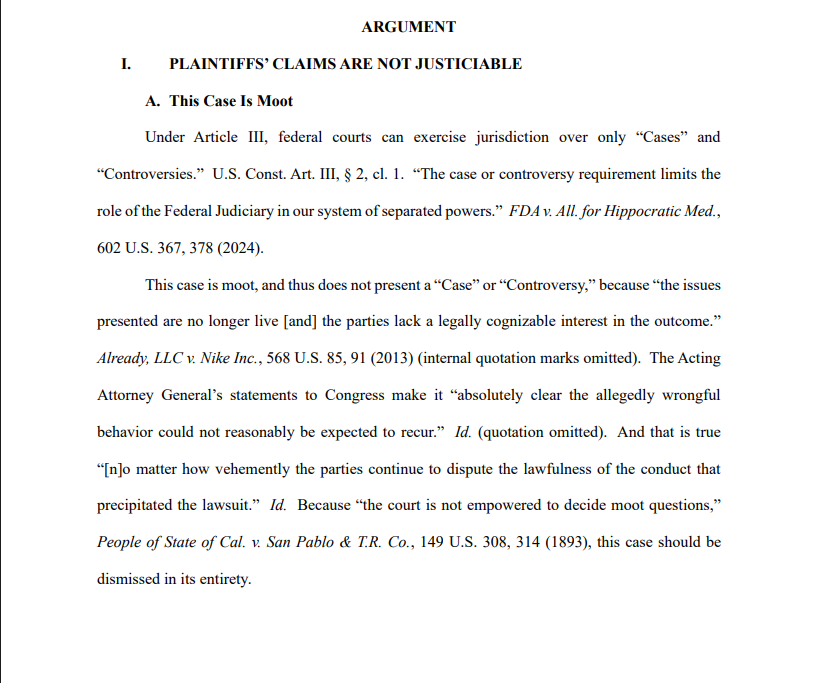
NEW: You might have heard folks say, in the wake of the Supreme Court immunity argument, that sending this case down for the district court to parse what is official versus personal could substantially prolong the time to trial. Enter Ex. A:
This is an order entered tonight in three civil cases against Trump for his role in 1/6; in those cases, the D.C. Circuit reaffirmed former presidents are entitled to civil immunity for acts even on the "outer perimeter" of their official duties.
But they held Trump had not yet shown his entitlement to such immunity and would instead have a chance to prove in the lower court that "his alleged actions in the runup to and on January 6 were taken in his official capacity as President."
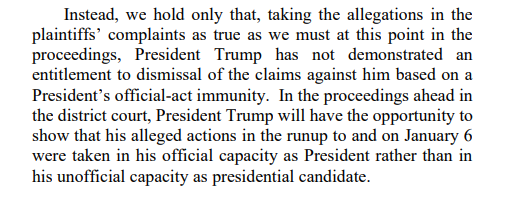
That opinion was handed down on December 1, 2023. And now, in the last days of April, Judge Amit Mehta, the district court judge to whom the case has been assigned, has allowed the parties to conduct "immunity-related discovery" through September 11, 2024.
Now think about the criminal case before Judge Chutkan: In a world where the Supreme Court similarly decides there must be further lower court proceedings to determine whether Trump can mount an immunity defense, can that case be tried before 2025? Increasingly, I think not--and that might be the only win Trump wants or needs.
• • •
Missing some Tweet in this thread? You can try to
force a refresh

NEW: Comey moves to dismiss on grounds of multiple alleged instances of grand jury misconduct, stating that because the two-count indictment was never presented to the full grand jury, there was no actual indictment within the five-year statute of limitations for the two charged crimes.
This is hardly Comey's only effort to dismiss the indictment. He has two fully briefed and already argued motions to dismiss: one on grounds of selective/vindictive prosecution and the other due to Lindsay Halligan's allegedly unlawful appointment.
Some expected that Comey would wait for Judge Michael Nachmanoff to decide whether, as a magistrate judge previously ruled, he should get the transcripts and other grand jury materials.
NEW: In order to prove vindictive prosecution, a defendant has to show they have been charged due to a genuine animus toward them on account of their exercise of constitutional or statutory rights. That's usually a very tough road to hoe. 1/
Enter Tish James (and her legal team, led by Abbe Lowell). Their brief tonight cites to an Exhibit A, a 112-page compilation of 360 of Trump's public statements dating back to the day after she opened her investigation of the Trump Org and him. 2/
That exhibit reflects a LOT of work but everything in it was already public. What I don't recall seeing before is Exhibit G, an August 2025 letter to Lowell from DOJ's "special attorney for mortgage fraud" Ed Martin. 3/
As I was looking for information about the appointment of Kelly Hayes, the U.S. Attorney for the District of Maryland, I found an interesting DOJ press release. It describes how U.S. Attorney vacancies should be filled. 1/
Specifically, it explains: “Pursuant to the Vacancy Reform Act, 28 U.S.C. § 546, the Attorney General has the authority to name a U.S. Attorney to serve on an interim basis for up to 120 days.” 2/
The press release continues, “After that time, if a successor isn’t nominated and confirmed, it falls to the district court to appoint a U.S. Attorney to serve until the confirmation of his or her successor.” 3/
On February 27, Attorney General Bondi told Kash Patel she'd learned the NY field office was sittting on thousands of pages of Epstein records in a sharp letter. 1/
And then she gave a directive: "By 8:00 a.m. tomorrow, February 28, the FBI will deliver the full and complete Epstein files to my office, including all records, documents, audio and video recordings, and materials related to Jeffrey Epstein and his clients, regardless of how such information was obtained." 2/
Bondi continued, "There will be no withholdings or limitations to my or your access. The Department of Justice will ensure that any public disclosure of these files will be done in a manner to protect the privacy of victims and in accordance with law." 3/
NOW: House Judiciary Committee is voting on Rep. Raskin's motion to subpoena four major banks for their suspicious activity reports concerning Epstein's transactions; Rep. Massie votes with Democrats against tabling the motion. 1/
These are documents that Sen. Ron Wyden, the ranking Democrat on the Senate Finance Committee, has been seeking from Treasury without success for months. 2/
The effort to subpoena to the banks just failed; by a vote of 20-19, the motion to table won. 3/
The idea that district courts' refusal to unseal grand jury testimony is a barrier on the release on any further Epstein-related information, whether to Congress itself or the public, is a fallacy. 1/
There is a host of information in the DOJ's possession that with or without redactions could be shared. For example, the FBI's own FOIA reading room has a 22-part file concerning Epstein that can be accessed online. 2/
Those materials are heavily redacted, but they also include handwritten notes from the FBI's interviews with several survivors and other records reflecting the 2006-2007 investigation. 3/