Good morning from New York.
Yesterday, attorney Keith Davidson listened to a tape of this passage—and testified that Trump said "I hate the fact that we did it" about the "Stormy Daniels settlement."
A witness who authenticated more tapes is back on the stand today. 🧵
Yesterday, attorney Keith Davidson listened to a tape of this passage—and testified that Trump said "I hate the fact that we did it" about the "Stormy Daniels settlement."
A witness who authenticated more tapes is back on the stand today. 🧵
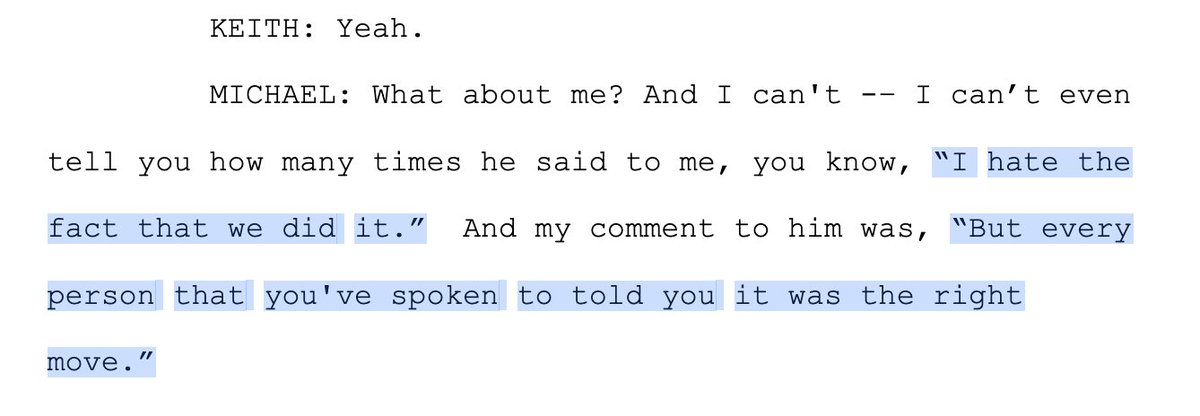
Michael Cohen quoted Trump saying "I hate the fact that we did it" in this tape, which the metadata suggests was recorded on Oct. 16, 2017.
Listen here 🔗🔊 pdfs.nycourts.gov/PeopleVs.DTrum…
Listen here 🔗🔊 pdfs.nycourts.gov/PeopleVs.DTrum…

Note:
There appears to be a discrepancy in the date on the name of the file (Oct. 7, 2016) and the one ascertained by the separate metadata report exhibit (Oct. 16, 2017).
The metadata is both more authoritative — and makes more sense in context.
There appears to be a discrepancy in the date on the name of the file (Oct. 7, 2016) and the one ascertained by the separate metadata report exhibit (Oct. 16, 2017).
The metadata is both more authoritative — and makes more sense in context.
Trump appears in court, and once the photographers arrive, plunges into his usual pose: leaning forward, hands folded onto the table, eyes sharpened straight ahead.
When they leave, Trump sinks right back into his chair.
When they leave, Trump sinks right back into his chair.
Justice Merchan addresses Trump's comments yesterday at his end-of-day press conference, falsely claiming he's gagged from testifying.
"I want to stress to Mr. Trump: You have an absolute right to testify at trial."
The Constitution guarantees that right, he emphasizes.
"I want to stress to Mr. Trump: You have an absolute right to testify at trial."
The Constitution guarantees that right, he emphasizes.
Trump's lawyer Todd Blanche fights the admission of an article about the 'Access Hollywood' tape "in light of the Weinstein decision."
Justice Merchan tells him: "I don’t see it having any impact on my ruling."
Let's unpack that exchange, briefly.
Justice Merchan tells him: "I don’t see it having any impact on my ruling."
Let's unpack that exchange, briefly.
New York's top court overturned Harvey Weinstein's convictions, finding the court excessively admitted "prior bad acts" evidence prohibited by Molineux.
There's been some discussion since then about whether the decision would redound to Trump's favor.
Not so, the judge said.
There's been some discussion since then about whether the decision would redound to Trump's favor.
Not so, the judge said.
Merchan refused to admit certain evidence, like sexual assault accusations against Trump, to avoid Molineux issues.
He said the Weinstein case wouldn't change those rulings:
"The Court of Appeals did not create any new law. They simply applied it to the facts of that case."
He said the Weinstein case wouldn't change those rulings:
"The Court of Appeals did not create any new law. They simply applied it to the facts of that case."
The same was true, the judge said, with the line he drew on Sandoval — that is, the rulings establishing what prosecutors could confront Trump with should he testify.
Later in the morning arguments, Trump's attorney Todd Blanche tried to fight the admission of an "alleged Truth" by his client.
He's referring to something Trump posted on his social media platform by that name.
He's referring to something Trump posted on his social media platform by that name.
Thursday's witness, Douglas Daus, is back on the stand.
"All rise."
The jury enters.
"All rise."
The jury enters.
Trump's attorney Emil Bove continues with an uncommonly thorough cross-examination for this type of witness.
Bove has been seeking to poke holes in the chain of custody and type of extraction used on the phone to acquire the evidence.
Bove has been seeking to poke holes in the chain of custody and type of extraction used on the phone to acquire the evidence.
Quick note on Trump's post here:
* This post doesn't violate Trump's gag order, which lets him attack the judge—just not jurors, witnesses, or family members of certain trial participants.
* Trump's defense succeeded in excluding some evidence & even notched a gag order win.
* This post doesn't violate Trump's gag order, which lets him attack the judge—just not jurors, witnesses, or family members of certain trial participants.
* Trump's defense succeeded in excluding some evidence & even notched a gag order win.

Back to the trial:
Bove turns the witness's attention to the metadata of Michael Cohen's conversation with Trump.
Trump's lawyer seems to suggest that the recording was "modified," and the forensic analyst disputes the premise at length.
Bove moves to strike.
Overruled.
Bove turns the witness's attention to the metadata of Michael Cohen's conversation with Trump.
Trump's lawyer seems to suggest that the recording was "modified," and the forensic analyst disputes the premise at length.
Bove moves to strike.
Overruled.
Bove tries to cast more doubt at the recording's authenticity, getting the witness to agree that there isn't metadata on incoming calls.
Q: You would have to take Michael Cohen's word for it, right?
A: It would seem so.
He repeats this line of question later. Same answer.
Q: You would have to take Michael Cohen's word for it, right?
A: It would seem so.
He repeats this line of question later. Same answer.
With that last answer, Assistant District Attorney Christopher Conroy begins redirect.
The witness agrees with the prosecutor's characterization that he worked with a "full forensic extraction of the device," the "gold standard."
Lengthy sidebar after the prosecutor asks whether the witness saw evidence of manipulation.
Bove objects. The parties meet privately.
Overruled.
Bove objects. The parties meet privately.
Overruled.
Asked whether he saw "any evidence of tampering of manipulation" in the data, the witness replies: "I did not."
Recross by Bove:
He says that his questions were more about variables that are unanswered in the data.
The witness agrees.
He says that his questions were more about variables that are unanswered in the data.
The witness agrees.
The witness agrees with the defense attorney's description that there are "gaps" in the data creating "unknowns."
He did not affirmatively see any evidence of tampering.
He did not affirmatively see any evidence of tampering.
Single question from the prosecutor:
If he made a call on his phone seven years ago, would the witness expect to see a log of it.
"I would not," he says.
If he made a call on his phone seven years ago, would the witness expect to see a log of it.
"I would not," he says.
With that, Daus's testimony ends.
The defense's extensive cross-ex adds up to a concession of certain "unknowns" — that prosecutors established are typical of such circumstances.
The defense's extensive cross-ex adds up to a concession of certain "unknowns" — that prosecutors established are typical of such circumstances.
Next witness: Georgia Longstreet, a paralegal at the Manhattan DA's office
Longstreet has been called to review social media posts in connection with the case. Expect lengthy disquisition on the authentication of tweets, posts, 'grams, and Truths.
For the curious, the witness uses SnagIt for screen captures.
For the curious, the witness uses SnagIt for screen captures.
First proposed exhibit: A post retrieved via the Wayback Machine.
Blanche objects.
Morning recess.
Blanche objects.
Morning recess.
The jury leaves.
Justice Merchan asks the defense's objection, and Blanche wants a chance to confer with his client about whether to stipulate to an exhibit in light of the judge's prior ruling.
If Trump agrees, it would be the first stipulation of the trial.
Justice Merchan asks the defense's objection, and Blanche wants a chance to confer with his client about whether to stipulate to an exhibit in light of the judge's prior ruling.
If Trump agrees, it would be the first stipulation of the trial.
Trump and his lawyers confer over the break.
Explainer:
In most criminal trials, the parties typically agree to avoid unnecessary tedium by agreeing to the authenticity of certain evidence that cannot be disputed through stipulations.
But this isn't a typical trial. We haven't had one yet.
In most criminal trials, the parties typically agree to avoid unnecessary tedium by agreeing to the authenticity of certain evidence that cannot be disputed through stipulations.
But this isn't a typical trial. We haven't had one yet.
The stakes of the controversy at issue:
Is a certain archived version of a Washington Post article about the 'Access Hollywood" tape authentic?
Is a certain archived version of a Washington Post article about the 'Access Hollywood" tape authentic?
Find out in a few minutes after the break.
Blanche:
"We continue to have our hearsay objection."
"Assuming that is overruled," the defense agrees to the stipulation.
"We continue to have our hearsay objection."
"Assuming that is overruled," the defense agrees to the stipulation.
With the jury still out of the room, Todd Blanche rattles off various hearsay objections to the archived Washington Post article.
In a small win for the defense, the prosecution withdraws it.
Next up: A batch of old Trump tweets.
In a small win for the defense, the prosecution withdraws it.
Next up: A batch of old Trump tweets.
Justice Merchan says he's satisfied with the reliability of the old-school Twitter posts.
Next up: A Trump "Truth."
Next up: A Trump "Truth."
The Trump post in question:
"IF YOU GO AFTER ME, I'M COMING AFTER YOU!"
The prosecution says this goes to Trump's pressure campaign on the witnesses.
"IF YOU GO AFTER ME, I'M COMING AFTER YOU!"
The prosecution says this goes to Trump's pressure campaign on the witnesses.
The Twitter posts and "Truth" are coming in as admissions, the judge rules.
The prosecutor clarifies her withdrawal of the WaPo article: That's "subject to the stipulation" of its authenticity, presumably if it later becomes admissible.
The prosecutor clarifies her withdrawal of the WaPo article: That's "subject to the stipulation" of its authenticity, presumably if it later becomes admissible.
"All rise."
The jury enters.
The jury enters.
The prosecutor reads her stipulation about the archived WaPo article into the record.
Trump video tweet, dated Oct. 8, 2016, is played for the jury:
The then-candidate's apology for his "Access Hollywood" comments, where Trump said he "said things that I regret."
"I said it. I was wrong, and I apologize."
The then-candidate's apology for his "Access Hollywood" comments, where Trump said he "said things that I regret."
"I said it. I was wrong, and I apologize."
Next tweet:
Trump going after John McCain for distancing himself from Trump after the Access Hollywood tapes.
Trump going after John McCain for distancing himself from Trump after the Access Hollywood tapes.
Another Trump tweet shown to the jury:
"Polls close, but can you believe I lost large numbers of women voters based on made up events that NEVER HAPPENED."
"Polls close, but can you believe I lost large numbers of women voters based on made up events that NEVER HAPPENED."
Others like it are shown to the jury, before moving on to a Truth Social post of Trump referring to this criminal proceeding as the "'Horseface' case."
Trump's lawyer Todd Blanche has some questions for the witness on cross-ex.
Asked if she reviewed Michael Cohen's social media accounts, she answers in the affirmative.
"Twitter. I don't know if you could call podcasts 'social media,' but that. That would be it."
"Twitter. I don't know if you could call podcasts 'social media,' but that. That would be it."
Asked if she listened to all of Michael Cohen's "Mea Culpa" podcasts, the witness answers: "Absolutely not," to laughter in the courtroom.
Blanche chuckles after too.
Blanche chuckles after too.
Blanche asks whether the witness has an "independent knowledge" from working at Twitter or working at Truth Social on how they date and time-stamp posts.
Longstreet concedes that she doesn't, but she adds that the recent Truth Social posts unfolded in real time.
Longstreet concedes that she doesn't, but she adds that the recent Truth Social posts unfolded in real time.
She has worked in the DA's office for roughly two years, and she says this isn't her only case.
No further questions.
The witness exits.
No further questions.
The witness exits.
Read my coverage of Hope Hicks' upcoming testimony in this thread.
https://x.com/KlasfeldReports/status/1786416471565914177
• • •
Missing some Tweet in this thread? You can try to
force a refresh