Department of Justice has now posted its hundreds of great slides from closing arguments. I’ll share 13 slides that tell story imho captured by this list.
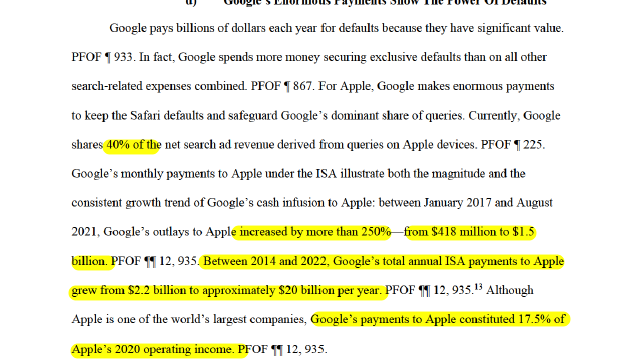
First, if search defaults don’t matter, why pay approx $30B, 40% of revenue to maintain them? 1/13
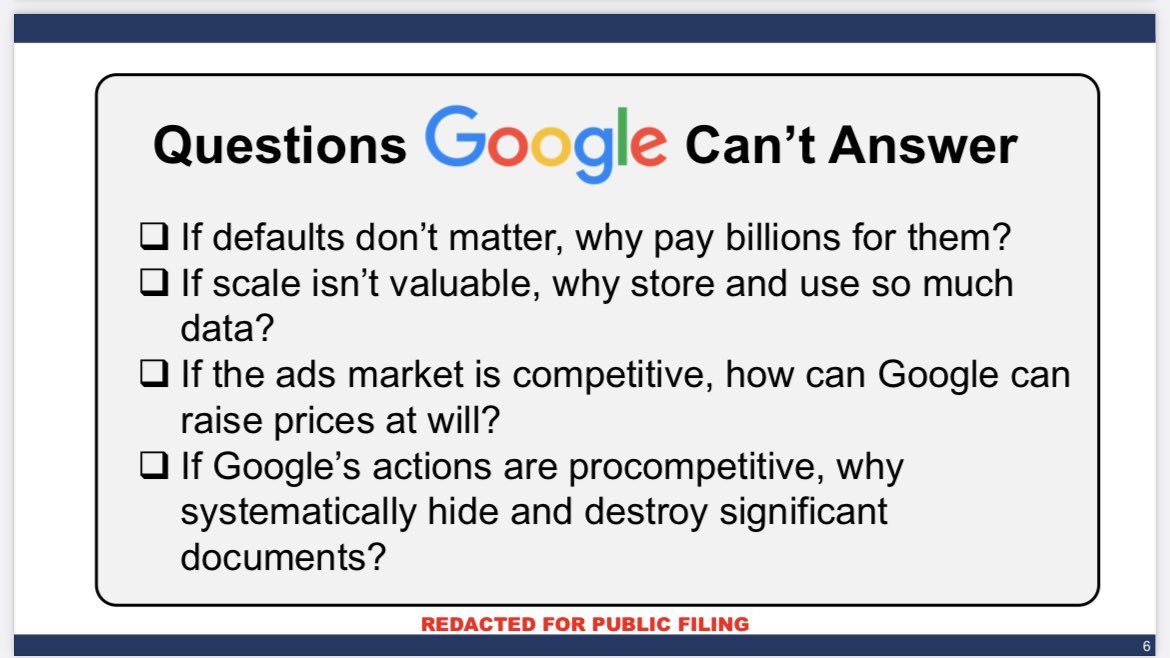
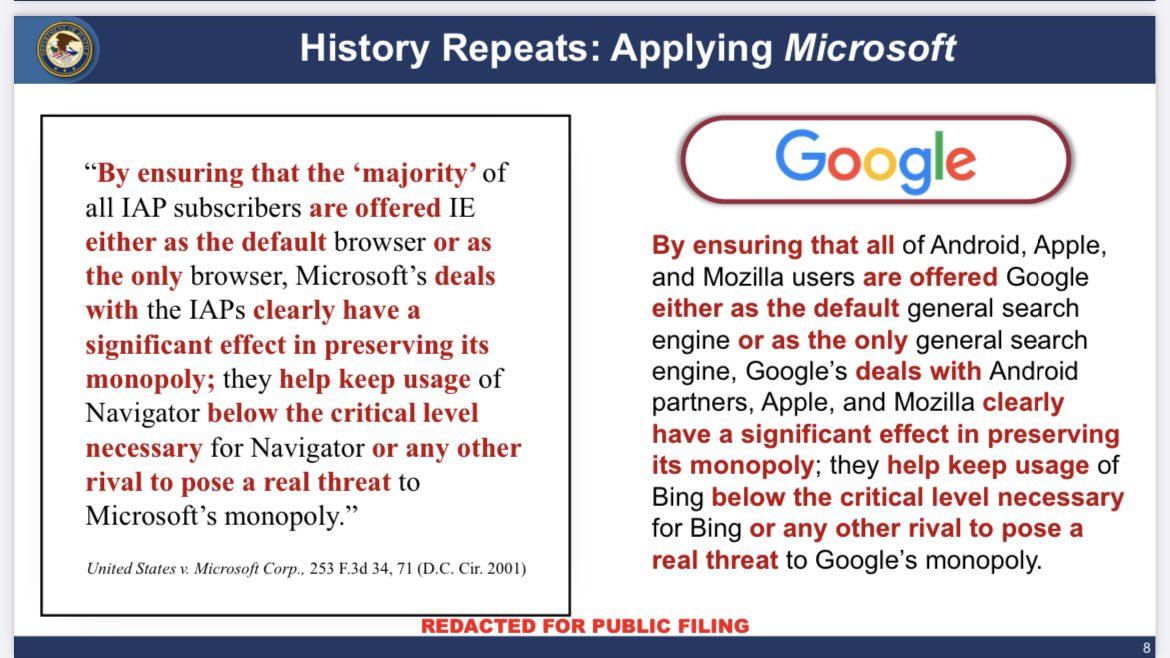
DOJ cleverly took this sentence from the DC circuit opinion in U.S. vs Microsoft and replaced it with Google’s search defaults story in red. “Fits like a glove” as they said to Court on Friday. Hard to argue. 2/13
The story on importance of Google’s data harvesting to monopoly maintenance was crystal clear so let’s move on to how DOJ alleges Google was able to use its market power to impact ad prices which drive much of their revenues. 3/13
Google would call a “code yellow” when it needed to tune its pricing knobs (levers) by rolling out tests / “launches” to get to revenue targets according to the allegations and senior exec emails we saw in the Fall. 4/13
Profiting from a price increase of more than 5% is an important test in monopoly land so these two slides stand out. Wait for the next one. 5/13
Yes, it gets worse for Google. And as you’ll see momentarily Google was able to maintain its profit margins as its only material marginal cost for those ads is passing along that 40% to Apple or whomever Google is paying off for search defaults. 6/13
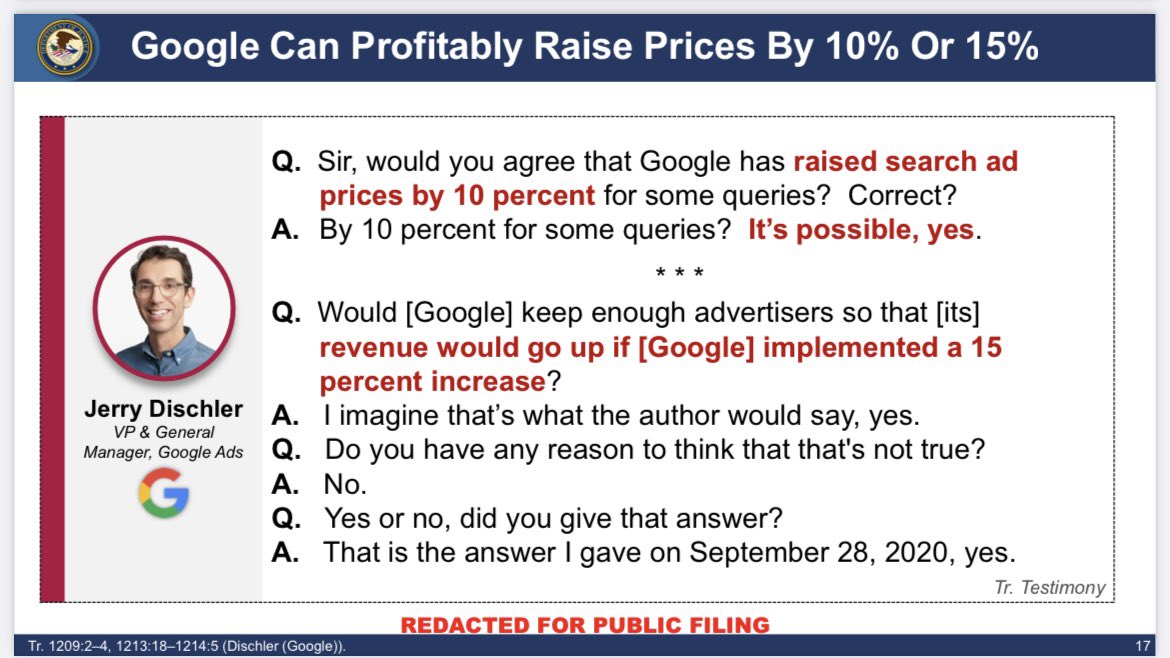
This answer stands out when Google tries to argue its price increases are justified by its unilateral self-assessment on quality increases. Advertisers: Google monopoly power decides it’s “fair” to charge you more. 7/13
If this isn’t making you angry as an advertiser thinking your bids are the only thing impacting pricing, it’s “intentional.”
When it’s controversial, they might not tell you, may even not tell their own employees and put fancy code names on it. 8/13
There is a certain level of exuberance and arrogance if you recall some of the decks from discovery in the Fall. At least the ones that didn’t get tripped up by ‘fake privilege.’ 9/13
Remember Superman? As the Court noted, there isn’t a single mention of competition and how it might react in these ‘adventures in pricing’ emails and decks which is a pretty clear sign of a problem. 10/13
And that’s how a monopoly can have steady revenue growth and constant margins. And as noted, the margin didn’t grow because TAC (traffic acquisition cost) has increased significantly from paying Apple and friends for defaults. Closing the loop on the case. 11/13
A monopolist can raise prices without consideration of competition. Don’t say Facebook or TikTok or Amazon, those arguments are dead in Court. Happy to explain. 12/13
And if you want to know why Google’s surveillance advertising has been so good to it and not so good for everyone, here you go. You would be shocked at what Google rolls out as its defense of “innovation.” Cheers. 13/13
If you made it this far and asking about last bullet, here. 14/13
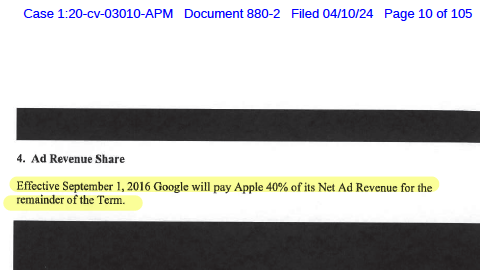
There is a report going around Apple is going to facilitate blocking of ads in Safari - it deserves your attention. Meanwhile, I want to connect dots w/ a number of redactions lifted (yellow) late last night in the post-trial docs of US v Google - closing arguments are tmw. /1
It's critical to understand the importance of Safari to their Google deal under microscope. It's reasonable to say Safari delivers nearly 20% of Apple's Income from Ops almost entirely subsidized by Google. Without Safari, there is no Google deal. /2
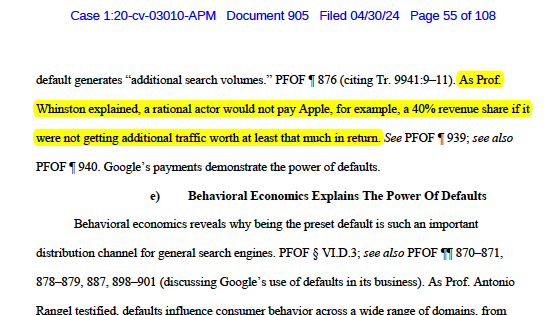
As the expert witness in the trial pointed out, there isn't a rational explanation for a 40% revenue share on traffic that Google's proxies argue would happen without Apple. But hey, maybe that cash also pays for special influence into Safari's roadmap, too? /3
!!!!! just unsealed, and higher than prior news reports. /1
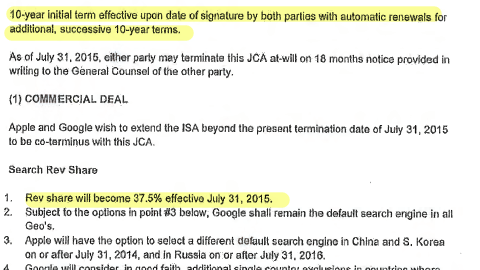
we learned last Fall in a different G lawsuit (NdCal) during widely reported testimony the number 36% as the share Google paid Apple to be locked in as default search across Apple's surfaces.
But now this was just unsealed from the two key contracts (here is 2014 which even then was 37.5%) /2
Whoa. Facebook had a secret "Project Ghostbusters" (get it?) which allegedly was to decrypt "man-in-the-middle" style Snapchat traffic to copy it. Yellow highlight indicates redactions just lifted in nine unsealed plaintiffs briefs in private antitrust lawsuit. Wild stuff. /1
A lot of new stuff. There was lots of reporting (including Apple threats to boot Facebook) at the time on Facebook's software and Onavo acquisition allowing it to "spy" on competitive apps but I recall the decryption was written as a hypothetical. CEO email kickstarting it. /2
You can read the press back in Jan 2019 spoon fed by Facebook PR to friendlies with no mentions of decrypting SSL then compare to this internal email below sent to Facebook's most senior executives - "currently includes SSL decryption"... /3
TikTok? Y’all are crazy. Yes, it’s a huge problem but hypocrisy. Last year after Facebook worked years to keep it sealed, a court unsealed its secret app audit. It showed 86,961 developers in China had access to all of our personal data…yet crickets. /1 storage.courtlistener.com/recap/gov.usco…
This is the same app audit Zuckerberg promised Congress after concerns American’s personal data had been readily mined in Russia. Throw in Iran, North Korea, you name it. Press didn’t dig in. A good source told me DOJ and Congress hadn’t ever even seen this forensic audit. /2
Yet Facebook had spent four years trying very hard to keep even the names of the forensic auditing / clean-up firms confidential. Senate Intel Chairs did send a letter, no word on whether Facebook even responded to them. /3
ok, I've now read the NYT response this week to attempts by OpenAI to dismiss NYT's landmark lawsuit against the high-flying AI company.
Put simply, NYT makes it brutally clear on page one how you can tell the difference between the two companies.
Oomph. /1
A few other observations from me. Like NYT's original complaint, it's smart and future-focused on fair value. Where OpenAI made frankly bizarre claims NYT was hacking the platform as it detected OpenAI had its content, NYT is right. OpenAI isn't and can't dispute it copied it. /2
Um, 2022 > 2020 = TRUE. Where OpenAI tried to inject a statute-of-limitations argument that OpenAI's lifting of content was "common knowledge" in 2020, NYT points out that ChatGPT and OpenAI didn't go viral until Nov 2022. /3
That's rich.
Microsoft's motion to dismiss NYT landmark lawsuit against MSFT/OpenAI. The most valuable company on the planet at 3 trillion claims the right to mine (aka 'harness') every work of journalism as part of its 'collaboration.' Comparing it to copying video tapes. 1/6
To be fair, MSFT, and its leadership, were testifying from Australia to US Congress on importance of a free and plural press and antitrust enforcement to support it just a few yrs ago. They genuinely seemed to care now Team Nadella has prioritized its OpenAI 'collaboration.' 2/6
I keep putting 'collaboration' in air quotes as it's an amusing attempt to reframe what is an investment worth tens of billions in which MSFT's CEO literally helped save the OpenAI CEO and company late last year. 'Collaboration' is a nice lawyer spin word for it. 3/6