10 great Python packages for Data Science not known to many:
1️⃣ CleanLab
You're missing out on a lot if you haven't started using Cleanlab yet!
Cleanlab helps you clean data and labels by automatically detecting issues in a ML dataset.
It's like a magic wand! 🪄✨
Check this out👇
github.com/cleanlab/clean…
You're missing out on a lot if you haven't started using Cleanlab yet!
Cleanlab helps you clean data and labels by automatically detecting issues in a ML dataset.
It's like a magic wand! 🪄✨
Check this out👇
github.com/cleanlab/clean…
2️⃣ LazyPredict
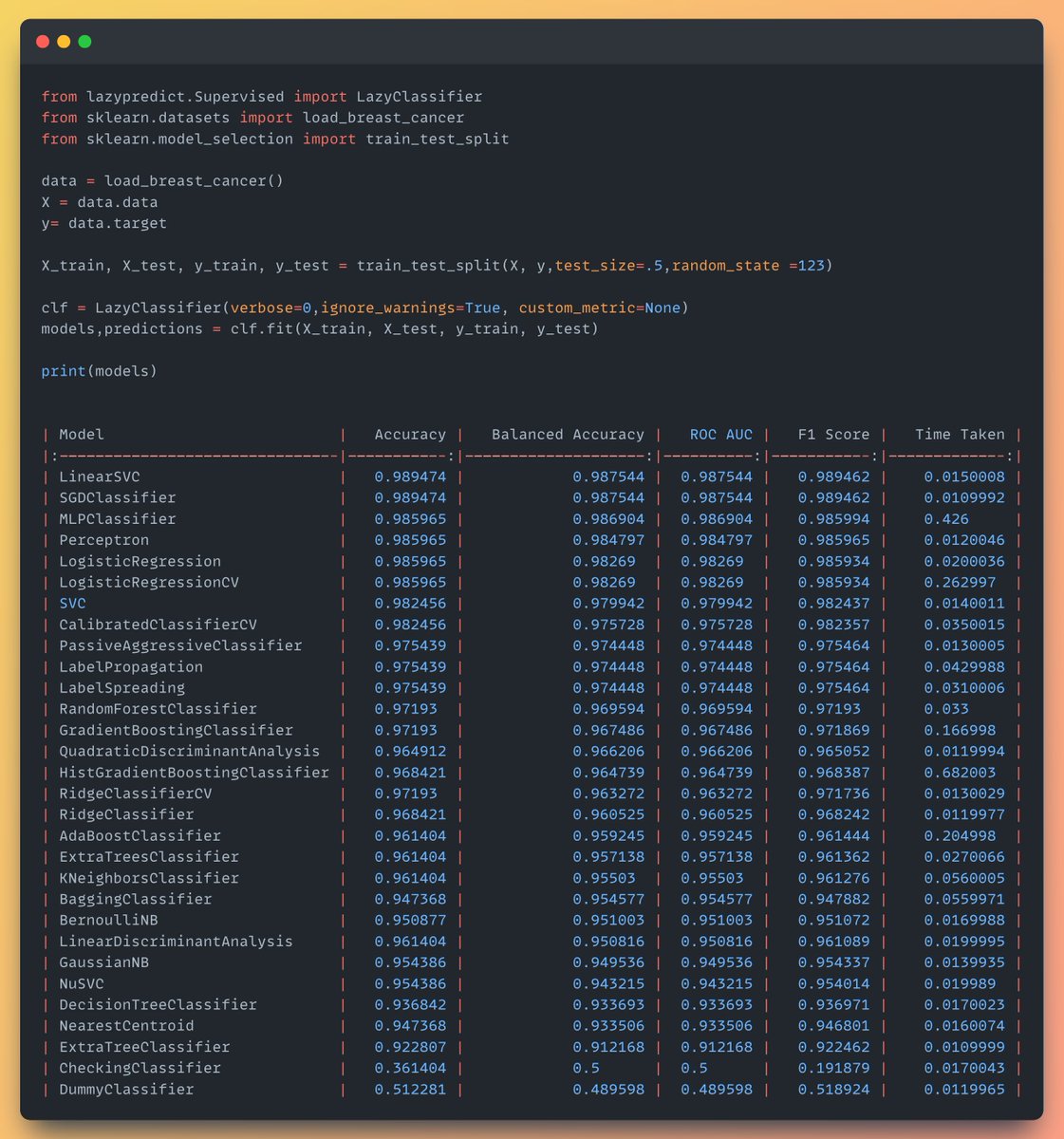
A Python library that enables you to train, test, and evaluate multiple ML models at once using just a few lines of code.
Supports both regression & classification! ✨
Check this out👇
pypi.org/project/lazypr…

A Python library that enables you to train, test, and evaluate multiple ML models at once using just a few lines of code.
Supports both regression & classification! ✨
Check this out👇
pypi.org/project/lazypr…
3️⃣ Lux
A Python library for quickly visualizing and analyzing data, providing an easy and efficient way to explore data.
Check this out👇
github.com/lux-org/lux
A Python library for quickly visualizing and analyzing data, providing an easy and efficient way to explore data.
Check this out👇
github.com/lux-org/lux
4️⃣ PyForest
A time-saving tool that helps in importing all the necessary data science libraries and functions with a single line of code.
Check this out👇
pypi.org/project/pyfore…
A time-saving tool that helps in importing all the necessary data science libraries and functions with a single line of code.
Check this out👇
pypi.org/project/pyfore…
5️⃣ PivotTableJS
PivotTableJS lets you interactively analyse your data in Jupyter Notebooks without any code 🔥
Check this out👇
pypi.org/project/pivott…
PivotTableJS lets you interactively analyse your data in Jupyter Notebooks without any code 🔥
Check this out👇
pypi.org/project/pivott…
6️⃣ Drawdata
Drawdata is a python library that allows you to draw a 2-D dataset of any shape in a Jupyter Notebook.
Very handy for learning & understanding the behaviour of ML algorithms!
Check this out👇
pypi.org/project/drawda…
Drawdata is a python library that allows you to draw a 2-D dataset of any shape in a Jupyter Notebook.
Very handy for learning & understanding the behaviour of ML algorithms!
Check this out👇
pypi.org/project/drawda…
7️⃣ black
The Uncompromising Code Formatter
Arguably the best, I use it everyday!!
Check this out 👇
pypi.org/project/black/
The Uncompromising Code Formatter
Arguably the best, I use it everyday!!
Check this out 👇
pypi.org/project/black/

8️⃣ PyCaret
An open-source, low-code machine learning library in Python that automates the machine learning workflow.
Check this out👇
github.com/pycaret/pycaret
An open-source, low-code machine learning library in Python that automates the machine learning workflow.
Check this out👇
github.com/pycaret/pycaret
9️⃣ PyTorch-Lightning by @LightningAI⚡️
If you like PyTorch, you'll love PyTorch Lightning!
Streamlines your model training, automates boilerplate code, and lets you focus on what matters: research & innovation.
Check this out👇
lightning.ai/docs/pytorch/s…
If you like PyTorch, you'll love PyTorch Lightning!
Streamlines your model training, automates boilerplate code, and lets you focus on what matters: research & innovation.
Check this out👇
lightning.ai/docs/pytorch/s…
🔟 Streamlit
Although already quite popular but a lot of folks are yet to try this!
A framework for creating web applications for data science and machine learning projects, allowing for easy and interactive data viz & model deployment.
Check this out👇
streamlit.io
Although already quite popular but a lot of folks are yet to try this!
A framework for creating web applications for data science and machine learning projects, allowing for easy and interactive data viz & model deployment.
Check this out👇
streamlit.io
If you interested in:
- Python 🐍
- Machine Learning 🤖
- AI Engineering ⚙️
Find me → @akshay_pachaar ✔️
My weekly Newsletter on AI Engineering, Join 9k+ readers: @ML_Spring
Cheers! 🥂
- Python 🐍
- Machine Learning 🤖
- AI Engineering ⚙️
Find me → @akshay_pachaar ✔️
My weekly Newsletter on AI Engineering, Join 9k+ readers: @ML_Spring
Cheers! 🥂
• • •
Missing some Tweet in this thread? You can try to
force a refresh