
@adamgluck @chris_j_paxton @ReadyRobotics @DanGrover Thanks for tagging me in @adamgluck (and great meeting in person at Automate)!
Oh yeah, I definitely have thoughts here. Standard disclaimers on bias, etc, etc...
Why don't we see more robots deployed? A thread with all the reasons I've seen:
Oh yeah, I definitely have thoughts here. Standard disclaimers on bias, etc, etc...
Why don't we see more robots deployed? A thread with all the reasons I've seen:
Why We Don't See More Robots Deployed, Reason #1:
Skepticism. Everyone who works in a factory either has direct experience with a failed robot deployment, or they have a friend, or a cousin, or a friend's cousin's uncle who tried using a robot and it didn't work out.
Skepticism. Everyone who works in a factory either has direct experience with a failed robot deployment, or they have a friend, or a cousin, or a friend's cousin's uncle who tried using a robot and it didn't work out.
Why We Don't See More Robots Deployed, Reason #2:
Cost. I don't mean this entirely in the sense of "oh no, robots are too expensive." But imagine this scenario from a buying perspective: you run a small machine shop in a large, cheap building. You have 2 maybe 3 machine tools (CNC lathe, CNC mill, etc).
Let's say you have another $50K in capital to spend. Your choice is buying a robot to tend your existing mill, or buying a stamping press that lets you make new, different types of parts.
Which do you choose?
Literally every machine shop owner I've ever spoken to will pick buying the machine tool over the robot.
Why?
It opens up new revenue streams for your machine shop. The best the robot does is give you better machine utilization, which if you're a small shop with lots of physical space, doesn't count for much.
Oh they're labor constrained you say?
Most small machine shop owners have a cot in the shop. They'll sleep there while parts are being made. They're scrappy. They'll scrimp up and buy the machine tool, not the robot.
That's the right call for them. Its a big, big reason why its so hard to sell into the "S" part of SMBs.
Cost. I don't mean this entirely in the sense of "oh no, robots are too expensive." But imagine this scenario from a buying perspective: you run a small machine shop in a large, cheap building. You have 2 maybe 3 machine tools (CNC lathe, CNC mill, etc).
Let's say you have another $50K in capital to spend. Your choice is buying a robot to tend your existing mill, or buying a stamping press that lets you make new, different types of parts.
Which do you choose?
Literally every machine shop owner I've ever spoken to will pick buying the machine tool over the robot.
Why?
It opens up new revenue streams for your machine shop. The best the robot does is give you better machine utilization, which if you're a small shop with lots of physical space, doesn't count for much.
Oh they're labor constrained you say?
Most small machine shop owners have a cot in the shop. They'll sleep there while parts are being made. They're scrappy. They'll scrimp up and buy the machine tool, not the robot.
That's the right call for them. Its a big, big reason why its so hard to sell into the "S" part of SMBs.
Why We Don't See More Robots Deployed, Reason #3:
Software complexity. You need someone who can program a robot. If you want that robot to interact with stuff, odds are you're going to need a PLC too. So now you need to program ladder logic. You need someone to program the safety system. Oh you want vision? Gonna need a vision programmer.
So for a single robot cell, now you need:
1. Robot programmer
2. PLC programmer (they can handle the safety system)
3. Maybe a vision programmer
According to the BLS, there are at most 40,000 robotics engineers working in ALL of US manufacturing.
How many robot arms have we ever deployed annually in the US?
The US has never deployed more than 40,000 robot arms in any one year.
Even if you make the robot easy to program, if you cannot control the entire robot cell, you still need to end up bringing in other programmers, which makes it harder to deploy.
Coincidence? I don't think so.
Software complexity. You need someone who can program a robot. If you want that robot to interact with stuff, odds are you're going to need a PLC too. So now you need to program ladder logic. You need someone to program the safety system. Oh you want vision? Gonna need a vision programmer.
So for a single robot cell, now you need:
1. Robot programmer
2. PLC programmer (they can handle the safety system)
3. Maybe a vision programmer
According to the BLS, there are at most 40,000 robotics engineers working in ALL of US manufacturing.
How many robot arms have we ever deployed annually in the US?
The US has never deployed more than 40,000 robot arms in any one year.
Even if you make the robot easy to program, if you cannot control the entire robot cell, you still need to end up bringing in other programmers, which makes it harder to deploy.
Coincidence? I don't think so.
Why We Don't See More Robots Deployed, Reason #4:
Tooling design. There is no such thing as off-the-shelf tooling for robots. Anything that claims to be off the shelf is pretty much a lie.
If you're picking up parts, you need to design the gripper fingers properly. Lots of ways to design this.
Or maybe you're using suction. Ever seen how many different types of suction cups exist? Hundreds. Plus you have to cobble together all the extrusion.
Oh, you also have make sure there isn't too much or too little flex in your design.
So you're going to need some mechanical engineering capability for this, plus the ability to fab metal parts. Now if you're a metalworking shop, you can probably do this, but there is even a lot of work that goes into picking the right metal for the grasping.
Tooling design. There is no such thing as off-the-shelf tooling for robots. Anything that claims to be off the shelf is pretty much a lie.
If you're picking up parts, you need to design the gripper fingers properly. Lots of ways to design this.
Or maybe you're using suction. Ever seen how many different types of suction cups exist? Hundreds. Plus you have to cobble together all the extrusion.
Oh, you also have make sure there isn't too much or too little flex in your design.
So you're going to need some mechanical engineering capability for this, plus the ability to fab metal parts. Now if you're a metalworking shop, you can probably do this, but there is even a lot of work that goes into picking the right metal for the grasping.
Why We Don't See More Robots Deployed, Reason #5:
Parts presentation. This is probably the biggest reason a robot deployment fails. Robots are dumb like computers, so you need to make sure the parts that are going to be manipulated by the robot are showing up in the same place and in the same orientation so the robot can reliably pick them up.
This means you need some sort of parts presentation system. Sure, you can design a simple grid if you have a long(ish) cycle time tending a mill or lathe, and fill that grid every few hours.
But if you have a short cycle time, you need some way to rapidly dump parts in and let the system sort it out. You might need a step feeder, a bowl feeder, an elevator feeder, or something else entirely.
Designing the right parts presentation system is an art and science by itself. And almost every single parts presentation system is custom.
Almost every single parts presentation is custom.
And if you don't get parts presentation right, your system won't work properly, or worse, you'll spend all your time just feeding the robot instead of doing the task directly.
Oh, but you can just use vision?
Most bin-picking vision systems are extremely time consuming to configure at best(not to mention more expensive than a robot arm), and at worst, they are unreliable for a whole host of different parts.
Parts presentation. This is probably the biggest reason a robot deployment fails. Robots are dumb like computers, so you need to make sure the parts that are going to be manipulated by the robot are showing up in the same place and in the same orientation so the robot can reliably pick them up.
This means you need some sort of parts presentation system. Sure, you can design a simple grid if you have a long(ish) cycle time tending a mill or lathe, and fill that grid every few hours.
But if you have a short cycle time, you need some way to rapidly dump parts in and let the system sort it out. You might need a step feeder, a bowl feeder, an elevator feeder, or something else entirely.
Designing the right parts presentation system is an art and science by itself. And almost every single parts presentation system is custom.
Almost every single parts presentation is custom.
And if you don't get parts presentation right, your system won't work properly, or worse, you'll spend all your time just feeding the robot instead of doing the task directly.
Oh, but you can just use vision?
Most bin-picking vision systems are extremely time consuming to configure at best(not to mention more expensive than a robot arm), and at worst, they are unreliable for a whole host of different parts.
Why We Don't See More Robots Deployed, Reason #6:
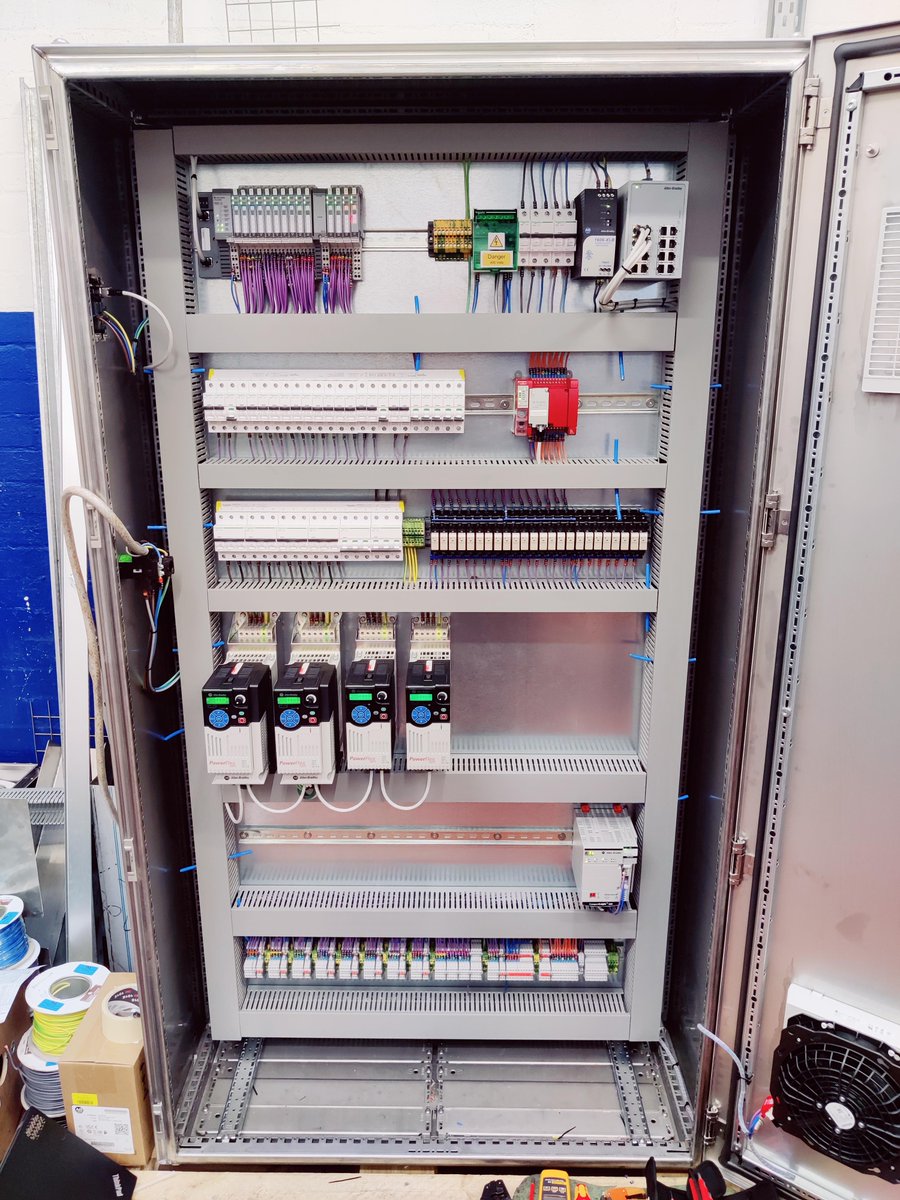
Electrical complexity. Everything in your robot cell has to be physically connected. Since the entire robot cell is custom, this means you need a custom electrical panel that hooks everything up. This will include a PLC or an industrial PC, but then you have to wire it all together.
This means you now need someone that knows how to do wiring.
Here's an example of an electrical cabinet you need for a lot of robotic systems:
Electrical complexity. Everything in your robot cell has to be physically connected. Since the entire robot cell is custom, this means you need a custom electrical panel that hooks everything up. This will include a PLC or an industrial PC, but then you have to wire it all together.
This means you now need someone that knows how to do wiring.
Here's an example of an electrical cabinet you need for a lot of robotic systems:
All the complexity adds a whole lot of friction to the process of deploying robots. We're working on solving the software complexity layer here at @ReadyRobotics, but that is only one piece of the puzzle!
I deeply believe that solving for the software complexity will significantly reduce the friction of managing robot cells once they're deployed, but we don't have magic technology that solves the friction of the design and implementation.
You need a whole team of specialists to deploy a single robot cell.
This is why ultimately large enterprises will establish an internal team to build and install robot cells, as well as relying on systems integrators.
I deeply believe that solving for the software complexity will significantly reduce the friction of managing robot cells once they're deployed, but we don't have magic technology that solves the friction of the design and implementation.
You need a whole team of specialists to deploy a single robot cell.
This is why ultimately large enterprises will establish an internal team to build and install robot cells, as well as relying on systems integrators.
One other thing to consider when it comes to the narrative around the US not being as good as China when it comes to installing robots: relative size.
China employs 128M people in manufacturing. They installed ~140K robots.
The US employs 12.1M people in manufacturing. We installed ~40K robots.
They have 10x the workforce yet only installed 4x the number of robots.
This isn't to say that we shouldn't be doing better, we should be. This is to say that we will never brute force a solution here, we will only get ahead by creating better technology faster than others.
So let's get back to building the future @adamgluck @chris_j_paxton @DanGrover
China employs 128M people in manufacturing. They installed ~140K robots.
The US employs 12.1M people in manufacturing. We installed ~40K robots.
They have 10x the workforce yet only installed 4x the number of robots.
This isn't to say that we shouldn't be doing better, we should be. This is to say that we will never brute force a solution here, we will only get ahead by creating better technology faster than others.
So let's get back to building the future @adamgluck @chris_j_paxton @DanGrover
• • •
Missing some Tweet in this thread? You can try to
force a refresh




