Good morning from New York.
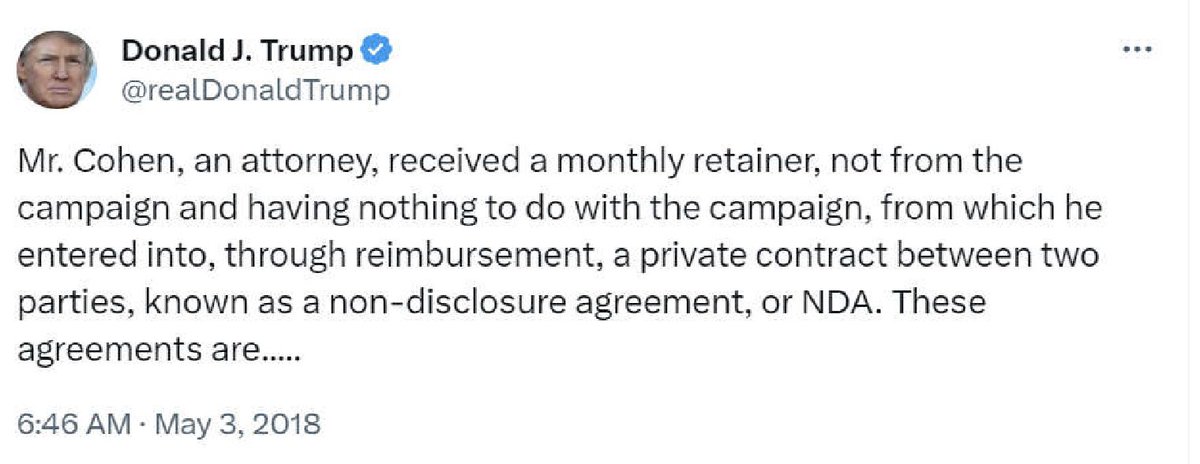
On Friday, the jury heard this Trump tweet recited into the record—about his "reimbursement" to Michael Cohen for "a non-disclosure agreement."
Trump's attorney denied the reimbursement when trial began.
Soon, Cohen is expected to testify.🧵
On Friday, the jury heard this Trump tweet recited into the record—about his "reimbursement" to Michael Cohen for "a non-disclosure agreement."
Trump's attorney denied the reimbursement when trial began.
Soon, Cohen is expected to testify.🧵
During opening statements, prosecutor Matthew Colangelo promised jurors Cohen's account would be backed up by an "extensive paper trail of bank records, emails, text messages, phone logs, business documents and other records."
Colangelo also told jurors when trial began that Cohen's account would be corroborated by other witness testimony, along with Trump's books, speeches, and social media posts.
Trump's attorney Todd Blanche vowed to show jurors:
"The $35,000 a month was not a payback to Mr. Cohen for the money that he gave to Ms. Daniels."
Jurors have now seen two sworn statements by Trump — and one of the former president's tweets — all describing "reimbursement."
"The $35,000 a month was not a payback to Mr. Cohen for the money that he gave to Ms. Daniels."
Jurors have now seen two sworn statements by Trump — and one of the former president's tweets — all describing "reimbursement."
On April 22, Blanche also mentioned that Cohen "said that he wanted to see President Trump in an orange jumpsuit. That was last night."
History repeats itself: On Friday, Blanche complained that Cohen posted a TikTok of Trump in an orange jumpsuit—on the eve of testimony.
History repeats itself: On Friday, Blanche complained that Cohen posted a TikTok of Trump in an orange jumpsuit—on the eve of testimony.
That earned Cohen a rebuke from Justice Merchan, who told prosecutors to convey that the judge asked him from the bench to stop doing that.
Cohen's social media swipes at Trump are almost certain to be an extensive part of cross-ex.
Cohen's social media swipes at Trump are almost certain to be an extensive part of cross-ex.
Now—
Trump enters the courtroom, stands next to the defense table and surveys the gallery.
In the front row behind him are Eric Trump and Alina Habba.
Trump enters the courtroom, stands next to the defense table and surveys the gallery.
In the front row behind him are Eric Trump and Alina Habba.
Making a rare appearance today:
Manhattan DA Alvin Bragg
Manhattan DA Alvin Bragg
Bragg also appeared in court on Friday, during testimony by his paralegals entering evidence into the record backing up Cohen's account.
"All rise."
Justice Merchan enters, and the attorneys register their appearances.
Justice Merchan enters, and the attorneys register their appearances.
Judge DENIES prosecutors' bid to allow Allen Weisselberg's separation agreement with the Trump Organization into evidence.
"This would be used to explain why somebody is not here," the judge notes.
Neither side has subpoenaed Weisselberg, who's jailed for perjury.
"This would be used to explain why somebody is not here," the judge notes.
Neither side has subpoenaed Weisselberg, who's jailed for perjury.
Prosecutors wanted to put the separation agreement into evidence to argue that it constrains what Weisselberg can say — and explain to jurors why they didn't call him.
With that out of the way, the court awaits the jury's entrance.
NOW
"The People call Michael Cohen."
"The People call Michael Cohen."
Michael Cohen enters the courtroom, walks to the witness and raises his right hand to be sworn.
"Yes, I do," Cohen responds to the familiar vow.
"Yes, I do," Cohen responds to the familiar vow.
Assistant DA Susan Hoffinger leads Michael Cohen through his biographical history.
He's 57 years old, and his marriage is "going on 30 years."
Cohen mentions his Holocaust-survivor father.
Background haaretz.com/us-news/2018-0…
He's 57 years old, and his marriage is "going on 30 years."
Cohen mentions his Holocaust-survivor father.
Background haaretz.com/us-news/2018-0…
Cohen said he didn't always want to be a lawyer:
"I wanted to go to Wall Street. My grandmother said that's not going to happen."
"I wanted to go to Wall Street. My grandmother said that's not going to happen."
When asked to identify Trump, Cohen stands up, cranes his neck and glances at the defense table.
He identifies Trump by his suit.
He identifies Trump by his suit.
Cohen describes his early legal work at the firm Phillips, Nizer — and how he started working for Trump on "some legal" and "some non-legal matters."
Q: Did he pay you for that work?
A: No, ma'am.
Q: Did he pay you for that work?
A: No, ma'am.
Cohen says that after he broached billing Trump for that work when he was with Phillips, Nizer:
"He asked me if I wanted to get fired on the first day [...] if I asked about the bill."
"He asked me if I wanted to get fired on the first day [...] if I asked about the bill."
Eventually, Cohen got the position of Trump's "special counsel," negotiating a salary of $375k base salary with a bonus to be discussed.
It ultimately added up to $525k, Cohen says.
It ultimately added up to $525k, Cohen says.
Asked to whom he reported, Cohen said: "Just to Mr. Trump."
One Cohen's tasks on the job, he says, was renegotiating bills and invoices.
"He didn't believe that the invoice was fair, reasonable, justified," Cohen said. "He would give me the task of renegotiating a specific bill."
"He didn't believe that the invoice was fair, reasonable, justified," Cohen said. "He would give me the task of renegotiating a specific bill."
Cohen recalls Trump telling him, "It's fantastic. It's incredible," when he successfully renegotiated bills and invoices.
Q: How did that make you feel?
A: Like I was on top of the world.
Q: How did that make you feel?
A: Like I was on top of the world.
Cohen testifies about threatening to sue companies and individuals for Trump, including someone from the Miss Universe pageant and reporters.
"I would express to them the need to redact or take the article down."
"I would express to them the need to redact or take the article down."
Referring to Cohen's threats to journalists, the prosecutor asks: "Did you do that in a strong and threatening manner sometimes?"
"I would say so, not all the time," Cohen says, slightly pausing before adding. "Often."
"I would say so, not all the time," Cohen says, slightly pausing before adding. "Often."
Context: Cohen's threats to journalists were notorious — and one was published by NPR.
You can hear Cohen threatening the unflappable and estimable Tim Mak, heard coolly asking for his statement here npr.org/2018/05/31/615…
You can hear Cohen threatening the unflappable and estimable Tim Mak, heard coolly asking for his statement here npr.org/2018/05/31/615…
Cohen:
"Mr. Trump never had an email address."
Asked to elaborate on that, Cohen quotes Trump saying: "Emails are like written papers. There are too many people who have gone down" because "prosecutors" had access to their emails.
"Mr. Trump never had an email address."
Asked to elaborate on that, Cohen quotes Trump saying: "Emails are like written papers. There are too many people who have gone down" because "prosecutors" had access to their emails.
Asked whether Trump was a "micromanager," Cohen replies: "Yes, ma'am."
Cohen says he would call him "Boss" and "Mr. Trump."
"Working for him was an amazing experience in many, many ways," he says, describing the company as a "big family."
Cohen says he would call him "Boss" and "Mr. Trump."
"Working for him was an amazing experience in many, many ways," he says, describing the company as a "big family."
Asked whether Cohen lied for Trump, Cohen replies yes, because it was sometimes needed to "accomplish the task."
"The only thing that was on my mind was to accomplish the task, to keep him happy."
"The only thing that was on my mind was to accomplish the task, to keep him happy."
Prosecutor Hoffinger asks Cohen to authentic his cell phone numbers, suggesting text-message evidence can't be far away.
In addition to text messages previously entered into evidence, Cohen's phone logs also entered the record on Friday, showing him on the phone with Trump twice on Oct. 26, 2016.
That will be key evidence for prosecutors, and an almost-certain topic of Cohen's testimony.
That will be key evidence for prosecutors, and an almost-certain topic of Cohen's testimony.
Cohen testifies that he and Trump decided to sync his contacts into his phone, leading him to have more than 30K contacts in his phone at one time.
Cohen authenticates his email addresses, past and current.
Q: Mr. Cohen, do you know someone named David Pecker?
A: Yes, I do.
Q: Mr. Cohen, do you know someone named David Pecker?
A: Yes, I do.
Cohen says he's known Pecker even longer than he's known Trump.
Cohen says that he and Pecker sometimes communicated via Signal, the encrypted messaging app that they thought would be untraceable.
Q: Would you say you had a good relationship with Mr. Pecker?
A: Yes, I would.
Cohen says that he also knew the Enquirer's then-editor in chief Dylan Howard, whom he remembers working for Pecker.
A: Yes, I would.
Cohen says that he also knew the Enquirer's then-editor in chief Dylan Howard, whom he remembers working for Pecker.
Cohen says he also chatted with Howard sometimes via Signal:
"For the same reason, it was a sensitive matter that we wanted to keep private."
"For the same reason, it was a sensitive matter that we wanted to keep private."
Cohen describes creating the website "ShouldTrumpRun [dot] com" to explore the possibility of a run back in 2011.
An archived version of that website, with Cohen's credit at the bottom, can be found here. web.archive.org/web/2011031122…
An archived version of that website, with Cohen's credit at the bottom, can be found here. web.archive.org/web/2011031122…
In 2011, Trump ultimately decided against running, but he opted for it some five years later.
Cohen was given a role as a surrogate, but one who wasn't officially working for Trump's campaign.
Cohen was given a role as a surrogate, but one who wasn't officially working for Trump's campaign.
Cohen: "One of the things that I noticed is that it's very white."
He says he started a National Diversity Coalition for Trump with Pastor Darrell Scott.
He says he started a National Diversity Coalition for Trump with Pastor Darrell Scott.
Cohen quotes Trump warning him that, as he announces his presidential campaign: "There's going to be a lot of women coming forward."
Questioning turns to what appears to be the Trump Tower meeting from August 2015.
Cohen quotes David Pecker saying at the meeting: "He would be able to help us know in advance what's coming out and stop it from coming out."
Cohen quotes David Pecker saying at the meeting: "He would be able to help us know in advance what's coming out and stop it from coming out."
Cohen says Trump was pleased with the Enquirer's stories elevating him and trashing his then-primary rivals.
"It's fantastic. That's unbelievable," Cohen quotes Trump telling him.
"It's fantastic. That's unbelievable," Cohen quotes Trump telling him.
Showing internal email messages, prosecutor Hoffinger shows Cohen involved in editing Enquirer articles. In this puff piece, Cohen recommends taking out a line about a Penthouse pet.
Q: Did AMI agree to make the edits that you suggested?
A: Yes, ma'am.
Q: Did AMI agree to make the edits that you suggested?
A: Yes, ma'am.
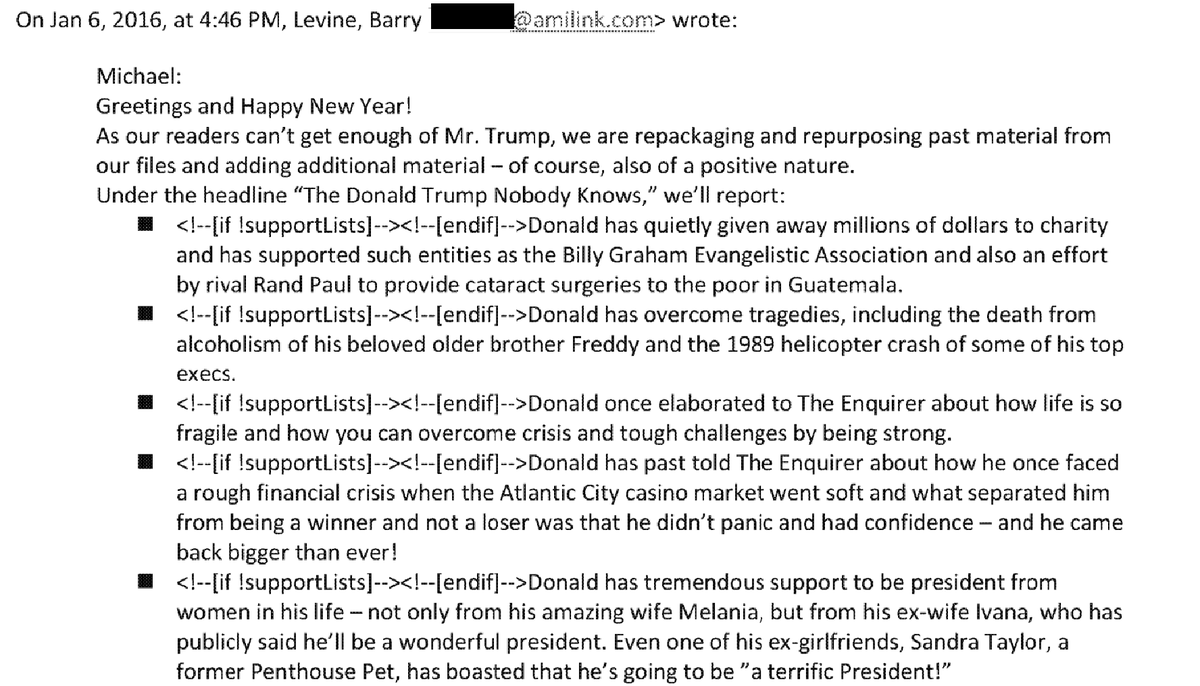

The email came into evidence earlier in the trial, and it can be viewed here. pdfs.nycourts.gov/PeopleVs.DTrum…
Cohen confirms that this is the story that he helped edit.

Questioning turns to Trump's doorman Dino Sajudin, who was paid $30,000 to silence a false story about Trump supposedly having a child out of wedlock.
Asked whether Trump was grateful that AMI quashed that story, Cohen responds: "Absolutely."
Asked whether Trump was grateful that AMI quashed that story, Cohen responds: "Absolutely."
Cohen describes reviewing Sajudin's agreement:
"I reviewed it to make sure that Mr. Trump was fully protected."
"I reviewed it to make sure that Mr. Trump was fully protected."
Cohen says he pushed for AMI to include a major liquidated damages penalty and a provision granting them the rights in perpetuity.
Q: Did AMI agree to include that term in the agreement as well?
A: They did.
Q: Did AMI agree to include that term in the agreement as well?
A: They did.
Jurors are attentive — and the "tennis match" dynamic is fully visible from the gallery.
Their eyes dart to prosecutor Hoffinger, as she asks a question, and to Cohen, when he answers them. Their eyes hit the screens when there is evidence to review.
Their eyes dart to prosecutor Hoffinger, as she asks a question, and to Cohen, when he answers them. Their eyes hit the screens when there is evidence to review.
Questioning turns to Karen McDougal:
Cohen says he learned about her allegations through David Pecker and Dylan Howard — specifically, that she's a Playboy playmate and there was a story about a relationship she had with Trump.
Cohen says he learned about her allegations through David Pecker and Dylan Howard — specifically, that she's a Playboy playmate and there was a story about a relationship she had with Trump.
Cohen says he talked to Trump about it "immediately"
He recalls saying, "Boss, I've got to talk to you," and telling Trump what he just learned.
"His response to me was, 'She's really beautiful.' [...] I said, "Okay, but there's a story that's right now being shopped."
He recalls saying, "Boss, I've got to talk to you," and telling Trump what he just learned.
"His response to me was, 'She's really beautiful.' [...] I said, "Okay, but there's a story that's right now being shopped."
Asked if Cohen drew any conclusions from Trump's remark, the defense objects.
Sustained.
Sustained.
Cohen reviews his text messages with Dylan Howard, dated June 16, 2016, referring to a meeting "on Monday - per their terms."

That day, Cohen urgently texted Trump's bodyguard in this chain.
Cohen says these relate to McDougal's allegations.
Cohen says these relate to McDougal's allegations.

Phone records showed that Cohen and Trump spoke right after, according to evidence shown to the jury.
Cohen and Howard speak about the topic more explicitly in this exchange some four days later.
Howard vowed to have the story "locked down" — and not have it out of his "grasp."
Howard vowed to have the story "locked down" — and not have it out of his "grasp."


Cohen describes overhearing Trump's conversation with David Pecker.
"Instead of lifting up the phone, he used the speaker box, so I was able to hear."
Trump "asked how things were going with the matter," and Pecker said that things were under control.
"Instead of lifting up the phone, he used the speaker box, so I was able to hear."
Trump "asked how things were going with the matter," and Pecker said that things were under control.
Cohen recalled Pecker saying: "we'll take care of this."
More text messages:
As usual, the jurors mostly tilt their heads down to their screens to review the evidence flashing on the monitors.
As usual, the jurors mostly tilt their heads down to their screens to review the evidence flashing on the monitors.
Cohen reviews text messages with Howard showing their concern that McDougal would tell her story to ABC.
"I implored my guy to GET IT DONE," Howard told Cohen.
"I implored my guy to GET IT DONE," Howard told Cohen.

Cohen says he told Trump that a "bulletproof" agreement had been finalized.
According to Cohen, Trump beamed: "Fantastic! Great job!"
According to Cohen, Trump beamed: "Fantastic! Great job!"
Cohen says Pecker grew uneasy: "David had asked me when he should anticipate being paid back the $150,000."
"It was too much money for him to hide," Cohen recalled, noting he also paid $30,000 for Sajudin. "So he put pressure on me to speak to Mr. Trump to get the money back."
"It was too much money for him to hide," Cohen recalled, noting he also paid $30,000 for Sajudin. "So he put pressure on me to speak to Mr. Trump to get the money back."
Asked whether Pecker urged him to get the money back, Cohen replied he wouldn't say Pecker "urged" so much as "insisted."
Q: Was he upset about it?
A: Very.
Q: Was he upset about it?
A: Very.
Q: Why did you think it was so important to tape this one conversation?
Cohen says he wanted to show Pecker that they were serious about reimbursing the money so Pecker would "remain loyal."
Cohen says he wanted to show Pecker that they were serious about reimbursing the money so Pecker would "remain loyal."
Cohen says he also was concerned about what stories Pecker could pull out about Trump from a "locked drawer" at AMI.
Cohen is asked to authenticate the tape recorded conversation that was previously entered into evidence.
Listen to it here.
pdfs.nycourts.gov/PeopleVs.DTrum…
Listen to it here.
pdfs.nycourts.gov/PeopleVs.DTrum…
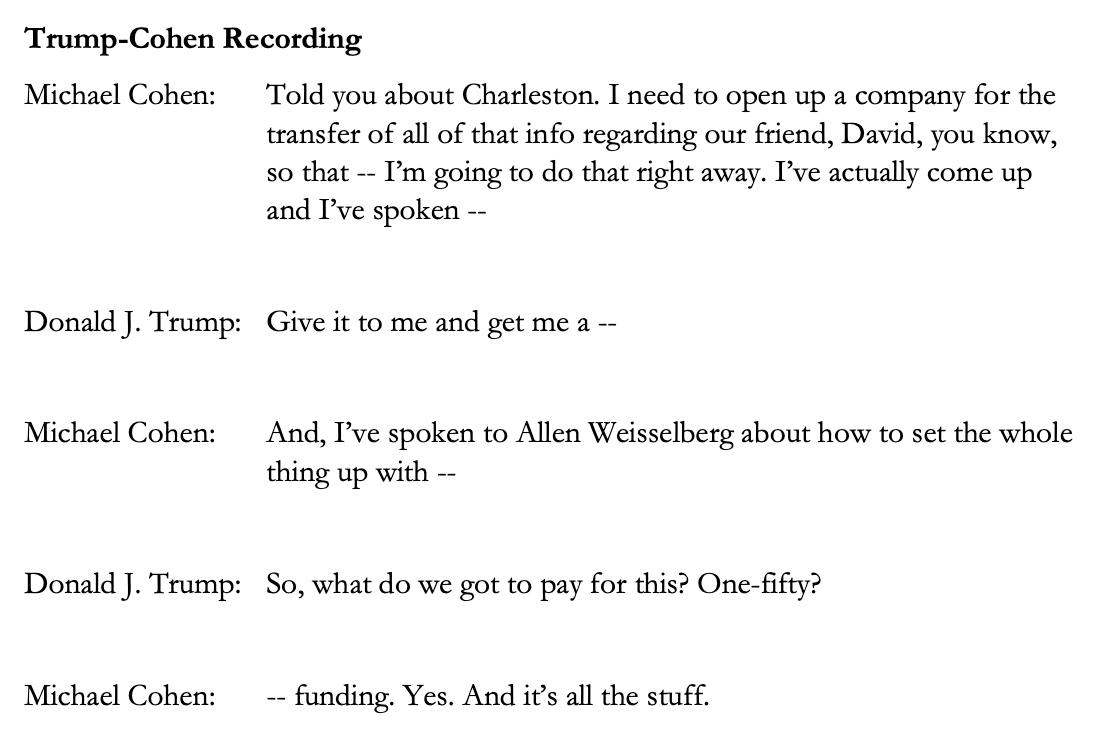
The jury listens to the recording, while glancing at the transcript on their monitors.
Rapt attention on the transcript from the jurors.
After playing the full tape, prosecutor Hoffinger focuses in on the parts about Karen McDougal.
Cohen confirms "our friend, David," refers to Pecker.
The references to opening "up a company" was for Trump's "privacy," Cohen testifies.
Cohen confirms "our friend, David," refers to Pecker.
The references to opening "up a company" was for Trump's "privacy," Cohen testifies.

Allen Weisselberg was the Trump Org's CFO.
Cohen testifies that Trump "directed" him to "speak to Mr. Weisselberg to get this matter handled."
Cohen testifies that Trump "directed" him to "speak to Mr. Weisselberg to get this matter handled."
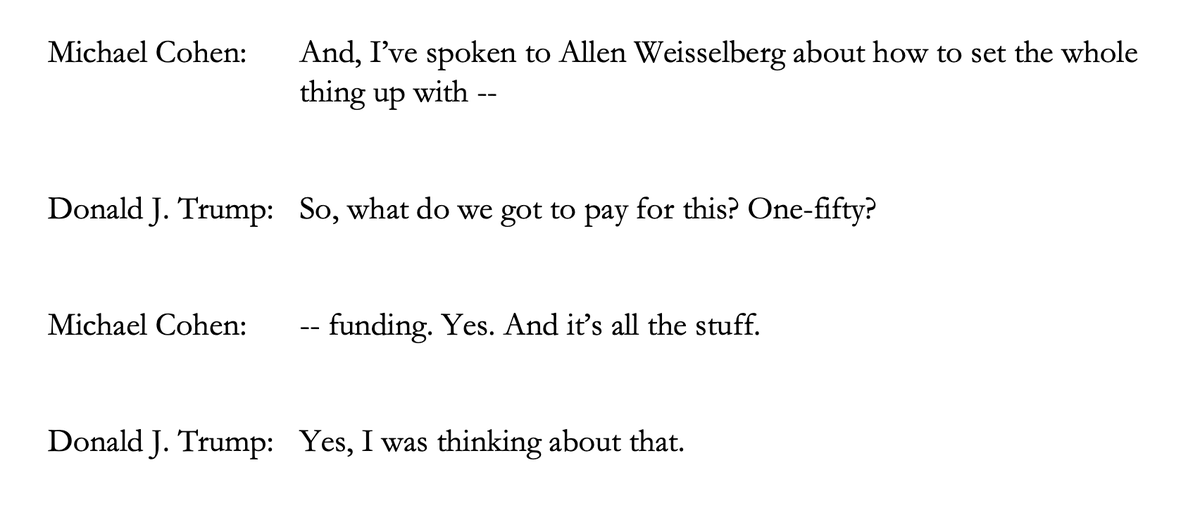
Asked about Trump citing the payment to McDougal, Cohen says: "He already knew based upon conversations with David, which is why he mentioned the number 150."
Cohen says "all the stuff" includes the McDougal story, and that Trump's line, "Maybe he gets hit by a truck," refers to the uncertainty of what happens to the story Pecker became CEO of Time Inc.

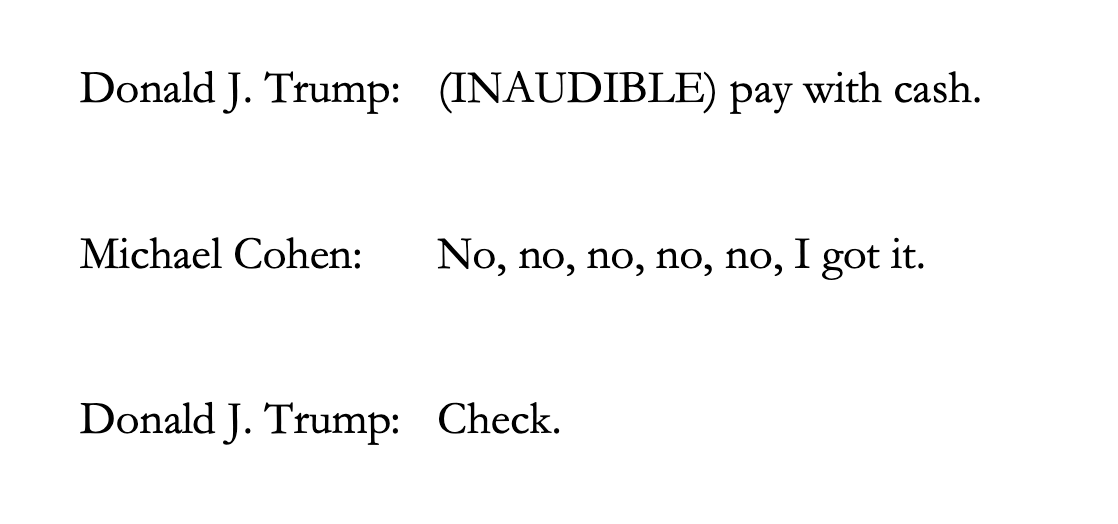
Asked about Trump's remark "pay with cash," Cohen says Trump thought it was "one way to avoid any sort of paper transaction — but I didn't think that was the best way to do it."
Morning recess
Morning recess
We're back.
The judge reminds Cohen he's still under oath.
"Let's get the jury, please."
The judge reminds Cohen he's still under oath.
"Let's get the jury, please."
The judge said earlier that he will remind jurors that the transcript isn't evidence:
It's only a guide to help them understand the evidence, which is the recording itself.
It's only a guide to help them understand the evidence, which is the recording itself.
Press pool report:
"Trump walked back into the courtroom at about 11:38 a.m. and waved to cameras set up in the hallway. He did not respond to the shouted question:
Is Michael Cohen a liar?"
"Trump walked back into the courtroom at about 11:38 a.m. and waved to cameras set up in the hallway. He did not respond to the shouted question:
Is Michael Cohen a liar?"
Cohen's testimony resumes.
Asked why he thought it would be a "bad idea" to pay in cash, Cohen says he wanted to "make it appear to be a proper transaction."
Asked why he thought it would be a "bad idea" to pay in cash, Cohen says he wanted to "make it appear to be a proper transaction."
Cohen says the last voice at the end was his own — and it was him picking up a phone call.
The recording ended there, Cohen says, because he already taped enough to convince Pecker that he'd be paid back.
The recording ended there, Cohen says, because he already taped enough to convince Pecker that he'd be paid back.
Cohen is shown his AT&T call records.
The logs show an incoming call from around the time his conversation with Trump cuts off on the tape, according to evidence shown to the jury.
The logs show an incoming call from around the time his conversation with Trump cuts off on the tape, according to evidence shown to the jury.
Analysis:
Prosecutors do not appear to be letting any detail that can be corroborated by extrinsic evidence hang on Cohen's word.
Prosecutors do not appear to be letting any detail that can be corroborated by extrinsic evidence hang on Cohen's word.
Cohen said that his conversation with Trump continued after the recording ended, essentially amounting to him telling Trump:
"I'm going to head over to Allen Weisselberg's office, and I'll get back to him with more of an update."
"I'm going to head over to Allen Weisselberg's office, and I'll get back to him with more of an update."
The prosecutor shows Cohen the metadata of the recording.
Q: Did you ever alter that recording?
A: No.
Trump's lawyer Emil Bove tried to suggest otherwise, without evidence, during cross of a custodial witness who entered it into the record.
Q: Did you ever alter that recording?
A: No.
Trump's lawyer Emil Bove tried to suggest otherwise, without evidence, during cross of a custodial witness who entered it into the record.
Weisselberg's office was also located on the 26th floor, toward the back, Cohen says.
He adds that Weisselberg and Trump interacted with each other "on a regular basis."
He adds that Weisselberg and Trump interacted with each other "on a regular basis."
Asked whether Weisselberg would handle a deal of this magnitude, Cohen says: "It wasn't even a deal of this magnitude. It was any deal. "
Allen handled all the finances, "going in and out," Cohen said.
Allen handled all the finances, "going in and out," Cohen said.
Cohen says he told Weisselberg that he would open up an LLC.
"It was in order to keep in separate," Cohen says.
"It was in order to keep in separate," Cohen says.
Latest exhibit: Signal messages between Michael Cohen and AMI's Daniel Rothstein
They are entered into evidence, and they appear to show Rothstein brainstorming LLC names.
"Please find possible names," the message states.
They are entered into evidence, and they appear to show Rothstein brainstorming LLC names.
"Please find possible names," the message states.
It's dated Sept. 7, 2016, a day after the Trump-Cohen tape.
Another message, referring to the assignment agreement, is dated right before AMI was going to acquire McDougal's life rights, Cohen says.
Cohen is shown the formation records for Resolution Consultants LLC, used for the assignment for the Karen McDougal deal.
He's then shown the assignment of license agreement, transferring the McDougal rights from AMI to Cohen's shell company.
He's then shown the assignment of license agreement, transferring the McDougal rights from AMI to Cohen's shell company.
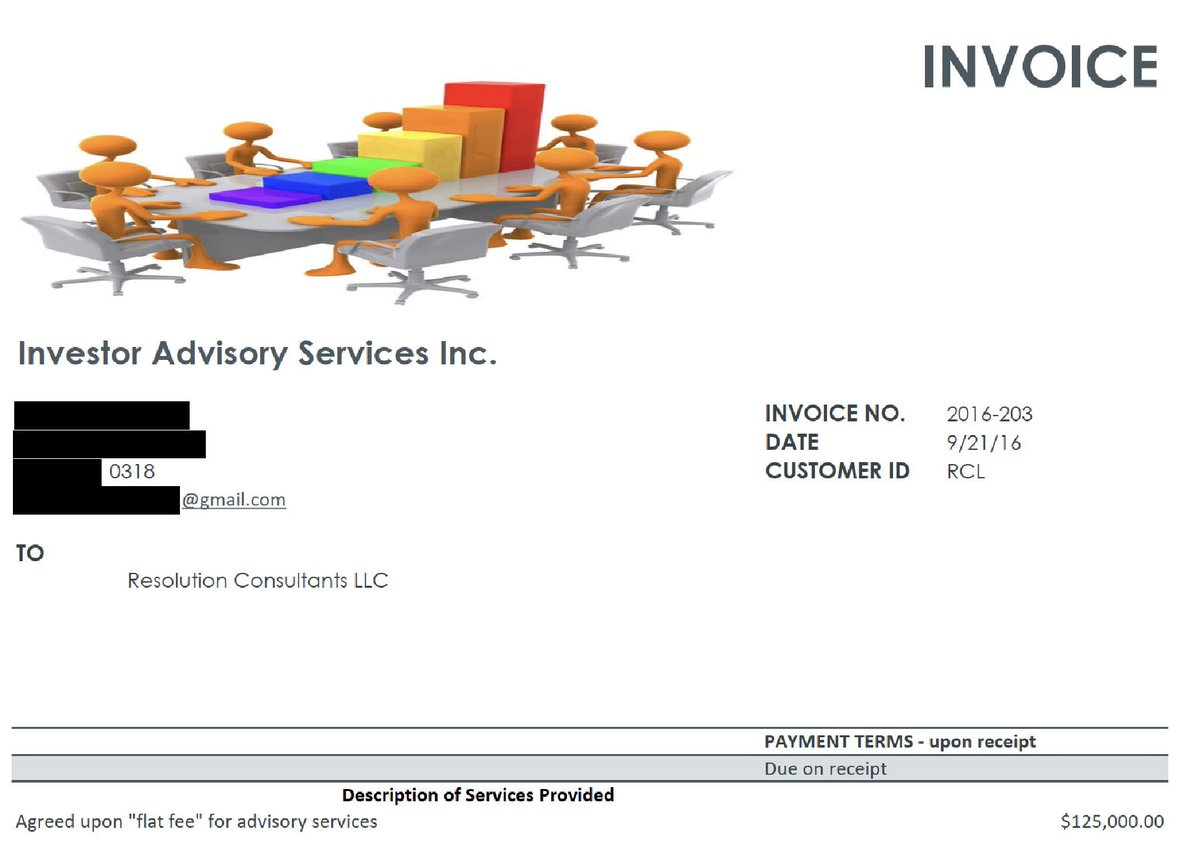
Asked why the LLC invoiced $125,000 — and McDougal's deal was $150,000 — Cohen says Pecker valued the remainder for McDougal's services under the agreement.
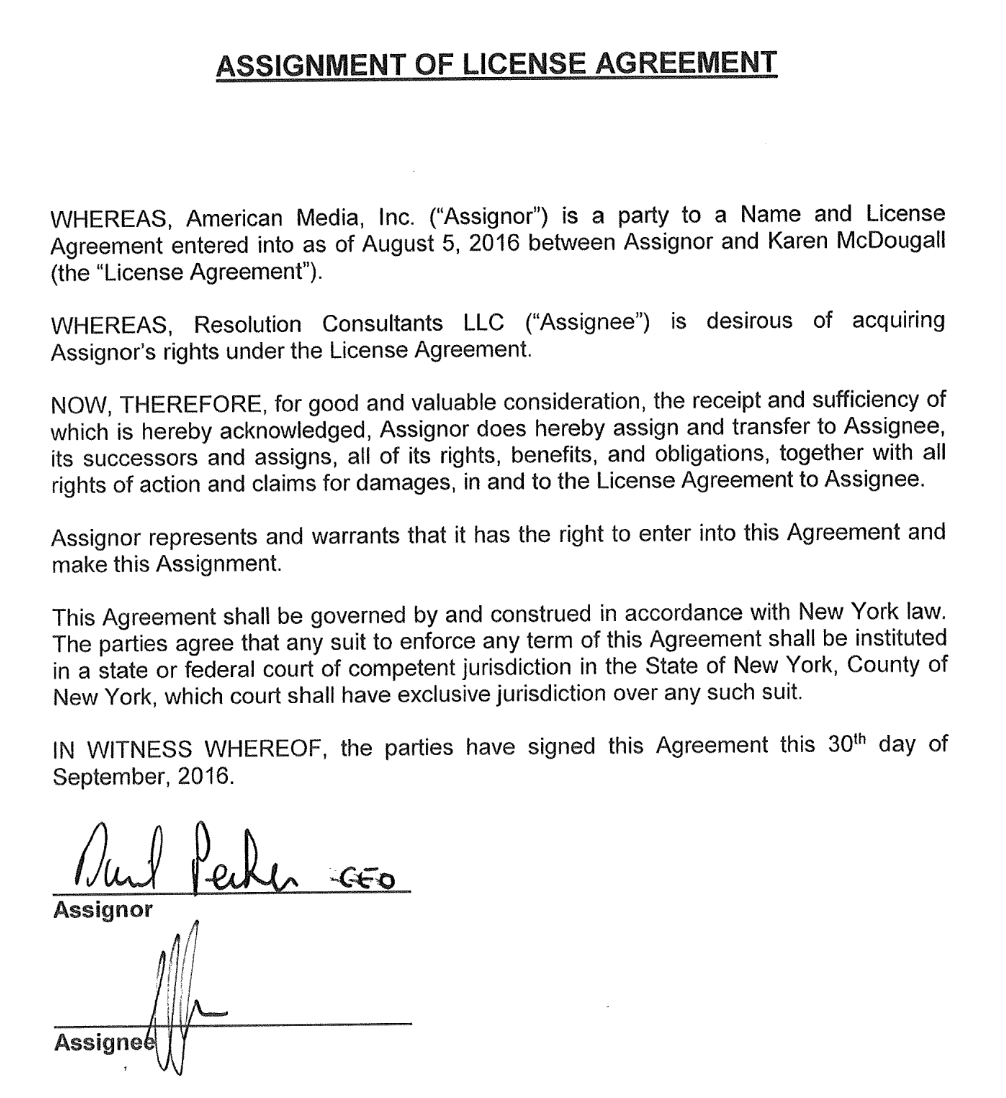
Asked whether the assignment agreement would have him or Trump own McDougal's story, Cohen says it was Trump.
"I had no reason to own, no need to own, the life rights," Cohen says. "What I was doing was at the direction of and for the benefit for Mr. Trump."
"I had no reason to own, no need to own, the life rights," Cohen says. "What I was doing was at the direction of and for the benefit for Mr. Trump."
Prosecutor: The invoice doesn't reference the McDougal hush-money, but rather a "flat fee" for so-called "advisory services."
It doesn't say AMI, but says another company.
Cohen: It was clearly a "separation" in order to "mask the transaction."
It doesn't say AMI, but says another company.
Cohen: It was clearly a "separation" in order to "mask the transaction."

Cohen confirms that David Pecker told him to "rip" up the agreement, but he gives a different account of why.
He says Pecker told him it was because McDougal's front cover made them a lot of money.
He says Pecker told him it was because McDougal's front cover made them a lot of money.
Background:
Pecker testified that he pulled out of the assignment agreement after a conversation with his lawyer, and that Cohen warned him Trump would be upset.
Pecker testified that he pulled out of the assignment agreement after a conversation with his lawyer, and that Cohen warned him Trump would be upset.
Questioning turns to the "Access Hollywood" tape, as well as Hope Hicks' now-infamous reaction: "Deny, deny, deny."
Bannon forwarded the message to Cohen, who told Bannon in response: "Please call me."
Bannon forwarded the message to Cohen, who told Bannon in response: "Please call me."
Displaying phone records, the prosecutor shows Cohen on the phone with Trump twice on Oct. 8, 2016.
"The spin he wanted to put on this was that it was 'locker room talk,'" Cohen says, adding that Trump told him that's what Melania "thought it was."
"The spin he wanted to put on this was that it was 'locker room talk,'" Cohen says, adding that Trump told him that's what Melania "thought it was."
Cohen recalls speaking to the press about the tape.
"The recording is quite damaging, and they wanted comment."
"The recording is quite damaging, and they wanted comment."
At least on direct, prosecutors are showcasing a starkly different Michael Cohen from his public persona: calm, slow, methodical, and even-keeled.
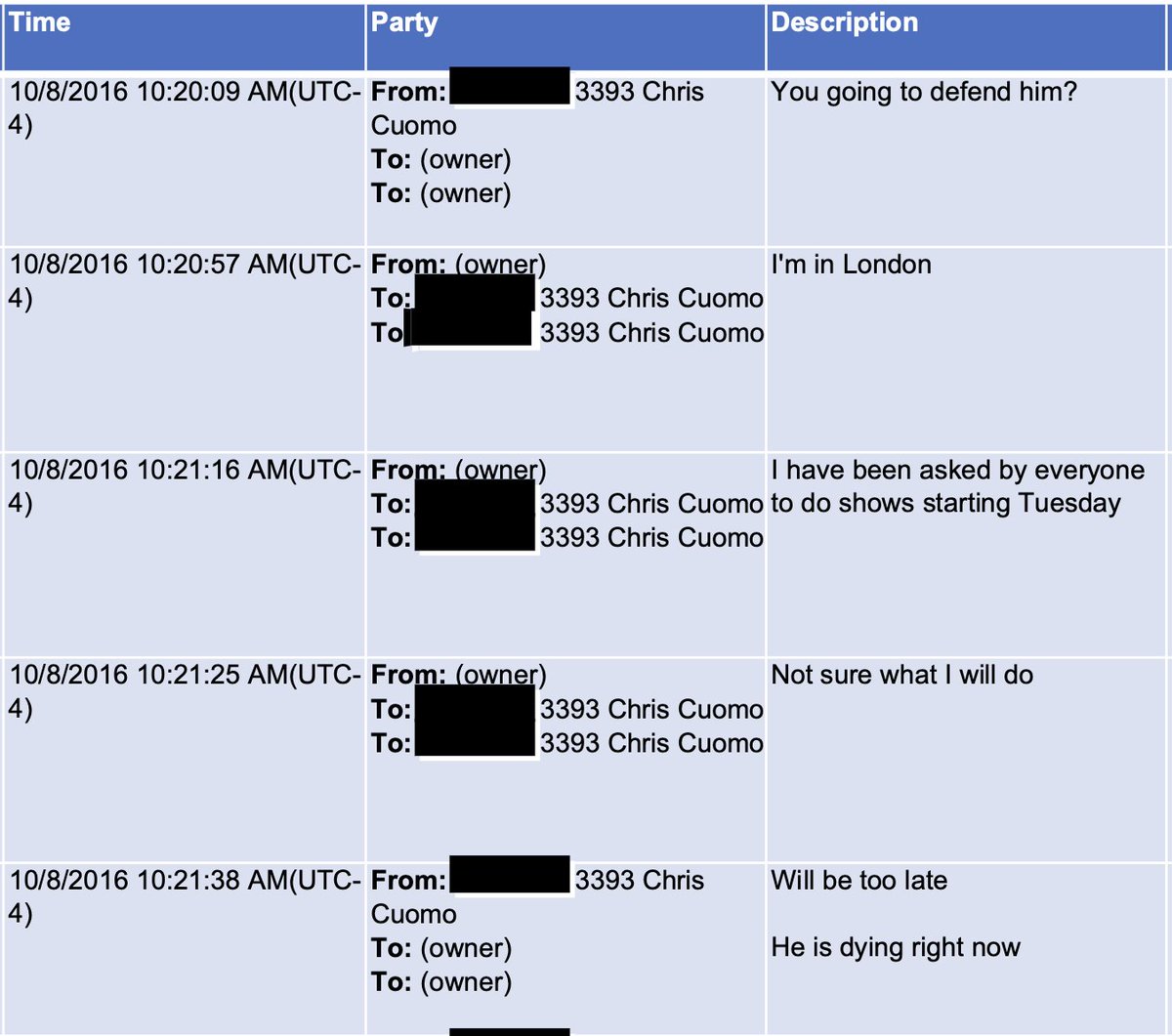
Chris Cuomo to Michael Cohen on Oct. 8, 2016, seeking comment on the "Access Hollywood" tape:
"He is dying right now."
"He is dying right now."
Also in the wake of the "Access Hollywood" tape, Cohen says he pushed to take down an old story on RADAR online, another AMI property — in an exchange memorialized in emails entered into evidence.

Cohen thought the tape could have a "catastrophic" impact that was "horrible for the campaign."
Cohen said that he spoke to Trump about Stormy Daniels in 2011, after the blog The Dirty published a story about them.
"I told him that one of the things that we need to do is take care of it," Cohen said.
"Absolutely," Trump replied, according to Cohen.
"I told him that one of the things that we need to do is take care of it," Cohen said.
"Absolutely," Trump replied, according to Cohen.
Cohen says he asked Trump directly about the alleged affair, but Trump didn't reply — except in a cryptic remark from earlier.
Trump said that he was playing golf with "big Ben Roethlisberger" and boasted that women prefer Trump even to him, according to Cohen.
Trump said that he was playing golf with "big Ben Roethlisberger" and boasted that women prefer Trump even to him, according to Cohen.
Trump also described Daniels as a "beautiful woman," Cohen said.
Trump's remarks about "big Ben" and "beautiful woman" Stormy Daniels came before his non-answers to Cohen's direct question about the alleged affair.
Cohen says that the business "opportunity" described here in a text chain between Dylan Howard, Keith Davidson and himself was purchasing the life rights to Stormy Daniels' story.
The messages are dated Oct. 10, 2016.
The messages are dated Oct. 10, 2016.

Cohen says Trump was angry about the Stormy Daniels story: "I thought you had this under control. I thought you took care of this."
Cohen says he replied that he did in 2011.
"Just take care of it. There's a lot going on at the campaign at the time," Trump said, per Cohen.
Cohen says he replied that he did in 2011.
"Just take care of it. There's a lot going on at the campaign at the time," Trump said, per Cohen.
Cohen quotes Trump saying: "This is a disaster. Total disaster. Women are going to hate me [...] Guys, they think it's cool."
Cohen says he broached the subject of Trump's wife Melania by saying: "How's things going upstairs?"
According to Cohen, Trump replied: "Don't worry. How long do you think I'll be on the market for? Not long."
According to Cohen, Trump replied: "Don't worry. How long do you think I'll be on the market for? Not long."
Cohen testifies that the liquidated damages clause punishing Daniels for any breach of the NDA was his idea.
Cohen said that he would be the only person with the side letter agreement disclosing the true identities of "Peggy Peterson" (Daniels) and "David Dennison" (Trump).
Q: At this point, he's asking for a funding deadline of Oct. 14?
A: Correct.
Asked if he planned to meet the deadline, Cohen replies in the negative and says he planned to delay.
Lunch recess.
A: Correct.
Asked if he planned to meet the deadline, Cohen replies in the negative and says he planned to delay.
Lunch recess.
Michael Cohen is back on the stand. The afternoon session will begin shortly.
Q: Good afternoon, Mr. Cohen.
A: Good afternoon.
A: Good afternoon.
Michael Cohen reviews his email exchange with Keith Davidson on reasons he couldn't pay the Daniels settlement.
"In this specific case, I used the holiday, Yom Kippur, as a way to delay."
Davidson testified that he suspected this was an excuse, and Cohen confirms it.
"In this specific case, I used the holiday, Yom Kippur, as a way to delay."
Davidson testified that he suspected this was an excuse, and Cohen confirms it.
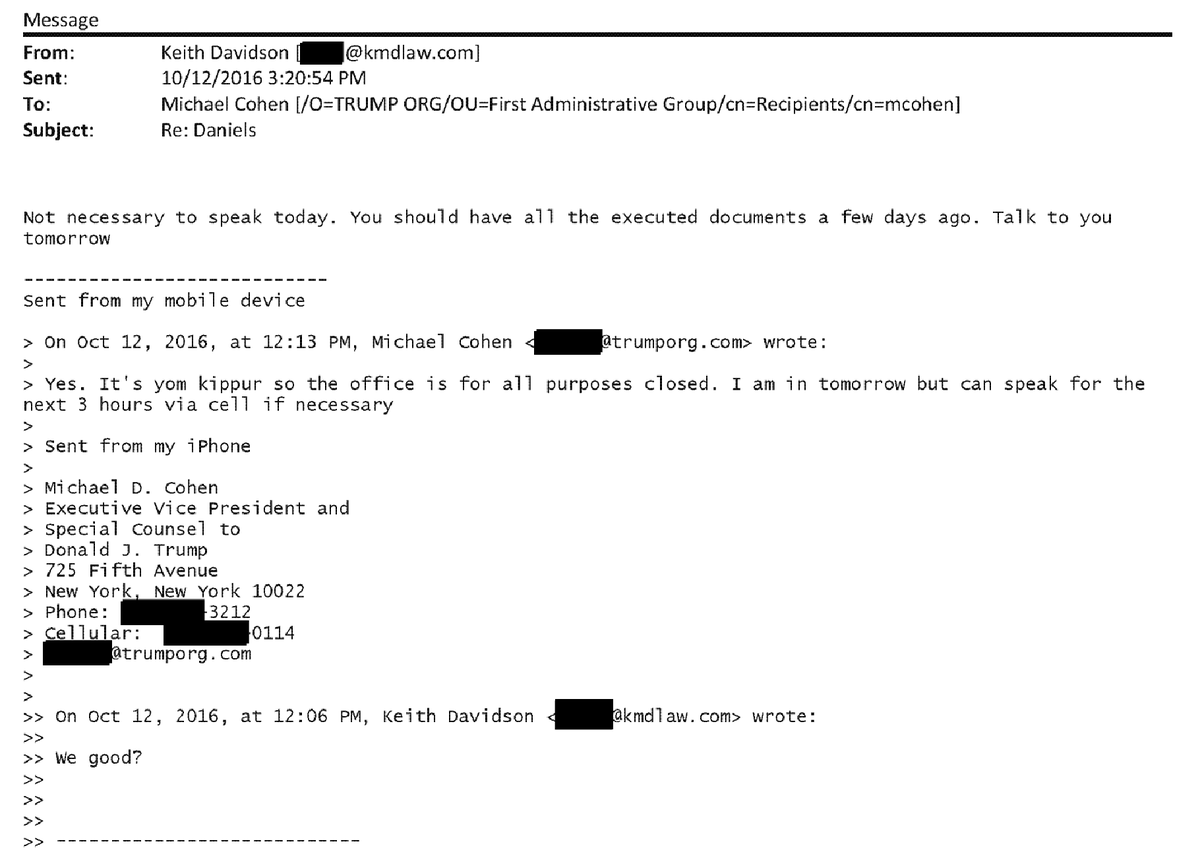
Cohen said he delayed things "because after the election, it wouldn't matter."
Q: According to who?
A: According to Mr. Trump.
Q: According to who?
A: According to Mr. Trump.
Cohen reviews correspondence among First Republic Bank employees about his account, "in the event" of "the need for an account to be opened in order to transfer the funds."
Q: Is that what you anticipated might need to happen soon?
A: Yes.
Q: Is that what you anticipated might need to happen soon?
A: Yes.

Cohen is shown the paperwork he sent one of the bank's employees, about his shell company Resolution Consultants.
This is how the document described the nature of the company, which was used to pay off Karen McDougal.
This is how the document described the nature of the company, which was used to pay off Karen McDougal.

Cohen signed it on Oct. 13, 2016.
Asked if the reasons for opening the account were truthful, Cohen replies: "No."
He says that's because he understood they may not have opened an account to pay off an "adult film star"
Asked if the reasons for opening the account were truthful, Cohen replies: "No."
He says that's because he understood they may not have opened an account to pay off an "adult film star"
Cohen inspects the Keith Davidson email titled "PP v. DD - IMPORTANT," referring to the pseudonyms of Stormy Daniels and Donald Trump.
It threatened to torpedo the agreement for nonpayment.
"My intent was to continue to delay it, as per Mr. Trump's demand," Cohen says.
It threatened to torpedo the agreement for nonpayment.
"My intent was to continue to delay it, as per Mr. Trump's demand," Cohen says.

In a follow-up email, Davidson informed Cohen the settlement was "canceled and void."
Cohen: "We were losing control of the settlement of this agreement in order to prevent the story from coming out," for nonpayment of funds.
Q: Were you concerned?
A: Very much so.
Cohen: "We were losing control of the settlement of this agreement in order to prevent the story from coming out," for nonpayment of funds.
Q: Were you concerned?
A: Very much so.

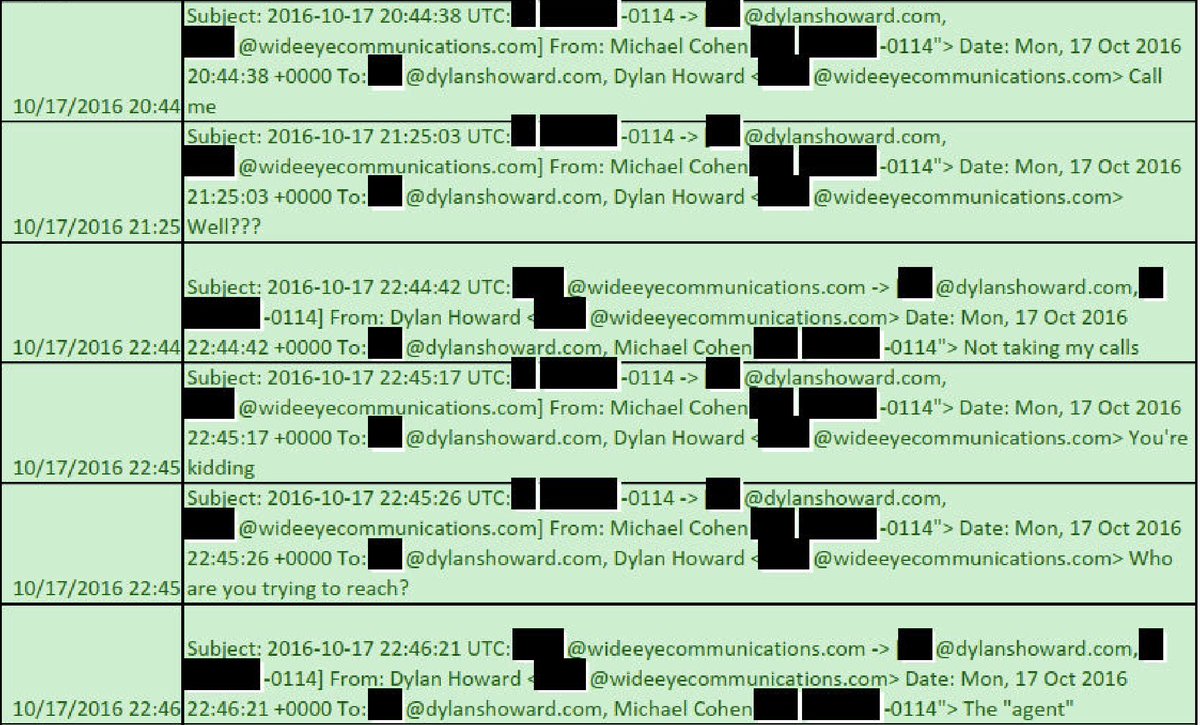
Cohen reviews his text messages with Dylan Howard, who was trying to reach "The 'agent.'"
That refers to Davidson, Cohen says.
That refers to Davidson, Cohen says.
On Oct. 17, 2016, Cohen called Trump, phone logs show.
Cohen says that he wanted to inform Trump that Stormy Daniels was going to tell her story to the Daily Mail, but he got Trump's voicemail, he said.
Cohen says that he wanted to inform Trump that Stormy Daniels was going to tell her story to the Daily Mail, but he got Trump's voicemail, he said.
A day later, on Oct. 18, 2016, Melania Trump texts Cohen: "Good morning Michael, can u pls call DT on his cell. Thanks."
"Of course," Cohen quickly replied.
DT, of course, meant Donald Trump, Cohen confirms.
"Of course," Cohen quickly replied.
DT, of course, meant Donald Trump, Cohen confirms.

Cohen then appeared for an interview with CNN's Wolf Blitzer:
"I advocated for Mr. Trump in the best light possible — denials, as well as exclamations that I had never seen him act in this manner before."
"I advocated for Mr. Trump in the best light possible — denials, as well as exclamations that I had never seen him act in this manner before."
Cohen said that Trump stated to him that he had spoken to "some friends, some individuals."
They pointed out that "it's $130,000," and Trump's "a billionaire." "Just pay."
"He expressed to me, just do it. Meet up with Allen Weisselberg and just figure the whole thing out."
They pointed out that "it's $130,000," and Trump's "a billionaire." "Just pay."
"He expressed to me, just do it. Meet up with Allen Weisselberg and just figure the whole thing out."
Cohen says he told Weisselberg: "You’re making seven figures. Why don’t you pay it?"
"[Weisselberg] said that he wasn’t in a financial position to do it," in light of prep school tuitions and summer camp for his grandchildren, according to Cohen.
"[Weisselberg] said that he wasn’t in a financial position to do it," in light of prep school tuitions and summer camp for his grandchildren, according to Cohen.
Cohen said that, "because of the urgency": "I ultimately said, ‘Okay, I’ll pay it.'”
Call logs show Cohen receiving a 1:24 minute voicemail from Allen Weisselberg on Oct. 23, 2016.
Cohen and Weisselberg had another call lasting more than three minute son Oct. 25, 2016, at 11:23 p.m., according to phone records.
Q: Was there a sense of urgency at that point?
A: Significant urgency.
Q: Was there a sense of urgency at that point?
A: Significant urgency.
Cohen describes the system of obtaining the funds for the hush money from a home equity line of credit (HELOC).
Once he repaid the loan, Cohen said: "Nobody would be the wiser."
Once he repaid the loan, Cohen said: "Nobody would be the wiser."
Cohen: "If this situation wasn't resolved, it would have been catastrophic to Mr. Trump and the campaign."
Cohen says Pecker refused to pull off the Stormy Daniels payoff, quoting him saying: "I cannot do it again. It could cost me my job."
Cohen inspects an exhibit of a flurry of Signal calls between Cohen and Pecker.
Explaining why so many, Cohen says: "Signal is terrible at keeping calls. It drops off all the time."
(This gets some knowing laughs from the press corps, which uses the encrypted app frequently.)
Explaining why so many, Cohen says: "Signal is terrible at keeping calls. It drops off all the time."
(This gets some knowing laughs from the press corps, which uses the encrypted app frequently.)
Context: Signal is a popular tool for, among other things, journalists protecting sources' anonymity.
On Oct. 26, 2016, Cohen opened the First Republic account for Essential Consultants LLC.
"I went across the street, which is where it was located, and I told them that I needed to do a transfer," Cohen says.
"I went across the street, which is where it was located, and I told them that I needed to do a transfer," Cohen says.
Call logs show Cohen spoke to Trump twice right before that.
Q: Now, before you went across the street, did you speak to Mr. Trump?
A: I did.
Cohen says: "I required approval from [Trump] on all of this."
Q: Now, before you went across the street, did you speak to Mr. Trump?
A: I did.
Cohen says: "I required approval from [Trump] on all of this."

Cohen is shown the "Know Your Customer" form that he submitted for the Essential Consultants LLC account with First Republic Bank.
The business narrative doesn't mention paying off Stormy Daniels.
"It's false," Cohen says of the notation.
The business narrative doesn't mention paying off Stormy Daniels.
"It's false," Cohen says of the notation.

Asked why he submitted a false business narrative on the form, Cohen responded: "To hide the intent for the reason for opening Essential Consultants."
"I believe that they probably would not" have opened up the account had they known the true reason, Cohen said.
"I believe that they probably would not" have opened up the account had they known the true reason, Cohen said.
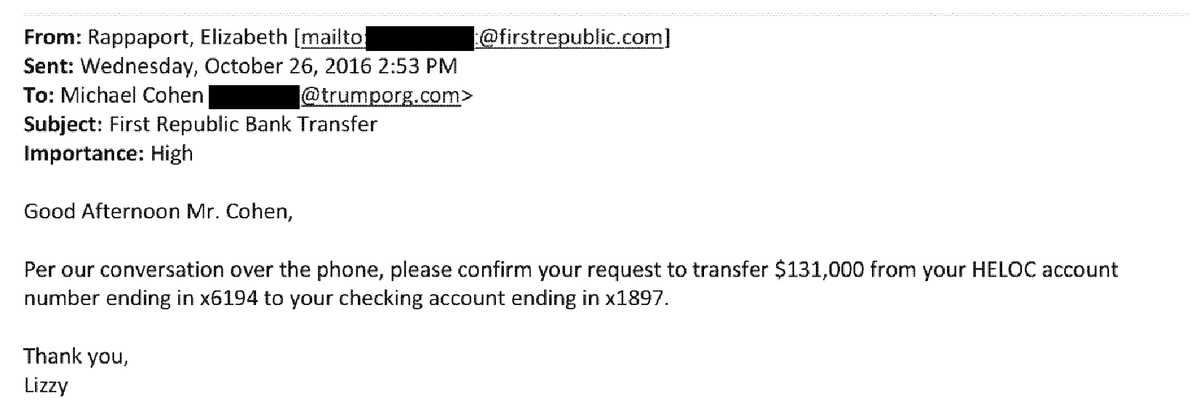
Cohen reads this email from a First Republic rep into the record.
In another email, Cohen confirmed the request for the transfer.
In another email, Cohen confirmed the request for the transfer.
Cohen recites this email that then-Enquirer editor in chief Dylan Howard sent to Cohen and Davidson, confirming the agreement on the deal.
"Dylan Howard works, of course, for David Pecker," Cohen adds.
"Dylan Howard works, of course, for David Pecker," Cohen adds.

Cohen says Trump intentionally didn't sign the agreement with Daniels to avoid detection. Instead, Cohen signed the agreement: "EC," short for "Essential Consultants," he says.
Asked whether the disguised signatures were to keep it confidential, Cohen agrees: "It was the whole purpose of this transaction."
On the day the deal was finalized, Cohen spoke to Trump for more than five minutes, call logs indicate.
Cohen says it was to inform Trump that the situation was "locked down."
Cohen says it was to inform Trump that the situation was "locked down."

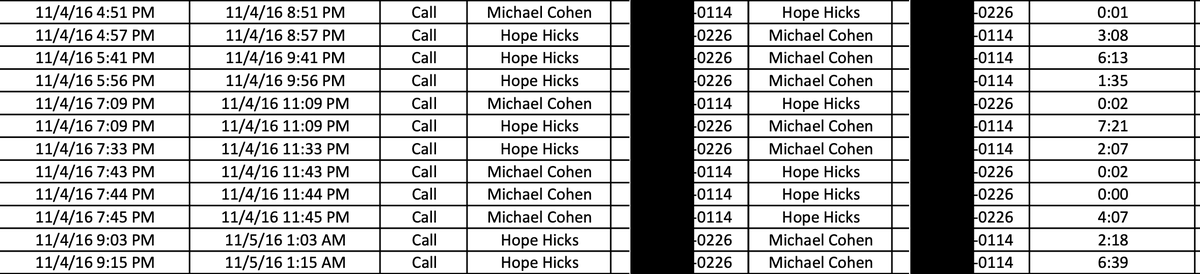
On the day the WSJ article about Karen McDougal landed, Cohen was frequently on the phone with Hope Hicks, call logs show
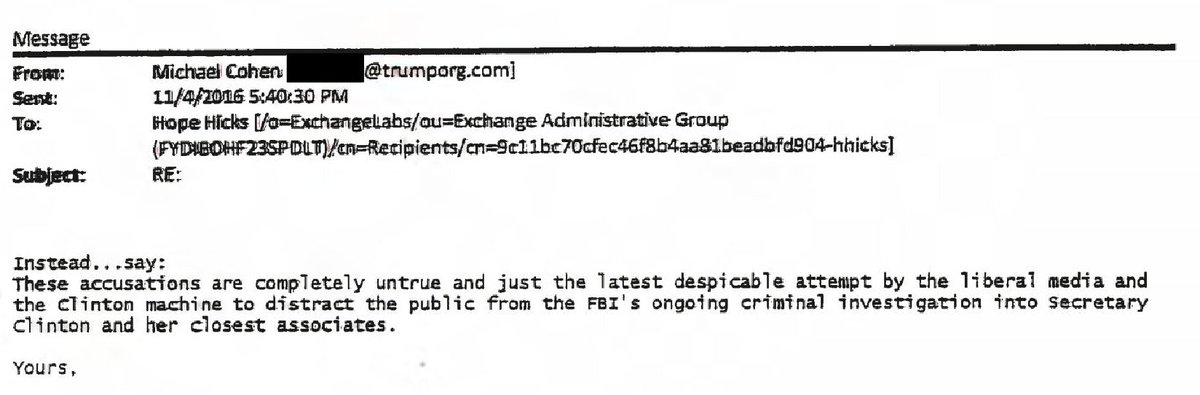
Next exhibit: Email from Hope Hicks to Cohen, floating ideas to spin the article.
Cohen suggested spinning the article as a ruse to deflect attention from the Clintons.
Full exchange here. pdfs.nycourts.gov/PeopleVs.DTrum…
Full exchange here. pdfs.nycourts.gov/PeopleVs.DTrum…
Q: Did you express any anger at Mr. Davidson for that article?
A: Yes.
When the WSJ article broke, Cohen had a flurry of calls with Pecker, phone records show. Cohen says he was "very" angry and suspected someone on his side may have leaked it.
A: Yes.
When the WSJ article broke, Cohen had a flurry of calls with Pecker, phone records show. Cohen says he was "very" angry and suspected someone on his side may have leaked it.

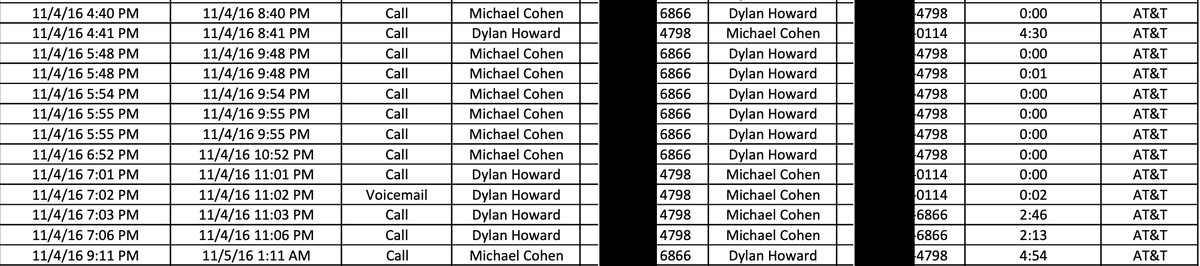
Cohen says he told Pecker and Howard: "I really hope that we don't come to find out that this was something you guys did."
He had a series of phone calls with both men on that day.
He had a series of phone calls with both men on that day.
Cohen said he also spoke to Trump through his bodyguard, Keith Schiller.
Q: Was he angry/upset on the call?
A: Yes.
Asked if Trump expressed why he was upset, Cohen says it was because a story was out that could hurt his campaign.
Q: Was he angry/upset on the call?
A: Yes.
Asked if Trump expressed why he was upset, Cohen says it was because a story was out that could hurt his campaign.

Back from the afternoon recess.
"Witness entering": Cohen returns to the stand.
"Witness entering": Cohen returns to the stand.
Trump appears to be reading a document at the defense table as Cohen's testimony resumes.
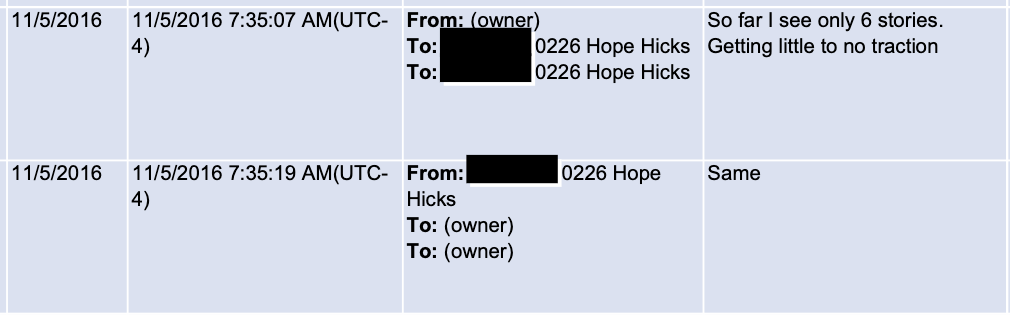
The day after the WSJ story landed, Cohen and Hope Hicks agreed the story was getting "little to no traction."
Their efforts were "suppressing" the story itself, Cohen testifies.
Their efforts were "suppressing" the story itself, Cohen testifies.

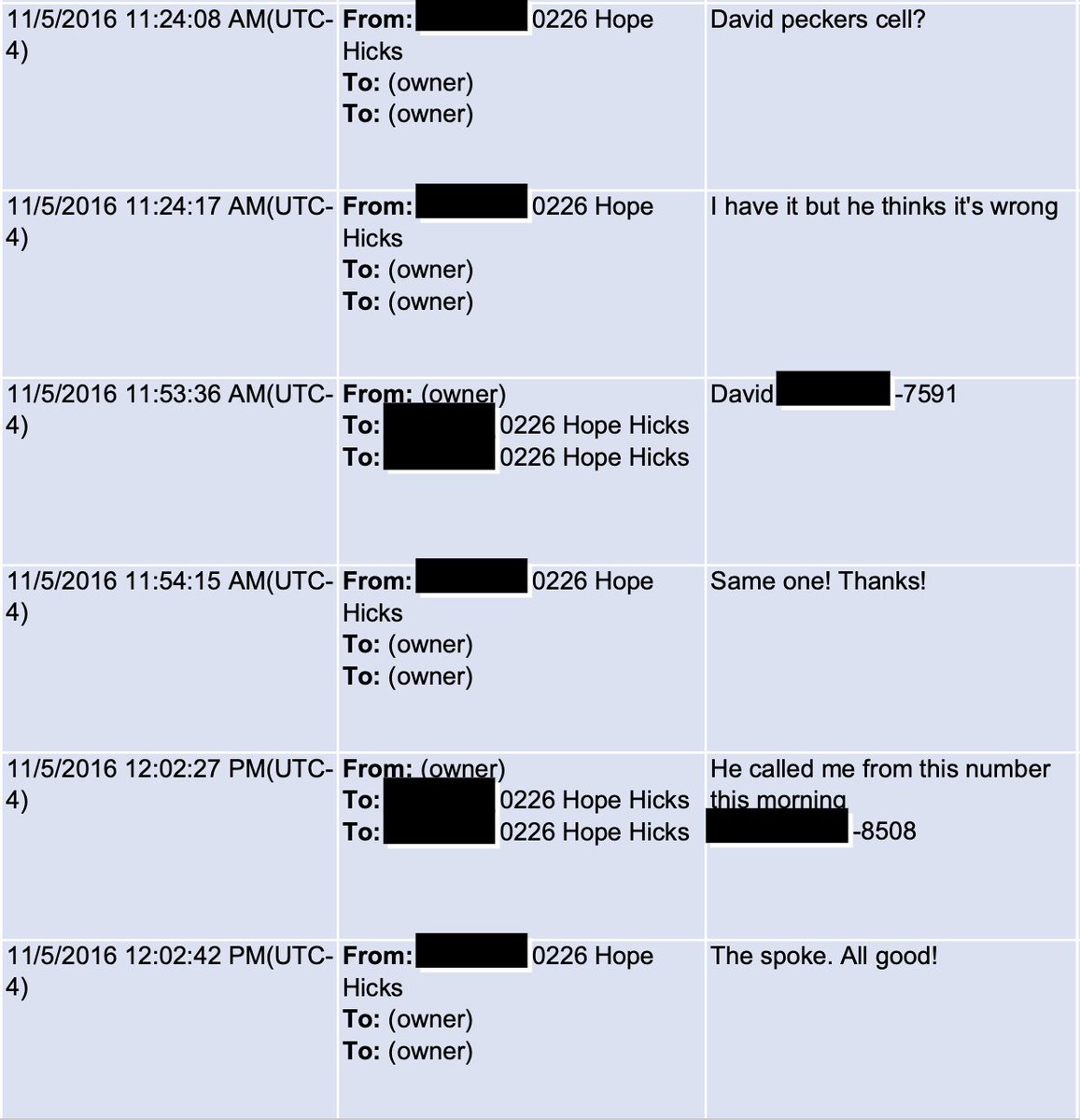
Cohen says that this text message chain refers to connecting Trump with David Pecker, who spoke to each other.
"All good!" Hicks chirped in the text.
Hicks gave the same interpretation of the exchange.
"All good!" Hicks chirped in the text.
Hicks gave the same interpretation of the exchange.
Asked if he was offered a position as assistant general counsel, Cohen said: "Yes," but he agrees he didn't want it.
"No, ma'am," Cohen said, adding he was disappointed about not being considered for a Chief of Staff role.
"It was more about my ego than anything."
"No, ma'am," Cohen said, adding he was disappointed about not being considered for a Chief of Staff role.
"It was more about my ego than anything."
Cohen said that he pitched a role of personal attorney for the president.
"I didn’t expect to be compensated," Cohen testifies.
Instead, Cohen said, he expected compensation to come from "companies that were already speaking to me."
"I didn’t expect to be compensated," Cohen testifies.
Instead, Cohen said, he expected compensation to come from "companies that were already speaking to me."
Cohen is shown text messages with his then-college aged daughter, which are entered into evidence. He says that she noticed he was upset.
"I explained to her that there were so many opportunities."
"I explained to her that there were so many opportunities."
Asking her father whether he would have a role in government, Cohen answered no — and that it was a "hybrid," Cohen says.
In December 2016, Cohen was still at the Trump Org, and he said it was customary for him to get an end-of-year bonus.
Rhona Graff would walk around with a Christmas card from Trump, with a Trump inside, and that's how employees would learn their bonus, Cohen says.
Rhona Graff would walk around with a Christmas card from Trump, with a Trump inside, and that's how employees would learn their bonus, Cohen says.
Trump cut his bonus by two-thirds, Cohen says.
"I was truly insulted" and "personally hurt," Cohen says.
"After all that I had gone through in terms of the campaign—as well as things in the Trump Organization—in laying out $130,000 to protect him, it was insulting."
"I was truly insulted" and "personally hurt," Cohen says.
"After all that I had gone through in terms of the campaign—as well as things in the Trump Organization—in laying out $130,000 to protect him, it was insulting."
"In some colorful language," Cohen says, he expressed to him about how angry he really was.
Part of his anger, Cohen says, was at Weisselberg for allowing it.
Part of his anger, Cohen says, was at Weisselberg for allowing it.
Cohen recalled Weisselberg telling him:
"Take it easy. You know that Mr. Trump loves you, [he] is gonna do right by you. [...] Enjoy your vacation. Relax. We're gonna make this right."
"I was, even for myself, unusually angry."
"Take it easy. You know that Mr. Trump loves you, [he] is gonna do right by you. [...] Enjoy your vacation. Relax. We're gonna make this right."
"I was, even for myself, unusually angry."
Earlier, Cohen said, he had to do a "double-take" when he saw the bonus. He wasn't expecting more, but he wasn't expecting less.
Cohen says Trump called him before new year.
"Don't worry about the other thing. I'm gonna take care of it before you get back," Trump told him, according to Cohen's testimony.
"Don't worry about the other thing. I'm gonna take care of it before you get back," Trump told him, according to Cohen's testimony.
Cohen provides the second identification of Weisselberg's handwriting on the bank statement showing the Stormy Daniels payoff.
The notation on the right, about the RedFinch expense, is Cohen's own handwriting, he says.
The notation on the right, about the RedFinch expense, is Cohen's own handwriting, he says.
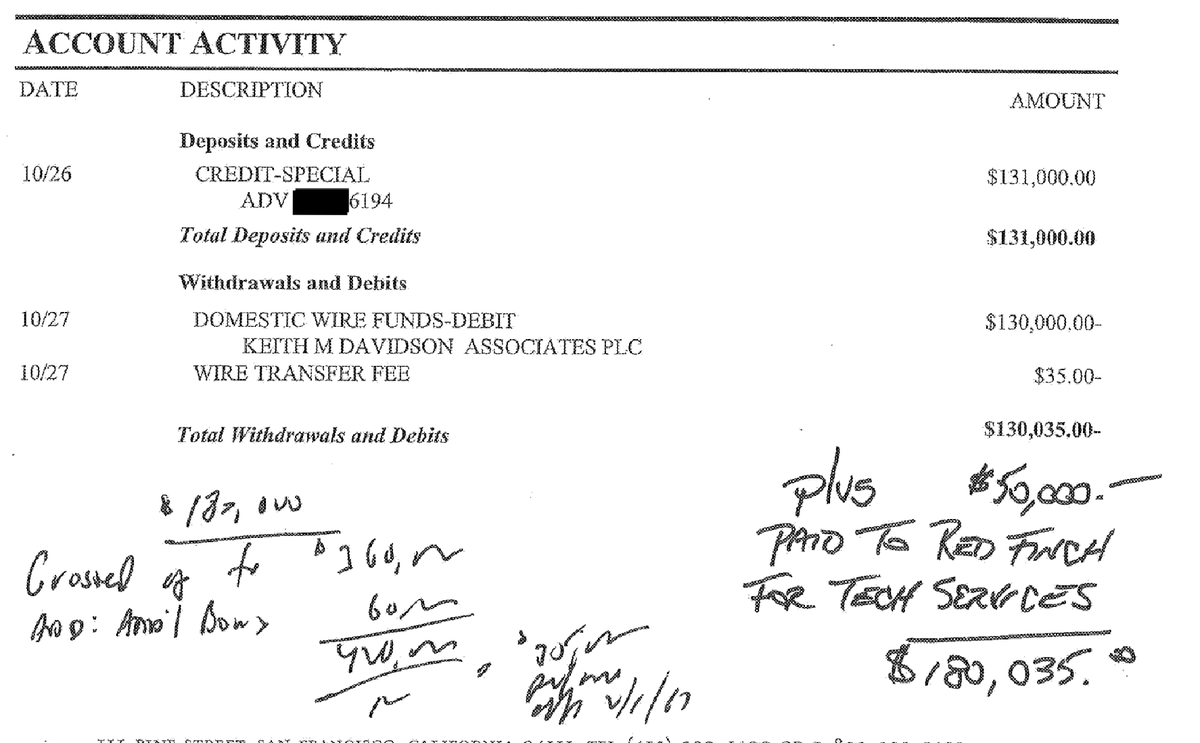
Ex-Trump Org controller Jeff McConney also identified Weisselberg's handwriting on the reimbursement system earlier.
Asked why Weisselberg "grossed up" the $180,000 to $360,000, Cohen said he was told he needed that in order to recover that money after taxes.
Cohen said he was also told to take it as income rather than a reimbursement.
Weisselberg isn't a CPA; he's been Trump's CFO for four decades, Cohen notes.
"He certainly knows more than I do" about taxes and accounting, Cohen says.
"He certainly knows more than I do" about taxes and accounting, Cohen says.
Asked about the ramifications for the reimbursements, Cohen says he didn't know or care about the tax implications. He simply wanted to get his money back, he says.
Cohen said he was told the reimbursement payments would start in February, because January was a busy month in light of the inauguration.
On Jan. 17, 2017, Cohen sent a text message to Gene Freidman, the operator of his yellow cab medallions in New York City.
"I leave tomorrow for D.C. And just between us, I will be personal counsel to Pres Trump."
Cohen says it clarifies his timeline for the Trump meeting.
"I leave tomorrow for D.C. And just between us, I will be personal counsel to Pres Trump."
Cohen says it clarifies his timeline for the Trump meeting.
This email is shown to Cohen, toward the end of the day's proceedings.
https://x.com/KlasfeldReports/status/1786167468278304847
Justice Merchan gives his usual instructions to the jury, as trial adjourns for the day.
* authenticate
• • •
Missing some Tweet in this thread? You can try to
force a refresh