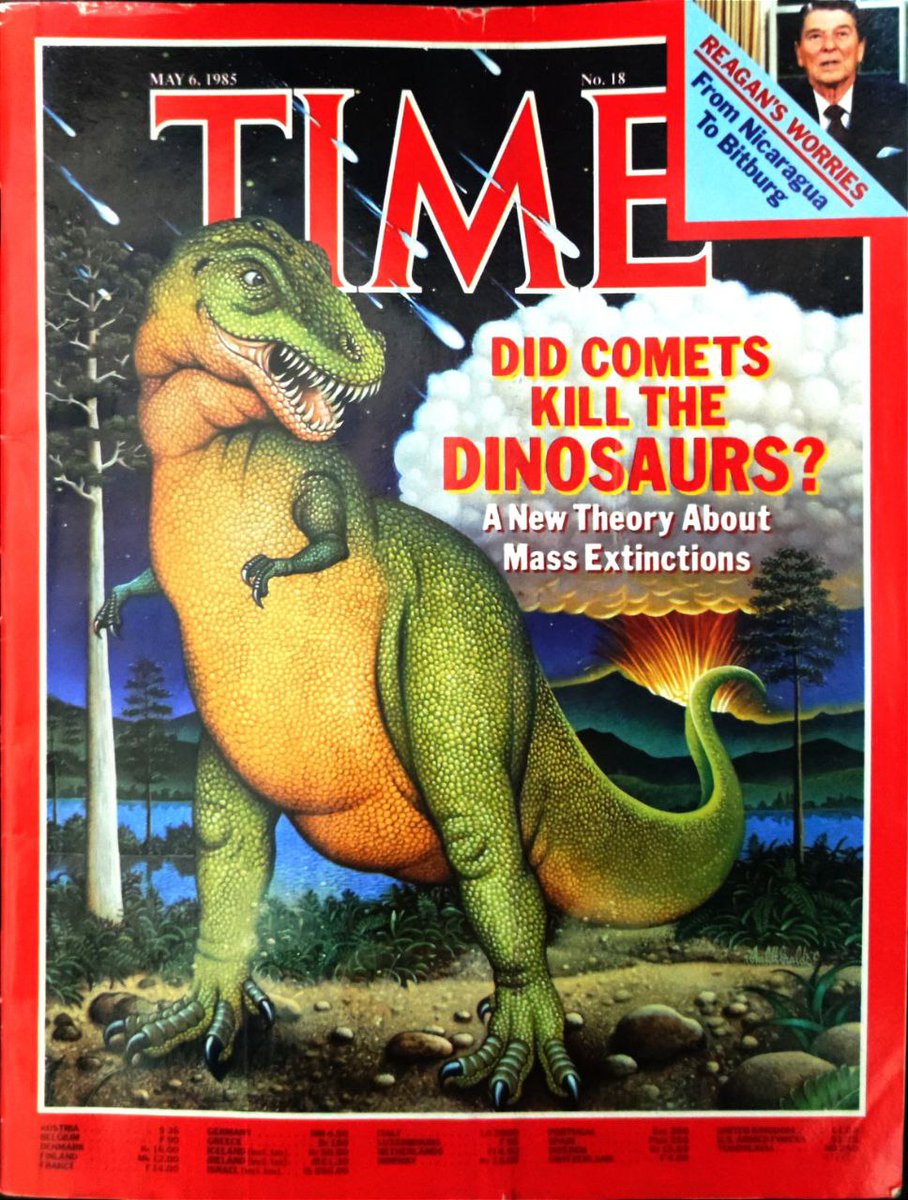
Our study on dinosaur climatic niche evolution and thermophysiology is out now in @CurrentBiology! (1/18) Artwork by @DavideBonadonna #dinosaurs 🪶 🦖 🌡️ Link: cell.com/current-biolog…

2/18 🌡️Challenging classic views of dinosaurs as cold-blooded "reptiles", six decades of discoveries suggest certain lineages exhibited traits typical of endothermic, homeothermic tetrapods, maintaining a constant body temperature through internally generated heat…

3/18 when and how this aspect of dinosaur biology – eventually inherited by birds – evolved, along with the specific dinosaur lineages it originated in, are still open to debate.

4/18 We reconstructed the climatic adaptive landscape of Dinosauria throughout the Mesozoic using phylogenetic comparative methods. We collated specimen-based occurrence data & combined literature w/ @PaleoDB info to ensure taxonomic, spatial, and temporal accuracy in our dataset

5/18 🔍 We investigated the evolution of physical parameters like temperature and precipitation in Ornithischia, Sauropodomorpha, & Theropoda through ancestral state reconstructions. This allowed us to infer how dinosaurs diversified through changing climatic conditions over time
6/18 📊 Macroevolutionary Ornstein-Uhlenbeck modelling revealed directional trends in climatic niche space occupation, indicating that ornithischians and theropods occupied broader, cooler niches, whereas sauropodomorphs stabilized at warmer conditions.
7/18 🤒 The Jenkyns event, an Early Jurassic episode of global warming (~183 million years ago), marked the exploration of wider climatic niche spaces and potentially played a role in the evolution of endothermal physiology among theropods.
8/18 🌋 This event was triggered by intense volcanism and was followed by the diversification of many dinosaur lineages…

9/18 further key changes in climatic preferences (e.g. in ornithischians) likely occurred during the Cretaceous Thermal Maximum, a later (~90 million years ago) excursion in temperature, supporting a critical role of adaptation during hyperthermal events in the geologic past.
10/18 Previous research (e.g., by myself, @bonz_us, and colleagues) has suggested how atmospheric and sea level changes may have influenced the dispersal and diversity of hadrosauroids out of Asia around this time. Therefore, this is worth investigating closely in the future.
11/18 🌐 Testing dinosaurian occupation of climatic zones due to biome preferences, we show that, contrary to expectations, sauropodomorphs were less represented in high primary productive regions...
12/18 …having a higher prevalence in low-productivity arid regions, particularly during the Late Jurassic–Early Cretaceous.
13/18 🦕 These observations hint to a stronger dependence on higher temperature rather than plant productivity in sauropodomorphs, indicating poikilothermy in this group.

14/18 🪶 Notably, these results provide novel insights into the origin of birds’ unique temperature regulation, suggesting that the evolution of their active metabolism likely started in the Early Jurassic, a crucial interval for the evolution of small, feathered dinosaurs
15/18 An active metabolism might have provided an advantage for speeding up the development of smaller-feathered species, who might have found it easier to survive than earlier, larger, and slower-developing ancestors in the wake of environmental crises like the Jenkyns event.
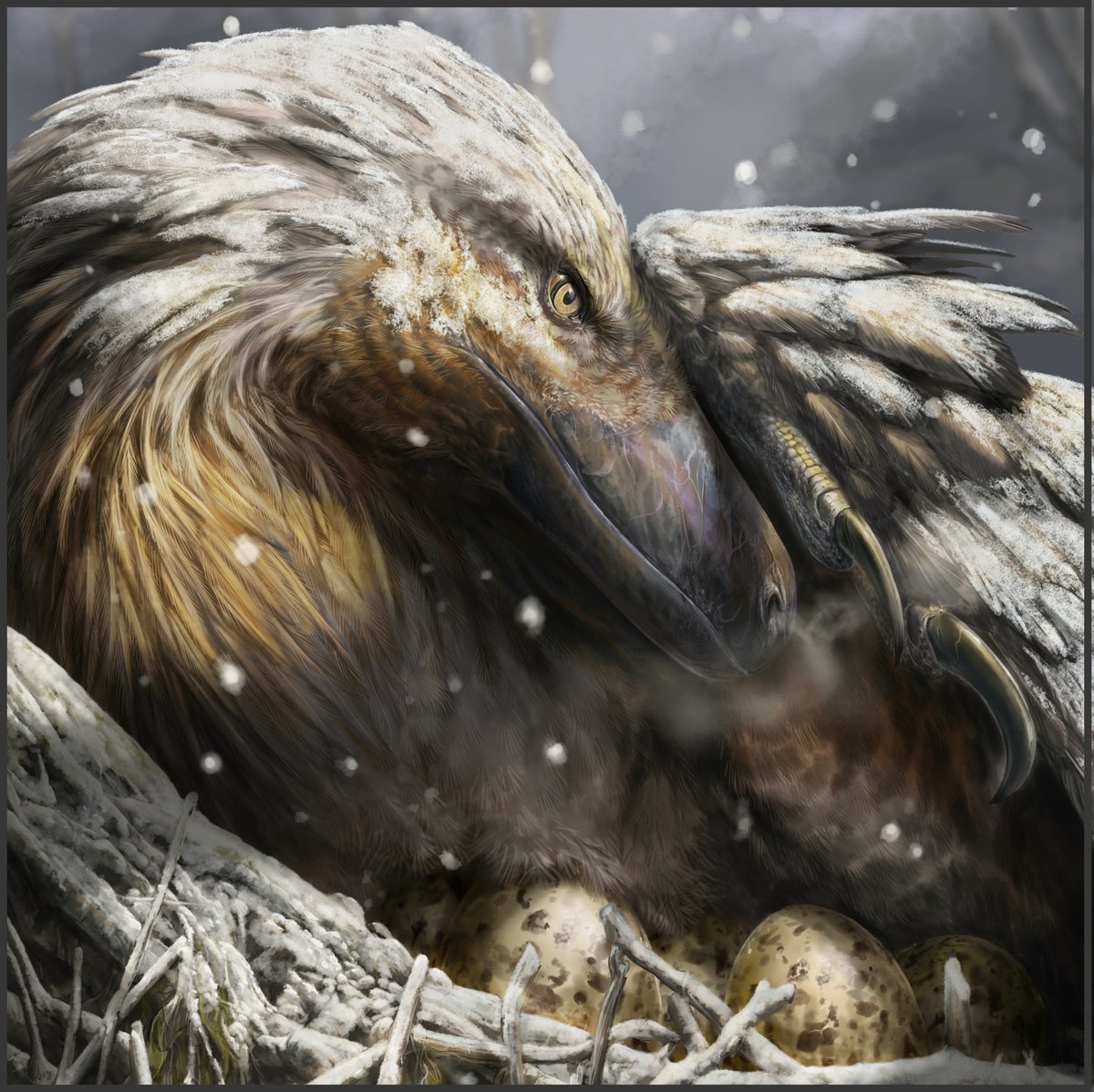
16/18 paleoart by @d_bonadonna features a dromaeosaurid theropod (a group reconstructed as homeothermic & endothermic in our study) heating its nest in a cold, harsh environment, underscoring the connection between the evolution of thermophysiology & climate central to the paper
17/18 This was a collaborative effort, so thanks to coauthors @_Sara_Varela, @Paleobicha, @sofiaGA96, @Climate_AlexF, @LewisAlanJones, Paul Valdes, Graciela Sotelo…
18/18 & @singerstone who is to blame if the paper sounds very Gouldian\Vrbaian\Simpsonian at places, but that's what our exchanges over adaptive landscapes, timing and modes of evolution over the last 4 years working on this study sounded like.
Thanks @ERC_Research #ERCStG @MapasLab @uvigo, #JdC @CienciaGob, @NERCscience & #RS_ResearchFellow #RSGrant @royalsociety for funding.
• • •
Missing some Tweet in this thread? You can try to
force a refresh