
Our next speaker is @sian_witherden, talking on 'Teaching hybridity with blog posts'. Sian works now in the rare books trade.
#teachingcodex Before this, Sian worked on a manuscript digitisation project at @StJohnsOxLib
@StJohnsOxLib Here's a taste of their digital library #teachingcodex 

@StJohnsOxLib Sian's talking about her blog post #teachingcodexstjohnscollegelibraryoxford.org/2022/09/13/med…
@StJohnsOxLib #teachingcodex Bindings that use waste material are intrinsically hybrid, in terms of texts, materials, dates
@StJohnsOxLib #teachingcodex How do we contextualise a hybrid object that's no longer a hybrid, but once was? Something that was a fragment around a text block, and is now just a fragment?
@StJohnsOxLib #teachingcodex Blog contextualises the box of fragments with reference to fragments that are still in situ in their hybrid context (and a reference to Poirot!)
@StJohnsOxLib #teachingcodex In most cases, we don't have info on the books of origin of the St John's fragments but in one case, there was a shelf mark. And so I had to explain e.g. what a shelf mark was so readers would understand why I was excited by one!

#teachingcodex We're lucky at @StJohnsOxLib that fragments were kept when books were rebound and we can use codicological evidence to line things up, as shown in the blog post.
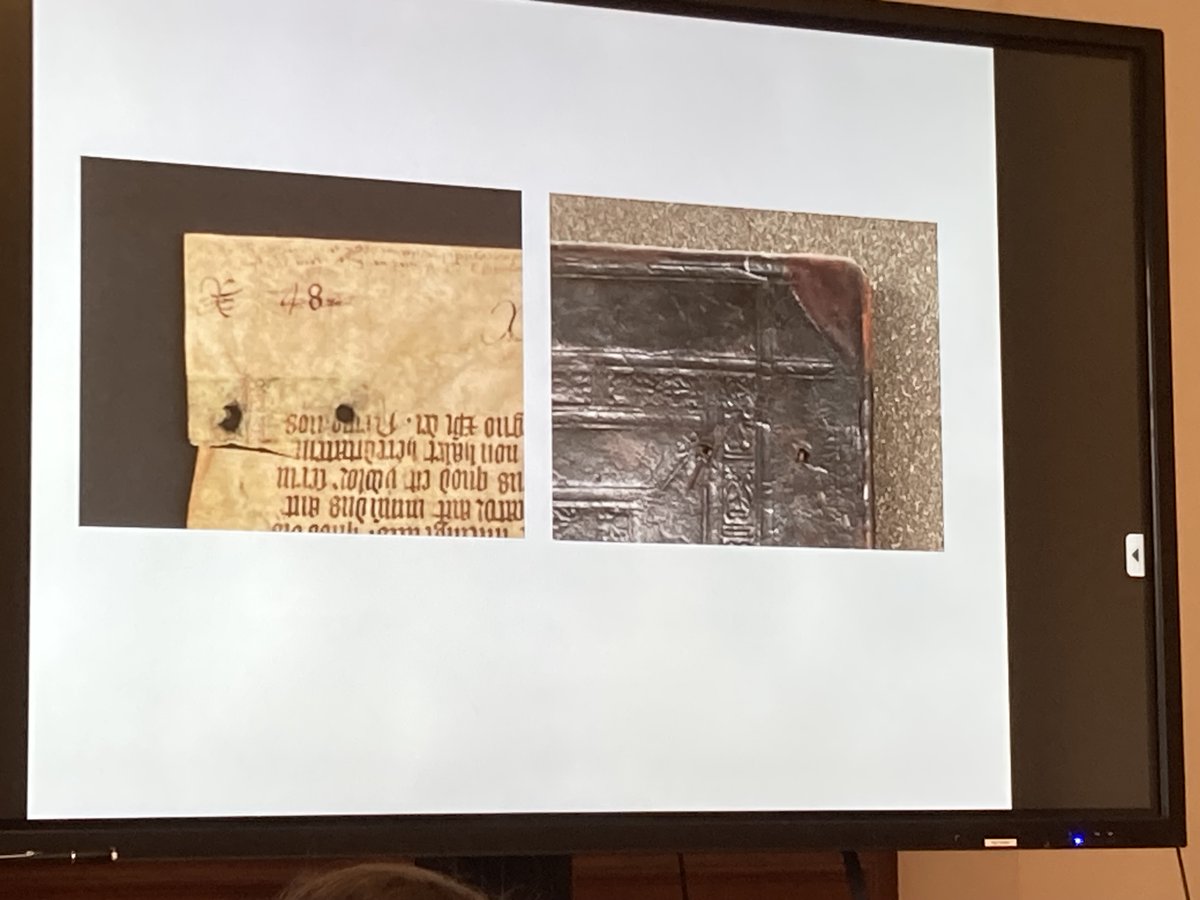
#teachingcodex Blog posts are useful for teaching: can be accompanied by links to additional resources. They are visual and eye-catching. Communicating info in a blog post democratises access to the material. Might whet appetite of people who do have opportunity to access MSS
#teachingcodex But there are drawbacks to blog posts. Especially current issue: digital longevity (see British Library attack).
#teachingcodex Also need to consider length of blog posts. And they don't have same immediacy of Q&A format, or ability physically to handle books. But it's helpful for those who can't get those opportunities, and supplementary even for those who can.
#teachingcodex Blog posts can help demystify book history!
@threadreaderapp please unroll
• • •
Missing some Tweet in this thread? You can try to
force a refresh





